
An eyebrow transplant moves hair-bearing grafts from a donor area into part or all of an eyebrow. It can be considered for selected hair-loss or appearance concerns, but it does not treat every cause of thinning, lift the brow or guarantee a maintenance-free result. The important choices are the cause of the loss, the proposed shape, the donor hair’s character, the direction of growth and the care needed afterward. A graft count alone cannot describe those choices.
ISHRS describes eyebrow restoration as a process requiring assessment of the hair-loss history and the recipient area. Disease, injury, previous treatment and repeated plucking can create different situations. Some people seek enhancement rather than replacement of lost hair. The first question is therefore what problem is being treated, not which fashionable brow outline should be copied. ISHRS eyebrow restoration education
Establish why the eyebrow is sparse
Make a record of when the change started, whether one or both sides are involved, and whether it is continuing. Identify prior injuries, operations, hair removal and cosmetic treatments. If you have older photographs that show the change, ask whether they would help the assessment. A history of lifelong sparse brows is different from a recently disappearing patch; the same appearance in a photograph does not establish the same cause.
Alopecia areata is an immune-related hair-loss condition that can affect eyebrows as well as other hair-bearing areas. NIAMS explains that its pattern and course vary. That is one reason not to assume that every gap can simply be filled surgically. A clinical assessment should address the underlying condition and the appropriateness of restoration, rather than treating the visible space as the only relevant issue. NIAMS alopecia areata guidance
Ask what the assessment has established and what remains uncertain. If further evaluation or treatment is needed, clarify who will coordinate it. Do not interpret a transplant consultation as proof that every medical cause has already been excluded. Likewise, do not diagnose a condition from the presence of a particular gap or an online comparison image. The objective is a clear explanation of your own situation before an elective design decision.
For an established cosmetic preference, describe what you would like to change without assuming that the current brow is defective. Some people want a small gap addressed while keeping the surrounding pattern; others want to discuss an overall outline. Doing nothing or using a cosmetic approach may remain acceptable choices. A good assessment explains which options fit the concern rather than making surgery the automatic answer to thinness.
Separate hair restoration from brow position and pigment
Eyebrow transplantation concerns hair. A brow lift concerns tissue position, while cosmetic pigment changes the apparent outline on the skin. If your concern is that the brow sits low, ask whether adding hair would address it at all. If your concern is a sparse patch within a satisfactory outline, changing the whole outline could introduce a different commitment from the one you intended.
Before approving a design, compare the proposed outline with your brows at rest and during ordinary expression. Explain whether you want to preserve an existing asymmetry or reduce it. Your preference does not need to match a template based on gender or a current trend. The agreed design should describe your goal and the clinician’s assessment of what is feasible, rather than an invented universal ideal for every face.
| Concern | Feature to define | Question before choosing treatment |
|---|---|---|
| A missing patch | Hair distribution within the existing outline | Will the plan preserve the surrounding shape? |
| Overall thinness | Desired density and extent | How will the result be assessed beyond the graft total? |
| Low brow position | Tissue position relative to the eye | Would adding hair leave the position concern unchanged? |
| Existing cosmetic pigment | Skin outline versus hair-bearing outline | How will the proposed hair relate to the existing pigment? |
| Different sides | Shape, position and hair pattern separately | Which difference is the procedure actually intended to change? |
Keep a copy of the agreed drawing or photograph used for planning. Check whether the beginning of the brow, central body and tail are included in the same proposal. A small change at one end can alter the overall outline even when the total graft count is modest. Discuss uncertainty before committing rather than relying on a later opportunity to revise an outline that was never clearly agreed.
If you normally fill the brows with cosmetics, consider bringing both an unfilled photograph and an example of the outline you prefer. Label them clearly so the planning conversation distinguishes existing hair from a drawn shape. An image with cosmetic pigment is a useful preference reference, but it is not a measurement of your natural hair distribution. Ask which version will be used as the baseline for later comparison. That simple distinction prevents a subsequent photograph from appearing to demonstrate additional hair when part of the visible difference is actually makeup or a changed outline.
Donor hair character is part of the result
Donor selection concerns more than whether enough hair is available. Hair caliber, texture, color and growth behavior affect what the proposed brow may look like and how it will be maintained. ISHRS notes that transplanted hair can require trimming and management of its direction. Hair-bearing restoration should therefore be discussed as an ongoing practical commitment, not just as a one-day addition of density.
An original comparative study published in its July 2022 issue reviewed 155 patients receiving hair from the frontal-temporal triangle or the periauricular and occipital areas. It examined donor characteristics, trimming intervals and satisfaction. The frontal-temporal group had slower growth and longer trimming intervals in that retrospective study. That finding supports discussing donor character; it does not identify a universally best donor area for every person. Original donor-area comparison
Ask the clinician to explain how the proposed donor hair compares with your existing eyebrow hair. If an obvious mismatch is possible, ask what the plan can and cannot do about it. More grafts do not automatically solve a difference in thickness or growth behavior. The consultation should distinguish the amount of transplanted hair from its visual compatibility and the grooming it might require.
Include the donor area in the discussion of appearance and recovery. Ask how it will be harvested, what hair may be trimmed or shaved, and how the area will be assessed later. A procedure advertised as no-shave should explain exactly which areas and parts of the process that description covers. The label is not evidence of scarlessness, complete invisibility or a result equivalent to every other harvesting approach.
Direction and density are separate design questions
An eyebrow can contain more hair without having the desired outline or direction. The plan needs to address how the transplanted hair will relate to the existing pattern. Ask how the clinician considers direction across the brow and how this will be reviewed after growth. You do not need surgical angles or an implantation tutorial; you need a clear explanation of the intended appearance and its limitations.
Density also needs a context. Are you seeking additional coverage in a patch, a more continuous outline or a denser entire brow? Those requests differ in extent and in how a later result would be judged. Ask what the quoted graft count includes on each side and how the team will determine whether the agreed goal has been met. Avoid comparing prices by graft count before confirming that the proposed areas and goals are comparable.
A graft is not automatically the same as one hair. ISHRS describes the use of follicular units or single hairs in eyebrow restoration. If the quote uses the word graft, ask how that unit is defined in the proposed plan. A total without a side-specific allocation or a clear counting convention can make two proposals look similar when they are not. The count should support the design explanation, not replace it.
For a small scar or a limited patch, clarify how the transplanted section is intended to blend with neighboring hair. For a more complete reconstruction, ask which features determine the outline when little existing hair is present. These are different planning situations. A photograph demonstrating one cannot be assumed to validate the other, even when both are described as eyebrow transplantation.
Understand what the outcome studies actually measured
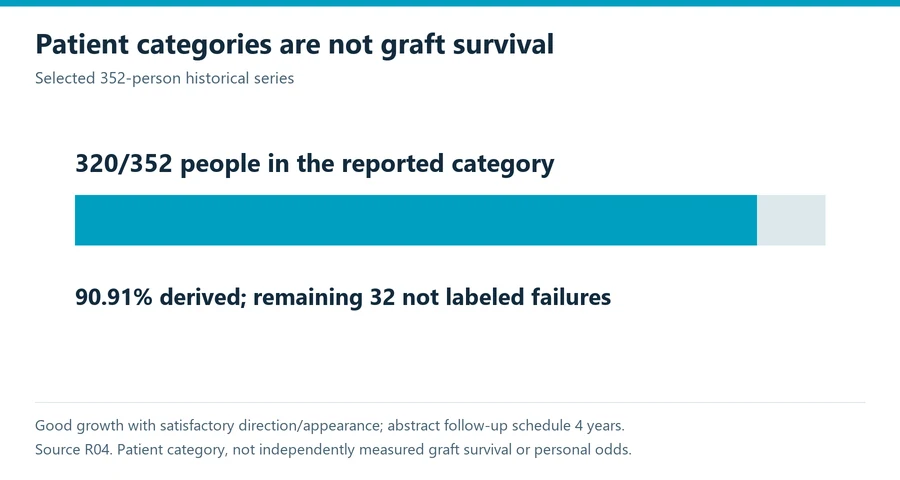
An original case series, published online in December 2019 and in an August 2020 issue, reported 352 people undergoing eyebrow restoration. Its abstract described 320 people with good growth and satisfactory direction and appearance, 17 who received additional transplantation for sparse hair, 12 who used makeup because transplanted and natural hair differed, and three with mild folliculitis. The abstract described follow-up every two months for four years. These are reported patient experiences, not a measured percentage of individual grafts surviving. Original 352-patient case series
Patient satisfaction is not a graft-survival denominator
Dividing 320 by 352 describes the reported patient category in that series. It does not mean that 91% of every patient’s grafts grew or that you have a 91% chance of your preferred outcome. A hair-level endpoint would need a defined number of implanted and subsequently assessed hairs or grafts. The visible result also involves direction and appearance, which cannot be inferred from a survival count alone.
The other reported categories answer different questions. Additional transplantation concerns a later intervention; use of makeup concerns a visible difference; folliculitis concerns a clinical problem. Their appearance in one abstract does not make them a standardized set of mutually exclusive outcomes for every modern technique. Do not turn them into a combined failure rate or assume that their sum provides a complete account of every possible limitation.
| Evidence item | What was actually checked | Interpretation to avoid |
|---|---|---|
| 352-patient series | Reported patient-level growth, appearance and other experiences | Relabeling 320 patients as surviving grafts |
| 155-patient donor comparison | Retrospective comparison including hair character and trimming | Declaring one donor area best for everyone |
| 18-patient scar series | Selected scar-related losses treated with modified FUE and adjuncts | Assuming FUE alone caused every observed result |
| Your proposed plan | Individual donor, recipient and design assessment | Treating another cohort’s percentage as a personal forecast |
Ask which outcome matters most to the proposed plan: hair growth, outline, direction, grooming burden or satisfaction. Then ask whether the cited research measured it. A paper with a positive conclusion can still leave questions about your cause of loss, donor match or future maintenance unresolved. Clear limitations make the research more useful; they do not require dismissing it or replacing it with testimonials.
Scar-related reconstruction requires its own assessment
A separate original report examined 18 people with scar-related eyebrow loss after trauma, burns or removal of a congenital lesion. The authors used modified FUE with additional treatments and reported satisfactory outcomes. Because this was a small selected series involving adjuncts, it does not isolate the effect of FUE or establish a universal first treatment for every scar. Original scar-related restoration series
If your concern involves a scar, ask how the recipient tissue will be evaluated and whether a preliminary step is being proposed. Clarify its purpose, evidence and financial scope separately from transplantation. A plan that includes another intervention is not identical to a transplant-only proposal. Avoid assuming that an additional treatment is required simply because it appeared in one published series.
Ask how the result would be assessed within and around the scar, and whether expectations differ from those for an unscarred cosmetic enhancement. Record the explanation before comparing a price or promised density. The study’s small selected population also should not be pooled with a larger general-restoration series to create one supposedly authoritative success rate. Different histories and interventions need to remain identifiable.
Plan maintenance and the recovery period
An eyebrow transplant can involve care at both the donor and recipient sites. Request the actual written instructions for the proposed operation, including cleansing, contact with the area, medicines if prescribed, and follow-up. Do not copy another person’s schedule or a product seller’s routine. Ask which changes the team wants reported and how you can reach them outside routine appointment hours.
Think about activities that bring products or physical contact near the brows. Makeup, face washing, eyewear and workplace equipment may need specific discussion. Describe what you actually use and ask for individualized instructions. This is a way to make recovery planning concrete, not a claim that every activity is prohibited or that a fixed date is appropriate for everyone.
Longer-term grooming is a separate commitment from early recovery. Ask how often trimming might be needed, how the team will review direction, and whether you are comfortable with the anticipated routine. The donor-area comparison shows why growth behavior deserves attention, but it does not provide a universal grooming interval. An attractive photograph alone cannot tell you how much maintenance its appearance required.
If later density assessment or an additional session may be considered, ask when that decision would be made and what information it would use. An immediate postoperative appearance is not a final assessment of growth. Keep photographs under reasonably comparable conditions and identify their dates if they are used in follow-up. A change in lighting, cosmetics or hair length can otherwise obscure the feature you are trying to evaluate.
Compare the complete course, not an advertised count
The checked primary sources do not establish a contemporary national total price for eyebrow transplantation. Obtain a dated quote for the actual design and procedure. Ask whether it covers one or both brows, the donor work, the intended graft allocation, anesthesia or facility charges, routine follow-up and any proposed adjunct. If a later session is possible, request the written policy instead of assuming it is included.
| Quote item | Detail to record | Comparison value |
|---|---|---|
| Treatment area | Side-specific patch or whole-brow outline | Makes the extent comparable |
| Counting unit | Grafts, hairs and planned allocation | Prevents a larger number from implying a larger equivalent result |
| Donor approach | Site, harvesting method and shaving scope | Connects appearance claims to the actual procedure |
| Additional intervention | Purpose, evidence and separate cost | Distinguishes a combined plan from transplant alone |
| Later assessment or session | Timing, decision criteria and financial policy | Clarifies the possible course beyond the initial appointment |
Ask who is responsible for the clinical assessment, design and surgical steps, and how you will obtain care if a concern occurs. A branded method or a large social-media following does not answer those questions. Compare the explanation of your plan and the documented evidence, not an invented ranking of providers. This guide does not recommend a clinic or promise a particular result from a price point.
Choose with the whole brow in view
A useful eyebrow transplant decision combines cause assessment, an agreed outline, donor compatibility, direction and maintenance. Keep these features separate when evaluating evidence and photographs. More hair is only one part of the desired appearance, and a patient-level satisfaction finding is not proof of every graft’s survival. Ask for the actual denominator and the observation period whenever a numerical claim is used to justify the plan.
Retain the design record, side-specific quote, donor explanation and follow-up arrangements. If uncertainty remains about the cause of loss or whether the proposed procedure addresses your concern, resolve it before booking. Proceeding, deferring or using a cosmetic alternative should reflect your preferences and the assessment of your situation, with the limitations of restoration clearly understood rather than hidden behind a generic permanence promise.
For related planning, see questions to ask a plastic surgeon, plastic surgery recovery and the procedure guide index.
Sources and review scope
Plastic Surgery Editorial Team. Source records checked through October 12, 2026. Review scope: source and editorial checks for general education. No individual clinical assessment is represented.
- ISHRS eyebrow restoration. ishrs.org. Publication/update date not stated. Checked 2026-10-12.
- NIAMS alopecia areata. niams.nih.gov. Source date: 2024-08. Checked 2026-10-12.
- Original donor-area comparative study. pubmed.ncbi.nlm.nih.gov. Source date: 2022-07-01. Checked 2026-10-12.
- Original352-patient eyebrow restoration series. pubmed.ncbi.nlm.nih.gov. Source date: 2019-12-09. Checked 2026-10-12.
- Original18-patient cicatricial restoration series. pubmed.ncbi.nlm.nih.gov. Source date: 2021-10-26. Checked 2026-10-12.