
An endoscopic brow lift uses a camera-assisted surgical approach through small scalp incisions to adjust forehead and brow tissues. It may address a low brow and selected upper-face concerns, but it is not interchangeable with removal of excess eyelid skin or treatment of every expression line. The useful question is whether changing brow position matches your examination and goals, with acceptable scars, hairline effects, risks and recovery. A higher brow alone is not a complete definition of a good result.
ASPS describes the endoscopic approach as using a thin camera and instruments through incisions within the hairline. Small incisions still mean surgery, anesthesia and healing. Ask what adjustment is proposed and why the endoscopic approach suits your anatomy rather than treating the word endoscopic as a guarantee of no scars or no complications. ASPS brow lift approaches
First distinguish brow position from eyelid skin
A low brow can contribute to hooding over the upper eyelid. Excess eyelid skin is a related but different concern, and ASPS notes that brow lift and eyelid surgery may be performed together. The examination should establish which structures contribute to what you see. A photograph of hooding does not tell you which operation is appropriate. ASPS brow lift scope ASPS eyelid surgery scope
Ask the surgeon to explain the brow and eyelid findings separately. If both operations are proposed, clarify the intended contribution of each. If only one is proposed, ask which part of your concern it is expected to address and what may remain. This helps prevent an upper-face package from obscuring the decision that actually matters to you.
The eyelid surgery guide covers that separate assessment in more detail. Keep concerns about vision, eyelid closure or eye comfort explicit during the consultation rather than framing every problem as looking tired. Functional symptoms deserve clinical evaluation even when appearance is also important.
| Starting concern | Question for examination | Separate outcome to discuss |
|---|---|---|
| Hooding over the upper lid | How much comes from brow position versus lid skin? | Brow position and any residual eyelid concern |
| A low outer brow | Which region requires adjustment? | Tail position and overall brow shape |
| Unequal brows | What asymmetry exists before surgery? | Realistic degree of improvement, not perfect symmetry |
| A high or receding hairline | How does the approach affect scars and forehead proportions? | Hairline appearance as well as brow elevation |
| Expression lines | Is movement or tissue position the main issue? | The particular line or contour, not an all-purpose rejuvenation claim |
Define the shape you want to preserve
Brow elevation and an acceptable brow shape are different endpoints. Someone may want less lateral heaviness without a noticeably higher inner brow. Someone else may prefer to preserve a relatively straight brow rather than adopt an exaggerated arch. These are preferences to discuss, not anatomical targets everyone should share.
Bring ordinary photographs that communicate your appearance and identity. State which features you like and which changes would feel unfamiliar. A reference image can help express a preference, but another person’s brow shape is not a personalized surgical plan. Ask what can reasonably be illustrated in a simulation and what healing or anatomical limits remain uncertain.
Men should not be assumed to want the same contour as women, and no single brow template represents every person of either sex. Describe your own preference rather than relying on a gender label to convey it. The same applies to cultural or family features that you want preserved. This makes the desired result concrete enough for the surgeon to discuss.
At the consultation, separate the inner brow, central brow and outer tail in your description. You do not need to select a millimeter target yourself. The purpose is to avoid using the vague phrase lift everything when your concern is concentrated in one region. A clear regional goal gives the later review a more meaningful reference.
Compare photographs without changing the question
A useful photographic comparison keeps the face relaxed and the camera view consistent. If one picture shows raised brows and the other shows a resting expression, the difference does not isolate a treatment effect. The same problem arises when the hairline is hidden in one photograph, visible in another, or the head angle changes the apparent distance between the brow and eye. Ask what views the practice uses and whether the comparison includes the features that matter to you.
Keep a position comparison separate from a shape comparison. A brow could occupy a different height while preserving its contour, or its contour could look different without a large overall height change. State which observation matters to your goal. You can also identify whether the inner brow and outer tail are being evaluated separately rather than asking for one overall impression of looking younger.
For asymmetry, request a record of the starting difference and an explanation of the intended adjustment. A later unequal appearance should be considered against that baseline and the clinical examination. This is more informative than expecting two brows to match a mirrored digital face. Documentation improves the discussion; it does not establish a diagnosis or promise that every pre-existing difference can be eliminated.
Hairline and scalp considerations belong in the plan
ASPS describes several brow lift approaches, including endoscopic, coronal and anterior hairline incisions. Its description of a hairline approach illustrates why forehead height can matter in technique selection. That does not make one approach universally preferable. Ask how your hairline, hair density and incision placement affect the proposal.
If you wear your hair very short, have a receding hairline or prefer styles that expose the scalp, say so. The relevant question is where scars would lie and how they might look in your usual hairstyle. Do not assume that an incision described as within the hairline will remain hidden under every future pattern of hair growth.
Ask whether the operation is expected to change forehead proportions and how that assessment is being made. A statement that the forehead never changes is too absolute. Equally, a visible change in brow-to-eye spacing is not automatically the same as an increase in forehead height. The landmark being measured must be clear before discussing either concern.
What original studies show about lasting elevation
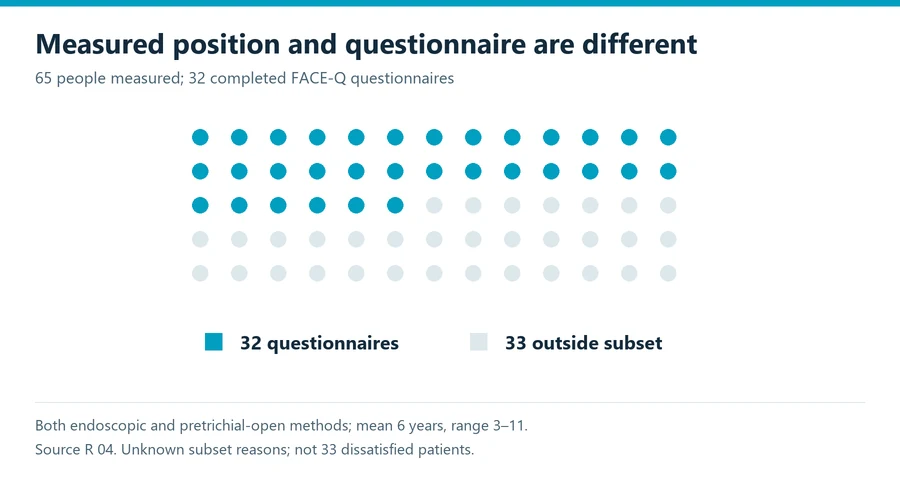
A 2022 original comparison measured brow positions in 65 patients after endoscopic or pretrichial open forehead lifts. Follow-up averaged six years and ranged from three to eleven years. Both approaches showed sustained elevation in this selected observational sample, with no significant difference reported between techniques. Only 32 patients completed the FACE-Q satisfaction questionnaires. Their responses should not be presented as satisfaction data from all 65 measured patients or as a randomized demonstration that the methods are equivalent. Original long-term morphometric comparison
A separate 2022 study analyzed standardized photographs from 97 endoscopic brow lift patients; only 14 had multiple follow-up records for a longitudinal analysis. It distinguished brow elevation from forehead height and reported a greater relative change around the eyes. This supports examining different facial proportions separately, but does not establish that every person has no hairline or forehead change. Original brow and forehead proportion study
A retrospective report published in the January 2025 issue examined 118 cases using a particular suspension technique. Its quantitative long-term analysis concerned 29 isolated brow lift patients with at least one year of follow-up. The report also described suture extrusion and temporary hair loss in the overall case series. A favorable result in a selected subgroup is not proof that a fixation method prevents all relapse or outperforms every alternative. Original internal suspension case series
| Study question | What the original record contributes | What it does not establish |
|---|---|---|
| Can elevation persist over years? | A 65-patient observational comparison assessed long-term positions | A guaranteed personal duration or randomized equivalence |
| Did all measured patients provide satisfaction data? | The questionnaire count was 32 | Satisfaction from every one of the 65 patients |
| Are brow height and forehead height identical? | A separate photographic study measured distinct proportions | A universal absence of forehead change |
| Does a technique report prove no relapse? | A selected subgroup had quantitative follow-up | Superiority over all methods or zero failures |
A measurement needs a landmark and a timepoint
When a study reports brow elevation, ask which point was measured. The inner brow, central arch and lateral tail are not interchangeable. Ask whether the measurement describes a single later visit or repeated observations in the same people. Those distinctions affect what the study can say about shape and stability.
The term long-term also needs a date or interval. A study’s average follow-up does not mean every patient was assessed at that exact time. In a comparison spanning several years, the timing may differ substantially between participants. A useful chart or caption should make that variability visible instead of drawing a smooth trajectory that the research never measured.
No chart in this guide converts selected cohort data into a personal prediction. The study findings provide a basis for questions about evidence and follow-up. They do not determine your target elevation, select your fixation method or establish your risk of recurrence. Those decisions require the proposed operation and individual assessment.
Fixation is part of the operation, not a durability certificate
Ask how the adjusted tissues will be supported and whether a fixation material or device is included. You can request its name, the reason for choosing it and what complications or later issues would need assessment. A marketed technique name should not replace discussion of the actual operative plan.
If the surgeon cites a study, compare its population and follow-up with your situation. Did it evaluate an isolated brow lift or combined procedures? Was it a controlled comparison or the operator’s own series? Were outcomes measured in everyone or a selected subset? A technically sophisticated explanation should still leave you understanding these basic limits.
Combined surgery is particularly relevant to interpreting satisfaction. A person having eyelid surgery and a brow lift may report a better upper-face appearance without identifying the contribution of each procedure. That does not make the report useless, but it does make a claim about the brow lift alone less secure. Keep your own planned components and goals separate for the same reason.
Compare a brow lift with wrinkle treatment
ASPS describes botulinum toxin as temporarily reducing selected facial lines through its effect on muscle activity. That is a different treatment category from camera-assisted tissue adjustment. Do not assume that a treatment for an expression line necessarily addresses the same structural concern as a surgical brow lift. ASPS toxin mechanism and scope
Ask which concern each proposed treatment is intended to address and whether both are being suggested for distinct reasons. A temporary injectable option may fit one person’s goal and not another’s. There is no obligation to progress from injections to surgery or to purchase both because they are discussed together.
If you recently had forehead or brow injections, bring the dates and product records when available. Discuss how that history affects examination and planning. Do not schedule another treatment independently to modify the appearance just before the surgical assessment. The clinician needs a clear picture of your history and the goals being evaluated.
Risks include the scalp, nerves and eye comfort
ASPS lists brow lift risks including bleeding, infection, elevated hairline, hair loss near incisions, altered sensation, asymmetry, nerve injury, eye irritation or dryness, unfavorable scars and possible revision. Small scalp incisions do not remove these concerns. Discuss which risks are especially relevant to your proposed approach and health history. ASPS brow lift risks
If eyelid surgery is also proposed, review its risks separately. ASPS describes potential dryness, difficulty closing the eyes, changes in lid position and rare vision complications. A combined consent discussion should identify these additional concerns rather than treating an upper-face package as one indistinguishable procedure. ASPS eyelid surgery risks
Ask what symptoms require prompt evaluation, how to reach the team outside normal hours and where urgent care would take place. Record the instructions in a format you and a helper can use. Early concern should be assessed through the care route specified by your surgeon, rather than waiting for a later cosmetic review or comparing photographs with other patients online.
Health and previous procedures influence the decision
ASPS describes general brow lift candidacy in terms of health, nonsmoking and realistic goals. These are broad considerations rather than an online eligibility score. A consultation should address your actual medical history and whether the proposed surgery is appropriate now. ASPS candidacy considerations
Bring a medication and supplement list and details of previous facial procedures or unexpected reactions. Tell the surgeon about eye comfort and any prior treatment relevant to that concern. ASPS consultation guidance includes medical history, medication use and examination of the upper face. Your records help make that discussion specific. ASPS consultation preparation
Preparation should be coordinated with the care team. ASPS notes that medical evaluation, medication adjustments and smoking cessation may be requested. Do not stop a prescribed medicine independently because a general list mentions bleeding or bruising. Ask who will provide the final medication instructions and how they will be coordinated with the clinician who prescribed treatment. ASPS surgical preparation
Recovery: protect the repair and distinguish milestones
ASPS describes possible dressings and drains and individualized wound-care instructions. It specifically advises against applying ice or heat to the operated area in its brow lift recovery guidance. Follow your own surgeon’s written plan rather than borrowing an eyelid treatment routine or another person’s recovery advice. ASPS brow lift recovery
Ask separately about washing the hair, handling dressings, wearing headgear, returning to work and resuming vigorous activity. These tasks impose different demands, so a general statement that you can return to normal life is not sufficiently precise. Identify any equipment or work conditions that contact the scalp before scheduling the operation.
Visible bruising settling is not the same as final healing. ASPS explains that results and incision lines continue to develop over the following months. A recovery calendar should distinguish early care, activity clearance and later assessment of shape, symmetry and scars. Avoid treating an early photograph as proof of permanent elevation or a final disappointing result. ASPS result development
Cost: compare the actual operation and complete bill
ASPS states that its brow lift average excludes anesthesia, operating facilities and related expenses. The general average is not a dated endoscopic-only local total. Obtain a complete proposal identifying the approach, additional procedures, shared expenses, follow-up and possible later charges. ASPS brow lift cost scope
| Estimate item | Information needed | Comparison error to avoid |
|---|---|---|
| Brow lift | Approach and included operative work | Comparing technique names without matching scope |
| Additional eyelid work | Separate rationale and charge | Assuming every upper-face proposal includes the same procedures |
| Anesthesia and facility | Complete estimated fees | Calling the surgeon fee the total |
| Fixation and aftercare | Included materials and review visits | Assuming everything mentioned is included |
| Later concerns | Evaluation and revision policies | Assuming all further surgery is free |
Do not judge value by the smallest incision or a promised number of lasting years. Compare the proposed change, evidence limits, recovery and full cost together. Our cost planning guide provides a broader way to organize the complete financial commitment.
Review the result against the original regional goals
At the planned follow-up, assess the concern that prompted surgery: the outer brow, central position, upper-lid hooding or another agreed feature. Include shape and hairline preferences as well as height. Comparable relaxed photographs are more useful than an expression-raised brow photographed under different lighting.
If a concern persists, ask what the examination suggests and whether healing affects interpretation. Keep eye comfort, sensation and scar concerns separate from the cosmetic judgment so each receives an appropriate response. An unsatisfactory appearance does not establish the cause, and a pleasing appearance does not eliminate the need to assess a functional symptom.
An informed endoscopic brow lift choice should leave you able to explain the intended regional change, the features being preserved, why this approach was chosen and what the evidence cannot promise. Use the procedure library to compare related decisions, and keep eyelid treatment distinct whenever it is part of the discussion.
Sources and review scope
Plastic Surgery Editorial Team. Source records checked through October 12, 2026. Review scope: source and editorial checks for general education. No individual clinical assessment is represented.
- ASPS endoscopic and other brow lift approaches. plasticsurgery.org. Publication/update date not stated. Checked 2026-10-12.
- ASPS brow position and combined procedures. plasticsurgery.org. Publication/update date not stated. Checked 2026-10-12.
- ASPS eyelid surgery scope. plasticsurgery.org. Publication/update date not stated. Checked 2026-10-12.
- Original long-term forehead lift morphometry comparison. pubmed.ncbi.nlm.nih.gov. Source date: 2022-06-03. Checked 2026-10-12.
- Original brow versus forehead photographic analysis. pubmed.ncbi.nlm.nih.gov. Source date: 2022-02-04. Checked 2026-10-12.
- Original vertical internal brow suspension series. pubmed.ncbi.nlm.nih.gov. Source date: 2025-01-16. Checked 2026-10-12.
- ASPS toxin mechanism. plasticsurgery.org. Publication/update date not stated. Checked 2026-10-12.
- ASPS brow lift risks. plasticsurgery.org. Publication/update date not stated. Checked 2026-10-12.
- ASPS eyelid additional risks. plasticsurgery.org. Publication/update date not stated. Checked 2026-10-12.
- ASPS candidacy considerations. plasticsurgery.org. Publication/update date not stated. Checked 2026-10-12.
- ASPS history and examination. plasticsurgery.org. Publication/update date not stated. Checked 2026-10-12.
- ASPS coordinated preparation. plasticsurgery.org. Publication/update date not stated. Checked 2026-10-12.
- ASPS recovery guidance. plasticsurgery.org. Publication/update date not stated. Checked 2026-10-12.
- ASPS healing results. plasticsurgery.org. Publication/update date not stated. Checked 2026-10-12.
- ASPS cost exclusions. plasticsurgery.org. Publication/update date not stated. Checked 2026-10-12.