
Dysport cost depends on the exact product, clinician-assessed treatment and billing rule. A low advertised unit price can produce a higher complete appointment charge when a minimum applies or assessment is billed separately. Billed units and administered units must be clearly distinguished. A financial minimum must never become a reason to receive extra product beyond the clinically appropriate plan.
This guide offers an original hypothetical minimum-charge worksheet for Dysport only. Its invented dollar rates and billing floor are not market prices or observed practice policies. The example does not convert Dysport units into Botox or another product’s units, select a dose for you or recommend a repeat schedule. It helps reconcile a professionally determined plan with the written financial terms offered for that same plan.
What product does a Dysport cost quote need to identify?
The DailyMed Dysport label identifies abobotulinumtoxinA and says its potency units are not interchangeable with other botulinum toxin products. The record was updated October 24, 2024; its prescribing and medication-guide text identifies a September 2023 revision. These dates are different from this guide’s October 12, 2026 source check.
The label’s cosmetic indication is temporary improvement of moderate to severe glabellar lines in adults younger than 65. Its labeled regimen there totals 50 Dysport units, with retreatment no more frequently than every three months. It carries a boxed warning about distant toxin effects, including potentially life-threatening swallowing or breathing difficulties. Suitability and treatment remain clinician decisions. Seek immediate medical help for those serious symptoms after treatment.
The worksheet uses 50 units solely to anchor its arithmetic to that specific labeled regimen, assuming a clinician has already determined it appropriate. It is not a personal prescription. No brand conversion is attempted. A quote should identify the exact product and task; a generic “toxin units” promotion does not provide enough information for a valid product-specific financial comparison.
Is the published injection average a Dysport cost average?
The ASPS botulinum toxin cost page, checked October 12, 2026, displays $435 for the broader injection category and names multiple products. It does not establish a Dysport-only average, a standard unit price or a price for the label’s 50-unit regimen. The underlying fee year is not verified here. Keep its category wording and limitations when citing it.
Do not divide $435 by 50 and present the resulting $8.70 as an observed Dysport rate. That would combine a broad category average with a separate product-specific regimen without evidence that the denominator describes the source’s appointments. The mathematical division is possible, but the supposed market meaning is unsupported. Obtain the actual product-specific quote and its stated billing basis.
Likewise, do not compare nominal per-unit rates across different toxin brands by assuming a potency conversion. A lower numerical unit price does not establish a lower price for an equivalent treatment or an equivalent clinical result. This page isolates one product so the billing arithmetic remains interpretable. A broader treatment choice requires clinical discussion rather than a conversion formula supplied by a cost calculator.
Which Dysport cost billing terms should be written down?
Ask whether the office charges by administered Dysport units, a defined area, a flat appointment or a minimum monetary amount. If it quotes a unit minimum, ask whether that is merely a financial floor and how the actual administered quantity will be documented. It must not be confused with a requirement to inject the minimum. Record the quoted rule and the clinician’s assessed plan separately.
| Quote field | What to establish | Why it matters |
|---|---|---|
| Exact product | Dysport identity on the assessed plan | Units cannot be treated as generic across brands |
| Clinical quantity | Clinician-determined plan and actual treatment record | Financial terms do not select a dose |
| Billing basis | Administered units, area, flat fee or stated floor | Changes the complete charge |
| Minimum | Monetary or billed-unit minimum and conditions | Low unit rate may not apply to actual quantity |
| Assessment charge | Included, separate or credited | Changes complete appointment spending |
| Review arrangement | Included assessment and separate additional-service terms | Review is not automatically more treatment |
The ASPS consultation guidance places discussion of treatment with the practitioner. Obtain your clinical plan before filling in financial quantities. A sales assistant may explain a minimum charge, but that does not answer whether treatment is suitable or how much should be administered. Keep those responsibilities distinct when reconciling the estimate.
Original Dysport cost worksheet: the smaller unit rate loses
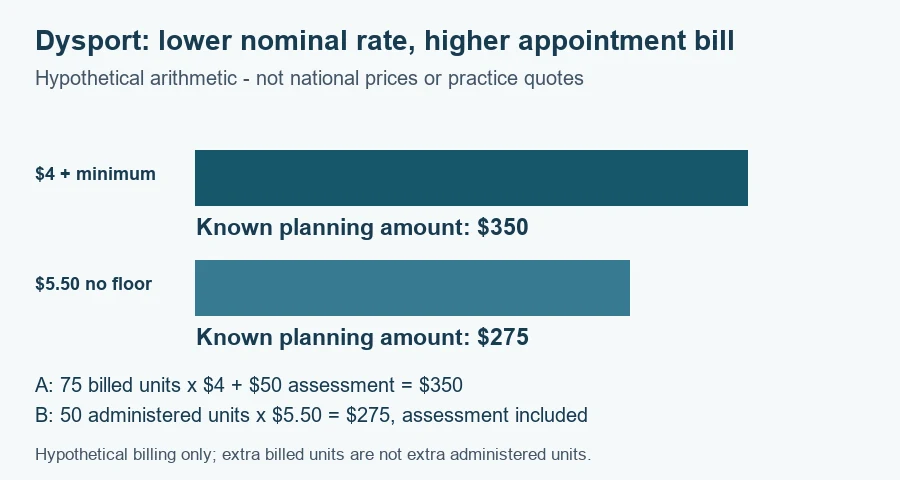
Suppose two purely hypothetical quotes cover the same clinician-confirmed 50-unit Dysport plan with otherwise matched service scope. Offer A advertises $4 per Dysport unit but bills a 75-unit financial minimum and adds a separate $50 assessment charge. Its treatment charge is $4 multiplied by 75, or $300, even though the assumed administered quantity is 50. Add the assessment to obtain $350. The extra billed units are not extra administered units.
Offer B charges $5.50 per administered Dysport unit with no minimum in this fictional example and includes the same assessment. Its complete appointment charge is $5.50 multiplied by 50, or $275. Although B’s nominal unit rate is $1.50 higher, its complete amount is $75 lower. This result depends on the stated invented minimum and assessment terms; it is not a finding about actual clinics or appropriate product quantity.
| Hypothetical input or result | Offer A | Offer B |
|---|---|---|
| Assumed clinically appropriate administered units | 50 | 50 |
| Nominal Dysport unit rate | $4.00 | $5.50 |
| Financial billed minimum | 75 units | None in this example |
| Units used for charge calculation | 75 billed units | 50 administered units |
| Treatment charge | $300 | $275 |
| Separate assessment | $50 | $0, included |
| Complete appointment charge | $350 | $275 |
For this specific 50-unit plan, the nominal $4 rate alone would misleadingly suggest $200. Its financial floor adds $100 relative to that bare multiplication, and its separate assessment adds another $50. The resulting $350 is 75% above the $200 calculation. That percentage measures the effect of the example’s billing assumptions, not a product premium or an adverse clinical outcome.
If you divide complete spending by the 50 actually administered units, A has an effective spending ratio of $7 per administered unit and B has $5.50. Call A’s $7 a whole-appointment ratio, not its advertised unit rate. It includes a minimum and assessment. Ratios can help explain the discrepancy, but the complete dollar amount and exact inclusions are usually clearer than a new rate label that conceals their origin.
How can a financial minimum change Dysport cost without changing treatment?
A contractual floor can make the bill exceed the bare product multiplication. Ask how the office explains that floor and whether the assessed appointment’s complete amount is still the offer you wish to accept. Do not ask the clinician to administer the difference simply because you are paying a minimum. An unused billing allowance is not a clinical entitlement to additional injections.
If the office’s rule is a dollar minimum rather than a unit minimum, record it in dollars. For example, a stated $300 treatment minimum with a $4 nominal rate would also yield $300 for the assumed 50-unit plan in the worksheet. That arithmetic similarity does not make the actual contracts identical. One may have different conditions or scope. Use the office’s real rule instead of translating it into a unit count that sounds clinical.
If a quoted floor cannot be explained, request a complete appointment estimate rather than trying to infer the rule from a receipt. A line reading “75 units” can be ambiguous when the clinician’s actual administration record differs. Ask the office to distinguish financial quantity from administered quantity clearly. The worksheet should preserve the actual treatment record without rewriting it to match the amount billed.
Can an assessment credit change Dysport cost comparisons?
Yes, if the actual credit applies to the exact appointment being compared. Suppose the fictional A’s $50 assessment becomes fully credited toward the $300 treatment charge. Its complete appointment obligation would then be $300, with the $50 already paid reducing the later balance to $250. Total spending remains $300. Adding $50 again would lose the credit and distort the comparison. This is a separate sensitivity scenario, not the base chart.
Even with that full credit, A would remain $25 above the example’s $275 B. The original $75 gap narrows because the assessment treatment changed financially, not because the product or administered quantity changed. Keep the credit’s qualifying conditions visible. A credit valid only for another service or a future appointment cannot be deducted from this appointment without actual confirmation.
Record payments and obligations separately. If B requires a hypothetical $100 credited advance, its remaining balance is $175 while its complete amount stays $275. Comparing A’s complete $300 with B’s remaining $175 would mix two different accounting stages. Put both offers on either a complete-charge basis or a remaining-balance basis with all prior payments shown. A smaller amount due today does not automatically mean a smaller total.
What if a Dysport cost offer includes a review?
Ask what the review includes, when it is offered and whether any separately proposed treatment would generate another charge. An included assessment is different from a promise of additional product, and a promotion cannot establish the clinical appropriateness of another injection. Keep actual care instructions and the clinician’s timing decisions central rather than using a financial offer to set a repeat date.
If an office describes a package with included follow-up, obtain the written limits. Does it include a review consultation only, a specific service under conditions, or something else? Do not assume all possible concerns or expenses are covered. Equally, do not add a second assessment charge if the quote clearly includes the relevant review. The same inclusion discipline used for the initial appointment applies to later financial questions.
The worksheet supplies no automatic yearly appointment count. An interval restriction is not a recommendation that every person repeat treatment at that interval, and a temporary effect does not establish your treatment frequency. A yearly budget needs an actual clinician-agreed plan and the actual prices applicable to each appointment. Do not multiply a promotional quote by four and call that a universal annual Dysport cost.
How should a prepaid Dysport cost package be evaluated?
Ask whether it purchases specific appointments, monetary credit or a stated billing allowance, and how medical reassessment affects unused value. Save its expiry, postponement, cancellation and refund terms. Do not assume a package can be used for another product or transferred to another person. These are contract questions for the actual offer, while clinical suitability remains individualized.
Avoid committing to more treatment solely to reduce a nominal rate. In the example, receiving additional product to use the 75-unit financial minimum would change the clinical plan and is not suggested. A prepaid package can likewise create pressure to use value before expiry. The financial record should make that pressure visible without turning it into a treatment recommendation or an assumption that all prepaid care will be appropriate.
If the clinician changes or pauses the plan, ask how the actual credit is handled. Keep unused credit separate from spent amounts and from any confirmed remaining obligation. A package with a low advertised rate may still cost more per attended appropriate appointment when unused value cannot be recovered, but this guide does not assign an unused-credit probability or invent a universal refund policy.
Which questions clarify a Dysport cost quote fastest?
Ask for the exact product, assessed scope, complete appointment amount, financial minimum and assessment-credit rule. These five answers usually reveal whether the advertised unit rate describes the actual purchase. If two quotes differ, identify the particular rule creating the difference. A written question about a 75-unit billing floor is more useful than asking which office is cheaper without naming the plan.
| Unclear line | Question to ask | Record to retain |
|---|---|---|
| Generic toxin units | Which exact product is being quoted? | Product-specific estimate |
| Minimum exceeds assessed quantity | Is this a financial floor, and how is it documented? | Separate billing and administration records |
| Assessment fee | Included, separate or credited for this appointment? | Credit terms and receipt |
| Review package | What service is included under which conditions? | Actual review scope |
| Prepaid value | What happens if clinical plans change? | Actual unused-credit terms |
Before paying, compare the estimate with the assessed plan and the contract. If the office changes a minimum or adds a fee, request an updated complete amount. After treatment, retain the actual administration record and financial receipt. If their quantities differ, ask the office to clarify whether a billing floor explains the difference. Do not change the medical record yourself or assume a billing quantity proves that more product was administered.
For broader context, see the Dysport guide. This page helps normalize one product’s financial terms. It does not compare clinical superiority across toxin brands, supply a conversion ratio or choose a dose. A valid decision can be to seek clarification, postpone or decline treatment; a minimum charge or prepaid allowance should not make that decision for you.
Frequently asked Dysport cost questions
There is another way to reconcile the fictional floor without altering the clinical quantity. At the unchanged $4 nominal rate and separate $50 assessment, A would need a treatment charge of $225 to match B’s complete $275. Dividing $225 by $4 gives a financial-equivalence threshold of 56.25 billed units. The actual fictional floor is 75, so it lies above that threshold. This is an algebraic description of charges, not a fractional dose or a proposed administration amount.
If an actual office offers only whole billing units or a fixed dollar minimum, use its valid charge rule rather than assuming you can purchase a fractional financial allowance. For the documented 50-unit plan, ask for the complete amount the office will actually accept. The threshold merely explains why a low rate can lose once its floor and assessment are included. It does not suggest negotiating a clinical dose, adding treatment or converting units between brands. This additional Dysport cost calculation keeps the product quantity unchanged and makes the source of the financial difference explicit.
Is a $4 unit offer necessarily cheaper than $5.50?
No. In the explicit hypothetical model, the $4 offer has a 75-unit financial floor and separate $50 assessment, totaling $350 for the assumed 50-unit plan. The $5.50 offer totals $275 with assessment included. Different actual offers require their own documented rules. The calculation does not justify receiving more product to use a billing minimum.
Can I convert another toxin’s units to compare Dysport cost?
This guide supplies no conversion. Product identity and the clinician-assessed plan must be clear before comparing complete charges. A nominal numerical rate across different products cannot establish equivalent treatment. Use a product-specific written quote and discuss treatment choices with the responsible clinician rather than inferring them from a price table.
Does a minimum charge mean more units were administered?
Not necessarily. A financial floor and an actual administration record describe different facts. Ask for clear documentation of both. The example assumes 50 administered units and 75 units used solely for A’s charge calculation. It does not recommend that billing pattern or establish any office’s actual practice.
What is the next step in comparing Dysport cost?
Request a complete appointment estimate naming the exact product, financial minimum, assessment inclusion and credit terms. Keep administered quantity separate from billed quantity and prior payments separate from total obligations. That makes Dysport cost a clear comparison of documented financial rules for an assessed plan, without allowing a low unit rate or package allowance to determine clinical treatment.
Sources and review scope
Plastic Surgery Editorial Team. Source records checked through October 12, 2026. Review scope: source and editorial checks for general education. No individual clinical assessment is represented.
- DailyMed Dysport label and product-specific units. US National Library of Medicine DailyMed. Source date: 2024-10-24. Checked 2026-10-12.
- ASPS broad botulinum toxin fee context. American Society of Plastic Surgeons. Publication/update date not stated. Checked 2026-10-12.
- ASPS botulinum toxin consultation. American Society of Plastic Surgeons. Publication/update date not stated. Checked 2026-10-12.