
A direct brow lift is an approach to changing brow position that involves accepting a scar near the brow rather than assuming every incision can be hidden behind the hairline. Its suitability depends on the assessed problem, the person’s goals and the tradeoffs of the proposed course. Brow position, eyelid skin and lid opening are different assessment questions. A photograph of a hooded upper-eye area does not determine which of those questions matters or select the correct operation.
Leeds institutional guidance distinguishes lifting the brow from removing loose upper-eyelid skin and describes the direct approach’s scar above the eyebrow hairs. That distinction should be clear before comparing direct, endoscopic or other brow-lift proposals. The technique name alone does not establish a better result or remove the need for an eye-area assessment. Leeds forehead and brow guidance
This guide focuses on the direct approach, the scar-position tradeoff and the way historical evidence reports brow-level satisfaction. It does not tell you how to test your brow at home, choose an incision or perform surgery. Its purpose is a clearer treatment discussion rather than a universal brow-height target.
Identify which part of the upper-eye concern is being assessed
Describe what prompted your appointment in ordinary language. You might notice a lower brow, a heavy feeling, excess-looking upper-lid skin or an appearance preference. Keep those observations separate instead of treating the entire area as one problem. Ask the clinician which finding has been assessed and which proposed component responds to it.
If your concern involves seeing, opening the eyes or eye comfort, say so explicitly. Do not let an appearance discussion replace the evaluation of those symptoms. A still photograph cannot establish the explanation for every eye-area complaint. Ask what further assessment is appropriate and whether another clinician or test is needed before an elective decision.
If the concern is primarily cosmetic, describe the preference relative to your own face. Avoid asking for a brow angle or height copied from a filtered image of someone else. A manufactured ideal does not establish the safest or most suitable change for you. Ask what result the clinician considers feasible and what uncertainty remains.
Record whether the concern is on one side or both and whether it followed a previous treatment or another condition. Bring available operative or assessment records. These details are useful history, not a basis for selecting an operation on your own. The current examination and explanation should remain central to the plan.
| Concern | Clarification to request | Shortcut to avoid |
|---|---|---|
| Low brow position | What finding is being assessed and changed? | One ideal height for every face |
| Upper-lid skin | Is skin removal part of the proposal? | Assuming brow lifting removes the skin |
| Difficulty with eye opening or vision | What functional assessment is needed? | Diagnosis from a still photograph |
| Appearance preference | What is the realistic goal and tradeoff? | A filtered brow template as a guarantee |
Understand why a direct approach is being proposed
Ask the clinician to explain why a direct brow lift is being considered rather than another approach. The answer should relate to the assessed concern and the scar tradeoff, not simply the claim that a method is newer, faster or more powerful. A technique can be useful in selected circumstances without being the universal winner.
The direct approach’s scar location should be discussed in the context of your own preferences. Ask how visible it may be and how that uncertainty is explained. A statement that a scar can blend with nearby features is not a promise that it will be invisible. If scar visibility matters greatly to you, make it a primary part of the decision rather than a footnote after booking.
Compare the scope of alternatives as well as their incision descriptions. A different approach may involve a different course, and a combined eyelid procedure may address a separate concern. You should understand the purpose of each component and the consequences you are accepting. An operation label does not make those proposals equivalent.
You do not need a cutting or suture recipe to assess a proposal. You do need a plain-language explanation of the intended position change, the expected scar and the follow-up plan. If the explanation remains a collection of technical terms, ask for clarification. A comprehensible rationale is more useful than trying to become an operative expert from an online diagram.
Treat scar appearance as its own endpoint
One-sided goals need an explicit baseline
If the proposed operation is on one side, ask what the team intends to compare with the other side and how that comparison will be made. A natural difference between sides should not be confused with a newly promised matching target. Write down whether the goal concerns height, contour, comfort or another assessed feature. A single word such as symmetry can hide those different questions.
Ask how ordinary expression will be considered in the appearance discussion. A neutral photograph and an image taken while raising the forehead may communicate different concerns, but neither is a home test of the correct operation. Keep the expressions labelled if the team requests photographs. Do not select a treatment by copying a demonstration in which someone manually moves their brow.
For a two-sided proposal, make the same questions explicit for each side. Identical procedure names do not by themselves define the intended change or your preferences. If different goals are being discussed, preserve them in the plan instead of reducing the result to a single combined rating. The assessment should make the decision easier to understand, not require you to guess what a broad appearance label means.
Discuss both the desired brow change and the scar you would be willing to accept. They are related parts of the decision but should remain separate outcomes. A person can value the position change while being less satisfied with the scar, or the reverse. A single overall result label can conceal that distinction.
Tell the team about previous problematic scars or healing concerns you know about, and ask how those histories are evaluated. Do not diagnose your likely healing response by comparing your skin with someone else’s photograph. The record should identify what is known and what remains uncertain. A simulation cannot establish how your wound would heal.
Ask how scar appearance will be reassessed and what care instructions would apply. Follow the actual treating team’s guidance rather than adopting massage, products or treatment settings from another account. This guide does not prescribe a scar regimen. If you are unsure whether a later change needs assessment, contact the team instead of improvising care.
Avoid evaluating a scar from a comparison that changes lighting, expression or camera position without noting the difference. If photographs are used, keep the date and course of treatment attached. A close-up can communicate a concern but should not be treated as a complete assessment of brow function or overall appearance.
| Endpoint | Discussion record | What does not prove it |
|---|---|---|
| Brow position | Baseline, intended change and reassessment | Technique name alone |
| Scar appearance | Visibility tradeoff and follow-up | A promise of invisibility |
| Sensation or comfort | Symptoms and clinical assessment | A pleasing photograph |
| Overall preference | Your priorities and accepted uncertainty | One combined satisfaction label |
Combined upper-lid surgery needs a separate explanation
Worcestershire institutional education describes a low-brow assessment context and notes that upper-lid blepharoplasty may be performed alongside a direct brow lift to address excess lid skin. It does not mean every brow proposal requires both operations. Ask what the clinician believes each component contributes in your situation. Worcestershire direct brow education
The distinction is practical when reviewing a quote or consent form. A brow operation and an upper-lid operation may target different findings. Ask whether the plan includes both, why, and how the endpoints will be discussed. If you prefer only one component, request an explanation of how that changes the anticipated course rather than assuming the other is mandatory.
The existing blepharoplasty guide gives broader context for eyelid surgery. Use it to prepare questions, then return to the exact clinical proposal. Neither that guide nor a brow illustration diagnoses the cause of your upper-eye concern. The plan should explain the assessment rather than relying on a photograph of a bundled result.
If previous eye-area surgery or facial nerve care is part of your history, keep it visible when asking about evidence. A selected rehabilitation population is not automatically comparable with a person seeking a first elective appearance change. Matching the words direct brow lift does not make the histories, indications or outcomes identical.
Read the historical study using its actual units
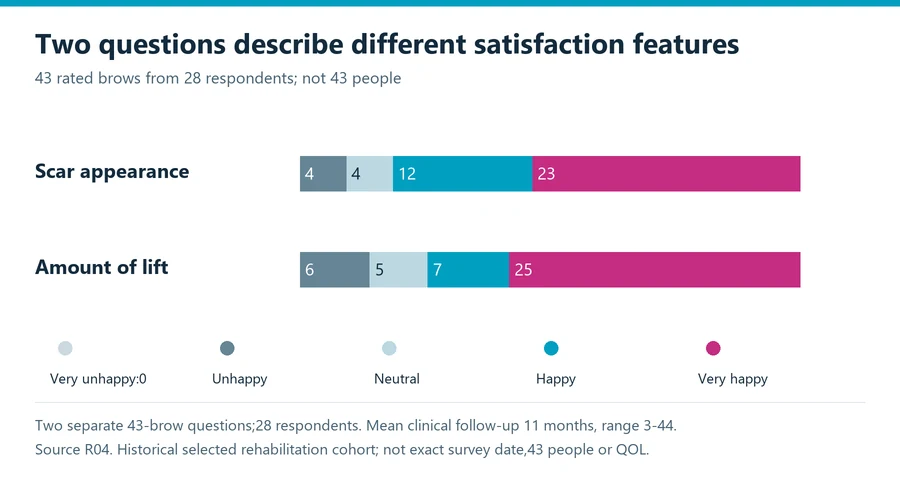
A May 2004 retrospective report describes 54 direct brow operations in 36 people, with mean clinical follow-up of 11 months and a range of three to 44 months. Its selected population was mainly being treated for comfort and visual rehabilitation. The questionnaire replies came from 28 people and concerned 43 brows. Scar appearance and amount of lift were separate questions. Original direct brow study
Forty-three rated brows are not forty-three patients
For scar appearance, the reported ordered response counts were zero very unhappy, four unhappy, four neutral, 12 happy and 23 very happy. For the amount of lift they were zero, six, five, seven and 25 in the same order. Each question concerns 43 rated brows. The proposed chart keeps the questions separate and preserves that denominator rather than combining them into an overall personal success probability.
These ratings are not independent patient-level observations simply because they are displayed as bars. Some people contributed information about more than one brow. The respondent group is also not the same unit as all operations in the clinical review. The author-devised questionnaire was not intended as a formal quality-of-life test. Those limits should remain attached to the results.
The study’s mainly rehabilitation context and historical course do not establish the result of every modern cosmetic direct brow lift. Nor does the range of clinical follow-up mean every person was observed for 44 months. Ask how the evidence offered for your proposal relates to the assessed indication and actual endpoint, particularly if the discussion uses a satisfaction headline without its units.
A favorable record and a favorable patient rating are different
Ask how the team evaluates the result from your perspective as well as through examination. The amount of lift, scar visibility, sensation and practical comfort can matter differently to different people. A technically described improvement should not make your concern disappear from the discussion. Conversely, a personal concern still needs interpretation in the context of assessment.
A questionnaire is useful when its question and unit are clear. It is less useful when a response about one feature is presented as proof of every benefit. If a practice or study cites a high satisfaction number, ask what participants were asked, when, how many replied and what treatment they received. A denominator of rated brows should not silently become a denominator of people.
Keep any appearance simulation separate from that evidence. A simulation describes a proposed look, while a questionnaire describes reported experience after a real course. Neither establishes your individual outcome. The distinction allows you to use both as discussion aids without treating either as a promise.
| Reported element | Actual meaning | Unsupported conversion |
|---|---|---|
| 36 people | Clinical study population | 54 independent people |
| 54 operations | Operation-level count | Questionnaire reply count |
| 28 respondents | People who replied | Every clinical participant replied |
| 43 rated brows | Questionnaire unit | 43 independent patients |
| Separate scar and lift answers | Two endpoint questions | One universal success probability |
Discuss safety and eye-area access to care
ASPS provides general brow-lift safety guidance for an individualized consent discussion. It is not a source of direct-approach personal event rates. Ask which risks the clinician considers relevant to the specific operation and how the plan accounts for your history. A favorable selected study should not replace that conversation. ASPS brow-lift safety guidance
The Worcestershire leaflet identifies severe pain after surgery as a reason to seek immediate help because it can signal a problem requiring emergency treatment. It also discusses closure, sensation, asymmetry and vision concerns. Seek urgent medical or eye-care assessment for concerning symptoms after treatment; do not wait for a routine cosmetic review or an online photograph opinion.
Obtain a written contact and escalation plan before surgery. Know who handles concerns outside ordinary office hours and where assessment is available if the team cannot be reached. This matters even for a planned day-case course. A description of a short hospital visit should not be interpreted as absence of further responsibilities.
Do not practice pulling the brows, manipulating the eyelids or testing your field of vision to decide which operation you need. This guide cannot translate a home maneuver into a diagnosis. Likewise, do not copy medication, dressing or eye-care instructions from an institutional example; obtain the instructions for your own assessed course.
Use source dates accurately when planning care
The Leeds page records a December 29, 2025 last-review date, distinct from its earlier development information. The Worcestershire leaflet records approval on November 23, 2023 and a review due date in November 2026. Those dates describe different events. A future review date should not be presented as a completed update, and today’s access date is not a new clinical publication date.
Institutional information is useful for identifying questions, but an institution’s course does not set a universal recovery timetable. Ask the treating team which instructions apply to the actual operation and any combined procedures. Keep those instructions with the scope and contact plan rather than relying on a calendar that was written for a different service.
Arrange practical recovery around the actual proposal
Explain your work, driving, caregiving, travel and activity responsibilities to the team. Ask which decisions require follow-up assessment instead of setting your own return date. If temporary help is needed, plan it around the team’s instructions. A promise of a quick procedure does not determine every practical part of recovery.
Keep follow-up notes organized by endpoint. Record a concern about sensation separately from a concern about scar appearance or brow position, with the date and context. A still image can accompany that record but does not replace symptoms. The recovery planning guide supports broader preparation without supplying a direct-brow medical timetable.
Compare costs after the scope is clear
No verified direct-brow-lift total-price dataset is supplied here. Request an estimate identifying one-sided or two-sided treatment, any accompanying upper-lid procedure, anesthesia or facility charges and follow-up. Compare the same proposed course before comparing amounts. A general brow-lift fee is not automatically the price of this particular approach or combination.
Ask what financial terms apply to further evaluation, revision or a concern about the result. Keep those written terms separate from an explanation that a concern could be treated. Coverage questions also require the insurer’s applicable assessment and documentation process; a functional concern or procedure label does not guarantee a decision. The cost planning guide explains why the complete course matters.
Decide with the position and scar tradeoff visible
Summarize the assessed brow problem, separate eyelid questions, proposed components and scar tradeoff in plain language. Record which endpoint matters most to you and what uncertainty remains. If the explanation implies that every feature will improve together, request a more specific account. A meaningful position change can coexist with an important scar decision.
Use consultation questions and the procedure library to prepare. A useful direct-brow-lift decision preserves the distinction between brow position, eyelid skin and eye function, and reads the evidence in the units and population that were actually studied.
Sources and review scope
Plastic Surgery Editorial Team. Source records checked through October 12, 2026. Review scope: source and editorial checks for general education. No individual clinical assessment is represented.
- Leeds brow/eyelid scope and scar guidance. leedsth.nhs.uk. Source date: 2025-12-29. Checked 2026-10-12.
- Worcestershire direct brow assessment and safety. worcsacute.nhs.uk. Source date: 2023-11-23. Checked 2026-10-12.
- ASPS brow lift safety. plasticsurgery.org. Publication/update date not stated. Checked 2026-10-12.
- Original retrospective direct brow study. pubmed.ncbi.nlm.nih.gov. Source date: 2004-05. Checked 2026-10-12.