
A corner lip lift is surgery intended to elevate the corners of the mouth. It addresses a different goal from adding lip volume or shortening the distance between the nose and upper lip. The useful decision is whether a change in resting corner position matters enough to you to accept an incision and its scar tradeoff. A photographic angle is one way researchers measure position; it does not measure happiness, personality or how naturally your mouth moves. ASPS education on lip lift distinctions
This guide explains what to compare before choosing a corner lip lift, how to read the original studies and what a complete proposal should specify. It does not define a normal mouth as a defect. Your preferences may support surgery, a different assessment, postponement or no treatment. The starting point is the feature you want changed, rather than an assumption that an upward corner will improve every aspect of your expression.
Name the feature before naming the procedure
Look at your concern in three settings: a relaxed face, an ordinary smile and speaking. Write down which setting matters most. A corner that appears lower in a still photograph is a different concern from an unwanted change during movement. If you dislike the appearance only in one photograph, ask how the assessment will distinguish a reproducible feature from the expression or camera position in that image.
Separate corner position from the central upper lip. In the ASPS educational description, a conventional upper lip lift can shorten the skin distance beneath the nose. A corner operation focuses on the outer mouth. The terms sometimes appear together in a treatment proposal, so request a description of each component. One label should not conceal two operations or imply that changes at the center and sides are interchangeable.
Volume is a third dimension. A wish for a fuller lip does not automatically identify a corner-position problem. Ask the clinician to explain whether the concern involves volume, position, upper lip length, nearby tissue or a combination. Keep your own description specific: “I want this resting corner less downward” communicates a different preference from “I want more upper lip fullness.” Neither sentence establishes candidacy by itself.
Avoid making other people’s interpretation of your face the only goal. You might want a different resting outline while still valuing your current smile and recognizable expression. Say which characteristics you want to preserve. A proposal becomes easier to judge when it includes the desired change, the features that should remain familiar and the possibility that the requested change is too limited to justify surgery.
| Main concern | What to have assessed | What the label alone cannot establish |
|---|---|---|
| Resting outer mouth position | Corner location and side-to-side differences | Natural movement after healing |
| Upper lip length beneath the nose | Central upper lip proportions | Whether a corner operation is appropriate |
| Lip fullness | Tissue volume and proposed product or surgery | A reliable upward corner change |
| Appearance during smiling or speech | Dynamic movement and relevant history | A cosmetic operation as a functional diagnosis |
| Several surrounding facial concerns | Separate contribution of each proposed component | Which component caused a combined result |
A scar tradeoff belongs in the first discussion
The corner lip lift is not a scar-free method. The January 23, 2024 ASPS article specifically cautions about visible scars at the corners. Ask where the proposed scar would sit on your own mouth and how its location differs from a subnasal scar. A general claim that lip lift scars can be concealed beneath the nose does not answer the corner-specific question.
Consider the scar under the conditions in which you usually see your face: close conversation, natural daylight, photographs and your normal grooming or makeup habits. These are preference questions, not a way to predict healing from a mirror. Ask to see the proposed location without treating a drawn line as an exact forecast of the eventual scar. Discuss how the clinician would assess an unfavorable scar and what further treatment might involve.
The original 2021 retrospective study reported visible scarring in three patients, undercorrection in one and asymmetry in one. Those observations show why the topics belong in consent. They are not your personal complication probabilities. The abstract does not establish whether the categories overlap, so adding them into a single total would create an unsupported statistic. Original oral commissure lift study
Ask what “undercorrection” would mean in your proposal. A subtle result can be a deliberate goal, whereas a smaller change than agreed may be disappointing. Clarify the expected range of change and the limits of revision before deciding. An acceptable scar with a restrained position change may fit one person’s priorities and be unacceptable to another. There is no universal aesthetic threshold that this guide can supply.
Resting position and movement need separate endpoints
Ask for both the intended position change and the features to preserve. A still-image measurement can be useful, but your mouth also participates in ordinary conversation, smiling and eating. Ask how the consultation and follow-up will record your current movement and any concern you already have. This is an assessment request; it is not a claim that every cosmetic corner procedure improves or impairs those functions.
Prepare a short record of relevant prior treatment. Include earlier facial operations and injectable treatments, approximate dates and any available product records. Mention differences you noticed before or after those treatments. The ASPS facial consultation framework includes goals, health history, medicines, substances and previous surgery. It supports a thorough discussion but is not a corner-specific eligibility checklist or a reason to stop a medicine on your own. ASPS facial consultation framework
Photographs should help define the question rather than force a numerical ideal. Ask which views and expressions will be compared and whether the follow-up uses similar lighting, distance and head position. Request that the corners be considered separately. An average across two sides can conceal a difference that matters to you. A clinician may choose other measurements, but their relationship to your stated concern should be explained.
Make a simple comparison sheet with separate spaces for the right corner, left corner, central lip and smile. In each space, record your concern in words before looking at proposed changes. Then ask the clinician to mark which concern is within the operation’s scope and which is not. This is an original planning aid, not a validated outcome questionnaire. It helps reveal a mismatch such as wanting more central fullness while being offered only outer-corner elevation. Keep a copy of the agreed priorities so the follow-up discussion can return to the same questions.
If your main concern is a new change in movement or a functional difficulty, describe it clearly and ask for an appropriate assessment before treating it as a cosmetic preference. A procedure name does not explain why a change happened. This guide does not diagnose facial weakness or select a reconstructive operation. The distinction protects the usefulness of the consultation: appearance, function and cause should not be collapsed into one photograph.
What the original angle study actually measured
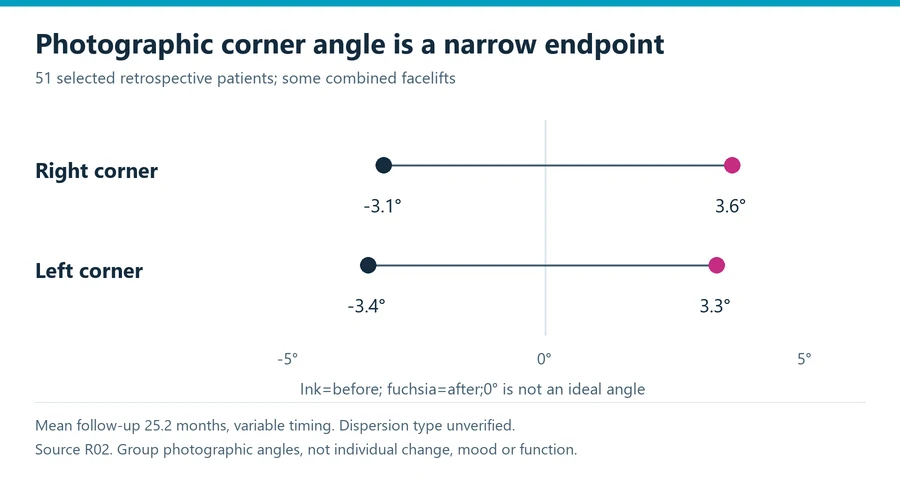
The 2021 paper examined 51 patients retrospectively, with procedures performed between January 2010 and December 2017. It reported a mean follow-up of 25.2 months. That is an average across the series, not a promise that every participant was assessed at the same point or that every future result lasts that long. The study was assigned Level IV evidence and included patients having simultaneous facelift surgery.
The reported mean right corner angle changed from −3.1 degrees before surgery to 3.6 degrees afterward; the left changed from −3.4 to 3.3 degrees. Subtracting the reported before value from the after value gives a mean change of 6.7 degrees on each side. That subtraction is a calculation from rounded group means. It does not describe every patient’s improvement or provide an angle to request for your own mouth.
The authors compared some groups to explore the influence of concurrent facelift surgery. A lack of a statistically significant difference in those comparisons does not establish that the operations are equivalent or eliminate every source of confounding. The series was not a randomized comparison of all available methods. Its photographic endpoint cannot establish a change in mood, social response or everyday function.
An angle is an endpoint, not an ideal
Read the chart as four reported group means connected in two before-and-after pairs. The zero line provides a reference for that study’s measurement. It is not a boundary between healthy and unhealthy expression. No error bars are supplied here because the abstract’s plus-or-minus figures do not explicitly identify the dispersion statistic. The graphic also avoids simulated patient photographs that could make a group average look like a guaranteed result.
| Evidence feature | What it tells you | What remains unanswered |
|---|---|---|
| Mean corner angle | Group photographic position before and after | Your eventual position or preferred expression |
| Mean follow-up of 25.2 months | Average observation duration | A uniform assessment date or lifetime durability |
| Reported scar, asymmetry and undercorrection events | Specific problems occurred | An individualized risk estimate |
| Concurrent facelift subgroup comparisons | Authors explored a potential influence | Complete separation of treatment effects |
| Retrospective selected series | Experience with a particular approach | Superiority over every alternative |
Why a larger series does not settle every question
A separate original report published February 26, 2020 described 498 patients. Only 178 had corner mouth lift alone; the rest had other perioral procedures at the same time. The report described some unfavorable scars, asymmetry, persistent swelling and undercorrection. Its statement that most patients were satisfied does not provide a standardized numerical satisfaction score for every reader to apply. Original corner mouth lift series
The combined-treatment mix matters when you look at a photograph or a headline. A result after several operations cannot automatically be attributed to the corner component. Ask which procedures were performed in an example and which part of the visible change is relevant to your concern. This does not make combined treatment inherently wrong; it makes the description of the example more important.
Another original 2020 study involved 159 patients having a combined corner-lifting technique. It used its own anatomical categories of effectiveness and reported patient satisfaction separately. Those are distinct endpoints. A position classified as effective by the study’s criteria need not be the same thing as a patient being fully satisfied. The study’s selected population and particular method also limit generalization. Original combined-technique study
When a proposal cites a high success rate, ask for the actual definition of success, the denominator and the follow-up. Was success an angle, an anatomical category, a patient questionnaire or absence of a recorded complication? Were revisions included? Were the patients having isolated corner treatment? These questions let you compare evidence without turning unlike endpoints into a league table of techniques.
Alternatives require a matching goal
A different procedure may address a different part of the concern. Central upper lip surgery, volume treatment, broader facial surgery and observation should be discussed according to the feature being assessed. Avoid asking which option is best in the abstract. Ask what each option would change, what it would leave unchanged and why that mechanism matches your priority. A plan can reasonably exclude an operation you initially expected to need.
If filler is proposed, request the exact product, intended site and patient labeling. FDA approvals apply to specific products and uses; an approval for lip augmentation is not a blanket endorsement of every technique advertised as a corner lift. Fillers carry their own risks, including potentially serious vascular complications. Removal can be difficult or require further intervention, so “temporary” should not be treated as a guarantee that any unwanted result is easily reversed. FDA filler uses, risks and labeling guidance
Keeping your current appearance is a meaningful comparison. Write down what would make the scar tradeoff worthwhile and what outcome would leave you preferring no surgery. If you cannot define that preference yet, more time may be useful. A simulation can help discussion if its limits are clear, but it is not evidence of what your tissues will do. No image should replace a defined plan and an explanation of uncertainty.
Compare a complete proposal rather than a package name
A corner lip lift quote should identify whether the operation is isolated or combined with a subnasal lift, facelift or another treatment. Record which clinician and facility services are included, the anesthesia plan, planned follow-up and the financial policy for further assessment or revision. The purpose is to compare the same scope. A lower headline number may simply omit services listed in another proposal.
ASPS’s general facelift cost page distinguishes a surgeon fee from anesthesia, facilities and other expenses. That is useful accounting context when a facelift is part of the proposal; its average is not a corner lip lift price. No defensible dated corner-specific total is supplied here. Ask for a written total and exclusions rather than importing a fee from another facial operation. ASPS fee versus total-price distinction
| Proposal field | Record explicitly | Why it helps comparison |
|---|---|---|
| Operation scope | Corner only or named additional components | Avoids comparing unlike packages |
| Scar plan | Intended location and uncertainty | Makes the main tradeoff visible |
| Endpoints | Resting position, movement and patient priorities | Separates a photograph from your goals |
| Follow-up | Visits, location and contact arrangements | Defines who assesses concerns |
| Financial scope | Total, exclusions and revision policy | Prevents a surgeon fee being mistaken for a total |
If a facelift is included, discuss its risks independently. ASPS lists issues including bleeding, infection, nerve injury, poor healing and unfavorable scars for facelift surgery. Those are not a corner-specific complication rate and should not be replaced by the small angle study’s event counts. The consent discussion must reflect the complete operation proposed to you. ASPS facelift safety context for combined proposals
Plan recovery around mouth-related daily tasks
Ask for individualized instructions about eating, oral hygiene, speaking, work and exercise, including how they differ if another procedure is added. This guide does not supply a universal food list, wound-care product or return-to-work day. A paper’s average recovery observation is not permission for an individual activity. Obtain written instructions and a contact route for questions rather than relying on a promotional description of minimal downtime.
Discuss practical needs that fit your day: long telephone calls, public speaking, customer-facing work, travel and scheduled dental care. These are planning examples, not evidence that the operation necessarily restricts each activity. Ask which arrangements are relevant to your actual proposal. If there are several procedures, clarify which component determines the recovery instructions and whether follow-up can be completed reliably near home.
Ask how a concern will be documented between scheduled visits. For example, the practice may have its own instructions for photographs or an in-person assessment; establish that process before travel or a return to demanding work. Clarify who receives messages, who makes the clinical decision and what to do outside usual opening hours. Do not assume that an early photograph settles the eventual scar or position. The useful arrangement is a defined way to ask about a change and obtain assessment, with timing determined by the treating team rather than an online average.
Before leaving the consultation, make sure you can explain the proposed change in ordinary language: which corner feature is being addressed, where the scar may be, how movement will be considered and what evidence supports the expectations. If the explanation depends only on a success percentage or an idealized smiling photograph, the proposal needs more detail. A useful decision balances your own priorities against a specific, understood tradeoff.
For related planning, see the procedure guide hub, questions to ask a plastic surgeon and plastic surgery cost guide.
Sources and review scope
Plastic Surgery Editorial Team. Source records checked through October 12, 2026. Review scope: source and editorial checks for general education. No individual clinical assessment is represented.
- ASPS lip lift distinction and corner scar caution. plasticsurgery.org. Source date: 2024-01-23. Checked 2026-10-12.
- Original oral commissure photographic angle series. pubmed.ncbi.nlm.nih.gov. Source date: 2021-07-27. Checked 2026-10-12.
- Original Surgical Method of a Corner Mouth Lift. pmc.ncbi.nlm.nih.gov. Source date: 2020-02-26. Checked 2026-10-12.
- Original combined-technique perioral study. pubmed.ncbi.nlm.nih.gov. Source date: 2020-05-27. Checked 2026-10-12.
- FDA product/site-specific filler guidance. fda.gov. Publication/update date not stated. Checked 2026-10-12.
- ASPS facial consultation framework. plasticsurgery.org. Publication/update date not stated. Checked 2026-10-12.
- ASPS combined-proposal fee scope. plasticsurgery.org. Publication/update date not stated. Checked 2026-10-12.
- ASPS combined-facelift risks. plasticsurgery.org. Publication/update date not stated. Checked 2026-10-12.