
Cleft rhinoplasty is nasal surgery considered in the context of a person’s cleft history, prior repairs and current goals. It is not simply routine cosmetic rhinoplasty with a different name. Begin with the problem being assessed, the previous care that informs the plan and the specific change the proposed operation is intended to achieve. Appearance and breathing need separate goals and separate evidence. A preferred nasal contour does not establish how you breathe, and an overall satisfaction score is not an airflow measurement.
Institutional cleft-septorhinoplasty education describes both functional and appearance goals and emphasizes an individualized timing discussion. Its examples should not be read as a universal age or operative timetable. A decision needs the treating cleft team’s assessment of the actual person and prior course. Institutional cleft septorhinoplasty education
This guide helps organize that discussion and interpret original studies without promising perfect symmetry, guaranteed breathing improvement or a single best technique. It does not diagnose nasal obstruction, provide surgical instructions or replace cleft-team assessment.
The nose is one part of a broader cleft-care history
NHS guidance describes cleft care as an individualized course involving a specialist team, with surgery and other assessments such as speech and dental care as needed. Nasal surgery can be one part of that course. The broader history matters when understanding a current proposal, rather than treating the nose as though no related treatment has taken place. NHS cleft care overview
Prepare a record of previous operations and assessments you can identify accurately. Include the approximate date, purpose and any available operative report, while marking uncertain information as uncertain. A childhood procedure name remembered by a family member may not identify every component. The aim is to help the team retrieve and interpret the actual records, not reconstruct a surgical history from assumptions.
If you are returning to cleft care as an adult, explain which concerns are current and which are part of past treatment. You do not need to accept another operation simply because earlier care occurred. Ask how the current assessment relates to the previous plan and whether other members of the team should be involved. A renewed assessment can clarify options without committing you to a course.
Keep speech, dental, jaw, lip and nasal concerns on separate lines when they are relevant. A problem involving one part of cleft care should not automatically be attributed to another. Ask the team which assessment addresses each concern and which questions belong outside the proposed rhinoplasty. This keeps a nasal-surgery promise from becoming an unsupported promise about the entire cleft-care course.
| Information to gather | How it helps discussion | What to avoid assuming |
|---|---|---|
| Prior operation and purpose | Establishes the actual care history | One remembered name captures every component |
| Available reports and dates | Supports accurate comparison and planning | An uncertain childhood date is exact |
| Current breathing concern | Keeps function visible in assessment | Appearance identifies the cause |
| Current appearance preference | Clarifies the change you value | Every cleft-related concern needs the same procedure |
Separate breathing concerns from appearance preferences
Describe breathing concerns in your own words, including when you notice them and whether the experience has changed. Tell the team about prior relevant assessment or treatment. This is a history for clinical evaluation, not a way to choose a procedure yourself. A photograph or a self-scored online test cannot establish the cause of difficulty breathing through the nose.
Describe appearance concerns separately, using your own face as the reference. You might want an explanation of a particular contour, visible difference or profile feature. Ask which proposed component addresses it and what uncertainty remains. Avoid converting a wish for greater symmetry into a requirement that every feature match an idealized template.
If both concerns matter, identify their relative importance. A plan should explain how each will be assessed and discussed after treatment. An appearance change can be meaningful without being evidence of a functional change; the same distinction applies in the other direction. Do not let an overall phrase such as improved nose replace two specific questions.
Ask whether the clinician intends to use a patient questionnaire, an examination, an instrument or photographs for each endpoint. These methods may complement one another but are not automatically interchangeable. The explanation should connect each method with the question it answers. That makes the later conversation more useful than a single statement that the result looks good.
Timing needs the actual person and care plan
The institutional leaflet discusses maturity and the person’s facial structure as part of timing. It is not a rule that a particular birthday makes every person ready for surgery. Ask why the operation is being considered now, how it fits with other planned care and what might change if the decision is postponed. The answer should be specific to the assessment.
For a young person, make room for their own questions, preferences and ability to participate in the decision. A family’s wish for a particular appearance should not be assumed to be identical to the young person’s goal. Request an explanation that the person receiving care can understand. Psychological support can help explore expectations without treating an operation as obligatory.
For an adult, previous treatment fatigue, practical responsibilities and changing preferences are legitimate discussion topics. Ask what the proposed course requires in appointments, recovery and follow-up. A decision to pursue assessment is different from agreeing to surgery. A decision to pause should not be framed as a failure to complete someone else’s appearance ideal.
The two institutional sources used here are dated references. The NHS page was last reviewed in March 2023, with a March 2026 review due date. The leaflet was published in May 2023 and lists May 2026 for review. Those scheduled dates have passed; a due date is not proof that a new review happened. Their general context is useful, while current timing and care instructions need confirmation with the treating team.
Understand the proposed components without learning an operative recipe
Ask for a plain-language explanation of what the operation is intended to change. If the plan uses the word septorhinoplasty, ask what functional and appearance components are included. If additional tissue or another treatment area is being discussed, request an explanation of that area’s own consequences and follow-up. Do not assume the nose is the only location relevant to a combined plan.
Prior records should inform that explanation. Ask how the team accounts for the earlier nasal or cleft procedures when describing the new course. A technical approach name is not enough to explain why it suits the assessed problem. You need the rationale and expected tradeoffs, not instructions about incisions or graft construction.
Clarify what is planned and what may depend on further assessment. A consultation can identify uncertainty honestly instead of presenting every detail as fixed. Keep that uncertainty in the written record so that a later change is not misunderstood as an unannounced promise. Ask when and how decisions would be revisited if new information changes the plan.
For broader terminology, the rhinoplasty guide explains general nasal-surgery questions. It is context rather than evidence that a standard cosmetic proposal applies to your cleft history. The exact clinical plan and its comparison population remain the important details.
| Goal or component | Useful explanation | Unsupported shortcut |
|---|---|---|
| Breathing | Assessed concern and method of reassessment | A preferred profile guarantees airflow |
| Appearance | Specific feature and acceptable limits | Universal perfect symmetry |
| Prior care | How records relate to this proposal | Primary-surgery evidence automatically applies |
| Additional treatment area | Its own burden and follow-up | Only the nose needs discussion |
What an overall questionnaire score can and cannot show
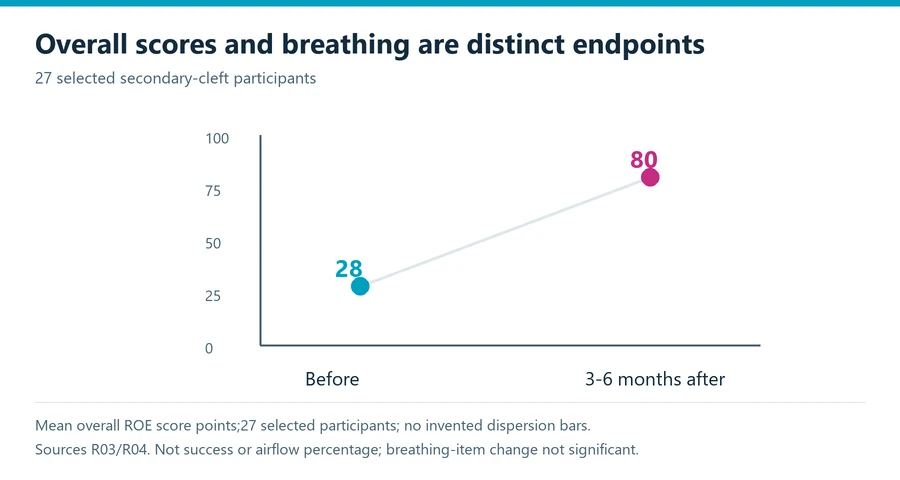
A prospective study first published July 19, 2016 included 56 participants, of whom 27 underwent secondary cleft rhinoplasty. Evaluation forms were completed before surgery and three to six months afterward. In the cleft group, reported mean overall Rhinoplasty Outcomes Evaluation scores increased from 28 to 80 on a zero-to-100 scale. The breathing item changed from 2.7 to 3.2, without a statistically detected change. Original prospective cleft questionnaire study
Overall questionnaire scores are not airflow measurements
The overall score combines aspects of reported experience. It is not the percentage of patients who were cured, the percentage of a nose corrected or a measurement of air passing through the nose. A higher overall score should not erase the separate breathing finding. The two observations describe different endpoints within the same selected course.
The planned chart shows only the reported mean overall scores, with the 27-person cleft denominator and the three-to-six-month assessment window. It does not invent individual trajectories or turn the difference into a personal success probability. The abstract includes plus-or-minus values without clarifying their type here, so the chart will not infer an error-bar definition. A reader should see the measured quantity and its limits together.
This was a single-unit, single-surgeon prospective course, not a randomized trial establishing the best technique for every cleft nose. Its short follow-up also does not promise a lifetime result. Ask what evidence is relevant to the actual operation being proposed and whether it separately assesses the outcome most important to you.
Nasal volume, airflow and visible form are different measures
A September 2009 prospective study evaluated 68 cleft patients with objective respiratory measurements before surgery and at six months afterward, along with appearance assessments. Its abstract reported increased nasal volume without a detected change in nasal airflow or hydraulic diameter. That is another reason to avoid treating a change in form or one internal measurement as proof of every functional benefit. Original cleft form and function study
The accessible abstract does not provide every effect magnitude or individual response. A lack of detected change in a particular measure is not a statement that no person could experience a benefit. Nor does an appearance finding establish the opposite functional conclusion. The evidence should retain the measured endpoint rather than being forced into a simple all-success or all-failure claim.
When a clinician offers a study as support, ask which measure it used and at what time. If your main concern is breathing, request an explanation of how a satisfaction score or a photographic result relates to that concern. If the study does not measure it directly, that limit should be stated. Evidence remains useful when its scope is clear.
| Measure | What it describes | What it does not automatically establish |
|---|---|---|
| Overall questionnaire mean | Group-level reported experience on its scale | Percentage success or individual prediction |
| Breathing questionnaire item | A specific reported aspect of breathing | Instrument-measured airflow |
| Nasal volume measurement | A defined internal measurement | Every airflow endpoint |
| Appearance assessment | Defined visible features at a timepoint | Breathing or lifetime durability |
Discuss realistic limits and safety
Match the comparison to the prior care
Ask whether the study being discussed describes people with a similar cleft context and previous nasal treatment. The label secondary can cover different histories; it does not make all prior operations or current concerns equivalent. If the comparison includes a noncleft group, preserve that distinction rather than assuming its result is the expected result for you. A group average can be useful context while leaving substantial uncertainty about a particular person.
Also ask whether the reported outcome follows an isolated nasal operation or a broader treatment course. If several components were performed, the study may not isolate their separate contributions. That is especially relevant when a visible change is attributed to a technique name without explaining the rest of the operation. Keep the denominator, treatment scope and endpoint together in your notes. An evidence summary should become clearer when these details are added, not more confident merely because a percentage or favorable quotation appears in it.
The institutional cleft leaflet discusses risks including persistent swelling, residual unevenness, reduced airflow or smell, a visible or tender scar and possible further surgery. These are matters for an individualized consent discussion, not a cleft-specific personal probability derived from the studies above. Ask how the team relates the relevant concerns to your history and proposed components.
If perfect symmetry is being promised, request a more realistic explanation of the goal and remaining uncertainty. A meaningful change can still leave differences, and a visible difference does not by itself determine the need for another operation. The outcome should be discussed in relation to the agreed endpoints and examination, not a fixed image of an ideal nose.
Obtain the contact and escalation plan before treatment. Know who reviews concerns, what happens outside usual hours and where urgent assessment is available if needed. Do not wait for a cosmetic photograph comparison when you have a concerning symptom. The clinical team should provide instructions specific to your course rather than leaving you to diagnose a problem from online descriptions.
Avoid home maneuvers, medication changes or attempts to alter nasal support from a technical article. This guide does not prescribe postoperative treatment or a test of airflow. If an instruction is unclear, ask the team to explain it. The same principle applies to advice shared by another person whose cleft and operation may be different.
Plan practical recovery and follow-up
Describe work, study, travel, caregiving and physical activity needs when planning treatment. Ask which decisions depend on follow-up assessment rather than choosing your own clearance date. A calendar from one institution is not necessarily your care plan. Keep the actual instructions and appointments with the written treatment scope.
If a proposed course includes another treatment area, include its care requirements in practical planning. Ask what help may be needed and how concerns from each area should be reported. A plan that discusses only the visible nasal result can omit important responsibilities. The recovery planning guide helps organize broader questions without replacing the cleft team’s instructions.
For follow-up, retain dates and the purpose of each assessment. An early wound review, a later appearance discussion and a breathing evaluation are different contacts. A photograph should preserve the complete course and context. Do not let a pleasing image replace a symptom report, or a concern about one endpoint become a verdict on every part of treatment.
Compare financial terms without assuming coverage
No verified US total-price dataset for cleft rhinoplasty is supplied here. Request an estimate that identifies the nasal components, any additional treatment areas, facility or anesthesia charges and follow-up. Ask what financial terms apply if further assessment or treatment is needed. A routine cosmetic rhinoplasty fee is not automatically the total for a cleft-related course.
Ask the team and insurer about documentation and coverage processes when functional or reconstructive care is being discussed. A procedure name or cleft history does not establish a particular insurer’s decision. Keep clinical suitability, coverage and personal preference as separate questions. The cost planning guide explains why the complete course matters more than a single quoted fee.
Decide with your own priorities visible
Write a short summary of the prior care relevant to the plan, your breathing and appearance goals, the proposed components and the uncertainty that remains. Read it back to the team and correct misunderstandings before consent. If one goal matters much more than another, make that priority explicit instead of assuming an overall result label captures it.
Use the consultation questions and procedure library to prepare. A useful cleft-rhinoplasty decision respects the person’s history and preferences, separates functional from appearance evidence and allows further assessment or a pause without pressure to meet someone else’s template.
Sources and review scope
Plastic Surgery Editorial Team. Source records checked through October 12, 2026. Review scope: source and editorial checks for general education. No individual clinical assessment is represented.
- NHS cleft multidisciplinary care overview. nhs.uk. Source date: 2023-03-23. Checked 2026-10-12.
- Institutional cleft septorhinoplasty education. evelinalondon.nhs.uk. Source date: 2023-05. Checked 2026-10-12.
- Original prospective secondary cleft ROE study. pubmed.ncbi.nlm.nih.gov. Source date: 2016-07-19. Checked 2026-10-12.
- Original prospective cleft form/function study. pubmed.ncbi.nlm.nih.gov. Source date: 2009-09. Checked 2026-10-12.