
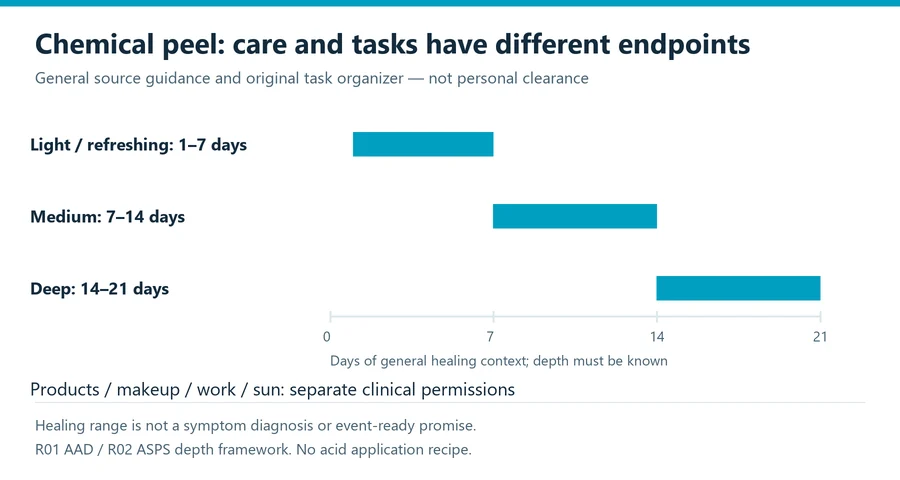
Chemical peel recovery depends on the actual depth of treatment. AAD guidance gives general healing ranges of one to seven days for a light or refreshing peel, seven to fourteen days for a medium peel and fourteen to twenty-one days for a deep peel. Those are different procedures, not interchangeable downtime promises. Healing time also does not automatically determine makeup permission, work readiness or the resolution of every color change. Obtain instructions for the peel you actually received. AAD chemical peel recovery guidance
This resource concerns professionally supervised chemical peeling. It does not provide acid concentrations, application times, neutralization methods or a home treatment recipe. A branded peel name alone may not explain its depth or aftercare needs. Start with the treating clinician’s description and written instructions. The purpose here is practical planning: understanding the timetable’s endpoint, identifying care questions and knowing when a concerning change needs assessment.
What should a chemical peel recovery plan identify first?
Ask what type and depth of peel was performed, which areas were treated and whether anything else was included. Keep the treatment record if available. You do not need to interpret a chemical formula yourself, but another clinician assessing a concern should not have to infer the procedure from advertising. If the description is unclear, request clarification rather than assigning the peel to the shortest recovery category.
For chemical peel recovery at home, obtain instructions that name the approved care routine, products, sun precautions, makeup restrictions and contact route. Ask which actions you perform and whether any dressing or review needs clinical staff. This guide does not reproduce the detailed care regimen for a medium or deep peel. The relevant method should come from the clinician who knows the depth, area and circumstances of your treatment.
Separate your practical commitments into functional tasks, appearance preferences and product permissions. A work task may be possible while your appearance is still changing. An event you would prefer to avoid is a different issue from a product your clinician has restricted. Keeping these categories distinct makes consultation more useful. It prevents the word downtime from concealing several questions that may have different answers.
Before leaving, confirm how to contact the team about a problem and where to obtain urgent assessment outside office hours. Ask whether a routine message is suitable for a question or whether a call is required. If treatment occurred away from home, clarify local access to care. A next appointment is a plan for scheduled review, not a reason to delay attention to a current concerning change.
How do the chemical peel recovery ranges differ by depth?
ASPS organizes its recovery information into light, medium and deep peel categories. ASPS depth-specific recovery framework That distinction should be preserved when reading a timeline. Selecting the shortest number from a different category does not create an appropriate plan for your procedure. Ask the clinician which category describes the treatment and what individual factors affect the instructions.
| Chemical peel recovery category | AAD general healing range | Important limit on interpretation |
|---|---|---|
| Light or refreshing peel | One to seven days | A broad healing estimate, not permission for every product |
| Medium peel | Seven to fourteen days | Different care and follow-up needs from a light peel |
| Deep peel | Fourteen to twenty-one days | More substantial recuperation and clinician-directed care |
| Makeup, work and sun precautions | Separate questions | Must follow your actual depth and clinical instructions |
The companion chart displays the three guidance ranges on a days axis, with permissions outside the axis. It does not show the course of a patient, a probability of healing or comparative effectiveness. The empty space after a band is not a claim that every color change or symptom has resolved. A chart is useful when it helps identify the right conversation; it cannot examine your skin.
For chemical peel recovery scheduling, ask what a stated date actually means. Is it a general healing estimate, a follow-up visit, permission for a specific product or an appearance expectation? The answer matters when you are planning work or an event. If the term healed is used in a consultation, ask what actions it permits and what restrictions continue. Do not extend a narrow answer to a wider group of activities.
A photographed event or a work requirement for makeup should be raised before treatment. Tell the clinician what would happen if you could not attend or use the product as planned. A flexible meeting and a nonrefundable event create different administrative constraints. This is a practical scheduling discussion, not a recommendation for a universal buffer period or evidence that everyone will look ready by a certain day.
What should be asked about skin care and products?
Bring the names of your usual cleanser, moisturizer, sunscreen, makeup and prescribed topical products. Ask which are permitted, which should wait and how their return will be decided. Listing those categories here is not an instruction to apply them immediately. A product-specific answer is more useful than a vague instruction to use something gentle, especially when the care routine is intended for a particular depth.
Keep a permission list rather than improvising a new routine
For each item, record the team’s answer and any unresolved question. If a recommended product is unavailable, ask for an approved alternative. Do not substitute a stronger exfoliant or a trending serum because its label promises renewal or repair. Chemical peel recovery instructions should not be expanded into an additional treatment without assessment. A product being natural or familiar does not establish compatibility with recently treated skin.
AAD advises following the dermatologist’s care instructions and avoiding scratching or picking treated skin. It directs people to contact the dermatologist if the skin burns, itches or swells. AAD care and contact advice This guide offers no home method for deciding which amount of peeling is ideal. More visible shedding should not be treated as proof of a better result or a reason to add another peel.
If a product seems to cause a problem, tell the clinician what it was, when you used it and what changed. Keep the packaging or ingredient list available if requested. Do not repeatedly apply it to test your tolerance or combine it with another product to counteract the effect. The clinician needs to assess the actual concern; this article cannot determine whether the cause is the procedure, a product or another condition.
Discuss any dressing or prescribed medicine as part of the same plan. Ask who handles a care item and where it will be reviewed. Do not remove a dressing or alter medicine because a general healing interval has elapsed. A prescription and a skin-care permission are specific instructions, not interchangeable suggestions from a product guide. If you cannot follow them, contact the team for a workable alternative.
How should sun exposure and outdoor responsibilities be planned?
For chemical peel recovery, ask the clinician to describe the sun precautions for your exact treatment. A light peel, medium peel and deep peel should not share an assumed outdoor schedule. Explain whether you work outside, commute on foot, supervise outdoor activities or have travel planned. The practical plan needs to address those circumstances rather than reduce the question to whether you own sunscreen.
Ask which protective measures and products are permitted, how long the advice applies and what to do if your work cannot follow it. This resource does not prescribe a sunscreen application schedule for newly treated skin or a method of covering a surgical dressing. If workplace equipment contacts the treated area, describe that too. Occupational requirements and clinical instructions both need to be understood before deciding how a task will be arranged.
An outdoor event is a different administrative commitment from a brief essential trip. Tell the clinician its duration and conditions and obtain advice relevant to the actual activity. Do not interpret a healing-range endpoint as automatic permission for extended exposure. Equally, avoid inventing a universal ban from another patient’s story. The clinician should provide the restriction; the organizer helps make its practical consequences visible.
During chemical peel recovery, a travel booking should not become the reason to change care instructions. Ask how you would obtain assessment away from the treating facility and how records would be shared. If sun exposure or access to follow-up conflicts with the plan, clarify the issue before committing. No universal fit-to-travel date is established here, and a broad days-scale chart cannot account for every destination or treatment depth.
Keep protection questions separate from appearance judgments. A color change may affect how you feel about being seen, but your preference does not determine the appropriate clinical precautions. Record the team’s advice even when the skin looks less affected than you expected. Conversely, a change that concerns you should be reported rather than dismissed merely because you are still observing the prescribed precautions.
How can work, makeup and social plans be discussed?
Work planning for chemical peel recovery should describe the environment and tasks. Indoors at a desk, outdoors, near heat or in a role requiring face products are different situations. Ask which features matter for your aftercare and whether duties need temporary adjustment. A generic return-to-work statement cannot establish that every condition of your actual job is compatible with the instructions.
If makeup is a work requirement, ask about the exact product and the depth-specific permission rather than assuming camouflage is always allowed. This guide does not give a universal makeup date. AAD’s guidance treats makeup separately within each peel category. AAD depth-specific permissions The treating clinician’s instructions should settle the actual product question, especially when another treatment was included.
For a workplace conversation, describe the temporary practical change you are requesting. It might involve an on-camera assignment, an outdoor duty or another requirement identified by your clinician. Whether it is possible depends on the role and employer. This resource does not establish leave rights or certify fitness for work. Ask what documentation is needed without turning an appearance preference into an unsupported medical restriction.
For chemical peel recovery social plans, decide which commitments can remain flexible. You may prefer to postpone a photographed event even if a task is permitted. That is a personal preference you can communicate directly. It should not create pressure to use a restricted product or accelerate peeling. The calendar can accommodate a change without assigning your skin a deadline it has not been clinically assessed against.
If a medium or deep procedure involves more substantial care arrangements, ask the team what support is required and who will provide it. A person available for errands may not be available for transport or urgent assessment. Make those responsibilities explicit before treatment. This is an organizational suggestion, not evidence that a specific helper schedule reduces downtime or predicts the outcome of a peel.
Why is a home acid routine a different question?
The FDA’s July 30, 2024 warning advises against purchasing or using certain chemical-peel skin products without appropriate professional supervision because of serious injury risk. It describes possible chemical burns, pain, swelling, infection, color change and scarring, sometimes requiring emergency or specialty care. FDA chemical-peel product warning This warning is not a professional-peel complication rate or a timetable for treating a burn yourself.
A recovery guide should not become an acid application guide. It does not tell you how to choose a concentration, layer a product, leave it on longer or neutralize it. If you used a product outside a professional plan and are concerned, obtain medical assessment and provide the product information. Do not use a light-peel range to assume the exposure was shallow or that a new symptom is ordinary peeling.
Keep product reporting separate from receiving care. The FDA warning identifies its adverse-event reporting route, but a report is not treatment. You should not wait to complete documentation before seeking assessment for a concerning injury. Saving the product record may help a clinician understand what happened; it should not become a barrier if urgent care is needed before you can collect every detail.
If you are considering another peel, ask your clinician when and whether it is appropriate. Do not repeat treatment to increase visible shedding or attempt to correct a concern before it has been assessed. A calendar interval used in a series for another person cannot establish suitability for your skin or current course. Subsequent treatment is a clinical decision separate from managing the recovery of the procedure already performed.
Which changes should prompt medical contact?
If a care instruction names a product category without identifying what you should use, ask for clarification. Record the answer and any later revision with the plan. This avoids treating several different recommendations as if they were the same instruction, particularly when a retail product suggestion differs from what your clinician intended.
Contact the treating dermatologist for burning, itching or swelling that raises a concern; do not diagnose it from a recovery photograph. Follow the team’s instructions for assessment and tell them whether the issue is worsening. This guide cannot distinguish a temporary effect from an injury or infection. A published healing interval is not proof that every symptom within it is harmless.
For a severe or rapidly worsening problem, use appropriate urgent medical care, especially if the team directs you to do so or cannot be reached. If you have an emergency such as new difficulty breathing or collapse, call emergency services; in the United States, call 911. This is an emergency response instruction, not a claim that those symptoms are common effects of professionally performed peels.
When seeking advice, give the treatment date, area, depth if known, products used afterward and what changed. Ask whether an examination is required and where to obtain it. If the clinic requests an image, use an approved private method, without delaying an examination. Photographs differ in lighting, skin tone and treatment scope, so a public image comparison should not determine whether you seek care.
At follow-up, separate care permissions from the evaluation of benefits. Ask which products or tasks can resume, which restrictions continue and when another assessment is needed. Chemical peel recovery is easier to organize when those answers remain specific. The original chart is an editorial planning aid, not a validated way to speed healing or predict effectiveness. Keep unresolved questions visible rather than filling them with the shortest number available online.
For related procedure context, read chemical peels and the plastic surgery recovery guide.
Sources and review scope
Plastic Surgery Editorial Team. Source records checked through October 12, 2026. Review scope: source and editorial checks for general education. No individual clinical assessment is represented.
- AAD chemical peel FAQs. aad.org. Publication/update date not stated. Checked 2026-10-12.
- ASPS chemical peel recovery framework. plasticsurgery.org. Publication/update date not stated. Checked 2026-10-12.
- FDA chemical peel skin-product warning. fda.gov. Source date: 2024-07-30. Checked 2026-10-12.