
Chemical peel cost depends on the actual treatment, setting, assessment and care included in the quote. A lower appointment price can become the same complete planning amount once required follow-up and prescribed care are counted. Keep optional retail purchases in a separate column. They should not quietly become part of the supposed medical minimum, and necessary care should not disappear merely to make a package look inexpensive.
The useful comparison is a written, clinically appropriate plan with clear inclusions. This guide uses an original hypothetical worksheet to distinguish treatment charges, specified care, personal logistics and an optional purchase. Its dollar amounts are invented arithmetic inputs, not observed practice prices. It does not tell you which peel to choose or which products to apply. Those decisions belong to the clinician assessing your skin.
What does the published chemical peel cost figure actually measure?
The ASPS cost page, checked October 12, 2026, displays $1,829 for skin resurfacing procedures such as chemical peels. That wording describes a broader resurfacing category. It does not establish a peel-only national average, a complete bill for your appointment or a price for each depth. The underlying fee year is not identified here, so the check date must not be presented as the year in which those fees were collected.
Use that figure as limited category context. Do not divide it by an assumed number of sessions, assign it to a named acid or claim that a local quote above it is excessive. A broad average cannot settle whether the written scope is suitable or whether two offices are quoting the same service. The price you can meaningfully plan around is the actual assessed plan and its stated related charges.
ASPS lists possible related expenses including anesthesia where applicable, prescriptions and facility charges. Those categories are questions to resolve, not automatic additions to every appointment. An office-based superficial peel and a different procedure requiring a surgical setting should not be forced into one assumed bill. Record whether each relevant item is included, separately priced, unnecessary for this plan or still unknown. A zero entered without confirmation creates false certainty.
Why depth and supervision change the chemical peel cost question
The American Academy of Dermatology’s peel guidance distinguishes preparation, aftercare and follow-up across different depths. Some people need a pre-peel care plan, and deeper treatments may require more involved settings and follow-up. These distinctions explain why the word “peel” alone is insufficient on a quote. They do not create a universal schedule or a standard recovery bill for every patient.
Ask the clinician to identify the planned treatment and setting before accepting a package description. A sales label such as premium, medical or advanced does not tell you which care obligations follow. The worksheet should contain a plain description that both you and the clinical team understand. You do not need to translate that description into a do-it-yourself formula, exposure time or concentration. The purpose is financial clarity around professionally determined care.
The FDA warning dated July 30, 2024 cautions against purchasing or using certain peel products without appropriate professional supervision because serious injuries can occur. The warning also says the agency has not approved chemical peel products. A cheap bottle sold online is therefore not an equivalent price comparator for an assessed professional service. This guide does not propose home peeling as a savings strategy.
Which chemical peel cost lines are necessary, conditional or optional?
Start with the agreed clinical plan, then ask the team to classify each proposed purchase. “Necessary for this plan” means the clinician has specified it for you. “Conditional” means a charge depends on a documented event or later decision. “Optional retail” means declining that particular purchase does not remove required care under the agreed instructions. These are worksheet categories, not permission to ignore clinical advice.
For example, a recommended aftercare item can be financially different from an additional branded skin-care collection offered at checkout. Do not decide that two products are interchangeable because their labels sound similar. Ask whether the exact product is required, whether any alternatives are acceptable and who can approve a substitution. Until that answer is clear, keep the care obligation in the required column and record its unresolved price rather than deleting it.
| Quote line | What to establish | How to record it |
|---|---|---|
| Assessed professional service | Exact planned treatment and setting | Included price or separate charge |
| Clinician-specified care | Required items, instructions and approved options | Known amount or unresolved amount |
| Review or follow-up | Which visits are included and their limits | Included once or separately priced |
| Optional retail collection | Whether purchase is optional without changing the care plan | Separate elective spending column |
| Transport and other logistics | Your actual needs rather than a universal allowance | Personal planning amount |
Do not use this table to bargain away monitoring or to substitute an unsuitable treatment. It helps expose whether a small advertised number represents only one piece of the actual commitment. A clearly explained quote may reasonably cost more because its scope differs. Conversely, a larger package number may include items you had incorrectly planned to buy twice. The answer comes from written inclusions, not from the appearance of the total.
Original chemical peel cost worksheet: two headlines, one core total
Consider two hypothetical quotes for the same already assessed service and specified care. Scenario A lists a $450 service, $75 of specified care and a $50 review. Scenario B lists a $500 service with that same review included and $75 of specified care. Add the same $30 personal transport allowance to both. Their complete known planning amounts are identical at $605. The $450 headline alone makes A appear $50 cheaper, but its separately billed review closes that gap.
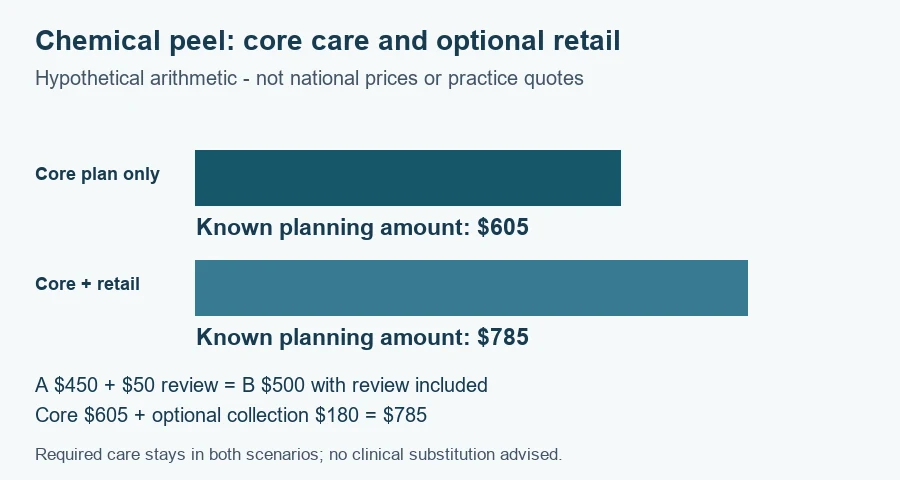
Now suppose B also offers an optional $180 retail collection. If it is genuinely optional and the clinician confirms that declining it leaves the specified care plan intact, the core $605 comparison still stands. Choosing the collection increases B’s personal spending to $785. That difference belongs to the optional purchase, not to a finding that B’s clinical service suddenly costs more for the same defined scope. Neither amount is a market estimate.
| Hypothetical input | Scenario A | Scenario B core plan |
|---|---|---|
| Assessed service | $450 | $500 including review |
| Specified care | $75 | $75 |
| Separate review | $50 | $0, already included |
| Personal transport | $30 | $30 |
| Known core planning amount | $605 | $605 |
| Optional retail collection | Not selected | $180 if selected |
| B including optional retail | Not applicable | $785 |
The calculation is simple: A equals $450 plus $75 plus $50 plus $30. B’s core equals $500 plus $75 plus $30. B with the elective collection equals $605 plus $180. Keep the included review at zero in B’s separate-review row because its charge is already inside the $500 service. Adding another $50 would count the same obligation twice and distort the comparison.
The optional purchase represents about 29.75% of the $605 core planning amount. It represents about 22.93% of the resulting $785 spending amount. Both percentages are mathematically correct, but their denominators differ. A claim that the collection is “about a quarter of the cost” hides that distinction. Write the dollars first and name the denominator if a percentage helps explain the choice. An optional collection does not become clinically necessary because it occupies a large share of spending.
How to use the chemical peel cost worksheet without changing clinical scope
Replace each input with an actual written charge only after the clinician defines the plan. If review is not needed in your particular plan, mark that as confirmed rather than borrowing the example’s $50. If a different follow-up is required, record its actual inclusion or price. The example is a method for reconciling charges; it is not a template for selecting the lightest procedure or minimizing care.
Ask the office to explain whether “included follow-up” has a time boundary, covers routine review only or includes specified additional services. Do not assume an included review means every future treatment or complication expense is covered. Equally, do not invent an emergency allowance and call it an expected expense. Record the available terms, the person who explained them and which questions remain unanswered. Unknown liability should remain visible instead of becoming a fabricated precise total.
If a retail purchase is bundled into a nonnegotiable package, the quoted package price is the price being offered. You can still identify what it includes, but you cannot assume the office will subtract the product’s shelf price. Ask whether a clinically appropriate service-only option exists. A refusal to unbundle does not prove that the products are required for your skin, and an unbundled alternative does not prove equivalent clinical care.
Does buying a series lower chemical peel cost?
A series price is meaningful only when the clinician has explained why a series is appropriate and what the package covers. A single appointment should not be compared with an assumed full course simply by multiplying a sales brochure’s session count. The AAD guidance discusses repeat treatments in particular contexts, but that is not a promise that every reader needs the same number. Your plan may change after reassessment.
If a series is proposed, obtain the number of paid appointments, assessment arrangements, included care and policy for unused appointments. Ask what happens if the clinician pauses or changes the plan. Record whether an unused balance is refundable, transferable, expires or becomes a credit under the actual contract. Do not purchase more treatment than clinically appropriate merely to achieve a lower arithmetic rate per appointment. A discount on unused care is not realized value.
Keep shared items separate from repeated items. An initial assessment might occur once, while a prescribed item may need replenishment according to actual instructions. Transport depends on attended appointments, not on the package’s advertised size. Count a shared item once unless the office confirms a repeat charge. This prevents a series worksheet from overstating savings by comparing one package with an artificially inflated pay-as-you-go alternative.
What should a written chemical peel cost estimate include?
Ask for a dated estimate identifying the assessed service, relevant setting, known care obligations, review arrangements and any optional retail purchases. A useful document states whether tax, where applicable, is already included rather than leaving a checkout surprise. Ask the seller for the actual applicable treatment of each line; this guide does not supply a jurisdiction-specific tax rule. Keep the estimate’s expiry and change policy alongside its amount.
| Question for the office | Why the answer matters | Worksheet consequence |
|---|---|---|
| Is this the clinician-assessed treatment? | A generic package may differ from your plan | Confirm scope before comparing |
| Is the listed review included? | Prevents missing or duplicate charges | Add it once |
| Which care purchases are required? | Separates clinical obligations from retail offers | Keep necessary care visible |
| Can optional products be declined? | Clarifies the actual offered package | Record core and elective spending separately |
| What happens if treatment is postponed? | Advance payment may have conditions | Save actual refund and credit terms |
When two quotes differ, send a short reconciliation request rather than asking which is cheaper in the abstract. For example: “Please confirm whether the listed service includes the review, which care products are required for this plan, and whether the $180 collection is optional.” The answer may reveal that both totals cover the same core obligation. It may instead reveal different scopes that require clinical discussion before any arithmetic comparison is appropriate.
How do you reconcile chemical peel cost with the checkout receipt?
Before paying, match the estimate’s service description to the appointment actually authorized by the clinician. If the plan changed, ask for an updated estimate rather than carrying over the old total. Compare the service, required care and review lines separately. A receipt containing a new retail item does not establish that the item was part of the original clinical obligation. Ask staff to identify what was added and whether you agreed to that purchase.
Save the original estimate, revised estimate, written care instructions and receipt together. This creates a useful record if a later bill contains a separate review that appeared included. State the discrepancy precisely: the estimate included a review within the service charge, while the later invoice shows a second review charge. Ask whether the second line represents a distinct additional service or a billing correction. Do not assume an error merely because two descriptions use similar words.
For chemical peel cost planning, this reconciliation matters more than memorizing an average. It also prevents an optional collection from being mistaken for a necessary replenishment at the next appointment. If an item is genuinely required later, obtain its current instructions and price at that time. A previous retail purchase should not be treated as evidence that the same item is appropriate indefinitely. Keep the financial record aligned with the actual evolving clinical plan.
When should you postpone a chemical peel cost decision?
Pause the financial comparison when the proposed treatment, supervision or required care is unclear. An expiring promotion is not a substitute for an assessment. If an offer invites you to bypass professional supervision or supplies instructions for an unassessed home peel, the FDA warning is directly relevant. Do not treat the price difference as a budget opportunity. The relevant question is whether the service is appropriate and safely supervised.
Also pause when declining an “optional” product appears to remove access to necessary advice or when staff cannot explain the difference between required care and a retail package. Ask for clinical clarification from the appropriate professional. The worksheet can expose an ambiguity but cannot resolve whether your skin needs a particular product or procedure. Avoid interpreting commercial terminology as medical clearance.
For the broader procedure context, see the chemical peel guide. Keep this cost page focused on quote scope rather than using a low price as evidence of treatment suitability. A careful decision can be to wait, seek clarification or decline treatment. No financial model requires that you proceed once you have paid for an assessment.
Frequently asked chemical peel cost questions
Is $1,829 the national price of a chemical peel?
No. The checked ASPS page describes a broader skin resurfacing category and does not establish a complete peel-specific price. Its underlying fee year is unknown here. Use it as limited context, then obtain an assessed written estimate. Do not label a current website check as a dated national survey or convert the number into a per-session promise.
Can a $450 offer cost the same as a $500 offer?
Yes, under the explicit hypothetical example: the $450 service adds a $50 review that the $500 service already includes. Identical specified care and transport then produce $605 for each. This conclusion depends on confirmed identical scope. It does not establish that differently described real treatments are equivalent or that the lower headline is misleading.
Should I remove every optional item from my budget?
You can distinguish elective purchases from the core obligation without declaring them worthless. Decide separately whether you want them and whether they are suitable. Never remove clinician-required care by relabeling it optional yourself. The point is to know what your choice changes: in the example, adding the collection changes spending by $180 while leaving the documented core service unchanged.
What is the most useful next step?
Request a reconciled estimate that clearly names the assessed service, included review, specified care and elective purchases. Enter confirmed amounts once, preserve unknowns and keep the actual supervision and care plan central. That gives chemical peel cost a concrete meaning for your proposed appointment without confusing a broad average, an advertised session or a retail checkout with a complete personal plan.
Sources and review scope
Plastic Surgery Editorial Team. Source records checked through October 12, 2026. Review scope: source and editorial checks for general education. No individual clinical assessment is represented.
- ASPS broad resurfacing fee scope. American Society of Plastic Surgeons. Publication/update date not stated. Checked 2026-10-12.
- AAD peel preparation and care distinctions. American Academy of Dermatology. Publication/update date not stated. Checked 2026-10-12.
- FDA chemical peel professional-supervision warning. US Food and Drug Administration. Source date: 2024-07-30. Checked 2026-10-12.