
Canthoplasty is surgery involving the corner of the eyelids and their support or position. It can appear in a reconstructive plan for an eyelid problem or an appearance-focused plan, often alongside other eyelid work. Those situations are not interchangeable. Before choosing it, identify the examined problem, the proposed change and how the team will assess both eyelid function and appearance. A fashionable eye-shape label or a photograph cannot establish which operation is appropriate.
This guide focuses on understanding a proposed canthoplasty rather than selecting a surgical technique. The outer and inner corners are different locations, and an operative plan should specify the site and purpose. A published lateral canthoplasty series included both reconstructive and cosmetic cases, illustrating the breadth of the term. Ask what it means in your particular proposal instead of treating every online use of the name as the same operation. Original lateral canthoplasty clinical series
Start with position, symptoms and preference separately
Make three short records before the consultation. Describe the position or shape that concerns you, the symptoms you experience and the appearance change you prefer. These records may overlap, but each supplies different information. A person troubled by a lid turning away from the eye has a different question from someone who wants a change in the outer corner’s appearance without symptoms. The examination needs to establish what is actually present.
The NHS describes ectropion as a lower eyelid turning outward and away from the eye. Symptoms can include irritation, watering, dryness and difficulty closing the eye. These are reasons to seek assessment rather than diagnose a canthal problem from a selfie. A complaint about eye shape should not obscure a symptom that deserves its own clinical evaluation. NHS explanation of ectropion
Describe when a symptom occurs and how it affects daily activities. Mention reading, screen use, outdoor exposure or other situations where you notice the problem, without assigning a cause yourself. Tell the clinician about previous eyelid surgery, injuries and eye treatment. If a symptom and an appearance concern began at different times, preserve that distinction. It can help the clinician understand the history you are asking them to assess.
Clarify the operation instead of relying on a shape label
Ask the surgeon to name the proposed procedures in plain language and identify the location of each. Is the plan intended to restore lid position, add support during another operation, change the corner’s appearance or address several findings? If more than one goal is proposed, request an explanation of which component addresses which goal. This is a more useful comparison than choosing a procedure because its name sounds more powerful.
Canthoplasty, canthopexy, blepharoplasty and other eyelid procedures should not be treated as interchangeable labels. The NHS defines blepharoplasty as eyelid surgery involving excess skin or fat and notes that lower-lid support may be part of a plan. Ask the surgeon how a support or corner procedure differs from the skin or fat work being offered. A list of names alone does not show whether the combined plan matches the examination. NHS eyelid-surgery scope
Avoid turning a stylistic phrase into a medical endpoint. Descriptions such as lifted, elongated or more symmetrical can mean different things to different people. Identify what you would like preserved as well as changed. Ask the clinician to explain the expected limits and whether a particular request creates a concern about lid function. An appearance choice remains a preference, not a requirement to conform to an ideal eye shape.
| Question to separate | Record to discuss | Assumption to avoid |
|---|---|---|
| What feels wrong? | Symptoms and the situations in which they occur | A symptom proves one specific anatomical cause |
| What looks different? | Location, timing and unfiltered photographs | A photograph establishes a diagnosis |
| What do you want changed? | Specific preference and preservation list | A fashion label identifies an operation |
| What did the examination find? | Clinician’s explanation of lid position and function | Every named procedure is necessary |
| What is proposed? | Components, purpose and limitations | Corner work and skin or fat work are equivalent |
An eye assessment matters even in an appearance consultation
Ask how the clinician will assess the eyelid and eye before deciding on a plan. Explain existing dryness, watering, irritation, trouble closing the eye or previous eye treatment. If a separate eye assessment is suggested, clarify the question it is intended to answer. Do not interpret that step as merely an administrative delay; it can clarify the problem the operation is supposed to address.
Bring the relevant history rather than relying on a general statement that you have already had eye surgery. When available, provide the previous operative report, its date and the concerns that remain. A prior photograph can show an earlier appearance, but it cannot identify every component of the operation. If records are unavailable, say so rather than guessing what was done from a scar or an online description.
Discuss who will evaluate a new concern after surgery. The person arranging appointments, the clinician performing the operation and the service providing urgent eye assessment may have different roles. Get a clear contact plan before the procedure. An appearance goal should not replace an explanation of eyelid function or eye-safety concerns. A satisfactory consultation makes those responsibilities understandable rather than assuming that a before-and-after photo covers them.
Read the historical series by what was actually counted
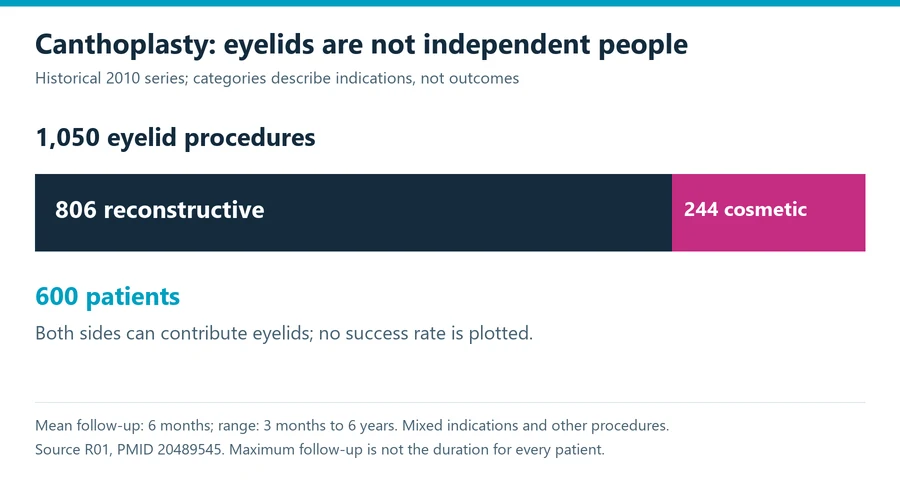
The 2010 lateral canthoplasty report retrospectively reviewed 600 patients and 1,050 eyelids. It classified 806 eyelid procedures as reconstructive and 244 as cosmetic. Minimum follow-up was three months, mean follow-up six months and maximum follow-up six years. Those are different summaries; the maximum is not everyone’s observation period. The single-surgeon series included varied indications and other procedures, so it cannot supply a universal cosmetic success prediction. Original 600-patient, 1,050-eyelid report
People and eyelids are different denominators
Our supporting graphic displays the reported indication categories in eyelids and states the separate patient count. It does not label those categories as good and bad outcomes. A person can contribute more than one eyelid, and the number of eyelids is not the number of independent people. Keeping that distinction visible prevents a large procedure count from being mistaken for a larger participant population.
Before interpreting an outcome percentage, identify its counted unit. Does it concern people, eyelids, operations or questionnaire responses? Ask whether both sides were treated, whether repeat procedures are included and what follow-up interval applies. You do not need to perform a statistical analysis to recognize that unlike denominators should not be merged. A transparent description is more useful than a precise percentage that conceals what was actually counted.
Keep a separate note for the side involved in your own assessment. A clinician may describe different findings or propose different work on the right and left, even when the appearance preference is symmetry. Record those explanations rather than assuming the two plans must be identical. At later visits, distinguish which side has a symptom, which has an appearance concern and which was treated. That record does not diagnose the cause, but it prevents a general statement about both eyes from obscuring a specific unresolved question. It also makes an additional procedure easier to discuss without confusing the original operative scope with subsequent treatment.
| Research detail | Accurate reading | Misreading to avoid |
|---|---|---|
| 600 people and 1,050 eyelids | Different units in one clinical series | Calling all eyelids independent patients |
| 806 reconstructive and 244 cosmetic eyelid procedures | Indication categories within the reported total | Presenting the categories as success or failure |
| Mean six-month follow-up | A summary of observation duration | Everyone observed for six years |
| One-surgeon retrospective experience | Evidence about a selected course and setting | A randomized comparison of every technique |
| Multiple possible indications | The procedure serves different tasks | Every case sought the same cosmetic eye shape |
Use a newer comparison without importing the wrong task
An original multicenter retrospective study published online October 19, 2023, examined lateral tarsal strip operations for age-related ectropion or entropion. It reported 1,079 operations in 891 patients, with average follow-up of 1.785 years. Its comparison concerned suture materials in that setting. It was not a trial of cosmetic canthoplasty against another appearance procedure, and its findings should not be repackaged as a forecast for an unrelated eye-shape request. Original lateral tarsal strip comparative study
This illustrates why the study population and purpose belong beside any outcome number. An operation performed to correct a turning eyelid in an older population answers a different question from a procedure proposed for cosmetic change in an otherwise different patient. Technique details can also differ. A familiar word in the abstract is not enough to transfer all reported outcomes to the operation you are considering.
Ask whether the clinician’s explanation relies on a study, documented clinical experience or another source, and what limitations they see in applying it to you. Keep uncertainty explicit when no directly comparable evidence is available. An honest absence of a strong comparison is more informative than presenting a small selected series as proof of a universal winner.
Restore position and change appearance as separate endpoints
Cambridge University Hospitals explains that ectropion correction aims to restore the eyelid’s position and improve associated symptoms. Where skin tightness or scarring contributes, a graft or flap may be part of the plan. That institutional guidance concerns an examined eyelid condition; it does not establish that every cosmetic canthoplasty needs additional tissue or that corner tightening alone resolves every cause. CUH ectropion-correction guidance
If additional tissue or another component is proposed, ask what finding supports it and what its separate implications are. Include any donor-site discussion in the consent and estimate. If the proposal is to correct a problem from previous surgery, ask how the original problem is being described and what the current operation can reasonably address. A revision plan should be grounded in the examined finding rather than the assumption that a second operation reverses every effect of the first.
At follow-up, keep symptom relief, lid position, scar appearance and preferred eye shape separate. You may value each differently. Combining them into a single satisfied-or-unsatisfied answer can obscure an unresolved concern. A useful outcome record states what was assessed, what changed and what remains uncertain, instead of allowing an attractive photograph to stand in for every functional result.
Compare photographs without creating a false outcome
For a fair appearance record, use unfiltered photographs with comparable view, expression and lighting. Note whether the image was taken before surgery, during early healing or at a later assessment. If the views differ, acknowledge that limitation. A change in pose or expression can make a comparison harder to interpret, and a photograph does not establish the condition of the ocular surface.
Ask what a digital simulation is intended to communicate. It may illustrate a preference but is not an observed postoperative result or a promise about symmetry. Discuss which changes it cannot reliably represent and how the proposed operation relates to the image. Keep the surgeon’s explanation of function and risk visible alongside the appearance discussion.
Do not request an outcome because it matches another person’s eyes without discussing differences in your own examined situation. A documented work example should identify the actual procedure and interval, with permission for its use. An anonymous online image or an invented patient story cannot supply that evidence. Your preference can be clear while the expected result remains uncertain.
Discuss complications without borrowing an unrelated rate
The NHS eyelid-surgery guidance lists risks involving asymmetry, scars, lower-lid malposition and vision, alongside general surgical risks. Those categories deserve discussion when eyelid operations are proposed. They do not provide a personal probability for a particular canthoplasty technique or combined plan. Ask which risks the clinician considers relevant in your case and how the team would assess and manage them. NHS eyelid-surgery risks
Make the distinction between routine recovery and a concern requiring prompt help concrete. The NHS ectropion page identifies eye pain and changes in vision among symptoms requiring urgent assessment. Obtain the specific postoperative emergency arrangements from your team before surgery. A routine photo message or the next planned appointment should not be the only route when those instructions call for urgent care. NHS eye-symptom assessment guidance
Do not add percentages from different papers into an invented overall risk. Events may overlap, definitions can differ and some reports count eyelids while others count people or operations. Similarly, an absence of a reported event in a small series does not prove that it cannot occur. Ask for an explanation of the evidence and its relevance, not just a reassuring number with no denominator or observation period.
Plan care and activities around the actual operation
Request written instructions for the specific procedures being performed. Clarify medication coordination, transport, assistance if needed and follow-up arrangements. Tell the team what your work, contact-lens use, exercise and other activities involve, so the instructions can address those tasks. General institutional leaflets offer context but should not replace the individualized plan supplied for your own operation.
Do not stop a prescribed medication or change an eye treatment because someone else’s postoperative routine differs. CUH’s leaflet explicitly places blood-thinning medication decisions with the surgeon. Bring an accurate medication list and ask which clinician coordinates any change. This keeps practical preparation connected to the actual treatment history rather than turning an online account into a prescription. CUH medication coordination
Separate visible recovery from the assessment of function and appearance. Permission to return to a particular activity does not establish that the healed result can be judged at that moment. Ask what each scheduled visit is meant to assess and when to raise a persistent concern. Keep the care team’s explanation in your record instead of using a calendar alone to decide that an operation succeeded or failed.
Compare complete proposals and complete costs
Obtain a quote for the named operation and any combined work. Ask whether anesthesia, facility fees, visits, prescribed care and possible additional components are included. If both sides are being treated, make that explicit. If a corrective procedure and an elective appearance change are combined, ask how each is described for payment purposes rather than assuming that one procedure name settles coverage.
| Proposal detail | Written clarification | Why it matters |
|---|---|---|
| Side and location | Inner or outer corner; one or both sides | The scope must match the examination |
| Combined work | Support, skin, fat or additional tissue components | A price may cover a different operative plan |
| Operating expenses | Anesthesia and facility charges | A surgeon fee may be only part of the total |
| Follow-up | Included visits and contact arrangements | Care access is part of the practical commitment |
| Further treatment | Assessment and charges for complications or elective revision | Later work should not be assumed free or guaranteed |
Compare like with like before choosing the lower total. Clarify whether a second-stage procedure is definitely included, optional or separately charged. A financing arrangement requires its own terms and does not resolve the uncertainty of the result. The plastic surgery cost guide can help organize those questions without inventing a national canthoplasty price.
Decide from the examined task, not the procedure’s reputation
Leave the consultation able to explain the finding, the purpose of the corner or support work and how it relates to any other eyelid procedure. You should understand both the appearance preference and the function discussion, along with the main uncertainties and care arrangements. If a proposal rests on a fashionable label without that explanation, request a clearer account before making a decision.
The blepharoplasty guide covers the broader eyelid appearance decision, while the procedure library helps organize related topics. Canthoplasty should remain specific to the actual eyelid problem and proposed change. Its usefulness in one reconstructive series is not a guarantee that every person seeking a different eye shape will obtain the same benefit.
Sources and review scope
Plastic Surgery Editorial Team. Source records checked through October 12, 2026. Review scope: source and editorial checks for general education. No individual clinical assessment is represented.
- Original aesthetic lateral canthoplasty series. pubmed.ncbi.nlm.nih.gov. Source date: 2010-05. Checked 2026-10-12.
- NHS ectropion and eye-symptom assessment. nhs.uk. Source date: 2025-07-17. Checked 2026-10-12.
- NHS eyelid-surgery scope and risks. nhs.uk. Source date: 2023-09-15. Checked 2026-10-12.
- Original lateral tarsal strip suture comparison. pubmed.ncbi.nlm.nih.gov. Source date: 2023-10-19. Checked 2026-10-12.
- CUH ectropion correction and medication coordination. cuh.nhs.uk. Source date: 2025-12-01. Checked 2026-10-12.