
Canthopexy is an eyelid-support procedure whose value depends on the problem being assessed and the exact operation proposed. A request for a different outer-eye appearance is not the same task as evaluating a lower eyelid that needs support. Before agreeing to treatment, ask the clinician to distinguish the intended lid-position change from the intended appearance change and explain how eye comfort and closure will be assessed. Support, eye comfort and appearance are separate endpoints. A plan should address all three rather than treating a photograph of a preferred eye shape as a complete medical assessment.
An original suspension-suture report discusses canthopexy for selected mild to moderate outward turning of the lower eyelid, including after other procedures. It is a report of a particular method, not proof that every operation carrying this name suits every eyelid. Original canthopexy report
This guide helps you interpret a proposed operation, organize the questions that distinguish its purpose and read the evidence without turning a combined eyelid-surgery study into your personal risk calculation. It does not provide surgical instructions or determine whether your eyes need treatment.
Start with the eyelid problem, not a fashionable label
Write down what prompted the appointment in ordinary language. You might be concerned about the position of the lower lid, persistent symptoms, a change following previous surgery or an appearance preference. Keep these descriptions separate even if they seem related. A clinician can then explain whether the same intervention addresses them or whether different assessments are needed. Calling every concern an outer-corner problem can hide the question that matters most to you.
Describe whether the concern involves one side or both, whether it is new or longstanding and whether there is a previous eye or facial operation. Bring the available treatment records rather than relying on a remembered procedure name. If symptoms change across the day, record that observation in words. These details are a history for examination; they do not establish the diagnosis or prove that a support procedure is the answer.
A photograph can communicate an appearance preference, but it cannot replace assessment of symptoms or eye function. Use a natural, unfiltered photograph to explain what you notice and ask what it cannot show. Avoid treating an edited corner angle as a specification that an operation must reproduce. The written goal should remain understandable without a beauty filter or a comparison with another person’s face.
| Starting concern | Clarification to request | Unhelpful shortcut |
|---|---|---|
| Lower-lid position | What is the assessed problem and proposed support goal? | Naming an operation before examination |
| Eye comfort or symptoms | What assessment is needed separately from appearance? | Assuming a cosmetic image measures comfort |
| Outer-eye appearance | What change is feasible and what function must be preserved? | Using a filtered angle as a guarantee |
| Change after previous surgery | How do prior records affect this plan? | Applying primary-surgery study rates unchanged |
Understand the name without using it as a surgical recipe
Canthopexy and canthoplasty appear together in eyelid-support literature, but a name alone does not tell you the complete work planned. Ask for the proposed procedure in plain language and whether it is being done alone or as part of lower eyelid surgery. If the surgeon uses a broader term such as lateral support, request the specific components. That answer belongs in the written plan and consent discussion.
The distinction matters when you compare consultations. One quote may describe an adjunct to another operation, while another describes treatment of an existing eyelid problem. Those proposals are not necessarily competing versions of the same service. Comparing the words or the price without comparing the indication and components can make a larger difference disappear.
You do not need instructions about sutures, cuts or tension to make an informed decision. You do need an explanation of the goal, what else is being changed and the consequences the clinician considers relevant to your eyes. Ask how the selected approach relates to the assessed problem and why a different approach is not preferred. A clear answer can acknowledge uncertainty instead of implying that a branded technique settles it.
If the explanation emphasizes preservation of a natural appearance, request a definition of that outcome. Does it refer to your own baseline, a measured lid position or your stated preference? A general phrase is not an agreement about every possible change. Record what would count as an acceptable result and what would require discussion, without making an online self-assessment into a clinical endpoint.
Keep support, comfort and appearance on separate lines
A useful planning sheet has separate spaces for the assessed support problem, current eye symptoms and appearance preferences. This makes it harder for a single pleasing photograph to stand in for every outcome. It also gives the clinician a chance to explain which concerns the operation is intended to address and which are outside its scope.
For support, ask what finding the proposed operation responds to and how it will be reassessed. For comfort, ask what symptoms need evaluation before elective treatment and what follow-up observations matter. For appearance, describe the preference in relation to your own face rather than asking for another person’s eyes. The exercise is a way to organize discussion, not a home diagnostic tool.
If the clinician expects one goal to involve a tradeoff with another, ask for that tradeoff explicitly. A plan that preserves one feature while changing another should not be summarized as a universal improvement. You can value a possible appearance change and still decide that an unresolved functional question needs attention first. That is a legitimate decision, not a failure to be enthusiastic about treatment.
| Endpoint | Useful discussion record | What does not establish it |
|---|---|---|
| Support or lid position | Assessed problem, proposed response and reassessment plan | Procedure name alone |
| Eye comfort and closure | Symptoms, clinician assessment and escalation instructions | A still photograph |
| Appearance | Your baseline, desired change and acceptable limits | Someone else’s edited image |
| Overall decision | Benefits, uncertainties and alternatives in your situation | A single study headline |
Combined eyelid surgery requires a component-level explanation
When canthopexy is proposed with blepharoplasty, ask the team to separate the purpose of each component. A plan may discuss skin, other eyelid tissues and support in the same appointment. The important question is whether you understand which concern each proposed change addresses. The procedure bundle should not make an optional cosmetic goal sound inseparable from every other aspect of care.
For context, the published blepharoplasty guide explains the broader eyelid-surgery decision. Use it to prepare questions, then return to the exact support proposal. A general guide cannot determine which combination is appropriate for your eyes. Neither can a diagram that shows regions without examining you.
Ask whether the evidence being discussed concerns isolated support or the complete combined operation. If a study reports events after several components, it does not identify which component caused or prevented an event simply because its name appears in the title. The same caution applies to a photograph attributed to one part of a larger procedure. The explanation should preserve the complete course of treatment.
For a proposed revision, request special care in choosing comparisons. A primary-operation study may exclude people with prior eyelid procedures. Its results then describe a different population, even if some names overlap with the proposed revision. Previous records, current findings and the clinician’s explanation of uncertainty are more useful than pretending that matching terminology makes the populations interchangeable.
Read the published evidence without losing its boundaries
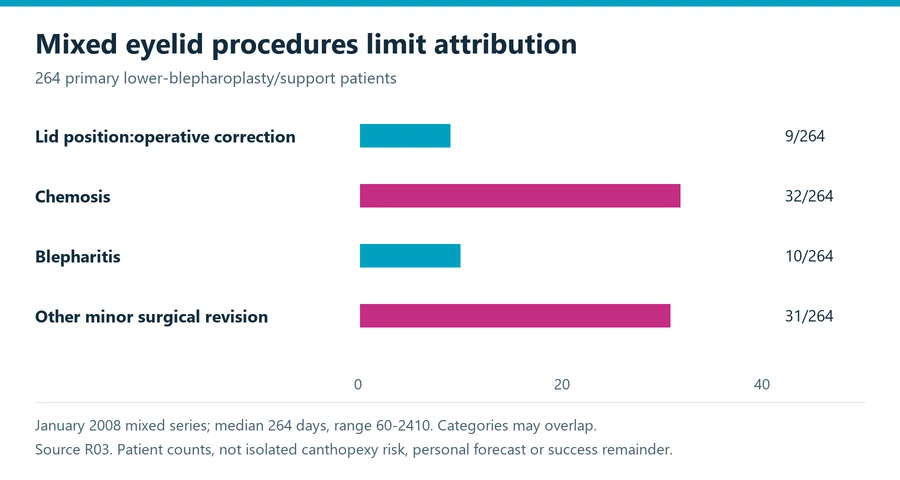
A January 2008 retrospective report reviewed 264 primary lower transcutaneous blepharoplasty patients receiving mixed lateral support. Prior eyelid surgery or midface lift was excluded. The support category included canthopexy, canthoplasty and orbicularis suspension. Median follow-up was 264 days, with a range of 60 to 2,410 days. The report recorded nine patients needing operative correction of lid malposition, 32 with chemosis, ten with blepharitis and 31 with other minor surgical revisions. These are separate reported categories, not an additive total. Original mixed lower-eyelid series
Operation period is not follow-up
The study describes a ten-year review period, but that does not mean every participant was followed for ten years. Its actual follow-up distribution is the relevant information. The distinction prevents a title from becoming a durability promise. It also illustrates why a summary should retain the population, components, endpoint and observation period next to a result.
The proposed supporting chart uses separate event-count bars on one patient-count scale. It does not stack the bars, subtract them from the sample to create a success rate or label them as the risk of canthopexy alone. That design preserves what was observed while refusing a stronger claim the study cannot support. A large sample does not remove the need to know what operation and patients it actually represents.
The December 2009 method report describes experience with “dozens” of patients, but its abstract does not provide an exact denominator or follow-up distribution. It therefore cannot supply a precise probability for your decision. An author’s favorable description of a selected method is also not a universal promise about eye shape, complications or the suitability of other techniques.
| Evidence question | Mixed primary series | Suspension-method report |
|---|---|---|
| Exact abstract sample | 264 patients | No exact denominator |
| Operation scope | Lower blepharoplasty with mixed support | Particular selected support method |
| Follow-up reported | Median 264 days; range 60–2,410 | Not specified in abstract |
| Appropriate use | Understand scoped observations and limitations | Understand a reported indication and method context |
| Unsupported conclusion | Isolated canthopexy risk or ten-year guarantee | Precise risk or universal unchanged shape |
Discuss risks before deciding on an appearance change
ASPS lists closure difficulty, dry eyes, outward lower-lid turning, revision and temporary or permanent vision changes among possible eyelid-surgery risks. Its guidance is broader than isolated canthopexy and does not provide a personal probability for this procedure. These categories should prompt an individualized explanation of the proposed operation rather than an assumption that support eliminates every eyelid-surgery risk. ASPS eyelid-surgery risk guidance
Ask how the team discusses existing symptoms, closure concerns and previous treatment in relation to those risks. The response should distinguish what has been assessed from what remains uncertain. You can ask for further evaluation before making an elective decision if the explanation leaves an important question unanswered. A reassuring phrase should not replace the specific issue that worried you.
Request the written contact plan for problems after treatment. Know who receives a call, what happens outside usual office hours and where you should seek assessment if the team cannot be reached. The plan should describe escalation, not encourage you to wait for an online photograph to be judged. Keep the contact information accessible to the person helping you after a procedure.
Do not practice pulling, stretching or testing your eyelids to decide whether you need support. This guide cannot translate a home maneuver into a diagnosis or select an operation. A clinician’s examination is different from following a social-media demonstration. Likewise, do not improvise eye drops, massage or scar treatment from another person’s account; ask for instructions appropriate to your own care.
Urgent eye symptoms are not a cosmetic planning task
NHS guidance advises urgent assessment for symptoms including a suddenly drooping eyelid, inability to open the eye, pain within the eye, sensitivity to light or changes in eyesight. It also warns against self-diagnosing eyelid problems. Seek urgent local medical or eye-care assessment for concerning symptoms, including after surgery; use emergency services where necessary. Do not postpone assessment while comparing cosmetic procedures or waiting for an online consultation. NHS eyelid symptom guidance
The NHS page was last reviewed on November 17, 2023. Its next review due date is not a completed new review. This distinction matters when checking whether a medical page is current. A scheduled date, website copyright year or today’s access date should not be presented as the publication date of a clinical recommendation.
Plan the practical course without inventing a recovery calendar
Ask for the recovery instructions associated with the actual operation, including any combined procedures. A generic day-by-day canthopexy calendar would conceal differences in scope and individual care. Instead, obtain the team’s plan for activity, work, follow-up, eye care and situations that need contact. Keep expected observations separate from warning signs that require assessment.
If your work depends on close visual tasks, describe those tasks directly. If you drive, care for someone else or have limited help at home, include that in the planning conversation. These are practical constraints, not reasons to set your own medical clearance date. Ask which decisions depend on examination or follow-up rather than assuming a friend’s schedule applies.
Organize photographs only as instructed by the treating team and with consistent context when they are requested. A difference in expression, light or camera angle can make an appearance comparison difficult to interpret. A photograph should accompany a description of symptoms and the date, not replace them. Avoid using a single flattering angle as evidence that every goal has been met.
For broader preparation, the plastic-surgery recovery planning guide offers a framework for arranging help and questions. It is supplementary planning information. Your actual eye-care instructions and clinical follow-up remain specific to your treatment.
Compare costs by scope and responsibility
No verified canthopexy-specific total-price dataset is supplied here. Ask for a written estimate identifying the support component, any other eyelid procedure, anesthesia or facility charges, follow-up and the handling of additional treatment. A low number without those boundaries is not a comparable total. Do not treat an unrelated blepharoplasty average as the price of isolated canthopexy.
If one estimate includes a combined procedure and another does not, reconcile that difference before comparing the amounts. Ask which components are proposed for the assessed problem and which address additional preferences. Also ask what the estimate says about evaluation of a later concern, rather than assuming an informal reassurance is a financial commitment.
Insurance questions need the same clarity. Request the applicable assessment and documentation process if functional treatment is being discussed; do not assume that using a support-related name creates coverage. Keep the insurer’s decision separate from whether treatment is clinically appropriate. The cost planning guide explains the distinction between a surgeon fee and the complete course of care.
Make the decision with a readable record
Ask the clinician to identify which measurements or observations will be compared at follow-up and which are simply appearance preferences. If a change is documented, its meaning should be interpreted in the context of the examination and complete procedure. A measurement without its baseline, method or timepoint can be as misleading as a photograph without its date. Keep the record organized by endpoint so that a discussion about appearance does not erase a question about symptoms. If different members of the team use different terms, request a shared explanation before consent. The aim is an understandable record of your proposed care, not a self-scoring system for eyelid surgery.
Before proceeding, summarize the assessed problem, proposed components, separate endpoints, remaining uncertainties and contact plan on one page. Read it back to the team and correct any mismatch. This exercise can reveal whether the same word has been used for different goals without requiring you to become an expert in operative techniques.
Leave room for a decision to postpone, seek further assessment or decline an elective change. A clear plan can explain why treatment is being considered without creating pressure to accept it. If the main benefit described is an appearance preference, say so plainly; if symptoms or lid position are central, preserve those concerns as separate parts of the discussion.
Use consultation questions and the procedure guide library to organize further reading. The most useful canthopexy decision is one grounded in your assessed eyelid problem, a comprehensible proposed operation and evidence kept within its actual boundaries.
Sources and review scope
Plastic Surgery Editorial Team. Source records checked through October 12, 2026. Review scope: source and editorial checks for general education. No individual clinical assessment is represented.
- ASPS eyelid-surgery risk guidance. plasticsurgery.org. Publication/update date not stated. Checked 2026-10-12.
- NHS eyelid symptoms and urgent assessment. nhs.uk. Source date: 2023-11-17. Checked 2026-10-12.
- Original mixed lower-blepharoplasty and lateral-support series. pubmed.ncbi.nlm.nih.gov. Source date: 2008-01. Checked 2026-10-12.
- Original suspension suture canthopexy method report. pubmed.ncbi.nlm.nih.gov. Source date: 2009-12. Checked 2026-10-12.