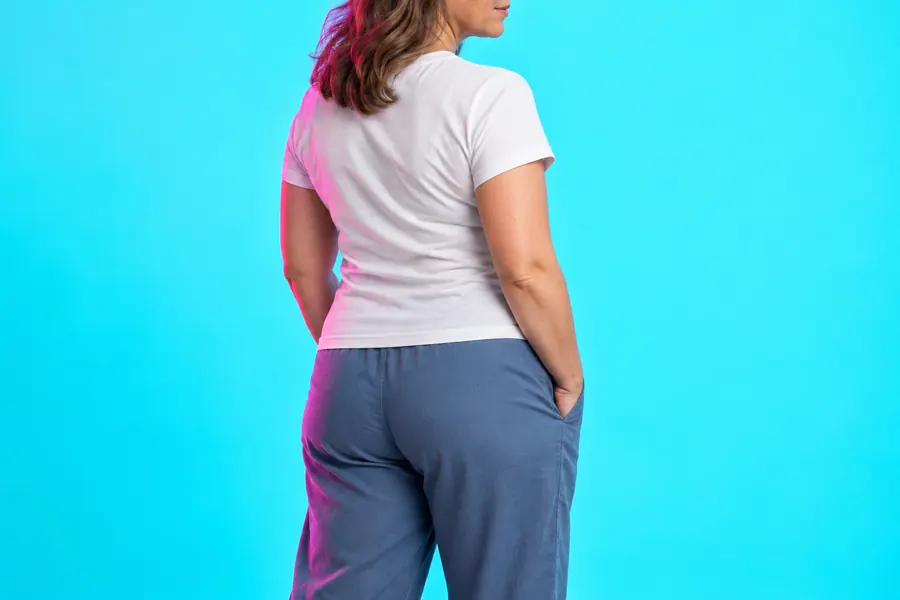
A butt lift removes and reshapes excess, sagging tissue around the buttocks. It can improve a loose skin envelope, but a traditional lift does not add buttock volume. A Brazilian butt lift, despite its name, principally adds transferred fat. These operations answer different questions. If your main concern is hanging skin after weight loss, ask about skin excision; if it is a lack of fullness, ask how a volume procedure would address that concern without assuming it will remove loose skin. ASPS distinguishes lifting from augmentation.
The central tradeoff is contour improvement in exchange for a permanent incision scar and surgical risk. A worthwhile plan identifies the actual area being lifted, the tissue being removed or retained, and the changes the procedure cannot deliver. It also identifies whether the proposed operation includes the abdomen, flanks, thighs, fat transfer or an implant. The word “lift” on a quote is not enough to establish that scope.
Start with the skin envelope, not a procedure nickname
Describe the problem in ordinary terms before choosing a technique: loose folds over the upper buttocks, skin hanging near the lower crease, flattening, excess tissue at the sides, or a combination. Ask the surgeon to separate skin looseness from available soft-tissue volume during examination. A request for a rounder profile is different from a request to remove a fold that interrupts the silhouette.
Lifting and enlarging are separate goals. A plan may combine them, but the combination needs its own explanation. Removing redundant skin does not mean creating the same projection as an implant or transferred fat. Likewise, adding fullness does not make a skin-removal operation disappear. The difference matters when comparing photographs, prices and recovery instructions: an example labeled “butt lift” may have involved several procedures.
| Main concern | Operation category to discuss | What still needs clarification |
|---|---|---|
| Redundant buttock skin | Excisional gluteal lift | Scar position, extent and remaining volume |
| Reduced projection | Augmentation or selected local tissue rearrangement | How fullness is created and maintained |
| Excess fat with suitable skin elasticity | Liposuction assessment | Whether skin can conform after reduction |
| Loose tissue extending around the trunk | Lower body lift assessment | Abdominal, flank, buttock and thigh scope |
| Mixed skin and volume concerns | Combined or staged plan | Each component’s independent risks and aftercare |
This is an organizing table, not a self-diagnosis. The ASPS body-lift overview describes the broader trunk and thigh regions and distinguishes excision from fat removal alone. Bring the table to an examination and mark which concerns are actually present rather than treating every listed procedure as necessary.
What a butt lift can change—and what it cannot promise
A useful goal is specific enough to evaluate later: reduce a particular fold, improve a named contour transition or address loose tissue above the crease. “Perfect buttocks” provides no clear endpoint. Ask which region should improve and which may remain largely unchanged. Ask whether preserving existing projection is realistic when tissue is removed, particularly if flattening already bothers you.
Skin texture is a separate discussion. A lift is not a promise that every dimple, stretch mark or surface irregularity will disappear. Ask which visible marks would lie inside the planned excision and which would remain. Do not judge the operation using lighting, pose or retouching that obscures the skin surface. Your goals can be modest and still matter; they do not need to match a social-media shape.
A stable result also differs from an unchanging body. The ASPS results guidance explains that tissues settle, scars mature and aging continues; outcomes are not guaranteed. An early photograph and a mature result answer different questions. Before committing, ask when the practice evaluates contour, when it evaluates scars and how it handles a concern that persists after healing.
Where the incision may go
The scar should be discussed on your body, with the proposed location shown while you are standing. ASPS describes an upper incision below the waistline and another approach near the crease between the buttocks and upper thigh. The amount and location of redundant tissue affect the pattern. An upper approach may form part of a broader body-contouring operation; a lower-crease approach has a different target. ASPS explains these lift approaches.
Do not choose a scar solely because a name sounds smaller or more discreet. Ask what that incision can reach, what it leaves untreated and whether extending it would be required to address your concern. Clothing coverage is personal: bring the waistband height, underwear style or swimwear shape you actually use. A scar hidden by one garment may be visible in another. Concealment is not the same as scar elimination.
Also ask whether the planned scar continues into the flanks or front of the trunk. A posterior lift and a circumferential lower body lift should not be treated as interchangeable operations. A drawing of the entire proposed incision is more useful than a cropped rear photograph. Keep a copy of that drawing with the written procedure description so the consent, quote and recovery plan can refer to the same operation.
Local tissue augmentation is different from fat injection
In selected cases, tissue that would otherwise be removed can be retained and rearranged beneath the remaining skin to support fullness. This is often called autoaugmentation. It is not a synthetic implant, and it is not simply another name for injecting harvested fat. Ask which tissue is being retained and what additional benefit the surgeon expects from that component.
An original 2022 study of post-weight-loss reshaping included several treatment groups rather than a single standardized lift. Its methods were individualized, not randomized. That matters when someone presents autoaugmentation as universally superior: patients receiving different operations may have had different starting tissue and goals. The paper’s selection rules belong to that study; they are not an online eligibility calculator. Read the original gluteal-reshaping study.
Ask whether a proposed local flap is intended to preserve projection or add it, what tradeoff it introduces, and what alternatives exist if your tissue is unsuitable. A lift without augmentation can still be an appropriate discussion. More components do not automatically produce a better match to your goals. The important distinction is the purpose of each component and the evidence supporting that purpose in someone with similar anatomy.
Read a study without turning it into your personal forecast
That 2022 report analyzed 52 people: 15 underwent liposculpture, 22 underwent lifting without an autologous flap, and 15 underwent lifting with one. The cohort included 41 women and 11 men. Treatment was not randomly assigned. Average follow-up was 15 months, with outcome assessment described at one year. These are study-design facts, not a promise that all 52 had the same operation or outcome.
| Evidence question | What the study actually supplies | What it does not establish |
|---|---|---|
| Who was studied? | Selected people after major weight loss | All cosmetic butt-lift candidates |
| Was the operation uniform? | Three treatment categories | A single procedure with a single risk rate |
| Were groups randomized? | Individualized allocation | A causal ranking of techniques |
| Were men included? | Eleven men within the overall cohort | A precise male-specific benefit estimate |
| How long were results assessed? | One-year assessment; 15-month average follow-up | Lifetime durability or absence of rare harm |
Use the table to interrogate other research or a practice’s own outcome summary. Ask whether the denominator counts patients, operations or complications; whether follow-up is complete; and whether combined procedures are separated. A small series with no observed rare event cannot demonstrate that the event is impossible. A satisfaction score also cannot substitute for a wound-complication assessment. Those are different endpoints, and both deserve attention.

Who needs a closer readiness assessment?
ASPS describes lift candidates as people with substantial tissue looseness, realistic goals, suitable health for healing and a commitment to nutrition and fitness; nonsmoking is part of its candidate guidance. This is an assessment framework, not clearance. See the lift-specific candidate section.
Tell the surgical team how your weight changed, whether it is still changing, what previous operations you have had and which scars are already present. Describe the goal you would accept even if additional volume were not possible. If the proposed operation follows major weight loss, ask how the team evaluates nutrition and medical readiness rather than relying on an arbitrary online number.
Postponement can be a useful decision rather than a failed consultation. Ask what needs to change, who will assess it and how readiness will be reconsidered. A clear explanation might distinguish an unresolved medical issue from a mismatch between your goal and the procedure’s capabilities. You should be able to understand that distinction without being pressured to purchase a different operation immediately.
Risks belong to the actual operation
Relevant discussions include bleeding, infection, fluid collections, poor healing, unfavorable scars, sensation changes, asymmetry, recurrent looseness and possible further surgery. Serious anesthesia, cardiac, pulmonary and clotting complications also require discussion. The ASPS buttock-enhancement safety page lists these categories; it does not provide a personal probability for your particular plan.
If the operation extends into a lower body lift, review that broader consent rather than assuming a posterior scar captures the entire risk. The ASPS body-lift risk guidance includes leg swelling and other complications relevant to the broader operation. Ask which additional risks arise from added procedures and how the team decides whether to stage them.
Ask about wound problems before they happen
Identify who evaluates a wound concern, how to contact that person and where care occurs if you are away from the operating facility. Ask which changes require urgent contact and what emergency route applies outside office hours. This practical plan matters as much as the label on a scar-care product. Do not assume an online photograph can establish whether drainage, separation or discoloration is harmless.
Recovery should follow your incision and procedure components
Dressings, temporary drains, support garments and individualized instructions may be part of recovery. Ask what applies to your operation, how each item is managed and who demonstrates the care. The ASPS enhancement recovery page separates fat-grafting instructions from general postoperative care. Its fat-grafting sitting advice should not be copied automatically onto every skin-only lift.
Create a practical activity plan with the team: sitting at work, getting into a car, bathing, clothing, driving, lifting children and returning to exercise. Ask for instructions tied to your wounds and any augmentation component rather than a generic “back to normal” date. If your plan combines a posterior lift with abdominal surgery, ask how both areas influence positioning and daily tasks.
| Daily task | Question for the treating team | Arrangement to make before surgery |
|---|---|---|
| Getting home | What transport and supervision are required? | Named driver and available helper |
| Sitting and sleeping | Which positions suit my exact procedure? | Suitable space; avoid generic BBL assumptions |
| Dressing and bathing | How do garments, dressings and drains affect care? | Clothing and assistance agreed with the team |
| Working | Which job tasks are restricted? | Duties and leave discussed without fixed online deadlines |
| Follow-up | Where and when are wounds checked? | Appointments and after-hours contact recorded |
For a broader body lift, ASPS advises immediate medical attention for shortness of breath, chest pain or unusual heartbeats. Follow the team’s emergency instructions rather than waiting for a routine review. Its recovery guidance also emphasizes individualized wound, drain and activity instructions. A schedule copied from someone else’s operation is not a substitute.
Preparation includes the home plan
The ASPS preparation guidance describes possible medical evaluation, medication review and smoking cessation, along with transport and supervision for outpatient surgery. Do not stop prescribed medicines on your own. Give the team a complete list so the clinicians responsible for them can coordinate changes when needed.
For planning, distinguish the person who drives you home from the person who can help with daily tasks. Ask whether overnight observation is expected and whether extra procedures change that arrangement. Record what happens if your helper becomes unavailable. These are operational questions that can be answered before surgery; resolving them in advance avoids treating discharge instructions as the first opportunity to organize care.
Compare costs by scope, not the headline price
A quoted butt-lift price can describe very different work. ASPS separates lift, fat grafting and implants on its cost page and explains that its averages exclude items such as anesthesia and operating facilities. Without a verified data year and comparable procedure scope, a displayed average should not be presented as your expected total. Read the ASPS cost exclusions.
Request a written breakdown for the surgeon, anesthesia, facility, any added procedure, tests, garments and follow-up. Ask what a second planned stage would cost and what happens financially if an unplanned complication requires care. Check the cancellation and revision terms before paying a deposit. An inexpensive headline with unclear scope cannot be meaningfully compared with a fully itemized plan.
One useful comparison is to place two quotes side by side and highlight every component that differs. If one includes a lower body lift and another a posterior-only lift, first resolve that clinical difference. Only then compare prices. The plastic-surgery cost guide can help organize the financial questions; it cannot determine which operation you need.
A nonsurgical “butt lift” needs a different explanation
A marketing label may describe a treatment that neither removes redundant skin nor corresponds to surgical lifting. Ask for the exact product or device, intended anatomical use and evidence supporting the claimed change. Do not infer regulatory approval from the fact that a material is approved somewhere else in the body.
The FDA recommends against injectable fillers for buttock enlargement; those uses are not approved. Injectable silicone is not approved for aesthetic enhancement. These warnings concern injections, not an endorsement or risk comparison for a surgical lift. A “no scar” advertisement does not remove the need to evaluate the actual intervention and its harms.
Leave with a plan you can describe accurately
Make one contour-and-scar record
Before consultation, create a simple record with three separate fields: the skin concern, the volume concern and the scar you would be willing to accept. For example, someone might describe loose tissue above the buttocks, say they want to preserve rather than increase fullness, and ask how a waist-level scar would sit beneath their usual clothing. This is an illustrative planning example, not an actual patient account or a prediction of what surgery can achieve.
At consultation, compare those fields with the proposed plan. If the surgeon suggests augmentation, ask whether that addresses a concern you actually named or compensates for a contour tradeoff introduced by excision. If a wider body lift is proposed, ask which additional region makes that extent necessary. If a shorter scar is offered, ask which part of your original concern would remain. Each answer should connect a specific intervention to a specific goal.
Use the same record when reviewing photographs. Note whether the examples show skin-only lifting, a retained-tissue flap, injected fat or a broader trunk operation. Ask for the time after surgery and whether other procedures were performed. A photograph showing more fullness cannot, by itself, demonstrate what skin excision contributed. A rear view also cannot show the full abdominal extent of a circumferential operation.
Finally, write down which goal is most important if the entire wish list is not feasible. You might prefer addressing looseness without added volume, retaining your current contour with less extensive surgery, or postponing intervention. This makes the discussion a decision about acceptable tradeoffs. It also gives you a concrete reference when evaluating whether the written consent and itemized quote actually reflect the plan you agreed to.
Before deciding, you should be able to state the primary concern, the tissue being changed, the full incision pattern, any augmentation component and the important limitations. You should also know who handles postoperative questions, how follow-up works and which costs are excluded. If those details remain unclear, request clarification before signing consent.
Use the procedure library to compare related operations, including liposuction and tummy tuck surgery. Keep the comparison focused on your goals. A butt lift is a substantial skin-reshaping decision, and the most useful result of consultation is a coherent plan—not a fashionable name or a guaranteed photograph.
Sources and review scope
Plastic Surgery Editorial Team. Source records checked through October 12, 2026. Review scope: source and editorial checks for general education. No individual clinical assessment is represented.
- ASPS lift versus augmentation. plasticsurgery.org. Publication/update date not stated. Checked 2026-10-12.
- ASPS body-lift regions and skin elasticity. plasticsurgery.org. Publication/update date not stated. Checked 2026-10-12.
- ASPS results and scar evolution. plasticsurgery.org. Publication/update date not stated. Checked 2026-10-12.
- ASPS lift incision and autoaugmentation overview. plasticsurgery.org. Publication/update date not stated. Checked 2026-10-12.
- Original gluteal reshaping after massive weight loss study. pmc.ncbi.nlm.nih.gov. Source date: 2022-05-27. Checked 2026-10-12.
- ASPS lift-specific candidate assessment. plasticsurgery.org. Publication/update date not stated. Checked 2026-10-12.
- ASPS buttock enhancement risks. plasticsurgery.org. Publication/update date not stated. Checked 2026-10-12.
- ASPS wider body-lift risk scope. plasticsurgery.org. Publication/update date not stated. Checked 2026-10-12.
- ASPS enhancement recovery components. plasticsurgery.org. Publication/update date not stated. Checked 2026-10-12.
- ASPS body-lift recovery and urgent symptoms. plasticsurgery.org. Publication/update date not stated. Checked 2026-10-12.
- ASPS preparation and outpatient support. plasticsurgery.org. Publication/update date not stated. Checked 2026-10-12.
- ASPS cost exclusions and different procedure categories. plasticsurgery.org. Publication/update date not stated. Checked 2026-10-12.
- FDA unapproved body filler uses. fda.gov. Publication/update date not stated. Checked 2026-10-12.