
Buccal fat removal cost should be compared using the complete proposed service and the actual dollar amount payable after any promotion. A larger advertised percentage can produce a smaller saving when it applies to only one part of the bill. The ASPS page displays a $3,142 partial average, checked October 12, 2026, excluding anesthesia, facilities and related expenses. It does not establish your complete quote or state the underlying fee year.
This guide provides an original hypothetical discount-base worksheet for two promotions applied to the same defined proposal. It does not recommend surgery or a promotional offer. The clinician must assess your concerns and the appropriateness of removing cheek volume independently of price. All example amounts are invented US-dollar accounting inputs, not current practice rates or a national total. Their purpose is to show which denominator a discount uses and which charges remain unchanged.
What does the published buccal fat removal cost average cover?
The ASPS buccal fat removal cost page displays $3,142 and states that anesthesia, operating facilities and related expenses are outside the partial average. Fee variation can reflect clinician experience, procedure and location. The page supplies no underlying fee year, so the date this guide checked it cannot be used as the collection year of the fee observations.
Ask whether a practice’s advertised buccal fat removal cost is a professional amount, a complete clinical package or a preliminary estimate. Record the actual included service, both-side status, anesthesia arrangement and billers. A complete quotation and a professional fee are different financial denominators. Comparing them before identifying inclusions can make a fee difference appear where the actual difference is an omitted expense.
Do not add guessed anesthesia and facility averages to the society number and label the result a current national price. Nor does dividing the average by two establish a per-cheek rate. The source does not provide those component definitions. An individualized written proposal is the evidence for the actual transaction, while the society figure remains limited background context.
Why should clinical suitability come before buccal fat removal cost shopping?
The ASPS candidacy guidance calls the procedure highly individualized and cautions against having it to satisfy someone else or an ideal image. A favorable price cannot establish that removing volume addresses your concern or is appropriate for your facial anatomy. Discuss your goals and expectations with a qualified clinician before treating any advertised package as a plan to purchase.
The ASPS consultation page describes health assessment, facial examination, options, likely outcomes and risks. Use that discussion to establish what is actually being proposed. This guide does not diagnose facial fullness, choose the amount of tissue to remove or predict future appearance. Those are not decisions a financial worksheet or a promotional percentage can make.
Keep the option to pause visible. A paid consultation or an expiring discount does not make surgery obligatory. Ask whether the proposed service remains provisional until examination and what happens financially if the clinician recommends against it. The transaction terms should support a clear decision record rather than substituting an urgency claim for an individual assessment.
Does the buccal fat removal cost quote describe the same service?
Ask for the ordinary procedure name and scope, not only a broad cheek contouring package. Determine whether the quote includes both proposed sides and whether any additional facial procedure is included. If another service is proposed, request its clinical explanation, consent discussion and incremental amount separately. A combined package should not hide a new purchase inside an apparent discount on the original operation.
An anesthesia or facility difference also needs clarification. Two proposals can have similar names while using different arrangements, and their suitability must be discussed with the clinicians. A lower subtotal cannot establish that an arrangement is appropriate. Record what the actual clinician recommends and obtain the corresponding complete amount rather than selecting a setting solely to fit a promotional price.
For a like-for-like financial comparison, match scope and inclusions first. If they do not match, leave the difference visible. The discount worksheet below assumes an identical confirmed proposal only to isolate arithmetic. It does not establish equal clinical results between real clinicians or turn different procedures into interchangeable ways of buying a facial appearance.
| Buccal fat removal cost comparison field | Written answer | Why it matters |
|---|---|---|
| Exact service and sides | Clinician-confirmed scope | A per-side promotion may not be the complete proposal |
| Clinical bill components | Professional, facility and anesthesia amounts | Discount may apply to only one component |
| Discount denominator | Eligible charges, percentage and conditions | Larger percentage can save fewer dollars |
| External planning and credits | Separate expenses and actual credit rules | Package total can omit costs or duplicate a deposit |
Original buccal fat removal cost worksheet: two discount bases
Imagine the same hypothetical confirmed proposal has a $3,200 professional amount, an $800 facility amount and a $400 anesthesia amount. Its complete clinical baseline is $4,400. We add $150 of specified medication and supply planning plus $150 of practical planning, producing a complete known baseline of $4,700. These are invented accounting inputs, not surveyed prices or recommendations about setting, anesthesia or a personal budget.
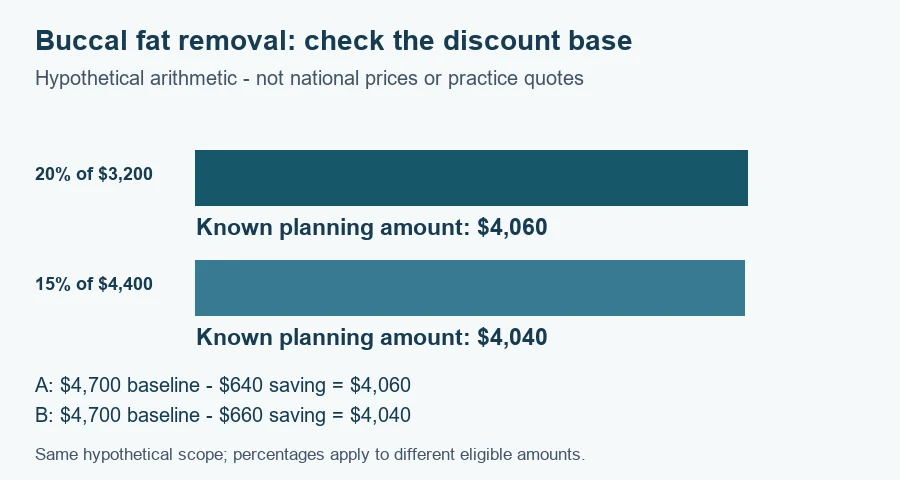
Promotion A discounts only the $3,200 professional component by 20 percent. Its saving is $640, leaving a $2,560 professional amount. Facility and anesthesia remain $1,200 combined, and the external planning input remains $300. The resulting known amount is $4,060. Promotion B instead discounts the entire $4,400 clinical baseline by 15 percent, saving $660 and leaving $3,740 clinical, plus the same $300 external input: $4,040.
| Hypothetical buccal fat removal cost calculation | A: 20% professional only | B: 15% complete clinical baseline |
|---|---|---|
| Discount denominator | $3,200 | $4,400 |
| Dollar saving | $3,200 × 20% = $640 | $4,400 × 15% = $660 |
| Clinical amount after discount | $2,560 + $800 + $400 = $3,760 | $4,400 − $660 = $3,740 |
| External planning | $300 | $300 |
| Known planning amount | $4,060 | $4,040 |
The chart compares $4,060 and $4,040. Although A advertises a larger percentage, B saves $20 more under the stated terms. The original lesson is that percentage and dollar saving answer different questions. The discount denominator must stay beside the percentage. A’s saving against the full $4,700 known baseline is about 13.62 percent; B’s is about 14.04 percent. Neither should be relabeled a 20- or 15-percent reduction of that complete baseline.
This model assumes both offers use the same undiscounted amounts and confirmed service, with no other changed charges. A real promotion may not satisfy those conditions. Ask whether a different package, extra charge or payment requirement changes the comparison. Do not use the example to decide which clinician to choose or infer that a discounted service has equivalent clinical quality.
How do you confirm the discount base in a real quote?
Ask the office to show the undiscounted amount, eligible component, stated reduction and resulting payable amount. If a percentage applies only to the professional service, retain the facility and anesthesia rows unchanged unless their own terms say otherwise. If it applies to a package, obtain the package definition. A verbal whole-procedure discount can be ambiguous when other entities issue separate bills.
Then ask whether consultation credits or another promotion can be combined with it. Do not subtract every advertised benefit unless the actual terms allow them together. A consultation may already be credited in the displayed net amount; subtracting it again would invent a saving. Keep the gross amount and confirmed credits distinct so the calculation can be checked against the invoice.
If the office quotes a flat promotional amount rather than a percentage, use that actual amount and its inclusions. There is no need to reverse-engineer a percentage from an unverified reference price. A meaningful comparison can be made using complete documented amounts without endorsing a claimed retail value or assuming that the earlier reference price was actually charged.
Can payment conditions change the effective buccal fat removal cost?
A promotion may require a particular payment method or date. Obtain those conditions in writing and ask whether another charge applies. This guide assumes no payment-method charge in the example. If an actual fee is stated, include it once in the relevant scenario. Do not infer that a percentage discount applies to an outside biller or that every payment option receives the same treatment price.
If borrowing is involved, keep the lender’s actual repayment obligation separate from the treatment amount. The worksheet contains no interest or lender fee assumptions and does not recommend financing. Reconcile any credited deposit with the financed balance so earlier payments are not counted twice. A small monthly payment does not identify the complete expense or establish that the proposed operation is appropriate.
For an advance deposit, distinguish timing from price. A credited $500 deposit on a $4,060 known amount reduces the remaining amount under its allocation terms; it does not reduce the complete price to $3,560. Ask which biller receives the credit and what happens if the plan changes. A favorable promotion should not obscure a different cancellation or refund commitment.
What if the quote adds another facial service?
Keep a new service in a separate scope scenario. Ask the clinician what concern it addresses and why it is being proposed. Only after that discussion should the office identify the incremental professional, facility, anesthesia and practical amounts. A discount on a combination does not establish that another procedure is needed or that declining it makes the original operation financially unreasonable.
Shared charges require actual written amounts. Adding two complete standalone packages could duplicate a facility amount; subtracting an assumed shared amount could omit a charge. Use the office’s itemized combined total and compare it with the base-only proposal if both are clinically appropriate options being discussed. Do not construct a combined price from two national averages and a guessed saving.
Also update external planning when the scope changes. The example’s $300 external input remains equal only because that assumption is explicit. A larger real proposal may require a different care arrangement or additional prescriptions. Obtain the plan-specific answers rather than carrying the smaller operation’s assumptions into a larger package and presenting the resulting sum as complete.
Which follow-up terms belong in buccal fat removal cost?
Ask what scheduled reviews are included and how concerns are assessed. Record separate expenses such as another evaluation, prescriptions or outside care where the policy identifies them. A package inclusion does not establish unlimited future care. Conversely, a quote that does not list a review separately needs clarification rather than an assumption that follow-up is absent.
A revision policy should distinguish any waived professional amount from anesthesia, facility or other bills. Do not assume another procedure is free, clinically appropriate or likely. The worksheet assigns no individual risk and no expected corrective expense. A chosen personal reserve can be recorded separately as a contingency; it should not be described as a predicted medical bill or guaranteed future treatment need.
Clinical questions about future facial appearance also belong with the clinician. The price model cannot establish how your appearance will change or what a future service might cost. Avoid treating removal as an investment with a verified lifetime maintenance saving. There is no supported financial comparison here that guarantees one permanent outcome or makes other facial treatments inevitable.
How can you test the discount calculation twice?
First calculate the saving directly from the eligible baseline and rate. For A, $3,200 times 0.20 gives $640. Then calculate the final known amount independently from the discounted professional amount plus unchanged facility, anesthesia and external rows: $2,560 plus $800 plus $400 plus $300 equals $4,060. Both routes should agree with the complete baseline minus the saving.
For B, calculate 15 percent of $4,400 as $660, then add $300 to the discounted $3,740 clinical amount to reach $4,040. These checks are simple but expose a common mistake: applying the percentage to external planning that the promotion never included. Another mistake is reducing facility and anesthesia under a professional-only discount. The written eligible-base definition controls the arithmetic.
If the numbers do not reconcile, ask the office for the actual calculation before paying. A revised baseline, excluded charge or already-applied credit can explain the mismatch. Save the corrected version with its date. Do not keep an unsupported saving because it makes the worksheet look favorable; the useful result is a documented transaction with assumptions still visible.
At what rate would the two hypothetical promotions match?
Holding the documented baseline and inclusions constant, A would need to save $660 from its $3,200 professional denominator to match B. That requires a professional-only reduction of 20.625 percent. Alternatively, a reduction of about 14.545 percent on B’s $4,400 clinical denominator would save the same $640 as A’s 20-percent professional reduction. This threshold calculation compares dollars across different eligible bases; it is not a suggested negotiation target or a market discount.
The threshold stops being valid if another input changes. If a facility charge increases, an outside amount is excluded or the service scope differs, recalculate the complete result rather than quoting the old percentage threshold. A precise mathematical comparison only remains meaningful within its stated assumptions. The practical question for a real office is the final amount for the same confirmed proposal, not which advertised rate sounds more generous.
How should an earlier reference price be recorded?
If a promotion compares today’s amount with an earlier price, ask what that earlier amount represented and whether its scope and inclusions match. Save the dated reference and the dated offer together. A change in package definition can make the difference look like a discount even when the current purchase is smaller or omits a charge. This is a reason to clarify the comparison, not to infer deceptive behavior by a particular practice.
If the earlier reference cannot be verified, retain the actual quoted payable amount and avoid describing a precise saving against that reference. You can still compare complete offers using their documented inclusions. The worksheet does not need an unverified retail value to be useful, and it should not create one from the national partial average.
Make sure the offer’s deadline is an actual transaction condition rather than an assumption. Record what must occur by that date and how a clinical change affects it. A quote expiry can be noted without allowing it to determine medical timing or the decision to have an operation.
Before paying: a buccal fat removal cost checklist
| Final checkpoint | Save this evidence | Pause the comparison if |
|---|---|---|
| Individual suitability and scope | Clinician-confirmed proposal | Promotion substitutes for assessment |
| Eligible discount base | Gross amount, percentage and exclusions | Denominator is described only as the whole procedure |
| Final complete amount | All billers, credits and external inputs | A deposit or percentage is applied twice |
| Conditions and follow-up | Payment terms and included-care boundaries | Extra purchase or care terms remain unclear |
The useful buccal fat removal cost answer is the complete amount for an individually assessed proposal, with the discount denominator and conditions attached. The partial society average provides limited context. The original model shows why a larger percentage can save fewer dollars without claiming that price decides suitability. Return to the buccal fat removal guide for procedure context and bring unresolved questions to a qualified clinician.
Sources and review scope
Plastic Surgery Editorial Team. Source records checked through October 12, 2026. Review scope: source and editorial checks for general education. No individual clinical assessment is represented.
- ASPS buccal fat removal partial average. American Society of Plastic Surgeons. Publication/update date not stated. Checked 2026-10-12.
- ASPS individualized buccal fat removal candidacy. American Society of Plastic Surgeons. Publication/update date not stated. Checked 2026-10-12.
- ASPS buccal fat removal assessment. American Society of Plastic Surgeons. Publication/update date not stated. Checked 2026-10-12.