
Brow lift recovery separates early wound healing from longer changes in swelling and appearance. ASPS describes initial healing and a possible return to work or normal activity around ten to fourteen days, while healing continues for weeks and full recovery may take several months. The work estimate is general context, not permission for every task. Get instructions for your actual operation, especially if eyelid surgery or another procedure is included. ASPS brow lift recovery
This guide concerns surgical brow or forehead lifting. An injectable brow change and eyelid surgery alone are different procedures. It helps organize questions about incision care, headwear, grooming, screen work, movement and follow-up. It does not select a surgical technique, predict the position of your brows or prescribe a home treatment routine. Practical scheduling should stay separate from promises about an appearance outcome.
What should a brow lift recovery plan make clear?
Ask your surgeon to name the operation and identify the areas needing postoperative care. Brow incisions may be arranged differently according to the operation; the care sheet should tell you what applies to you. If another procedure is included, confirm that its instructions are also addressed. A broad facial-surgery checklist may leave important details unanswered, particularly about eye care when eyelid surgery is part of the plan.
Request written instructions for any dressing, closure, prescribed medicine and review. Ask the team to explain which care tasks you will perform, which require assistance and which belong to clinicians. For brow lift recovery at home, the useful question is not what supplies everyone buys; it is what your own instructions require. Avoid adding a product or changing a routine because it appears in someone else’s recovery story.
Think through the everyday things that interact with the forehead or scalp: glasses, hair washing, hats, helmets, styling appointments and clothing pulled over the head. Ask about the item you actually use. You do not need to assume every item is restricted, but you should not infer permission from a product being described as soft or comfortable. Explain the task and let the treating team connect it to your operation.
Keep a contact plan that works outside office hours. Ask what symptoms the team wants reported, which route is suitable for a routine question and where urgent care would be obtained. If you are recovering away from the clinic, clarify how that affects assessment and follow-up. A future appointment is not a complete plan for a problem arising tonight, and a portal’s response time should not be assumed adequate for an urgent concern.
How do brow lift recovery milestones differ?
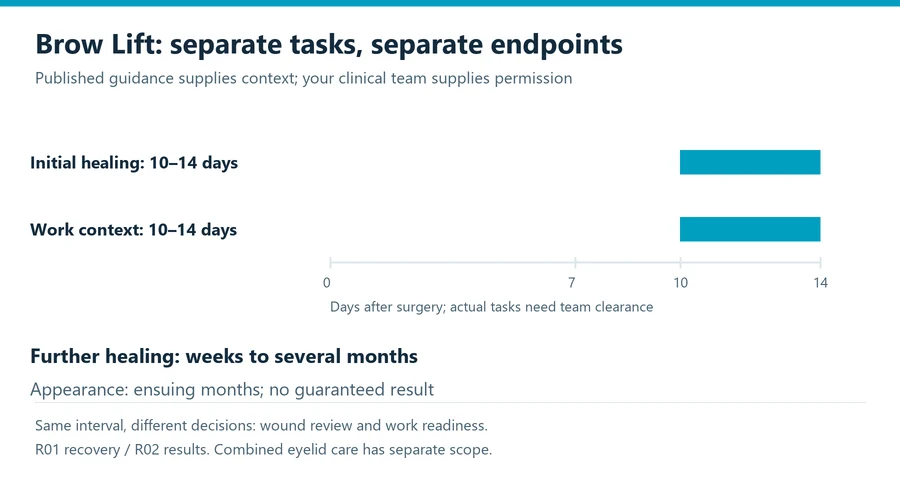
Use published intervals as discussion anchors rather than deadlines. A wound review, removal of a closure, return to a task and evaluation of appearance each answer a different question. The companion visual therefore separates the ten-to-fourteen-day early milestone from the longer healing horizon and keeps individual permissions outside the time axis. It contains no observations from patients and does not predict a personal result.
| Brow lift recovery question | Published general context | Individual clarification |
|---|---|---|
| When does initial wound healing occur? | ASPS: approximately ten to fourteen days | Actual incisions, closure review and any concerns |
| When might work resume? | ASPS: around ten to fourteen days for work or normal activity | Job duties, appearance preference and combined surgery |
| How long can recovery continue? | ASPS: several weeks of healing and several months for complete recovery | Your clinical course and task permissions |
| When should appearance be assessed? | ASPS: final results emerge over the next few months | Your surgeon’s review plan and any concern requiring earlier contact |
The ASPS results page describes appearance evolving over the following months and does not guarantee an outcome. ASPS brow lift results That general horizon is not permission to disregard a new symptom. Nor does an early work milestone mean every trace of swelling has resolved or that every activity is authorized. Keep those interpretations out of the plan unless your clinician explicitly addresses them.
For brow lift recovery scheduling, label the next review accurately. It is an assessment point, not an assured release from restrictions. Ask which tasks will be discussed and what information the team wants you to bring. If an employer asks for a fixed date, explain which activity you are planning and whether permission is still pending. Administrative certainty should not be created by turning a broad estimate into a clinical promise.
A photographed event raises an appearance question that may differ from work ability. Tell the surgeon about that constraint before deciding on timing. You may prefer to rearrange a public event even when a permitted task is manageable; that preference does not require an invented medical restriction. Conversely, feeling ready to be photographed cannot grant permission for strenuous movement or a restricted grooming service.
What should be asked about incisions and hair care?
Ask where the incisions are, what closure or dressing is present and who will review it. If the instructions use a term you do not understand, ask the team to identify the item in plain language. This article does not recommend removal of stitches, clips or dressings on a calendar date. A published early-healing interval is not an instruction to handle a closure yourself.
Make grooming appointments conditional on an actual answer
For brow lift recovery, hair washing and styling questions should be specific. Ask when washing is permitted, what method the team wants and which products or services should wait. Explain a salon appointment’s actual actions: contact, brushing, heat, color or other products near the treatment area. The clinician needs that detail to advise you; a general label such as hair appointment may conceal the task that matters.
Do not schedule an irreversible set of grooming appointments around an assumed recovery date. If permission remains unresolved, keep the booking flexible. A stylist can explain the service but cannot replace postoperative instructions from your surgeon. If the two instructions appear inconsistent, ask the clinical team to resolve them before the appointment. This prevents a practical booking from becoming the reason to improvise around a care restriction.
Ask about glasses, hats and any required occupational headwear separately. Bring an example or describe where it contacts the head. An item used by someone recovering from another procedure does not prove that it works with your incisions. This guide supplies no headwear fitting method or pressure rule. The useful step is to obtain an answer for the equipment you actually need and arrange an alternative if your team restricts it.
ASPS advises avoiding excessive force, abrasion or motion around healing incisions and says not to apply ice or heat to the operated area. ASPS protection instructions Do not borrow a compress routine from eyelid surgery or another facial operation. If discomfort raises a care question, ask the team rather than adding a home remedy with an unverified temperature, placement or duration.
How should work and visual tasks be discussed?
Work planning for brow lift recovery should describe the task, setting and equipment. A long screen session, a physically demanding shift and a role involving head protection raise different questions. Ask what your team needs to assess before resuming them. Working at home may make the schedule flexible, but it does not automatically remove movement, grooming or other clinical restrictions.
If you have a combined eyelid procedure, ask which instructions govern visual tasks, eye products and other eye-related care. Do not assume the brow-lift work interval answers those questions. Explain whether you drive, operate machinery, need precise near vision or wear contact lenses. Your actual operation and symptoms should guide the clinical advice; this article cannot assess your vision or certify readiness for a visual task.
For a workplace conversation, identify the temporary adjustment you are asking about. A staged day, changed meeting format or reassigned duty may be worth discussing if your clinician supports it and the employer permits it. This is administrative planning, not a recommendation for a specific schedule. Leave rights, documentation requirements and job-specific fitness decisions are not established by a general recovery guide.
For brow lift recovery appointments, make transport arrangements independently from your hoped-for driving date. Ask about anesthesia, prescribed medicines, comfort, movement and safe vehicle control; check applicable insurer or legal requirements. Being able to read a message or attend a remote meeting does not establish driving readiness. A passenger journey also needs discussion if it conflicts with your team’s position or care instructions.
Appearance preferences should be recorded separately from functional limitations. You might want flexibility around public-facing work without needing to disclose details of surgery. Explain the scheduling issue accurately rather than asserting that everyone requires the same amount of leave. A clear distinction helps the workplace understand what is an administrative request and what is a clinical restriction provided by your own team.
What does everyday help need to cover?
Ask the clinic what support is required after your anesthesia and operation. Then name who can provide it, who can take you to follow-up and who can help with restricted chores. If you live alone or have limited assistance, say so before surgery. A care plan should reflect the circumstances you actually have. This organizer does not prescribe a universal number of caregiving days or claim a particular arrangement improves healing.
During brow lift recovery, childcare may include lifting, bending, bath time, school transport and interruptions at night. Caring for another adult may include transfers or sustained physical effort. List these tasks so the surgeon can address their demands. A vague category such as family duties makes it harder to identify what needs help. Arrange a named substitute for any task the team restricts and a backup if that person is unavailable.
For household preparation, think about repeated tasks rather than purchasing a recovery kit first. Ask which movements should be avoided and arrange assistance or access accordingly. Phone chargers, appointment paperwork, approved care items and a contact list should be easy to locate. These are practical organizational suggestions, not a home rehabilitation program. Your clinical team remains responsible for explaining the actual movement and care restrictions.
For exercise, identify the activity, intensity and any contact or headwear involved. Ask how resumption will be assessed and whether another procedure changes the advice. No universal gym return date or lifting weight limit is provided here. Avoid trying a strenuous movement after surgery just to see whether it hurts; the absence of discomfort does not independently establish permission to resume it.
If a planned trip takes you away from your team, discuss access to care as well as transport. Ask how an intervening concern would be assessed and who would coordinate records. A booking should not be treated as evidence of medical readiness to travel. Keep your procedure and contact information accessible, and leave unresolved travel permissions visible in the plan rather than assuming the early work estimate clears every journey.
Which symptoms need a different response from routine follow-up?
A new or worsening problem should be assessed on its own merits, rather than dismissed as expected swelling. Follow the contact instructions supplied by your treating team for unexpected symptoms or recovery concerns. Describe what has changed, where it is happening and whether it is progressing. This guide cannot judge an incision or eye symptom from a photograph, and a general months-long appearance horizon does not make every intervening change routine.
If eyelid surgery was also performed, Guy’s and St Thomas’ blepharoplasty guidance directs immediate eye or emergency assessment for worsening eye pain, worse vision, increased eye redness or excess eye discharge. That source concerns eyelid surgery and is included here with that scope; its recovery schedule is not substituted for brow-lift guidance. Hospital eye-surgery warning guidance Do not attribute a worsening visual concern automatically to routine brow swelling.
New breathing difficulty, chest pain or fainting requires immediate emergency help; in the United States, call 911. CDC identifies these as possible clot warning symptoms, while new limb swelling, pain, warmth or discoloration needs prompt assessment. CDC blood-clot warning symptoms This general warning framework is not a brow-lift risk estimate or a diagnosis. Do not wait for a non-urgent portal reply when emergency evaluation is needed.
When calling about a non-emergency concern, have the operation date and current care instructions available. Mention any combined procedure and any advice already received. Ask whether an examination is needed and where to obtain it if your surgeon is unavailable. Sending an image through an approved private channel can support communication when requested, but should not delay assessment or replace an examination the clinician recommends.
Do not experiment with a bandage, compress, topical product or medicine change to determine the cause. Follow the team’s advice and use an appropriate urgent medical service if a problem needs prompt care and the usual team cannot be reached. A concern that changes the schedule is a clinical issue to assess, not a reason to force the recovery back onto its original calendar.
How can each review produce a usable next step?
Before the appointment ends, repeat the next step in your own words: the task you may do, the restriction that remains and the planned review. Ask the team to correct any misunderstanding. If a helper is coordinating your schedule, share the practical answer rather than a broad statement about being recovered. This small administrative check creates a usable record without making a new medical claim.
Bring a short list of unresolved activities and the instructions you have been following. Ask which permissions have changed, which restrictions continue and what needs another review. For brow lift recovery, a decision about screen work should not automatically be extended to driving, exercise, headwear or grooming. Record the task-specific answer so a helper can understand it without relying on a vague statement that everything is fine.
Ask separately when the surgeon intends to assess appearance and which concerns should be reported sooner. If a care instruction is revised, retain the current version and tell anyone helping you. If an issue remains unanswered, mark it pending rather than borrowing a date from another procedure. The point of a practical plan is to organize uncertainty honestly, not hide it behind a neat finish line.
The original timeline keeps early healing, work discussion and longer appearance change distinct. It is a source-scoped organizer, not evidence of a typical patient’s outcome or a validated method of speeding recovery. Brow lift recovery decisions become easier to coordinate when the task, the current clinical instruction and the next review are visible. Your own team makes the assessments a general resource cannot provide.
For related procedure context, read brow lift, eyelid surgery and the plastic surgery recovery guide.
Sources and review scope
Plastic Surgery Editorial Team. Source records checked through October 12, 2026. Review scope: source and editorial checks for general education. No individual clinical assessment is represented.
- ASPS brow lift recovery. plasticsurgery.org. Publication/update date not stated. Checked 2026-10-12.
- ASPS brow lift results. plasticsurgery.org. Publication/update date not stated. Checked 2026-10-12.
- CDC: About venous thromboembolism. cdc.gov. Source date: 2025-03-05. Checked 2026-10-12.
- Guy's and St Thomas' blepharoplasty warning guidance. guysandstthomas.nhs.uk. Source date: 2023-12. Checked 2026-10-12.