
Breast reduction cost has two different financial questions: the complete surgical charge if you pay directly, and your responsibility if a specific service is covered by insurance. The American Society of Plastic Surgeons page displayed a $7,800 average surgeon fee for aesthetic patients only when checked October 12, 2026. It excludes anesthesia, operating-room facilities and related expenses, and its underlying fee year is not stated. That aesthetic-only average does not estimate your insurer’s allowed amount, deductible or final patient liability.
Start by obtaining an assessed surgical plan and asking the insurer whether that proposed service is covered under your policy. If coverage is possible, request its requirements and the practice’s billing estimate in writing. Then distinguish the allowed amount, remaining deductible, coinsurance, covered in-network out-of-pocket limit and charges outside coverage. If paying directly, obtain an itemized cash quote instead. Neither pathway should be calculated by subtracting an assumed insurance percentage from the ASPS surgeon-fee average.
What does the ASPS breast reduction cost average cover?
The ASPS breast reduction cost page explicitly limits its $7,800 average to aesthetic patients and identifies it as a partial surgeon fee. It also explains that insurance approval may be needed and that copayments or deductibles can remain. These are different observations: an aesthetic fee reference and a potential insured pathway. Keeping their purposes separate prevents an attractive but unsupported estimate of what insurance will pay.
Record the observation date alongside the amount and write “underlying fee year unspecified.” Do not assign 2026 simply because that is when you read the page. The figure also cannot provide a national facility or anesthesia allowance. Those services require their own written estimates. A practice’s cash package may include them, but the public average does not establish that inclusion. Ask which quote components explain a difference rather than assuming the average is the complete price every practice should charge.
Aesthetic-only data are especially limited for this decision because a person discussing symptom-related reduction may be evaluating a different financial pathway. That does not establish coverage; it establishes the need to ask a different set of billing questions. A quote can be clinically appropriate yet remain uncovered under a particular policy. Conversely, a potentially covered service can still involve substantial patient responsibility. The financial worksheet needs evidence of your actual benefit rather than a category label alone.
Insurance-related breast reduction cost starts with a specific service
Ask the practice what operation is proposed and what information is needed for an insurer’s assessment. The clinician evaluates goals, health and the treatment plan; the insurer applies its own benefit terms. Do not infer coverage solely from symptoms, breast size, a procedure name or another person’s approval. Request the current requirements for your policy and ask the practice how it supports the necessary documentation. The worksheet cannot diagnose medical necessity or predict whether authorization will be granted.
Keep the proposed service description consistent across the clinical plan, authorization request and estimate. If additional elective work is discussed, ask whether it is a separate uncovered service and how shared charges are handled. Do not split anesthesia or facility expenses yourself using a percentage chosen for convenience. The practice and insurer need to explain the relevant billing arrangement. Your task is to record the answer accurately, including unresolved components, before agreeing to a financial obligation.
An authorization letter and a final explanation of benefits serve different purposes. Ask the insurer what its authorization does and does not establish, and ask the practice whether the estimate remains conditional. If a plan changes after assessment or the proposed date moves, confirm whether authorization and quote terms still apply. Keep dated copies rather than treating an earlier decision as covering any future version of the operation. A transparent estimate identifies the circumstances it assumes.
Breast reduction cost: allowed amounts are different from billed charges
An insured calculation should start with the insurer’s allowed amount for the covered service, not an advertised cash price or a surgeon’s public average. Ask whether the estimate uses an allowed amount and which components it includes. A professional, facility and anesthesia service can have separate billing and network questions. A statement that the surgeon participates in your plan does not automatically establish the same status for every participant. Confirm the actual arrangements with the insurer and relevant billing offices.
The HealthCare.gov coinsurance glossary defines coinsurance as a percentage of covered-service cost after the applicable deductible. That percentage is not a discount from an arbitrary headline. A quoted rate of twenty percent needs its denominator, deductible status and coverage conditions before it produces a meaningful amount. If the allowed amount is not yet known, keep the liability estimate provisional instead of multiplying a public average and presenting the result as a bill.
Retain a component-by-component estimate when possible. Record who bills each service, its covered status, network status, allowed-amount estimate and patient-responsibility estimate. Ask which entries are fixed and which are provisional. An unresolved component belongs in the unresolved column, not at zero. This may leave the total incomplete initially, but it gives you a precise list of questions and prevents uncertainty from being mistaken for a saving.
| Breast reduction cost insurance field | Evidence to request | Avoid substituting |
|---|---|---|
| Proposed covered service | Current plan and insurer response | Aesthetic fee average |
| Allowed amount | Insurer or billing estimate for the service | Full billed or cash charge |
| Network arrangements | Relevant surgeon, facility and anesthesia answers | One participant’s status for everyone |
| Remaining deductible | Current benefit information | Original annual deductible without prior payments |
| Coinsurance | Rate and covered denominator | Percentage of an advertising headline |
| Remaining covered limit | Current plan-year accumulator and conditions | A cap on every possible expense |
Deductibles and breast reduction cost use current accumulators
The HealthCare.gov deductible definition describes the covered costs you pay before the plan begins paying under its terms. The relevant worksheet input is the remaining deductible that applies to this service, not automatically the deductible printed at the start of the policy year. Ask the insurer for the current status and whether separate or family arrangements affect it. Your financial model should preserve the actual terms rather than assuming every plan behaves identically.
For an original simplified example, a hypothetical $12,000 covered allowed amount and $1,200 applicable remaining deductible leave $10,800 after that deductible. At an illustrative twenty-percent coinsurance rate on the remaining covered amount, coinsurance is $2,160. The combined responsibility before any applicable out-of-pocket cap is $3,360. All figures and conditions are invented for arithmetic. They do not predict approval, represent national prices or describe any specific insurance contract.
Do not apply the same deductible independently to every invoice if the plan’s accumulator is shared. A facility estimate and a surgeon estimate may each be provisional when viewed alone. Ask how the insurer reconciles the combined claims rather than adding estimates that assume the same deductible remains unpaid twice. Keep the calculation’s assumptions visible. The simplified worksheet demonstrates one aggregate covered amount; real separate claims require the policy’s actual processing and benefit explanation.
The out-of-pocket limit does not cap every breast reduction cost
The HealthCare.gov out-of-pocket maximum definition explains the limit for covered in-network care during a plan year. It excludes premiums, uncovered services and out-of-network care, and certain charges above allowed amounts. Therefore, a remaining limit is not a guarantee that every expense associated with surgery will fit beneath it. Record which charges are eligible for the limit and which are outside the covered calculation.
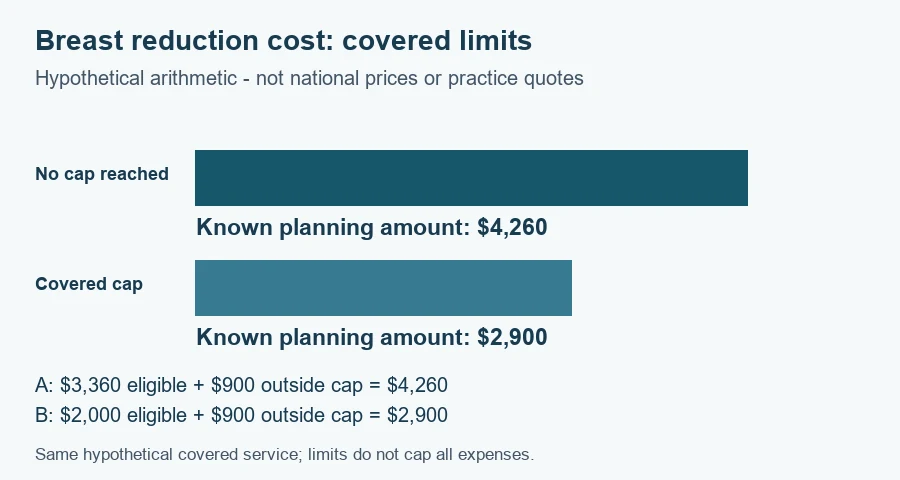
In the simplified example, assume the same $12,000 covered amount, remaining deductible and coinsurance, but now a confirmed $2,000 remaining applicable covered in-network out-of-pocket limit. The otherwise calculated $3,360 eligible responsibility is capped at $2,000 under the stated assumptions. A separate invented $400 uncovered service and $500 personal-support expense remain outside that cap. The known planning amount becomes $2,900, not $2,000. Neither uncovered amount is inferred from your actual plan.
This is not a choice between two clinically different operations. It compares two financial scenarios to show how a verified remaining limit changes eligible responsibility while leaving excluded expenses separate. Your plan may process charges differently, so have the insurer validate the actual calculation. Do not call the capped scenario a guaranteed saving until the relevant coverage, network, accumulator and service details are confirmed. Unknown charges remain unknown even when a covered limit is available.
Worked example: breast reduction cost before and after a covered limit
The original chart uses the same hypothetical clinical service and $12,000 covered allowed amount in both scenarios. The first has a remaining covered limit high enough not to cap the calculated $3,360 responsibility. The second has the illustrative $2,000 remaining applicable limit. Both add the same $400 uncovered charge and $500 personal support. This exposes the difference between eligible patient responsibility and the wider planning amount without conflating either with an aesthetic surgeon-fee average.
| Hypothetical breast reduction cost calculation | No cap reached in this example | $2,000 remaining applicable covered limit |
|---|---|---|
| Covered allowed amount | $12,000 | $12,000 |
| Applicable remaining deductible | $1,200 | $1,200 |
| Remaining covered amount | $10,800 | $10,800 |
| Illustrative coinsurance | 20% × $10,800 = $2,160 | Same calculation before cap |
| Eligible responsibility before cap | $3,360 | $3,360 |
| Eligible responsibility after cap | $3,360 | $2,000 |
| Separate uncovered charge | $400 | $400 |
| Personal support | $500 | $500 |
| Known planning amount | $4,260 | $2,900 |
Use this model only after replacing the inputs with actual policy information and obtaining an explanation of the applicable conditions. The example deliberately excludes premiums and assumes no additional separate copayment, no unresolved bill and no network discrepancy. If any of those assumptions fail, the model needs revision. It is not an expected-value estimate or a probability of coverage. Its value is making each step inspectable so a billing misunderstanding can be located rather than hidden inside one optimistic total.
Cash-pay breast reduction cost is a separate comparison
If the service is not covered or you choose to pay directly, request a complete cash quote for the assessed operation. Do not treat the insurer’s allowed amount as an available cash package unless the practice explicitly offers it on those terms. Identify professional, facility and anesthesia components, confirmed related charges and included follow-up. Ask whether the quote is fixed, estimated or dependent on additional evaluation. A provisional cash estimate should remain labeled provisional until the relevant scope is settled.
Compare the actual cash obligation with the actual insured obligation, including their conditions. A cash offer may have different included services or payment terms. Do not infer that it is cheaper merely because its headline is below billed charges, since insured responsibility uses a different pathway. Nor should you assume that choosing cash leaves all other benefits unchanged. Ask the insurer and practice how the choice affects the specific claim and retain their explanation before making the commitment.
Keep personal support and time away separate in either pathway. These costs may be important even if the covered medical obligation is relatively small. Use your own confirmed arrangements rather than a universal recovery allowance. The clinician determines appropriate activity and care timing; your financial plan should adapt to that advice. A budget that only includes eligible insurance cost sharing may omit the very arrangements that make postoperative care practical in your circumstances.
Plan-year timing and breast reduction cost uncertainty
A current deductible or covered-limit status can change before the operation or as other claims are processed. Ask the insurer how recently its estimate was updated and whether the planned date falls in the same benefit year. An estimate based on today’s accumulator is not automatically valid after a plan-year reset. Record the expected date and relevant policy period. Do not schedule against medical advice simply to fit a financial scenario; discuss both the care timing and benefit uncertainty appropriately.
If the operation is postponed, revisit authorization, network arrangements, accumulator status and the cash quote’s expiration where relevant. Keep previous estimates as history rather than mixing their favorable assumptions with current terms. A more complete estimate may change without any change in the clinician’s recommendation. Understanding that reason helps you distinguish an administrative update from a revised clinical plan and prevents a surprising bill from being explained by an assumption no longer in force.
You can test a scenario with a different remaining deductible, but label it as an assumption. For example, if the same hypothetical $12,000 covered amount had no remaining deductible and twenty-percent coinsurance before any cap, the calculation would be $2,400. It does not mean you should pursue unrelated care to change an accumulator or that the insurer will adopt the model. It simply demonstrates the sensitivity of the estimate to one input that needs current confirmation.
Check breast reduction cost estimates against the final bill
Retain the authorization response, itemized estimate, deposit receipt and later explanation of benefits. If a payment was credited toward your responsibility, count it once and ask the practice to reconcile the remaining balance. The estimate, submitted claim and final benefit calculation may differ. Request an explanation of the specific difference rather than assuming the entire invoice is an extra expense on top of the earlier estimate. A payment already applied to the same obligation should not be added again.
Record unresolved discrepancies and ask the appropriate issuer to explain them: clinical scope with the practice, benefits with the insurer and payment credits with billing. Do not alter the worksheet to force agreement by replacing documented amounts with guesses. A clear audit trail shows the source of every input, the assumptions in effect and what changed. If an appeal or correction is being considered, follow the actual policy and billing procedures rather than treating this educational worksheet as legal or claims advice.
| Final breast reduction cost check | Record to retain | What remains conditional |
|---|---|---|
| Actual assessed service | Written proposed plan | Coverage decision until confirmed |
| Insured calculation | Allowed amount and benefit estimate | Claim processing and applicable terms |
| Cash alternative | Complete current cash quote | Scope changes and quote expiration |
| Covered limit | Current accumulator and eligible-charge explanation | Excluded expenses and network uncertainty |
| Payments | Credited receipt and final reconciliation | Outstanding disputed or unresolved charges |
| Care arrangements | Confirmed follow-up and personal support | Future needs not yet assessed |
Ask for a breast reduction cost estimate you can inspect
Request the calculation rather than only its final number. An estimate stating “patient portion” without identifying the covered denominator and benefit assumptions cannot be independently checked. Ask which deductible status, coinsurance rate and covered limit it uses and when those inputs were obtained. If the office cannot yet confirm one input, record that dependency explicitly. This turns a vague promise into a practical list of information needed before the estimate can support a commitment.
Before accepting a breast reduction cost commitment
Read the breast reduction guide for procedure context, then bring the coverage and charge questions to the practice and insurer. Do not allow a possible benefit or money spent on assessment to determine whether you proceed. The clinical plan and your informed preference remain separate from the cost calculation. Obtain an updated estimate when either the plan or relevant benefit information changes.
A useful budget identifies the financial pathway, uses the correct denominator and distinguishes eligible cost sharing from excluded and personal expenses. It does not promise coverage or manufacture a national total from a partial aesthetic fee. With the assumptions documented, you can see which numbers are known, which depend on insurer terms and which questions still need answers before committing to the operation.
Sources and review scope
Plastic Surgery Editorial Team. Source records checked through October 12, 2026. Review scope: source and editorial checks for general education. No individual clinical assessment is represented.
- ASPS aesthetic breast reduction fee and insurance scope. American Society of Plastic Surgeons. Publication/update date not stated. Checked 2026-10-12.
- HealthCare.gov coinsurance and allowed-amount definitions. HealthCare.gov / U.S. Centers for Medicare & Medicaid Services. Publication/update date not stated. Checked 2026-10-12.
- HealthCare.gov deductible definition. HealthCare.gov / U.S. Centers for Medicare & Medicaid Services. Publication/update date not stated. Checked 2026-10-12.
- HealthCare.gov covered in-network out-of-pocket limit. HealthCare.gov / U.S. Centers for Medicare & Medicaid Services. Publication/update date not stated. Checked 2026-10-12.