
Breast reconstruction cost requires two separate totals: the complete treatment bill and the amount your specific health plan assigns to you. Coverage does not automatically make either number zero. Ask for the proposed reconstruction scope, each billing organization, the insurer’s allowed amounts and your remaining cost-sharing balances. If treatment has several stages, record which benefit period each stage belongs to. This guide provides an original hypothetical worksheet showing how a plan-year boundary can change patient liability without changing the procedures or their combined allowed amount.
No verified national complete breast reconstruction price is supplied here. Implant-based reconstruction, reconstruction using your own tissue, subsequent adjustments and individual clinical circumstances create different scopes. A single cash quotation also cannot establish your insured responsibility. The numbers below are invented inputs for understanding arithmetic, not observed prices, recommended treatment timing or promises that a particular operation will be covered. Decisions about cancer treatment and reconstruction belong with your treating team; financial comparisons must follow that assessed plan.
What does breast reconstruction cost actually measure?
Begin with the clinical proposal rather than an internet price range. Identify the intended reconstruction, the areas involved, the proposed stages and any known later work. A quotation for an initial operation may omit another stage that is already part of the proposed course. Conversely, a possible future adjustment is not automatically a scheduled or necessary expense. Keep planned work, possible contingencies and unrelated cosmetic requests in separate rows so their different certainty remains visible.
The American Society of Plastic Surgeons describes implant-based and tissue-based reconstruction and explains that reconstruction can involve stages. That overview establishes why scope matters; it does not specify your operation count or predict which technique will be suitable. Record the team’s actual proposal in plain language, along with what remains undecided. Where cancer treatment affects the sequence, a price spreadsheet must not substitute for coordinated clinical planning.
For an insured comparison, distinguish the submitted charge, the contracted or otherwise applicable allowed amount, the insurer’s payment and your responsibility. These are different denominators. A large submitted charge does not necessarily become your payable bill, and a lower displayed charge does not necessarily mean lower responsibility. Request the basis used by the plan for the actual clinicians, facility and services under discussion. Unresolved network or benefit questions should remain marked unresolved rather than being filled with assumed discounts.
Why breast reconstruction cost can remain after coverage
The Department of Labor explains qualified rights under the Women’s Health and Cancer Rights Act for people receiving covered mastectomy benefits. Its resource describes reconstruction-related benefits and notes that deductibles or coinsurance may still apply within the law’s requirements. It also identifies exceptions and tells people with governmental or church-plan coverage to check with their administrator. This is a reason to obtain the actual plan response, not to announce universal coverage from the word reconstruction. For separating reconstruction-benefit questions from a personal coverage decision, see breast reconstruction insurance coverage.
Keep the legal coverage question separate from the calculation of a covered claim. A service may satisfy a benefit requirement while still involving ordinary permitted cost sharing. A written pre-service estimate can help plan cash needs, but it is not the final processed explanation of benefits. Ask what could change the estimate, which billing entities supplied it and whether proposed services were actually included. Preserve the dated answer and identifying details so later differences can be investigated.
Avoid presenting an insurer’s approval for one description as approval for every associated service. Obtain the proposed scope and the relevant benefit determination together. When additional surgery or a revised plan is discussed, ask whether the earlier estimate still applies. These steps clarify information; they do not guarantee payment or instruct you how to meet an individual plan’s medical-necessity criteria. Your care team and benefits administrator must resolve those questions using the actual circumstances.
Which breast reconstruction cost components need separate rows?
ASPS lists professional, facility, anesthesia, medication, garment and testing or imaging expenses in its reconstruction cost guidance. The list helps reveal missing categories, but it does not supply a national average or say that every category will be charged separately in your case. Ask who bills each component and which items are bundled. A description of something included in a package is not an additional amount to add again.
Add practical expenses to a separate personal-budget section. Travel, parking, lodging, assistance and income effects can matter even when clinical claims are covered. Do not assume these expenses count toward an insurance limit. Obtain actual arrangements and any confirmed assistance before assigning numbers. If the proposed sequence is uncertain, record a range of possible practical needs with the assumptions visible, rather than labeling the largest speculative amount as your inevitable cost.
| Record | Information to obtain | Why it matters |
|---|---|---|
| Clinical scope | Assessed technique, known stages and separate contingencies | Prevents comparing an initial operation with a complete proposed course |
| Claim basis | Applicable allowed amount for each actual billing entity | Separates a submitted charge from the calculation denominator |
| Plan balances | Remaining deductible and applicable cost-sharing limit | Establishes the starting position for the estimate |
| Benefit period | Actual plan-year dates and where each stage falls | Prevents carrying one period’s balances into another automatically |
| Personal budget | Actual travel, assistance and income arrangements | Keeps nonclaim expenses visible without treating them as covered |
Original breast reconstruction cost worksheet: two benefit periods
The following invented example holds the assessed two-stage course constant. Both versions use an allowed amount of $18,000 for the first stage and $6,000 for the second, totaling $24,000. Every modeled clinical service is assumed to be covered in network and subject to the same deductible, coinsurance and limit rules. Those are explicit worksheet assumptions, not assertions about your plan. Premiums and actual claim-processing interactions are outside this simplified model.
In version A, both stages fall in one benefit period. At the first stage the hypothetical remaining deductible is $1,000, coinsurance is 20% after that deductible and the remaining applicable out-of-pocket limit is $3,000. Before applying that limit, responsibility would be $1,000 plus 20% of the remaining $17,000, or $4,400. The assumed limit reduces the covered-service responsibility to $3,000. The second stage then has zero remaining responsibility within these narrowly specified assumptions.
Version B places the second stage in a new benefit period. The first stage still costs the modeled patient $3,000. At the start of the second period, the hypothetical remaining deductible is now $2,000 and the remaining limit is $5,000. For the $6,000 allowed second stage, the calculation is $2,000 plus 20% of $4,000, or $2,800. This is below that period’s assumed remaining limit, so the modeled second-stage responsibility stays $2,800. The combined clinical responsibility becomes $5,800.
| Worksheet result | One benefit period | Two benefit periods |
|---|---|---|
| Combined clinical allowed amount | $24,000 | $24,000 |
| First-stage patient responsibility after assumed limit | $3,000 | $3,000 |
| Second-stage patient responsibility | $0 | $2,800 |
| Combined clinical responsibility | $3,000 | $5,800 |
| Separately budgeted practical expenses | $1,000 | $1,000 |
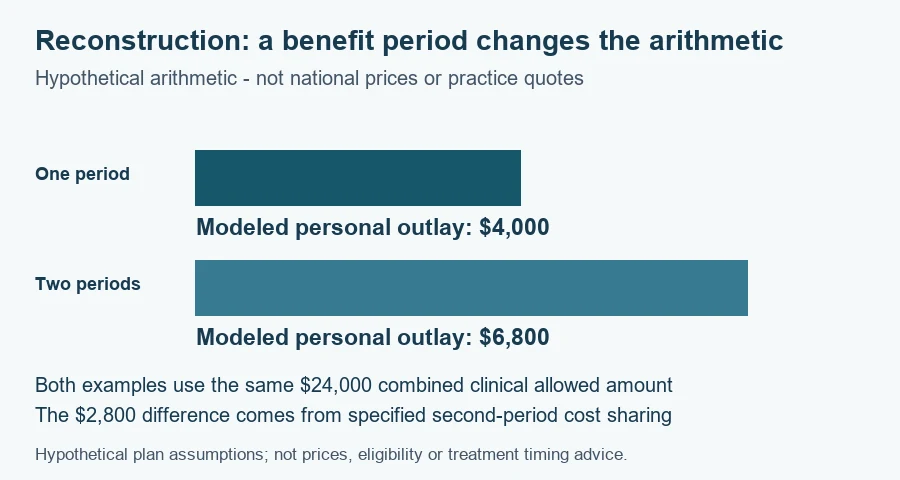
| Combined modeled personal outlay | $4,000 | $6,800 |
The $1,000 practical budget is an additional assumption: $600 associated with the first stage and $400 with the second. It is unchanged between versions and is not added to either plan’s deductible or limit. The original chart compares $4,000 with $6,800, a $2,800 difference caused entirely by the specified second-period cost sharing. Neither bar represents a market quotation, typical reconstruction price or safe scheduling alternative. The chart cannot identify which schedule is clinically appropriate.
How to recalculate breast reconstruction cost with your balances
Use the allowed amount for the specific covered claim, not an advertised cash figure. In this simplified model, the deductible contribution is the lesser of the remaining deductible and the allowed amount. Apply the specified coinsurance to the allowed amount remaining after that deductible. Then limit the result to the applicable remaining cost-sharing maximum, if the plan confirms that all modeled services count toward that maximum. Ask the insurer to verify the calculation rather than treating the simplified formula as a universal claims engine.
HealthCare.gov defines a deductible as an amount paid for covered services before the plan begins paying under the applicable rules, while noting that some services and separate deductibles can work differently. Its out-of-pocket glossary also distinguishes eligible covered in-network cost sharing from premiums, uncovered services and other excluded amounts. These boundaries matter more than choosing an impressive total. A limit cannot safely be applied to every expense in your personal reconstruction budget.
For another hypothetical sensitivity check, keep the second-stage allowed amount at $6,000 and 20% coinsurance, but reduce the new-period remaining deductible to $500. Before the assumed limit, responsibility becomes $500 plus 20% of $5,500, or $1,600. Combined with the first stage’s $3,000 and practical expenses of $1,000, that scenario totals $5,600. This is $1,200 below version B, because its starting deductible position differs, not because its surgeon or reconstruction is cheaper.
What changes breast reconstruction cost between estimates?
Other covered health spending may change the balances available when a reconstruction claim is processed. The date of the balance report therefore belongs on the worksheet. A calculation using an old remaining deductible might differ from a newer insurer estimate even when the proposed operation is unchanged. Ask which claims or pending amounts were considered. Do not alter medical appointments simply to make a spreadsheet match an earlier estimate; update the estimate around the clinically determined course instead.
Network status and the relevant allowance can also change the basis of a comparison. Obtain information for the actual surgeon, facility and other known billing organizations. A statement about one organization’s participation does not answer every entity’s question. Where something is unknown, show a separate unresolved row and request a specific response. This guide does not promise that a particular law, authorization or benefit automatically eliminates every unexpected amount.
The reconstruction proposal itself can evolve after assessment or during treatment. Record which services were removed, added or changed and why the estimate was revised. A new total without a scope revision log makes it difficult to see whether the difference comes from price, treatment, benefits or practical needs. Keep clinical reasoning with the treating team; the worksheet’s role is to document what financial assumptions correspond to the current proposal.
Which breast reconstruction cost questions should you send?
Ask for a dated written estimate naming the proposed stages, each known billing entity, the relevant allowed amounts and the insurer’s assumed balances. Include a request for the applicable plan-year start and end dates. Those dates may differ from your intuitive calendar boundaries. Ask which expenses count toward the stated maximum and which remain outside it. A clear request creates an answerable comparison instead of expecting a single staff member to predict every eventual bill.
For planned later work, ask whether it is included in the current estimate or needs a separate estimate. For a contingency, ask how a new clinical decision would trigger updated financial information. Also identify deposits or advance collections and how they will be reconciled against processed responsibility. The payment schedule is a cash-flow question; a deposit does not create a second clinical service or a discount unless the actual written terms establish one.
| Question | Record the answer | Keep separate |
|---|---|---|
| What is included in this estimate? | Named stages, services and billing organizations | Possible future work that is not yet planned |
| Which period and balances were used? | Dated deductible and applicable limit figures | Assumed calendar-year resets |
| What remains outside the limit? | Confirmed exclusions and personal expenses | Covered-service responsibility |
| How are advance payments reconciled? | Actual collection and reconciliation terms | The final processed claim amount |
| What requires an updated estimate? | Scope, provider or benefit changes | A promise that today’s estimate cannot change |
Comparing breast reconstruction cost without delaying necessary care
Use the worksheet to make uncertainty visible and prepare questions, not to choose medical timing independently. The two-period chart deliberately demonstrates an accounting effect with constant clinical scope. It does not compare cancer outcomes, surgical suitability or the consequences of delay. Discuss any financial difficulty promptly with the treating team and benefits staff so practical options can be assessed alongside medical needs. Do not assume that an apparent accounting saving makes a different treatment sequence appropriate.
When comparing assessed options, preserve the same distinction between complete clinical allowance, modeled responsibility and practical outlay. If one proposal has a different technique or known stage count, state that difference before comparing totals. A lower initial collection could simply precede later payments. A higher proposed allowance could still produce similar patient responsibility under a particular confirmed benefit position. Neither observation determines the better clinical option for an individual.
The most useful breast reconstruction cost record is a dated, revisable statement of the actual proposal and its financial assumptions. Keep the clinician’s plan, insurer’s response, estimates and processed claims together, while maintaining separate rows for uncovered personal expenses. Recalculate when verified information changes. This produces a defensible planning tool without turning unknown coverage, national price or future treatment requirements into facts. The breast reconstruction implants vs flaps comparison examines those alternatives as a separate decision.
Checking breast reconstruction cost against processed claims
An estimate becomes easier to evaluate when each subsequent statement has a matching row. Record the service date, billing organization, claim identifier, submitted charge, allowed amount, insurer payment and stated patient responsibility. Keep a deposit in the payment column rather than subtracting it from the service’s allowed amount. Otherwise the worksheet could both lower the calculation denominator and count the same advance payment again, creating an apparent saving that never occurred.
Suppose the hypothetical first-stage estimate requests a $1,500 advance collection and the final processed covered responsibility is $3,000. The advance payment leaves $1,500 to reconcile, provided the actual account confirms that it was applied to this claim. The patient’s total clinical responsibility remains $3,000, not $4,500. If an advance collection applies to another billing entity or service, moving it to this row without confirmation would be equally misleading. Ask for an account statement that identifies where each payment was credited.
Pending claims require a different kind of caution. An estimate may show a remaining deductible before another covered claim has been processed. A later estimate may show a smaller balance. Preserve both dates and ask the insurer which version should be used for the proposed service. Do not manually assign a pending claim to a benefit accumulator without confirmation or assume claims will settle in the order in which you received their statements.
For breast reconstruction cost comparisons, write the reason for each correction next to the changed input: updated scope, confirmed allowance, processed balance, credited payment or corrected practical expense. This small revision log preserves the distinction between a better estimate and a genuinely different treatment bill. When the plan’s responsibility and a billing statement appear inconsistent, send the relevant records to the insurer and billing office for clarification. The worksheet documents the disagreement; it does not decide contractual liability on its own.
Sources and scope
ASPS breast reconstruction cost categories, ASPS reconstruction scope, Department of Labor mastectomy-related rights, HealthCare.gov deductible definition and HealthCare.gov out-of-pocket maximum boundaries were checked October 12, 2026. Underlying publication dates are unspecified in these inspected records. No actual plan terms, patient eligibility, national reconstruction average or individualized clinical clearance were established.
Sources and review scope
Plastic Surgery Editorial Team. Source records checked through October 12, 2026. Review scope: source and editorial checks for general education. No individual clinical assessment is represented.
- ASPS reconstruction bill categories. American Society of Plastic Surgeons. Publication/update date not stated. Checked 2026-10-12.
- ASPS assessed reconstruction scope. American Society of Plastic Surgeons. Publication/update date not stated. Checked 2026-10-12.
- DOL qualified mastectomy-related rights. U.S. Department of Labor. Publication/update date not stated. Checked 2026-10-12.
- HealthCare.gov deductible boundary. HealthCare.gov. Publication/update date not stated. Checked 2026-10-12.
- HealthCare.gov covered cost-sharing limit. HealthCare.gov. Publication/update date not stated. Checked 2026-10-12.