
Breast lift cost should describe the actual mastopexy plan and distinguish any additional procedure. The ASPS cost page displayed an average surgeon’s fee of $6,816 when checked on October 12, 2026. It excludes anesthesia, operating-room facilities and related expenses, and the page does not identify the underlying fee-data year. That observation is not a current nationwide total, an implant price or a promise about what your own plan will cost. ASPS fee scope.
The original worksheet below separates a lift-only quote from a quote that contains additional volume-related treatment. It includes hypothetical complete-bill arithmetic and a deposit audit without presenting invented practice prices. For clinical context, read the breast lift guide. This page helps you ask financial questions about an examined recommendation; it does not prescribe an incision, implant, breast size or personalized treatment plan.
What the breast lift cost benchmark actually covers
The displayed ASPS figure is a surgeon-fee observation for mastopexy within that page’s reporting scope. It cannot be converted into a complete bill by assuming a fixed anesthesia or facility percentage. A separate implant, fat-transfer or revision task also cannot be priced by multiplying or dividing that average. Each additional assessed component needs its own inclusion status and actual quotation.
The latest ASPS procedural report available when checked was the 2025 report. We inspected its 47 pages and found procedural estimates and methodology rather than a surgeon-fee table. Its year does not establish that the separate $6,816 amount is a 2025 fee average. A current retrieval date establishes what the cost page displayed when checked; it does not reveal when the underlying fee data were collected. ASPS 2025 procedural report.
For breast lift cost comparisons, keep the category, source date and exclusions beside the number. Do not interpret a higher quotation as evidence of better results or a lower one as proof of equivalent care. The actual plan, clinical discussion and written billing terms provide more useful comparison information than a percentage difference from an undated average. If an office uses a benchmark, ask which year and services it means before relying on the comparison.
Identify lift-only scope before discussing additions
Ask the clinician to name the proposed operation and explain what it is intended to address. A breast lift, augmentation and reduction are distinct procedure discussions even when a proposal combines components. A package titled breast surgery does not reveal whether it contains volume addition, tissue reduction or only the assessed lift plan. Write the recommendation in ordinary language and reconcile it with both the consent and the financial estimate.
For breast lift cost offers, an implant should be treated as included only when your actual plan and quote say so. Do not infer it from an image, a desired cup-size discussion or a general package description. If an additional component is merely an option, record optional rather than assumed. If more clinical assessment is needed before choosing the plan, label the quote preliminary and note which component remains undecided.
Ask whether the operation involves both breasts, whether the quoted scope includes an assessed asymmetry or previous surgery, and whether another named procedure is outside it. These are scope questions, not instructions to choose a technique yourself. The ASPS consultation guidance describes medical history, goals, examination, options and possible risks; the written quote should follow that assessment rather than become the reason for it. ASPS consultation context.
The mastopexy and additional-component audit
Use a separate row for each agreed component and ask the office to confirm the status. A discussion about an additional service is not a commitment to buy it. A quotation that assumes one plan should be revised if the clinical recommendation changes. Save the earlier estimate as preliminary instead of combining its price with a later plan that has different scope.
| Scope field | Written entry needed | Comparison error it prevents |
|---|---|---|
| Lift plan | Actual named mastopexy scope | Treating every breast operation as one product |
| Side and asymmetry scope | Documented bilateral or other assessed plan | Inferring a per-breast rate from a reported average |
| Implant component | Agreed, optional, excluded or not proposed | Assuming augmentation is inside a lift price |
| Other volume-related treatment | Named service and inclusion status | Adding an undecided component to the total |
| Previous surgery task | Actual assessed scope or none | Comparing an initial operation with a revision task |
| Facility, anesthesia and follow-up | Included services and separate bills | Comparing professional fee with complete package |
If the proposal includes an implant, request the relevant device and service details in the clinical documents and ask how charges are represented in the quote. This guide does not choose a product or evaluate its suitability. Its financial purpose is to distinguish a named implant-related expense from a surgeon fee or another charge already included in a package. A precise line item still needs an appropriate clinical explanation.
Do not compare lift-only and combined breast lift cost as equal scope
A lift-only quotation and a lift-plus-augmentation quotation describe different tasks. Their totals should not be ranked as though one is simply a cheaper version of the other. Ask what goal the additional component addresses and whether the clinician proposes it for your situation. The existence of an affordable combined package does not establish that augmentation is needed.
When comparing two offers for an actually proposed combined plan, ask whether the quoted professional charge already includes both components. Adding a separate standalone augmentation estimate to a combined charge would double-count it. Conversely, if the lift estimate only mentions augmentation as an option, omitting a separate charge would understate the obligation. Record the actual inclusion in words before using a calculator.
The breast augmentation guide covers a separate substantial procedure discussion. Use it when that component is genuinely being considered rather than importing its price or assumptions into every mastopexy budget. The cost worksheet here joins the financial categories only after the proposed operation is defined. It does not make different procedures clinically interchangeable.
Separate professional, facility and anesthesia services
Ask whether the price is a professional fee or a documented package and who will bill each service. If facility and anesthesia are included, record the named coverage. If they are separate, request their estimates and calculation basis. A facility amount may contain some named services already; adding an excluded-cost line without checking the inclusions can overstate the total just as omitting a separate bill can understate it.
For breast lift cost comparison, conditional or time-based charges deserve an explicit rule. Ask what allowance the estimate covers, which changes may increase it and whether the office provides a cap or updated quote. Do not change the anesthesia plan or surgical setting yourself to obtain a cheaper line. The financial question is how the clinician’s proposed care arrangement is billed and what responsibility you would accept.
ASPS lists potential additional categories such as tests, prescriptions and postoperative garments. Ask which apply and which are already inside the price. A list is not evidence that every person needs every item or that a particular garment should be selected independently of instructions. Keep an unspecified service marked unknown. An unresolved item is different from a confirmed zero or an inclusion at no additional charge.
Worked breast lift cost arithmetic with hypothetical offers
All amounts below are hypothetical US dollars created to explain quote accounting. They are not market prices or quotes from practices. Assume identical assessed lift-only scope for Offers A and B. No implant or other augmentation service is included in this example. If your actual plan has an additional component, its documented charges and services must be added or reconciled separately.
| Hypothetical charge | Offer A | Offer B |
|---|---|---|
| Professional or documented package charge | $6,000 | $8,600 |
| Facility outside that amount | $1,800 | Included |
| Anesthesia outside that amount | $1,000 | Included |
| Other named surgical items | $250 | $250 |
| Known surgical subtotal | $9,050 | $8,850 |
| Personal transport and support allowance | $700 | $700 |
| Known planning total | $9,750 | $9,550 |
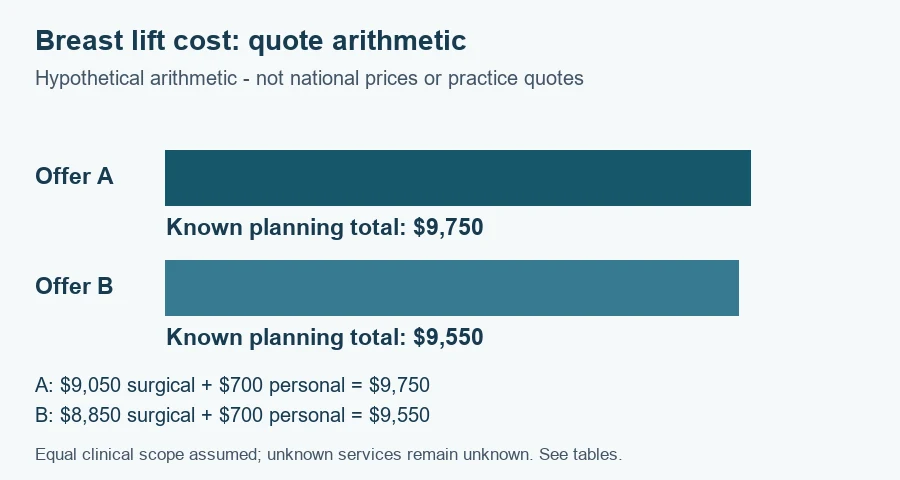
Offer A’s known surgical subtotal is $6,000 + $1,800 + $1,000 + $250 = $9,050. Adding the hypothetical $700 personal allowance produces $9,750. Offer B’s $8,600 documented package plus $250 produces $8,850, or $9,550 with the same personal allowance. A has a $2,600 lower headline but a $200 higher known planning total. That reversal is an effect of the stated exclusions, not evidence that packages generally provide better value.
Replace every example figure with an actual written amount before using this worksheet. Do not treat the hypothetical $6,000 as another national surgeon-fee estimate or the $700 allowance as a recommended recovery budget. The accompanying chart illustrates the same table and equal-scope assumption. It is not a clinical comparison, a second price dataset or a prediction of your own final bill.
Audit device-related charges separately when they apply
For a plan that includes an implant-related component, ask how the device charge, professional work, facility service and any follow-up are represented. Do not subtract an assumed device price from a package to invent the cost of the lift-only alternative. Ask for an actual alternative quote if that plan is clinically under consideration. A mathematical remainder is not a price the office has offered.
Ask whether any commercial warranty or protection arrangement is included and obtain its actual conditions. A device replacement provision should not be assumed to cover every related operation, facility charge, anesthesia service or personal expense. This page does not interpret an individual warranty or predict future device needs. The worksheet gives those terms their own place so a broad assurance does not hide excluded categories.
If prior implants or previous surgery are part of the clinical history, record the actual assessed task rather than reusing a standard first-operation quote unchanged. A removal, exchange or revision component may have different scope and billing terms. The clinician must explain the recommendation. Breast lift cost accounting should make the difference visible without claiming that every prior operation requires an additional procedure.
Count a breast lift cost deposit once
Request the payment calendar, including credited deposits and any separate consultation or booking fee. A credited deposit belongs within the surgical subtotal. If hypothetical Offer A’s $9,050 subtotal requires a $1,000 credited deposit, the remaining surgical balance is $8,050. The surgical obligation is still $9,050; adding the deposit again would produce an inflated comparison.
| Hypothetical Offer A payment timing | Amount | Treatment in the total |
|---|---|---|
| Credited deposit | $1,000 | Early payment within the surgical subtotal |
| Remaining surgical balance | $8,050 | $9,050 minus $1,000 |
| Total surgical obligation | $9,050 | Count deposit and balance once |
Ask what happens if assessment changes the plan, if the clinician advises waiting or if you choose to postpone. Obtain deadlines, retained charges, transfer conditions and any expiration of a credit. Separate organizations may have different cancellation terms. An educational guide cannot guarantee a refund or declare that every deposit is nonrefundable; your actual documents need to state the commitment.
What personal expenses sit outside breast lift cost?
Keep transport, household support, work arrangements and follow-up attendance in a separate personal budget. Ask how the actual proposed procedure and clinical instructions affect your duties. Do not set a return-to-work date from the price, the incision label or another patient’s experience. A person with physical work or dependent-care duties has specific planning questions that a national fee figure cannot answer.
Identify tasks rather than choosing a generic number of leave days. Ask about the duties you normally perform and who will reassess your readiness. If someone accompanies you or takes leave to assist, record that commitment separately from the office’s quotation. The example’s allowance is not a prediction of needed assistance. Your own arrangements should remain adaptable to the individualized plan and follow-up advice.
For travel, confirm where planned assessment occurs and who handles concerns after you return home. Accommodation, support and transport may have their own cancellation rules. Keep those personal commitments visible without treating them as part of an average surgeon fee. This avoids presenting your household budget as a national price or assuming an included clinical follow-up service covers every associated journey.
Separate breast lift cost from borrowing costs
If considering financing, ask for the cash price, amount financed, interest conditions, fees, payment count and total repayable amount. A monthly promotion does not explain the entire obligation. Do not interpret a larger credit limit as a reason to add an implant or another procedure, and do not treat approval as clinical clearance. The appropriate plan and the borrowing decision should be assessed independently.
The Consumer Financial Protection Bureau explains that deferred-interest arrangements can charge interest through their promotional period if required payoff conditions are unmet. Read the actual agreement and identify whether that model or another credit arrangement applies. This page does not recommend a lender, predict an approval or calculate a personalized repayment outcome. CFPB deferred-interest guidance.
Ask how a clinical change, postponement or cancellation affects both the practice payment and any financed obligation. A refund under the clinic contract may require a different process under the credit agreement. Keep those rules together without assuming they are identical. Your quote worksheet should stay useful even if you choose a different payment method because the underlying service scope is still clear.
Coverage and revision questions need actual documents
ASPS states that most health insurance plans do not cover cosmetic breast lift surgery or its complications. A separately assessed service and your own policy require direct review; this page does not make a benefit determination. Do not deduct an assumed reimbursement or describe a cosmetic operation differently solely to seek payment. Ask which component, if any, is being submitted and what responsibility remains.
Request the included follow-up period and contact route. If revision is discussed, ask what clinical assessment is required and whether a fee waiver refers only to the professional component. Facility, anesthesia, tests, device-related or personal expenses may have separate treatment under the actual policy. There is no universal rule that a future operation is free or that a dissatisfaction claim determines what is clinically appropriate.
Ask who handles unexpected concerns and where assessment occurs, especially if you travel. Necessary care should follow appropriate clinical instructions rather than wait for a billing disagreement. The breast lift cost worksheet records responsibilities and uncertainty; it does not predict complication rates, warranty eligibility or whether you will need another procedure.
Take home a breast lift cost quote you can explain
Confirm the assessed lift scope, any agreed additional component, the inclusion list and payment timing. Calculate the known surgical subtotal separately from personal commitments and financing costs. Mark unresolved charges unknown and revise the estimate if the clinical plan changes. Only then can two prices be compared without confusing lift-only treatment with another operation or a complete package with a professional fee.
Use the procedure guide and consultation questions to prepare your remaining questions. A useful breast lift cost decision is based on a documented plan and understandable obligation. It does not need an invented national total, an assumed implant inclusion or a promise that a fee predicts the shape, scar or result you will receive.
Sources and review scope
Plastic Surgery Editorial Team. Source records checked through October 12, 2026. Review scope: source and editorial checks for general education. No individual clinical assessment is represented.
- ASPS breast lift fee scope. American Society of Plastic Surgeons. Publication/update date not stated. Checked 2026-10-12.
- ASPS 2025 procedural report. American Society of Plastic Surgeons. Publication/update date not stated. Checked 2026-10-12.
- ASPS breast lift consultation. American Society of Plastic Surgeons. Publication/update date not stated. Checked 2026-10-12.
- CFPB deferred-interest credit explanation. Consumer Financial Protection Bureau. Source date: 2024-01-22. Checked 2026-10-12.