
Breast implant revision recovery depends on what is being revised, not simply on the fact that an implant is involved. Implant exchange, capsule or pocket work, a lift and an added fat-grafting procedure can create different care questions. Ask for the exact operative scope, one coordinated set of instructions and a task-specific plan for home, work and follow-up. Keep healing, activity permissions, later appearance and symptom evaluation separate. A previous augmentation recovery does not determine your current clearance.
This guide organizes those questions without prescribing a support garment, massage, washing, medicines or exercise. It does not recommend a capsule operation or promise that revision will relieve systemic symptoms. If surgery is being performed because of a diagnosed problem, ask how that diagnosis changes follow-up and who owns any additional testing. A general recovery article cannot substitute for the actual operation record or a clinician’s assessment of a new concern.
What should a breast implant revision recovery plan identify?
Ask the team to describe what will be done in plain language. Is an implant being exchanged, removed or repositioned? Is the surrounding capsule or implant pocket being addressed? Is breast skin being lifted, or is fat being collected elsewhere? The purpose is not to choose a technique through this article. It is to know which regions and care responsibilities the recovery plan must cover.
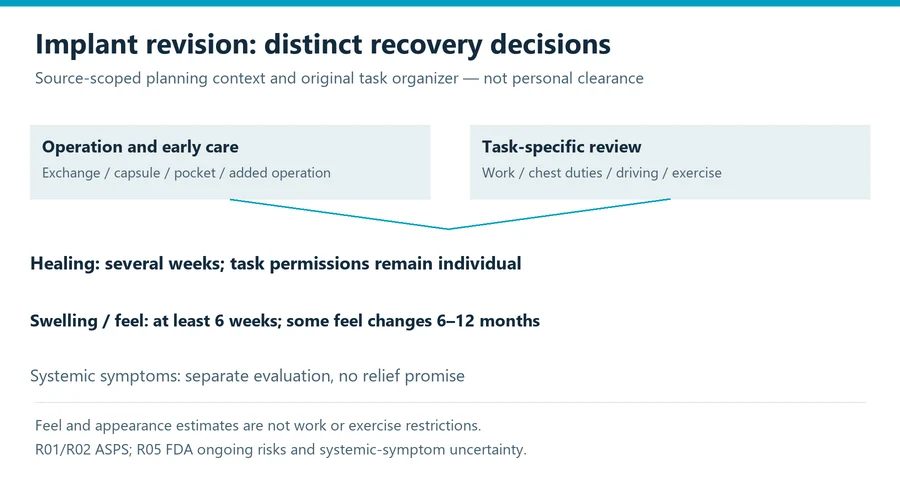
The ASPS revision recovery guidance describes possible dressings, support garments and drains depending on the operation, with individualized instructions and follow-up. It states that healing continues over several weeks as swelling decreases. It does not establish a universal work or lifting date for every revision.
Record the routine contact, out-of-hours route and first review. If another clinician is involved in a diagnosis or test, ask how the information will reach the surgical team. A recovery plan should not leave you guessing whether a symptom belongs to the surgeon, an imaging service or your usual clinician. Clarify the route before relying on an appointment that may be weeks away.
Use the old experience carefully
You can tell the team what was difficult after earlier surgery, including work duties, garment questions or help at home. That information may improve the discussion, but it is not a permission schedule for the new operation. Ask what is different this time and which previous habits should not be assumed. A familiar procedure name can conceal a materially different surgical scope.
How should breast implant revision recovery estimates be interpreted?
The ASPS results discussion describes swelling and feel changing over at least six weeks, with some patients taking six to twelve months for the breasts to feel normal. These are appearance and sensation examples, not work restrictions or guarantees. The source also notes individual variation. A particular date cannot establish what a new symptom means.
| Breast implant revision recovery endpoint | ASPS broad context | What remains individual |
|---|---|---|
| Early healing | Several weeks as swelling decreases | Care instructions and assessment for the actual operation |
| Swelling and feel | At least six weeks in the results discussion | Expected course and evaluation of an unexpected change |
| Later feel | Six to twelve months in some cases | Not guaranteed and not a task-clearance date |
| Work and activity | No universal date established here | Specific duties, restrictions and clinical review |
For breast implant revision recovery, use a timeline to organize questions rather than to judge yourself against another person. An office review may address an incision before it can settle a longer-term appearance question. A later appearance endpoint does not mean that every concern is expected or that you should wait months before seeking help.
Ask the team what a proposed date represents. Is it the next assessment, a typical observation period or an actual permission for you? Keeping those meanings distinct can prevent a provisional planning estimate from becoming an unsupported promise to an employer or a reason to resume an activity prematurely.
How can exchange, capsule work and added procedures change the questions?
For an exchange or repositioning, ask which instructions concern the implant and which concern the incision or surrounding tissues. If capsule or pocket work is involved, ask whether it changes the care or task plan. This article does not tell you how to protect a pocket, recommend massage or decide which movements are suitable. The team that performed the operation must provide those answers.
If a lift is added, the plan needs to cover the added operation rather than treating it as a minor detail. Ask how the instructions are coordinated and who will resolve any apparent conflict. If fat grafting is also performed, identify the donor site and its care responsibilities. A breast-only list can miss the physical demands associated with that additional region.
If revision is related to a clinical diagnosis, keep that issue in the follow-up discussion. Ask whether any results are pending, who will explain them and what would change the next step. The guide does not interpret pathology, rupture imaging or cancer-related findings. Practical recovery arrangements and diagnostic follow-up can coexist without being treated as the same decision.
Keep one current version of the plan
Store the instructions for every part of the operation together. If a new instruction replaces an older one, note the change clearly. A helper should not follow the original garment instruction while you follow a revised instruction from a later review. When two instructions seem inconsistent, ask the clinical team to reconcile them rather than choosing the one that seems easier.
What should be clarified about care items and personal care?
Ask which dressings, garment or drains actually apply to your revision. Identify their purpose, permitted handling, care teaching and review. If an item is not used, do not add it because it appears in a general guide. ASPS describes possible care items; it does not say that every revision needs the same equipment.
For personal care, describe your bathroom setup, dressing needs and any difficulty reaching an area. Ask what arrangement is appropriate within the actual instructions. This guide does not prescribe a shower date or a method for cleaning an incision. If a helper has a care role, confirm what they are trained and permitted to do.
Clothing questions can be specific. Mention work uniforms, usual bras, waistbands over any donor site and equipment that touches the chest. Ask how those items fit the current plan. A product described as postoperative or supportive is not automatically the correct item for your operation, and a previous garment may not match the revised instructions.
Medicines and products during breast implant revision recovery should remain connected to their prescribers. Bring the actual names and ask who will authorize a change. Do not add an internet supplement, heat treatment or massage routine to improve an assumed outcome. A useful question addresses compatibility with the operation; it does not assume more treatment steps are better.
How should work, driving and chest demands be planned?
Describe the tasks of your job, including the commute and anything carried. Reaching above shoulder height, pushing doors or equipment, repeated arm use, lifting stock and wearing protective gear are concrete questions. They can matter even when the job title sounds sedentary. The team can address the actual demands instead of giving a vague answer about returning to normal life.
A work plan for breast implant revision recovery can be provisional until review. Ask what duties could be considered, what restrictions actually apply and how a change will be documented. If your employer can adjust duties, discuss an arrangement that matches the clinical answer. This guide does not define safe weights, establish employment rights or guarantee that a modified job will be appropriate.
For remote work, consider concentration, calls, scheduled appointments and the ability to obtain advice during office hours. Being at home does not remove care responsibilities. A shorter or flexible arrangement may be a planning option if available, but it is not evidence of faster healing or a substitute for the clinical discussion.
Driving requires a separate answer. Ask the team about the actual operation, medicines, movements and review relevant to driving. Do not infer permission from comfort as a passenger or from an appearance improvement. The discharge journey should follow the facility’s requirements, with a named driver or arrangement as instructed.
Match home responsibilities to the same task detail
Childcare, pet care, laundry and shopping may involve more physical work than a desk role. Identify who will handle a task that is not yet permitted, and explain any responsibility that cannot be deferred. “Help at home” is useful only when the helper can do the actual job and knows what is expected. Care decisions still belong with the clinical team.
How should exercise, travel and later appearance be discussed?
For exercise, identify the activity instead of requesting one date for the gym. Resistance work, swimming, running, a class and ordinary walking have different demands. Ask which part of the revision affects that activity and what assessment is needed. This guide supplies no exercise progression or independent lifting limit.
Travel adds questions about luggage, seating, follow-up and access to care. Describe the proposed journey and ask whether it interferes with review. If you will be away from the surgical center, know how to obtain appropriate help and how another clinician can learn what was done. A travel booking is not a medical milestone.
Appearance concerns during breast implant revision recovery should be discussed without turning a mirror check into a diagnosis. Ask which changes can be evaluated now and which remain unsettled. If a concern includes a new symptom, report that symptom through the care route rather than saving it only for a cosmetic discussion. A later feel estimate does not promise that every concern will resolve.
If another operation is mentioned, ask whether it is merely a possible future option or a decision being made now. Keep that distinction in your notes. The present plan should explain care for the operation already performed, and it should not imply that a general revision results page determines your next treatment.
Which symptoms need urgent attention?
ASPS advises immediate medical attention for breathing difficulty, chest pain or unusual heartbeats after revision. Call 911 in the United States for an emergency. Do not wait for a routine appointment or a photograph response when immediate assessment is needed. This is a symptom-response instruction, not an estimate of your individual risk.
For surgical-site redness or pain, drainage or fever, CDC infection guidance says to contact a healthcare provider immediately. Describe the affected site and the change. A general expectation of swelling cannot determine whether a particular change is normal.
CDC blood-clot guidance calls for prompt assessment of new limb swelling, pain or warmth, and immediate help for possible lung-clot symptoms. The guidance is general and does not supply a revision-specific complication rate. Use the team’s instructions for other unexpected or worsening symptoms.
If you cannot reach the office and the concern is urgent, use the alternative care route supplied or seek appropriate urgent help. Have the operation information and current instructions available if practical. A photograph may assist triage if requested, but it cannot guarantee that examination is unnecessary or that a message is monitored immediately.
How can breast implant revision recovery questions be prioritized?
A revision follow-up can involve several subjects, so bring the decisions that need an answer in a usable order. A symptom or care-item concern belongs first, followed by a task that is approaching, then longer-term appearance and device questions. This is a communication aid, not a clinical triage rule; an urgent symptom still uses the urgent route rather than waiting for a routine visit.
For breast implant revision recovery, a question record can show the operation component, the task or concern and the answer still needed. If donor-site care or a lift is involved, include that component rather than describing the operation only as an exchange. You do not need to interpret the surgical findings to make the record accurate. Ask the team to explain any term you cannot confidently use.
If a review changes an instruction, identify what is being replaced and which activities the change covers. Permission for one movement or one work duty should not become a general statement that all restrictions have ended. If another clinician provides advice, ask how it will be coordinated with the surgeon’s plan, especially when care or testing is being performed for a diagnosed issue.
Keep ongoing implant records separate from a temporary household checklist, while making both available when needed. An employer may only need an actual restriction or schedule, whereas a clinician may need device and operation details. You can share the information appropriate to the situation without inventing a human review, disclosing every private concern or treating a product advertisement as a medical record.
Finally, ask what the next review is expected to decide. A breast implant revision recovery plan can then link the current instruction to a concrete follow-up rather than an assumed finish date. That makes practical commitments easier to describe honestly. It does not establish a surveillance schedule, diagnose a systemic symptom or promise that revision will produce a particular feeling or appearance.
How should implant safety and systemic symptoms stay separate from healing?
The FDA implant risks and complications resource explains that implants have ongoing risks and that the causes of reported systemic symptoms remain poorly understood. A revision recovery calendar cannot diagnose those symptoms or predict relief. This guide makes no promise that exchanging or removing an implant will resolve fatigue, pain or another systemic concern.
If symptoms were part of the reason for considering revision, ask who will evaluate them and how that evaluation will be followed separately from surgical healing. An incision review and a systemic-symptom assessment can involve different questions. Do not treat an improvement or lack of improvement on one day as proof of a particular cause.
Keep implant records and the operation details available for clinicians involved in your future care. Ask what ongoing monitoring applies to the implant type and circumstances, rather than using this recovery guide as an implant-surveillance schedule. The clinical team can address recommendations that depend on the device and the reason for revision.
See the breast implant revision guide for the broader procedure decision and the general recovery planning guide for support questions. A useful breast implant revision recovery plan identifies the actual operation, matches permissions to real tasks, distinguishes appearance from symptoms and keeps both immediate care and ongoing implant questions with the appropriate clinical team.
Sources and review scope
Plastic Surgery Editorial Team. Source records checked through October 12, 2026. Review scope: source and editorial checks for general education. No individual clinical assessment is represented.
- ASPS breast implant revision recovery. plasticsurgery.org. Publication/update date not stated. Checked 2026-10-12.
- ASPS breast implant revision results. plasticsurgery.org. Publication/update date not stated. Checked 2026-10-12.
- CDC blood-clot guidance. cdc.gov. Source date: 2025-03-05. Checked 2026-10-12.
- CDC surgical infection guidance. cdc.gov. Source date: 2024-04-11. Checked 2026-10-12.
- FDA implant risks and complications. fda.gov. Source date: 2023-12-14. Checked 2026-10-12.