
Breast implant removal cost should identify the assessed surgical task, the related charges and whether any listed amount is only a provisional allowance. An allowance can make an estimate look complete while leaving a later bill unresolved. Ask which services are covered by fixed charges, which are estimated and how any difference between the allowance and the actual bill will be reconciled. The clinical plan must determine necessary care; the estimate should explain its financial scope.
This guide provides an original hypothetical allowance-reconciliation worksheet. It distinguishes a provisional third-party testing amount from a confirmed bill and counts the allowance once. The dollar inputs are invented arithmetic, not actual laboratory prices, clinical recommendations or national totals. No testing quantity, capsule-removal technique or insured benefit is selected by the model. Use it to ask clearer financial questions about an assessed proposal.
What does the published breast implant removal cost average cover?
The ASPS removal cost page, checked October 12, 2026, displays a $3,979 average. It describes a partial amount excluding anesthesia, operating-room facilities and other related expenses. The underlying fee year is not verified here. This observation is not a complete current national price, a quote for your assessed task or a bill for every service potentially involved.
A partial average cannot tell you whether an actual estimate includes a pathology or imaging expense, whether those services are proposed for you or who would issue the bill. Nor does it determine a standard capsule-removal charge. Ask for the financial components of the actual plan rather than adding a guessed percentage to the displayed figure. Keep any unconfirmed amount visible instead of presenting an invented complete price range.
The price of removal also should not be inferred by subtracting an implant’s retail cost from a breast-augmentation average. Those operations have different tasks and billing scopes. A replacement proposal and a removal-without-replacement proposal need their own assessed estimates. Their differences cannot be reconstructed reliably from unrelated published averages, even when all the numbers appear to be expressed in the same currency.
Why breast implant removal cost needs an exact clinical task
The ASPS overview discusses implant removal and possible work involving surrounding scar tissue or leaked material. It does not mean every patient needs identical tissue work. Ask the surgeon to describe the proposed task and its reason. This guide does not adopt a universal replacement interval or tell you whether a specific implant should be removed.
The FDA implant-risk guidance updated December 14, 2023 distinguishes removal alone from removal involving part or all of the surrounding capsule. It also notes that a confirmed associated lymphoma diagnosis can change the operation required. Those clinical distinctions explain why a billing phrase such as “explant package” needs clarification. They do not establish a preferred operation, guarantee symptom improvement or assign your personal risk.
If you have persistent swelling, pain or other changes around an implant, seek evaluation from the surgeon or another health care professional. Do not use a cost comparison to decide whether a concern needs assessment. A change in diagnosis may change the proposed task and therefore its financial documents. The right response is a clinically appropriate assessment and a clearly revised estimate, not choosing the cheapest label before the task is known.
Which breast implant removal cost lines are fixed or provisional?
Ask who issued each amount and whether it is a fixed charge, an estimate under a defined rule, an included service or a provisional allowance. These are different fields. A document may contain a complete-looking total that combines them, but the total’s certainty depends on the least resolved line. Record the limitations beside the amount rather than relying on an asterisk that disappears when you compare headline prices.
An allowance is an amount reserved in an estimate for a service whose actual charge may differ. The term does not by itself explain who receives the money, whether it is prepaid, whether a credit is refundable or whether a separate entity can bill you directly. Ask the office what the actual arrangement means. This guide’s explicit reconciliation rule is hypothetical; no real office’s policy is presumed.
| Breast implant removal cost field | Exact clarification | Record |
|---|---|---|
| Professional scope | Which assessed tasks and sides are included? | Written clinical and financial scope |
| Facility or anesthesia | Is the amount fixed or estimated under a rule? | Issuing entity and adjustment basis |
| Testing allowance | Which service does it concern, if proposed? | Provisional amount and actual bill status |
| Reconciliation | Is the allowance replaced by the final amount? | Credit, refund or extra-payment rule |
| Direct billing | Could another entity bill separately? | Responsible entity and contact process |
| Pending service | Is clinical need or price still unknown? | Explicit unresolved designation |
Do not purchase unnecessary testing simply because a quote includes an allowance, and do not omit testing that the clinician considers necessary to reduce the total. Ask the clinician about the indication and the billing party about the charge. A financial allocation does not establish medical need, a universal test panel or a safe testing substitute. The two questions require different evidence.
Original breast implant removal cost worksheet: replace an allowance once
Assume a hypothetical assessed removal plan with professional charges of $4,300, facility of $1,800, anesthesia of $900, specified care of $200 and personal logistics of $400. These fixed example inputs sum to $7,600. The initial estimate also contains a $300 provisional third-party testing allowance, creating an estimated known planning amount of $7,900. Nothing here asserts a usual test or market price.
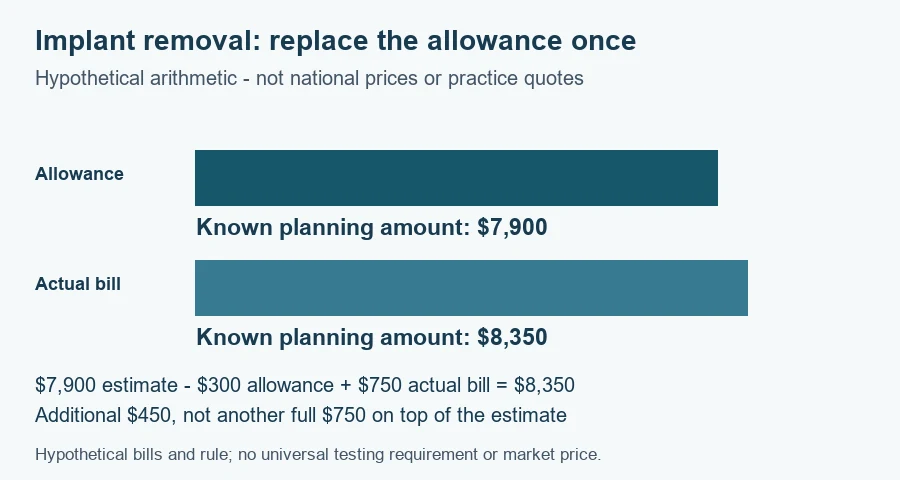
Now assume the actual bill for the same proposed third-party service is $750. Under the model’s explicit rule, the provisional $300 is replaced by $750. The reconciled total becomes $8,350: $7,900 minus $300 plus $750. The additional obligation is $450. Adding the entire $750 on top of the estimate without removing the allowance would double count $300 and create an incorrect $8,650 total.
| Hypothetical component | Initial estimate | Reconciled actual-bill scenario |
|---|---|---|
| Professional | $4,300 | $4,300 |
| Facility | $1,800 | $1,800 |
| Anesthesia | $900 | $900 |
| Specified care | $200 | $200 |
| Personal logistics | $400 | $400 |
| Provisional testing allowance | $300 | Removed and replaced |
| Actual service bill | Not yet confirmed | $750 |
| Known planning amount | $7,900, provisional | $8,350 under stated rule |
The formula is fixed known components plus the actual separately payable service amount. The provisional estimate is a planning entry, not another service purchased in addition to the actual bill. That distinction matters when the office collected an allowance beforehand: the money may already be part of what you paid. Ask where it appears in the actual ledger and how it offsets the final obligation.
This model concerns reconciliation for an unchanged service. If the clinical plan adds a different service, its charge should be identified separately rather than silently replacing the original allowance. Likewise, if the actual bill includes multiple services or an insurer’s adjustments, obtain the relevant itemization before using the simple formula. Do not force a different billing arrangement into the worksheet’s assumed rule.
Can breast implant removal cost decrease after reconciliation?
Under the same hypothetical replacement rule, an actual $180 bill would produce $7,780: the $7,600 fixed components plus $180. The difference from the $7,900 estimate would be a $120 reduction. That arithmetic does not promise a refund. The actual written arrangement must explain whether a collected allowance is credited, refunded or handled through another process. Keep the mathematical difference separate from the receipt showing that reconciliation occurred.
If the actual bill equals $300, the $7,900 planning amount remains unchanged. If it is not confirmed, the original total remains provisional rather than becoming fixed by repetition. A quote can show a useful planning amount while honestly acknowledging uncertainty. The mistake is describing a provisional amount as an all-inclusive ceiling without a commitment from the entities responsible for its charges.
| Hypothetical actual service bill | Reconciled total | Change from $7,900 estimate |
|---|---|---|
| $180 | $7,780 | $120 lower |
| $300 | $7,900 | Unchanged |
| $750 | $8,350 | $450 higher |
| Bill unresolved | Complete amount remains provisional | No confirmed difference |
Do not interpret this table as a probability distribution or a likely testing-price range. Its three figures were selected solely to demonstrate the formula below, equal to and above the allowance. There is no patient sample behind them. The actual clinical service and its verified billing terms supply the real input; until those are known, the table cannot forecast your final total.
How should breast implant removal cost handle direct third-party billing?
Ask whether the office is collecting the allowance for another entity or whether that entity will bill you directly. If a laboratory sends a separate bill while the office still holds a prepaid allowance, obtain a coordinated explanation before counting both as final costs. Preserve the bill and payment receipt, and ask how any existing payment is credited. Do not assume a transfer has occurred merely because the allowance appeared in the estimate.
A direct bill can also contain adjustments, prior payments or a remaining balance. Read those fields separately. An amount shown as originally billed is not necessarily the amount now payable; a remaining balance is not necessarily an extra full service charge. Request clarification from the billing party if the document is unclear. The worksheet helps distinguish categories, but it does not resolve a specific billing dispute or establish legal entitlement to a credit.
Keep a dated ledger containing the estimated allowance, any actual amount collected, the final bill, confirmed credit and remaining obligation. Change the final-total entry only when you have the relevant evidence. If a refund has been requested but not received, label it pending. This prevents an expected credit from being treated as money returned while a separate bill remains outstanding.
Does insurance determine breast implant removal cost automatically?
The FDA guidance cautions that some insurers do not cover removal or replacement even when complications exist or the initial implant operation was covered. That is a general warning, not an individual benefits determination. A symptom, a doctor’s recommendation and a particular insurer’s written coverage decision are different evidence. Ask the actual plan and billing entities about the specific assessed task and relevant requirements.
Do not subtract an assumed benefit from the hypothetical total or claim that a diagnosis guarantees payment. If coverage is being investigated, retain the self-pay estimate and the verified insured information separately, including their different scopes and limitations. An allowance for a third-party service may still be provisional until the entity confirms the applicable patient obligation. This guide supplies no diagnosis codes or universal medical-necessity criteria.
An implant warranty is also separate from health insurance and the complete surgical quote. A warranty may have conditions and limited benefits, but its existence does not establish that removal or every related charge is free. Ask for the actual applicable terms and written confirmation of any benefit before entering a credit. No manufacturer or provider is endorsed or linked here, and no particular warranty payment is presumed.
What changes require a new breast implant removal cost estimate?
If the assessed plan changes to include replacement, a lift or other reshaping, request a financial description of that added task. It may change professional, facility, anesthesia, care and personal arrangements rather than only one line. Do not treat a different operation as the same removal package with an unexplained surcharge. The purpose of itemization is to connect a confirmed clinical task with its financial obligations.
Likewise, findings during evaluation may affect proposed tissue assessment or surgery. Ask the surgeon about the clinical implications and the billing office about the resulting estimate. The allowance model does not authorize a test, determine the extent of capsule work or establish a standardized price for a finding. Preserve the original estimate and the revised document so you can distinguish an adjustment to the same task from a newly assessed task.
Routine follow-up inclusions should remain explicit. A testing allowance does not establish that every later appointment, medicine or possible revision is covered. Ask what is included in the current plan and how further services would be assessed if relevant. Do not invent a lifetime expenditure or promise that removal resolves all future concerns. The current quote can describe its actual scope without pretending to answer every future clinical or financial question.
How can you check the breast implant removal cost change log?
Write the original estimate date and the date each final charge became known. Then identify whether the change concerned the amount for an unchanged service, the number of services or a newly assessed task. Only the first situation follows the simple allowance-replacement formula directly. A change in service count needs an itemized explanation before the old and new figures can be treated as comparable. Preserve uncertainty where the billing document does not yet resolve it.
For the original model, the change log contains one clear adjustment: remove the provisional $300 and insert the actual $750. Its net $450 increase explains the difference between $7,900 and $8,350. If the revised document instead totals $8,650, ask whether the allowance has been counted twice or another charge accounts for the difference. The arithmetic identifies a question to investigate; it does not prove an error in an actual bill or accuse a billing entity of wrongdoing.
If an entity describes the allowance as a nonrefundable package component rather than an amount replaced by actual cost, record that different rule explicitly. The model cannot be used to demand a $120 refund under a contract that does not use the assumed reconciliation method. Ask what the wording means before payment and retain the explanation. Clear questions about fixed inclusions, provisional allocations and direct bills make competing proposals more understandable without assuming that every office must use the same financial arrangement.
Breast implant removal cost questions before accepting an estimate
Is an allowance a guaranteed maximum? The word alone does not establish that. In the model, it is expressly replaced by the actual charge, so the $300 allowance is not a ceiling. Ask what the actual written rule means and whether another entity controls the final amount. Keep that answer with the estimate rather than inferring a fixed commitment from a complete-looking total.
Should I add the final bill to the quoted total? First determine whether the original total already includes an allowance or payment for that same service. Under the documented model, you remove the allowance and add the actual bill once. A different real arrangement may require different reconciliation. Ask the issuing parties to identify the credit instead of assuming that either every bill is additional or every service is already included.
For clinical context, see the breast implant removal guide. For the financial decision, retain the assessed task, fixed components, provisional allowances, final bills, actual payments and confirmed credits as separate dated fields. That record makes breast implant removal cost easier to understand while preserving uncertainty, clinical judgment and the difference between an estimate and a settled obligation.
Sources and review scope
Plastic Surgery Editorial Team. Source records checked through October 12, 2026. Review scope: source and editorial checks for general education. No individual clinical assessment is represented.
- ASPS implant-removal partial fee scope. American Society of Plastic Surgeons. Publication/update date not stated. Checked 2026-10-12.
- ASPS assessed removal-task distinctions. American Society of Plastic Surgeons. Publication/update date not stated. Checked 2026-10-12.
- FDA implant removal and evaluation scope. U.S. Food and Drug Administration. Source date: 2023-12-14. Checked 2026-10-12.