
Breast implant exchange removes an existing implant and places a replacement. The important decision is why replacement is being proposed and whether changing the device addresses that reason. The implant, the surrounding scar capsule, its position and the breast tissue are different parts of the assessment. A plan can involve more than exchanging a device, and replacement is not the only possible course. Do not treat a familiar implant age or a desired new size as a complete surgical recommendation.
Begin by identifying the problem in ordinary language. Are you concerned about a diagnosed device issue, discomfort, a change in shape, dissatisfaction with size or a question raised by imaging? Separate what you have noticed from what a clinician has established. That distinction helps avoid two mistakes: assuming that every concern proves a device problem, and assuming that a replacement device automatically solves every concern. The evaluation should explain how the proposed treatment relates to the actual findings.
This guide helps you organize that decision. It does not select a replacement implant, prescribe a surgical approach or interpret an imaging report. Its comparison tools distinguish device replacement from treatment of the capsule, pocket or breast envelope, and distinguish a current operation from the longer responsibility of living with another implant.
Exchange is one part of the revision vocabulary
The American Society of Plastic Surgeons describes breast implant revision as replacing old implants with new ones, sometimes alongside other changes such as a lift or reshaping the implant pocket. The procedure needs an individualized plan rather than a standardized exchange recipe. ASPS breast implant revision overview
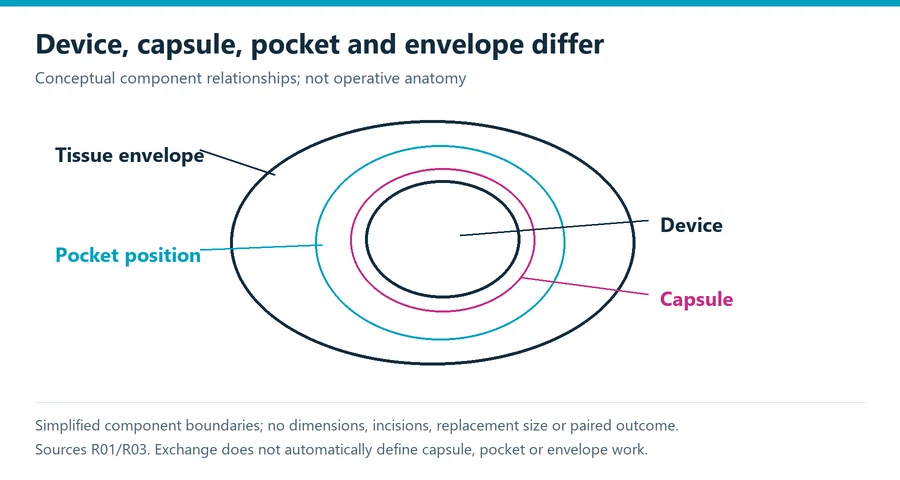
For a useful comparison, ask the team to describe the intended change at four levels. What happens to the device? What happens to the tissue around it? What happens to its position? What happens to the outer breast contour? You may need an answer at only some of those levels, but you should know which ones are part of the proposed operation. A device-only description can leave the rest of the plan unclear.
Removal without replacement is a different decision from exchange. So is a staged course in which the next step depends on findings. Do not allow the word “revision” to obscure those distinctions. If a discussion moves from replacing an implant to removing it without another device, ask why the recommendation changed and what that means for your stated goals. Keep the alternative and its reasons in the written record.
A new device is not the same as a new breast envelope
Imagine comparing two written recommendations. One proposes a different implant; the other proposes a device change plus additional work on the surrounding tissues. The recommendations may be addressing different questions even when both are called an exchange. Ask what each component is meant to accomplish and what concern would remain if that component were omitted. This is an explanation request, not a way to design your own operation.
| Part of the assessment | Question to ask | What should not be assumed |
|---|---|---|
| Existing device | What finding or preference supports replacement? | That device age alone defines an individualized deadline |
| Capsule | Is capsule treatment proposed, and for what reason? | That exchange always includes the same capsule operation |
| Pocket or position | Is position part of the problem and the plan? | That choosing a new size alone answers a positioning concern |
| Breast envelope | Is a lift or contour change included or discussed separately? | That replacing the implant describes every planned change |
| Longer course | What further decisions and monitoring remain? | That this exchange is guaranteed to be the final operation |
Implant age is context, not a countdown clock
The FDA states that breast implants are not lifetime devices, that complications become more likely the longer implants remain in place, and that device life varies between people and cannot be predicted. Its consumer guidance does not establish a personal replacement date from implant age alone. FDA consumer information about implant life
When you hear a fixed interval, ask what supports it in your situation. Is it a general statement about future surgery, a recommendation tied to a particular finding, a product-specific instruction or an office policy? Those are different kinds of information. You need the explanation that connects a proposed operation to your own device history and assessment, rather than a number repeated without its context.
The opposite shortcut is also unhelpful. The absence of an automatic replacement date does not prove that every implant can remain indefinitely without attention. Keep monitoring, symptom assessment and a decision about surgery as separate questions. Ask when your team wants to review the device, what information that review needs and what would prompt a different recommendation. Do not use an online calendar to overrule an actual clinical assessment.
Write down the date of the original operation and the dates of later procedures if known. If the history is incomplete, say so rather than estimating it as a fact. A replacement discussion should acknowledge gaps in the record. The age of an implant, the date of an imaging study and the date of a new symptom describe different events; placing them on one timeline can make the reason for an evaluation easier to understand.
Bring the device record, not just a remembered cup size
For a replacement consultation, gather the information you actually have: the implant card, operative reports, imaging reports and any documentation of later treatment. Do not invent missing manufacturer or surface details from a photograph or your memory of a conversation. Ask the team which records it needs and how an uncertain device history will affect the assessment. A clear statement of what is unknown is better than a confident but incorrect label.
Describe your concerns without trying to supply a diagnosis. For an appearance concern, say what seems different and when you noticed it. For discomfort or another symptom, describe the pattern and changes to the treating clinician. If a concern is based on a report, bring the report instead of only the conclusion you recall. That gives the team an opportunity to distinguish the reported finding from assumptions made afterward.
If you want a size change, explain the practical goal rather than asking for a number alone. Clothing preferences, how you want the breast to appear and which existing feature bothers you are different pieces of information. Ask how the recommendation relates to your tissues and previous surgery. A photograph can help explain a preference, but it cannot establish that the same device or course will produce the same result in another person.
Clarify capsule treatment without adopting an online slogan
The FDA describes reoperations that may include removal with or without replacement, capsule removal or release, repositioning and other treatment. It notes that more than one procedure can occur during a reoperation. The scope depends on the concern being addressed. FDA implant risks and reoperation information
Ask exactly what capsule treatment is proposed and why. Do not assume that a word in a social-media post means the same operation in every clinical setting. You should understand the relationship between the diagnosed concern, the proposed extent of treatment and its tradeoffs. If you are comparing recommendations, compare those explanations rather than treating a more extensive description as automatically more protective.
Separate a desired appearance change from an investigation of a medical concern. A recommendation made after diagnostic assessment should not be replaced by a generic promise about “cleaning out” the breast. Ask whether additional findings could change the plan and who will explain those findings. If tissue or fluid assessment is proposed, ask how the results will be communicated; the guide cannot determine which tests your situation requires.
The FDA also advises evaluation of persistent swelling, pain or other changes around an implant because a confirmed implant-associated lymphoma diagnosis can alter the operation. That is a reason to seek clinical assessment, not a reason to diagnose yourself or book a routine exchange without evaluation. If you have a new concern, contact your clinician rather than relying on a description of someone else’s revision course.
Rupture, contour and systemic symptoms are different questions
Keep the question that led to the visit visible throughout the discussion. A device finding, a shape preference and symptoms involving the whole body are not interchangeable explanations. Ask what the team thinks is established, what remains uncertain and what a proposed exchange is expected to address. If the uncertainty is substantial, request an explanation of the alternatives and the reasoning behind the recommendation.
For imaging, ask the clinician to explain the actual report in relation to your device and symptoms. Do not treat a breast image as a complete assessment of every implant concern or as a replacement for the required examination. Similarly, an apparently satisfactory contour does not answer every device-monitoring question. You need to know which question the test was ordered to investigate and whether another question remains unanswered.
The FDA consumer guidance distinguishes visible deflation of saline implants from potentially silent silicone rupture. It also explains that implant monitoring does not replace screening for breast cancer. Keep those care purposes separate when organizing follow-up. A device evaluation and ordinary breast health care may involve different questions; completing one should not be taken as proof that all the others have been addressed.
If systemic symptoms are part of your concern, ask for an assessment that acknowledges them without promising that changing one device for another will resolve them. Do not use this guide to label unexplained symptoms or select treatment. Keep a record of the proposed investigation and the stated limits of the recommendation. An honest explanation should leave room for questions that an exchange alone cannot settle.
Compare the actual treatment courses
A comparison should begin with the same priorities on both sides. Record what you want to change, what you want to preserve and what uncertainty you need resolved. Then ask how each proposed course addresses those priorities. Include the option of additional assessment before deciding. You do not have to treat every conversation as a choice between two ready-to-book operations when the diagnosis or recommendation is still incomplete.
If replacement is proposed, request the actual product information for the proposed device. Do not assume that an implant available now has identical labeling or study results to the one you received previously. Read the information in relation to the proposed use and your questions. Ask which claims are supported by device-specific evidence and which depend on the team’s clinical assessment of your situation.
The FDA’s current consideration page describes updated labeling that includes a boxed warning, a patient decision checklist, rupture-screening information, materials descriptions and a device card. The checklist is meant to be reviewed with the prospective patient by the healthcare provider. FDA implant decision and labeling information
Treat that process as a chance to ask questions, not simply collect signatures. Mark any item you do not understand for discussion. If a form uses a term differently from the consultation, ask for clarification before relying on either description. Keep the replacement device record with your earlier records so that a future clinician can understand the sequence without reconstructing it from memory.
| Course under discussion | Information needed before comparing it | Question that remains individual |
|---|---|---|
| Device exchange | Reason, proposed device and included tissue work | Whether replacement addresses the assessed concern |
| Removal without replacement | Expected course and explanation of contour alternatives | Whether the resulting tradeoffs fit your priorities |
| Exchange with additional revision | Purpose and scope of every added component | Whether each component is justified for your findings |
| Further assessment before deciding | Tests or consultations proposed and how results inform the plan | Whether a treatment recommendation can responsibly be finalized now |
Do not confuse a revision statistic with an exchange outcome
An original retrospective study examined secondary procedures after single-stage implant reconstruction, not a general cosmetic exchange population. It reported 271 reconstructions: 128 in 74 patients in one placement group and 143 in 84 patients in the other. Overall comparisons involved unequal follow-up; the reported one-year adjusted comparison did not show a statistically significant difference in secondary procedures. Original secondary-procedure study
A reconstruction count is not a patient count, and a secondary procedure is not automatically a failed implant. The distinction is useful even when you do not use that particular study to make a decision. Ask whether a statistic describes people, breasts, operations or devices. Ask whether it combines elective aesthetic work with treatment of complications. Ask whether it concerns primary augmentation, cancer reconstruction or revision after an existing problem.
Follow-up also changes what a count can show. A group observed for longer has more opportunity to record later procedures. A short-term comparison cannot be presented as a lifetime prediction merely because it reports a percentage. When a consultation cites a revision rate, ask for the actual time period and endpoint. The answer should retain the study’s boundaries rather than borrow an attractive number from a different setting.
This guide therefore does not offer a universal exchange success rate or declare a particular placement superior. Those claims would require evidence matching the procedure, reason for revision and outcome you care about. A useful evidence discussion may identify a gap. That is preferable to an apparently exact percentage that combines different operations and cannot explain your actual decision.
Price the included work and the future responsibilities
Before pricing the plan, check that the estimate and clinical recommendation describe the same operation. A consultation may have discussed several alternatives while the estimate covers only one. Ask for the selected course to be named explicitly, including which side or sides are involved and which additional components remain undecided. If a later finding could alter the operation, request the stated process for communicating that change and obtaining your agreement. This makes the financial comparison more accurate without pretending the clinical uncertainty has disappeared.
Request a written estimate for the proposed course rather than looking for a single national exchange price. It should make clear what device and procedures are included, who bills for the operation and what follow-up is included. Do not assume that a device warranty, an insurance decision and a clinical recommendation cover the same costs or answer the same questions. Ask for the actual terms that apply to you.
The FDA notes that removal or replacement may not be covered by insurance, even when complications occur. Confirm coverage with the relevant payer and obtain the required documentation before relying on a general statement. This guide cannot calculate a personal total or interpret your policy. Record undecided costs as undecided, especially if the final course depends on findings or a later treatment choice.
| Cost component | Clarification to request | Avoid this assumption |
|---|---|---|
| Replacement device | Included model and actual warranty terms | A device warranty pays every surgical charge |
| Surgical work | Exchange alone versus included capsule, pocket or contour work | Every quoted revision includes identical services |
| Facility and anesthesia | Billing parties and included amounts | A professional fee is the complete total |
| Later care | Included visits, monitoring responsibilities and contingency policy | Exchange removes future device-related commitments |
Leave with a reasoned replacement plan
At the end of the discussion, you should be able to explain why exchange is proposed, what it is intended to change and what remains uncertain. The plan should distinguish the device from the surrounding tissues, identify the actual included procedures and describe the next decision point. It should also explain the alternative if you decide against another implant or need further assessment first.
Breast implant exchange is a new decision about an existing course of care. Previous experience may help you describe your priorities, but it does not substitute for current assessment or product information. Keep the reason for surgery, the proposed scope and the continuing responsibilities together. A replacement device should be considered with the same attention to informed choice as the original device, including the possibility that future care will still be needed.
For related planning, see breast augmentation, breast lift and consultation questions.
Sources and review scope
Plastic Surgery Editorial Team. Source records checked through October 12, 2026. Review scope: source and editorial checks for general education. No individual clinical assessment is represented.
- ASPS breast implant revision overview. plasticsurgery.org. Publication/update date not stated. Checked 2026-10-12.
- FDA consumer implant information. fda.gov. Publication/update date not stated. Checked 2026-10-12.
- FDA implant risks and complications. fda.gov. Source date: 2023-12-14. Checked 2026-10-12.
- FDA implant decision information. fda.gov. Publication/update date not stated. Checked 2026-10-12.
- Original retrospective secondary-procedure reconstruction cohort. pubmed.ncbi.nlm.nih.gov. Source date: 2023-01-01. Checked 2026-10-12.