
Breast augmentation recovery needs separate plans for work, arm and chest activity, follow-up and the way the breasts settle. NHS implant-surgery guidance suggests one to two weeks away from work, at least a month avoiding heavy lifting or strenuous exercise, and a return to most activities around six weeks. Those are general planning estimates. Your surgeon’s instructions for the actual operation determine what you may do, and a work date does not automatically clear lifting or exercise.
This resource focuses on recovery after breast implants. It does not apply the same timetable to fat-transfer breast augmentation or to an implant operation combined with a breast lift. Use it to prepare practical questions, arrange help and keep different milestones separate. Recovery is not a contest to reach a date first. A plan that describes your actual responsibilities is more useful than a promise that you will feel normal after a certain number of days.
Confirm which operation the breast augmentation recovery timetable describes
Keep the proposed operation in writing: implant augmentation alone, augmentation with another procedure, revision or a different form of breast surgery. Ask the team to identify anything that changes the postoperative instructions. Do not borrow an augmentation-only calendar for a combined operation without discussing its scope. Likewise, an acquaintance’s previous experience with one operation cannot tell you what the team will ask you to do after another.
Ask how the implant placement affects your particular activity plan without expecting the answer to be identical for everyone. Request a clear description of what is restricted and when it will be reassessed. Your job is to describe the activities you hope to resume; the clinician’s job is to apply the operative plan and examination. Keep those roles clear so that a useful planning question does not become an attempt to determine your own surgical restrictions.
The NHS recovery advice cited here concerns breast enlargement with implants. It also describes taking at least a week away from driving and explains that the breasts may take months to look and feel more natural. These endpoints should not be collapsed into a single recovery date. NHS breast implant recovery guidance
If the operative plan changes, ask whether the written recovery instructions also change. This matters before you confirm a return date with an employer or end arrangements for help at home. Preserve the discharge document rather than relying on the shortest estimate heard during a consultation. A planning range can be a helpful starting point while still needing revision once the team knows the procedure actually performed and how the early course is progressing.
Read breast augmentation recovery by work, lifting and appearance
Use three calendar lanes. The first records when a particular job may be manageable. The second records the restrictions on loading, exercise and other activities. The third records follow-up for appearance and longer-term implant care. If a date moves in one lane, ask whether it changes the others. Returning to email does not mean you may carry a heavy bag, and feeling reassured about appearance does not tell you when a chest exercise is permitted.
| Task or endpoint | General source context | Question for your own plan |
|---|---|---|
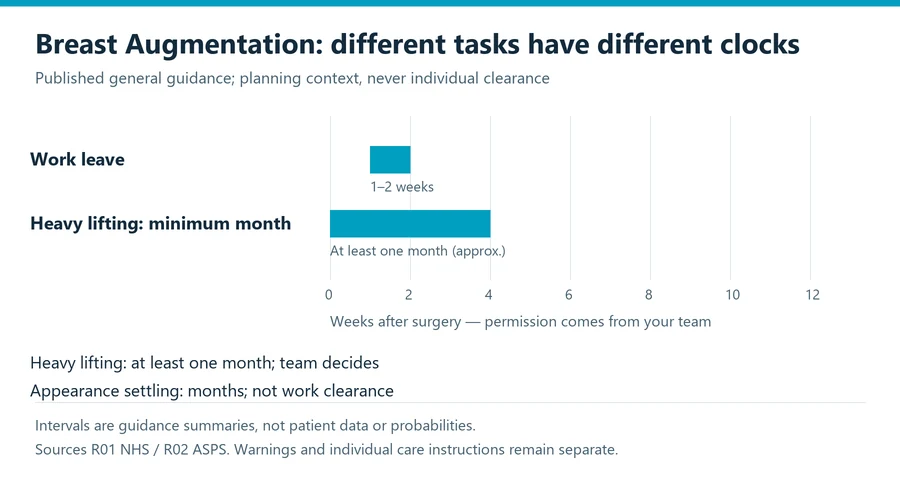
| Work leave | NHS estimate of one to two weeks | Which duties and commute does this estimate include? |
| Driving | NHS minimum of one week away | What additional conditions and insurance requirements must I satisfy? |
| Heavy lifting and strenuous exercise | NHS minimum of one month avoiding these demands | What counts as lifting or strenuous activity in my situation? |
| Most usual activities | NHS describes about six weeks | Which activities still need separate permission? |
| Appearance settling | NHS describes a period of months | When should we assess a particular concern? |
The accompanying planning graphic shows source windows and labels later or individually determined endpoints separately. It is not a study of how many patients recovered on each day. The bands are general guidance, not a probability distribution or a personal forecast. Keep the visible table with the graphic so that a screenshot does not lose the important context about procedure scope and clinical permission.
Write the actual review appointment beside a tentative return date. If the team has not yet answered a task-specific question, label that part of your plan as unresolved rather than filling it with a guess. Breast augmentation recovery becomes easier to coordinate when your employer and helpers know which dates are estimates and which instructions are current. A clear unknown is more useful than an apparently complete calendar built on assumptions.
Translate arm and chest restrictions into daily tasks
For breast augmentation recovery, list actions that involve reaching, pulling, pushing or carrying. Examples include getting a suitcase onto a shelf, moving a heavy door, lifting a child or using equipment at work. Ask the clinician which of these are relevant to your restrictions. Do not invent one weight limit that covers every action; direction, repetition and the actual task can make two activities quite different even when the objects have a similar weight.
Check the routines that happen without much thought. Where are the plates stored? Who puts groceries away? Does your work bag need to travel with you? Can another person manage a pet that may pull unexpectedly? These are questions for organizing the household, not evidence that a particular action will cause a complication. The goal is to avoid discovering an unresolved responsibility when you are already relying on someone else’s help.
Choose clothing and a routine that fit the instructions you receive. Ask the team about any relevant dressing or support-garment requirements before buying items on the strength of an online shopping list. A garment recommended to another patient may not be the garment your team wants you to use. If a practical item is difficult to manage, describe the problem and ask for an appropriate alternative instead of altering the medical plan yourself.
Arrange help with the tasks you cannot safely promise to perform. Be specific about days, times and backup coverage. A friend offering to visit is different from someone accepting responsibility for a school pickup or grocery delivery. Let your helpers know that you may receive revised instructions. That allows the arrangement to adapt without making the early estimate a deadline you must meet to avoid inconveniencing anyone.
Read the support and incision instructions literally
ASPS explains that postoperative dressings and a bra or band may be used, but incision care and support instructions vary. The organization directs patients to follow their own surgeon’s directions for activity and exercise. Ask the team to identify which parts of the plan apply to you rather than assembling a home protocol from several sources. ASPS breast augmentation recovery instructions
Ask how to use the prescribed support, when it may be removed and what to do if it causes an unexpected problem. Write down the answer in plain language. Avoid turning a published maximum duration or another person’s garment schedule into your own order. If you are unsure which instruction is current, contact the team before changing it. The right answer should refer to the operation and care plan you actually have.
The incision-care part of breast augmentation recovery needs its own instructions. Ask who will change the dressing, how care will be explained, what supplies are needed and when the wound will be examined. Do not remove tape or add a product because someone else’s photographs show a different approach. Different instructions can coexist in general patient guidance; the operative team must clarify your particular care rather than leaving you to choose the option that sounds most convenient.
Keep a separate medication record using the actual prescriptions and discharge instructions. Do not use this resource to start, stop or adjust medicines. Ask whom to contact about a missed dose, an unexpected reaction or uncertainty about a nonprescription product. A useful record contains the contact route as well as the medicine’s name. That helps a helper support the plan without becoming responsible for making medication decisions.
Make breast augmentation recovery at work a duty-by-duty discussion
Describe your job as a list of demands. Include travel, carrying equipment, moving your arms repeatedly, standing, concentrating and the availability of breaks. A job that sounds sedentary can still involve a heavy commute bag or physical tasks during the day. Bring a realistic description to the consultation so that a published one-to-two-week leave estimate does not get interpreted as a guarantee for a role the clinician has not considered.
Modified duties need an actual arrangement
Ask the employer what temporary changes are possible, then discuss those specific changes with the surgical team. A promise of light duties needs a shared definition. It may help to identify who will handle carrying, overhead tasks or other restricted responsibilities and when the arrangement will be reviewed. Do not return on the assumption that you can simply refuse any difficult task if the workplace has not agreed how it will be covered.
For home working, consider the structure of the day as well as its location. Can you shorten meetings, pause when needed and avoid additional responsibilities while working? Ask what information you should use to judge whether a proposed schedule is appropriate. You do not need to prove resilience by completing a full day as soon as you can open a laptop. The purpose is a workable return plan that remains compatible with the current medical instructions.
Keep the work estimate and clinical review date together. If you need documentation, ask for the form your employer actually requires. Avoid sharing more private medical information than is needed to explain an agreed restriction. When the plan changes, update the people responsible for coverage rather than assuming they will infer it. Breast augmentation recovery is easier to organize when a tentative date is openly tentative and there is a defined way to revise it.
Plan driving, bags and public transport together
Arrange a ride home according to the facility’s discharge requirements and discuss transport to follow-up visits. Keep driving permission separate from the ability to sit in a car as a passenger. Ask the clinician about the conditions you must satisfy and check any insurance requirements. Do not perform a quick trial drive to establish safety or use an online minimum interval as permission to drive while another restriction still applies.
If you normally use public transport, describe that journey too. It can involve a long walk, standing, carrying a bag or holding on during a sudden movement. Ask whether you need a different arrangement for a particular appointment or early return to work. The clinician can consider the demands, while you can investigate alternatives. A transport plan is more useful when it includes the complete journey rather than simply naming the vehicle.
Travel planning during breast augmentation recovery should also include a way to obtain help where you will be staying. Ask the team whether proposed travel is appropriate, how follow-up will work and what to do if a concern arises away from the facility. The fact that implants themselves can be present during travel does not establish that an immediate postoperative itinerary is suitable. Keep the question tied to surgery, timing and access to assessment rather than to the implant alone.
Exercise, intimacy and hobbies deserve their own questions
Describe the activity instead of asking only when exercise is allowed. Resistance training, swimming, running, a dance class and a gentle activity do not have identical demands. Ask whether the team wants to review you before each category and how any progression should be handled. This resource gives no exercise progression or chest-loading routine. The useful contribution is a clear inventory of the activities you want the clinician to consider.
Include non-work activities that matter to you. A hobby may involve carrying, reaching or repeated arm use even when you do not think of it as strenuous. Intimacy and sleeping arrangements can also raise practical questions. Ask about them directly rather than relying on an unnamed normal-activity milestone. A private question can be discussed with the team without needing to become a public comparison of other people’s recovery experiences.
Do not use lack of pain as the only permission signal. Ask the team what information it wants you to use and record any conditions attached to the answer. A well-defined permission for one task should not spread automatically to every similar task. If you are not certain whether an activity is included, clarify it first. This keeps the plan connected to the actual medical assessment rather than to an optimistic interpretation of a broad phrase.
Know when breast augmentation recovery needs assessment
The NHS advises prompt clinic contact for unexpected pain, burning, unusual breast swelling or skin-color changes after implant surgery. Keep the relevant daytime and after-hours contact routes accessible, and ask in advance how your team wants you to respond to an unexpected change. Do not assume a new symptom is normal because some postoperative discomfort was anticipated. Provide the time it started, how it has changed and any associated symptoms.
CDC guidance calls for prompt assessment of limb swelling or pain. New breathing difficulty, chest pain or fainting needs immediate emergency help. CDC clot warning guidance
An emergency should not wait for a routine clinic reply. In the United States, call 911 for an emergency. A photograph sent to a helper cannot rule out a serious condition. The warning information is not a diagnosis or a procedure-specific risk calculation. Follow the appropriate care route and the instructions you receive, rather than trying to treat a suspected complication from a recovery checklist.
When you receive advice about a concern, record what to do next and what change should prompt another call. If you cannot reach the planned service, use the appropriate urgent or emergency care route for the symptoms. Do not keep repeating messages indefinitely when the situation requires assessment. Your helper can organize contact details and transportation, but should not be expected to decide whether a new symptom is harmless.
Keep longer-term implant care on the calendar
Ask when appearance concerns will be reviewed and distinguish that appointment from a visit assessing early healing. Bring specific questions about changes you have noticed without deciding the cause yourself. A photograph or a comparison with someone else’s implant settling does not establish a problem or exclude one. The team needs the actual history and examination to explain what the change means and what follow-up is appropriate.
Keep breast augmentation recovery records with the implant information and ask how continuing follow-up should be organized. The initial recovery calendar should not become the only record of your breast surgery. Make a separate list for later care questions, so that returning to work does not get mistaken for the end of every responsibility. You can ask the clinician to explain the purpose of each future visit without assuming that every check must occur on a universal schedule.
Before surgery, finish a task list covering transport, care instructions, support, work, lifting and contact routes. After discharge, revise it using the actual operation and current directions. Review it again when the team changes an instruction. This makes breast augmentation recovery a series of practical decisions with accountable follow-up, instead of a single countdown that combines healing, appearance and every activity into one date.
For related context, see the breast augmentation procedure guide and the plastic surgery recovery planning hub.
Sources and review scope
Plastic Surgery Editorial Team. Source records checked through October 12, 2026. Review scope: source and editorial checks for general education. No individual clinical assessment is represented.
- NHS breast enlargement recovery guidance. nhs.uk. Source date: 2023-09-21. Checked 2026-10-12.
- ASPS breast augmentation recovery guidance. plasticsurgery.org. Publication/update date not stated. Checked 2026-10-12.
- CDC about venous thromboembolism. cdc.gov. Publication/update date not stated. Checked 2026-10-12.