
Breast augmentation cost is best compared using an assessed surgical plan, an itemized current quote and a separate account of future-care responsibilities. The American Society of Plastic Surgeons page displayed an average of $4,875 for implant augmentation and $5,719 for augmentation with fat grafting when checked October 12, 2026. These are partial fees excluding anesthesia, operating-room facilities and related expenses. The underlying fee year is not stated, and the two procedures are not interchangeable packages with equivalent clinical scope.
Ask the surgeon to establish which plan is appropriate before comparing its price. Then confirm whether the quoted amount includes the devices, professional fee, anesthesia, facility, required supplies and planned follow-up. Keep personal assistance and time away from work distinct from surgical charges. If considering implants, also ask about product-specific monitoring, warranty terms and financial responsibilities for possible later care. The initial operation’s price does not describe every expense you might encounter over time.
What does the ASPS breast augmentation cost figure include?
The ASPS breast augmentation cost page separates implant augmentation from fat grafting and explicitly notes excluded anesthesia, facility and related expenses. Record the category and limitations beside the displayed average. Do not describe $4,875 as the national all-inclusive implant surgery price or add the two category averages together for a combined operation. An actual combined plan needs its own assessed scope and written quotation.
The page identifies experience, procedure type and location as fee influences, but it does not provide a formula for a local total. A check date in 2026 does not establish that the average was collected in 2026. Nor does a separate procedural statistics report date this cost endpoint. Keep the underlying fee year marked unspecified. That is more useful than assigning an unsupported year and using it to claim a precise change in prices.
Use the average to organize questions about charge components. A higher quote may include excluded services or a different plan; a lower headline may omit them. Ask the practice to explain the actual difference. The broad average does not establish the fair price of a particular device or quantify a clinician’s value. Transparent inclusions and an appropriate assessed plan give you a defensible comparison without pretending that every operation behind an average matches your circumstances.
Define breast augmentation cost by the proposed procedure
The ASPS consultation guidance describes review of goals, medical history and breast assessment before options and risks are discussed. Your financial worksheet follows that evaluation. Ask whether the proposed operation involves implants, fat grafting or another specifically described combination. If a lift is also proposed, distinguish that additional operation in the plan and quote rather than assuming augmentation automatically includes it.
Do not use price to select a device size, placement or surgical approach. Those choices need an individual discussion of anatomy, goals, options and risks. A lower device charge does not establish suitability, and a premium label does not prove a better result. The worksheet should preserve the clinician’s actual recommendation and the choices you are considering, with separate quotes where the scope differs. It cannot substitute an arithmetic preference for clinical assessment.
If previous breast surgery is involved, disclose it before requesting a firm estimate. A first-operation promotional offer may not cover revision, removal or reconstruction-related work. Request a written description of the actual proposed services and a current quote reflecting them. A generic augmentation average cannot supply a revision surcharge or determine what an existing implant-related concern requires. Unresolved clinical scope should remain unresolved in the budget until assessment clarifies it.
| Breast augmentation cost scope field | Written detail to obtain | Why it matters |
|---|---|---|
| Procedure | Implants, fat grafting or defined combination | Different operations need separate scope |
| Device | Proposed manufacturer, model and included charge | Connects the quote to the actual product |
| Additional operation | Any lift, removal or other separately proposed service | Prevents assuming a broader package |
| Facility and anesthesia | Setting, personnel and charge arrangement | Identifies invoices beyond the professional fee |
| Follow-up | Included assessments and conditions | Defines initial aftercare responsibility |
| Future monitoring | Product-specific discussion and billing arrangements | Separates later obligations from initial price |
Devices and breast augmentation cost inclusions
Ask whether the device charge is already included in the professional or package fee. If it is, label it included rather than adding a second implant estimate from another source. If separate, record the quoted amount and which product it buys. A device surcharge should identify the actual difference in the proposed plan. Do not infer that an advertised “implant upgrade” is necessary simply because it appears on a pricing menu; discuss the clinical choice independently.
Request the device information and applicable patient labeling so you can understand the product proposed. The financial agreement should remain consistent with that plan. If product choice changes after consultation, request an updated quote and identify which prior version it replaces. Mixing an earlier low device charge with a later package for another product creates a total no practice actually offered. Retain both historical documents, but compare only current available plans.
Ask what happens if the operation is postponed or the product is changed before surgery. Refund conditions for deposits or device-related payments should be explained in the actual agreement. Do not assume a separate device payment is always refundable, always retained or transferable. The relevant terms depend on the practice and contract. A clear answer lets you assess the commitment while keeping the clinical decision free from pressure created by an unexplained advance payment.
Build a complete breast augmentation cost quote
Request professional, device, facility and anesthesia charges, even if they ultimately appear inside one package. Identify which are fixed, estimated or conditional and which office bills them. A package should state what it includes and any foreseeable exclusions. Ask how a change in the assessed plan or operative-time estimate would affect the bill. Do not assign a zero to an unanswered item merely to complete the spreadsheet; keep it in an unresolved column until clarified.
Add tests, prescriptions, garments or supplies only when the clinical team confirms the plan and the practice explains whether each is included. Avoid turning a generic recovery shopping list into required expenditure. A branded product sold by the practice is not automatically necessary simply because it is convenient to purchase there. Ask about its purpose and permitted alternatives, letting the clinician provide the relevant instructions rather than substituting budget-driven choices for the plan.
Personal support belongs in a separate column. Transport, help with household responsibilities and unpaid time away from work can affect practical affordability without changing the medical fee. Use your own arrangements rather than a universal recovery duration or allowance. Clinical advice determines the appropriate timetable; your budget should adapt to it. Keeping these costs visible prevents a complete surgical quote from being mistaken for the full amount you need available in your circumstances.
Worked example: breast augmentation cost after exclusions
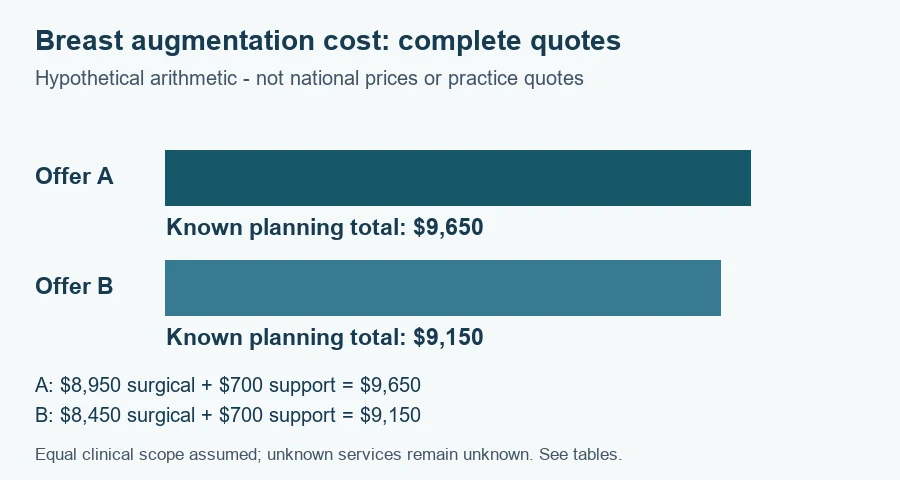
This original example uses hypothetical US-dollar inputs, not national prices or actual practice offers. Assume clinically comparable implant plans, the same defined device scope and the same follow-up arrangements. Offer A lists $4,900 professional, $1,200 devices, $1,600 facility and $1,000 anesthesia. Other confirmed surgical expenses add $250 and personal support adds $700. Its known planning total is $9,650. Offer B lists an $8,200 package explicitly including the professional, devices, facility and anesthesia, plus $250 other surgical expenses and $700 support, totaling $9,150.
Under those assumptions, B’s higher headline yields a $500 lower known planning total. The calculation changes if any claimed inclusion is wrong or another necessary service is confirmed. It cannot establish clinical equivalence between real implant choices, compare implants with fat grafting or choose a surgeon. Resolve those differences before using the worksheet. The arithmetic shows the effect of exclusions in an otherwise comparable plan, not a ranking of procedures or outcomes.
| Hypothetical breast augmentation cost item | Offer A: separate charges | Offer B: documented package |
|---|---|---|
| Professional charge | $4,900 | Included in $8,200 package |
| Devices | $1,200 | Included |
| Facility | $1,600 | Included |
| Anesthesia | $1,000 | Included |
| Other confirmed surgical expenses | $250 | $250 |
| Known surgical obligation | $8,950 | $8,450 |
| Personal support | $700 | $700 |
| Known planning total | $9,650 | $9,150 |
If a $1,000 deposit is credited toward A’s $8,950 surgical obligation, the unpaid surgical balance becomes $7,950. The obligation does not become $9,950 merely because you paid some of it earlier. Trace each payment to the bill it reduces and retain the receipt. If a consultation payment is credited only under certain conditions, record those conditions explicitly instead of treating the consultation as both a separate expense and an unconditional discount.
Long-term breast augmentation cost needs a separate horizon
The FDA breast implant guidance states that implants are not lifetime devices and that complications can require additional surgery. Individual device life cannot be predicted. That supports a discussion of future responsibilities, not an automatic assumption that everyone replaces implants on a fixed ten-year schedule. Ask the clinician about the proposed device’s labeling and your monitoring plan, then ask the relevant billing offices how those services are charged.
Keep routine breast-health screening and implant-related monitoring distinct in your questions. The FDA explains that silicone rupture can be silent and discusses MRI and ultrasound assessment. Your clinician can explain the applicable product-specific recommendations and how they relate to your other care. This worksheet does not prescribe an imaging interval. Financially, ask who orders and performs any recommended monitoring, what the current charge basis is and whether insurance coverage is confirmed or uncertain.
Do not add a fabricated national imaging fee or future operation price to create a lifetime total. Instead, use clearly labeled scenarios based on figures you actually obtain. For example, an invented $300 monitoring expense repeated twice gives $600, and repeated four times gives $1,200. Those counts and rates are assumptions, not a screening schedule or a prediction. Update the scenario when the actual clinical recommendation, local charge or coverage information changes.
Warranty terms do not settle breast augmentation cost liability
Ask for the actual warranty terms associated with the proposed product rather than relying on a broad “lifetime warranty” phrase. Identify what the document covers, what conditions apply and whether it refers to a device replacement, financial assistance or particular services. A device-related benefit is not automatically payment for surgeon, anesthesia, facility, tests, personal support or travel. Keep every unconfirmed component outside the guaranteed benefit column until the relevant written terms establish it.
Compare the warranty and practice revision policy separately. They may have different issuers, eligibility conditions and limits. Ask who submits a claim and which documentation is needed, without assuming a future event will qualify. A warranty is not a guarantee that no complication will occur or that a future operation will be appropriate. The financial question is which liabilities the document actually transfers and which remain yours under the circumstances it describes.
For a hypothetical illustration, a $1,200 device credit applied to an $8,000 later-care bill leaves $6,800 before any other confirmed benefits. That arithmetic is not a prediction of future care or a description of any manufacturer’s warranty. It simply demonstrates why a benefit covering one component should not be described as covering the entire operation. Use actual written terms and current estimates if a specific later-care situation arises, rather than importing these example numbers into your plan.
Insurance and breast augmentation cost
The ASPS cost page advises reviewing the actual insurance policy because cosmetic augmentation and related future care may be excluded. Do not assume coverage based on another patient’s experience or a clinician’s general statement that insurance is accepted. Ask the insurer about the specific service and the billing offices about estimated patient responsibility. Reconstructive and cosmetic services can involve different circumstances; the worksheet cannot determine your eligibility for a benefit.
If discussing possible coverage for later evaluation or treatment, keep an insurer estimate distinct from confirmed payment. Record authorization requirements, network questions and any stated exclusions. A covered initial service does not automatically establish coverage for all future implant-related care. Do not subtract an anticipated reimbursement from the cash commitment until its status and your liability are clear. Financial uncertainty should remain visible rather than becoming an unsupported promise of savings.
An insurance decision also does not settle the clinical plan. The appropriate operation and monitoring need their own assessment. Ask for an explanation of alternatives and costs if the insurer does not cover the proposed service, then consider the actual obligation. This preserves the distinction between a benefit determination, a medical recommendation and your choice to proceed. None should be silently substituted for the others simply to make the budget easier to complete.
Financing and breast augmentation cost commitments
Read quote expiration, cancellation and rescheduling terms before paying. Ask how a change in the assessed plan or a clinician-advised postponement affects your deposit and remaining liability. Retain written clarification rather than relying on an oral exception. A provisional estimate should be identified as provisional, with a clear point when the practice issues a final quote. Do not combine expired promotional figures with a later plan that no longer qualifies.
For borrowing, record the financed balance after credited payments, annual percentage rate, fees and total repayment. The CFPB explanation of deferred-interest promotions describes how failure to meet payoff conditions can trigger interest back through the promotional period. Review the actual agreement. This guide does not recommend a lender; it separates borrowing expense from the medical purchase so the full financial commitment can be understood.
| Final breast augmentation cost check | Written evidence | Purpose |
|---|---|---|
| Current procedure and device | Assessed plan and product details | Identifies the service being purchased |
| Initial complete obligation | Itemized quote and inclusions | Reconciles professional and other charges |
| Credited payments | Receipt and credit conditions | Establishes the remaining balance |
| Future care | Clinical monitoring discussion and billing information | Keeps later responsibilities visible |
| Warranty and revision terms | Separate issuer documents | Avoids treating partial benefits as complete coverage |
| Insurance and borrowing | Actual policy response and credit agreement | Separates conditional benefits and finance costs |
Keep breast augmentation cost records connected to the device
Keep the proposed product information, current quotation and later treatment record together. If the chosen device differs from the initial discussion, request a financial reconciliation and retain the updated product details. The identity matters for future clinical conversations as well as warranty questions. A historical quote for another device should not be used as evidence of your current coverage or future responsibilities simply because both operations were called augmentation.
Use a dated log to distinguish the practice’s commitments, a manufacturer’s terms, an insurer’s estimate and your personal arrangements. Each issuer answers a different question. If the documents disagree, ask the relevant office to resolve the discrepancy instead of combining the most favorable sentence from each. Record confirmed changes to the obligation and show how credited payments affect the remaining balance. This produces a practical audit trail without pretending to guarantee future prices or medical outcomes.
Before accepting a breast augmentation cost quote
Read the breast augmentation guide for procedure context and bring the device, care and payment questions to consultation. Ask for a current written estimate whenever the assessed plan changes. Check that the device and procedure description agree across the plan, quote and consent documents. Missing information should prompt clarification rather than a convenient zero in the worksheet.
The useful comparison has two financial horizons: the known initial obligation and honestly conditional future responsibilities. Count included services and credits once, keep personal support separate and preserve unknowns. A lower complete total matters only after the assessed care and contractual scope are clear. It cannot determine the right procedure, guarantee a result or turn an implant-related warranty into a promise of cost-free lifetime care.
Sources and review scope
Plastic Surgery Editorial Team. Source records checked through October 12, 2026. Review scope: source and editorial checks for general education. No individual clinical assessment is represented.
- ASPS implant and fat-grafting augmentation fee categories. American Society of Plastic Surgeons. Publication/update date not stated. Checked 2026-10-12.
- ASPS breast augmentation consultation. American Society of Plastic Surgeons. Publication/update date not stated. Checked 2026-10-12.
- FDA breast implant risks and future-care context. U.S. Food and Drug Administration. Publication/update date not stated. Checked 2026-10-12.
- CFPB deferred-interest credit explanation. Consumer Financial Protection Bureau. Source date: 2024-01-22. Checked 2026-10-12.