
A bra line back lift removes excess upper-back skin and associated tissue to change a hanging fold. It is different from reducing a small fat bulge, and its main tradeoff is a surgical scar in exchange for a change in contour. The name describes a proposed clothing-level scar location; it does not guarantee that the scar will remain concealed in every garment. The useful first decision is whether your concern is loose skin, localized fullness, or a combination, followed by whether the proposed scar and recovery are acceptable to you.
The procedure-specific literature describes upper-back tissue excess associated with aging and weight changes. However, a published technique review is not a personal eligibility rule or a reliable numerical forecast. A consultation should connect an examined finding to a clearly described operation, with both its intended benefit and its limits written down. Bra-Line Back Lift technique review
Locate the concern before comparing treatment names
An upper-back roll, a side-chest fold and an abdominal apron are different locations. A photograph of the entire torso can make these concerns appear connected without establishing that one operation addresses them all. Describe the area that bothers you using your own landmarks: under a garment band, beside the breast, near the underarm, or farther down the back. This gives the examination a specific question instead of turning a broad dissatisfaction into an unspecified full-body request.
Separate appearance from daily experience. You might want a smoother outline in clothing, less folded tissue in a particular position, or easier garment fit. Those are different outcomes and should not disappear into a single phrase such as better contour. Record which matters most and which would be a welcome secondary change. A procedure should be judged against the agreed task, rather than against an impressive photograph showing several unrelated improvements.
Do not assume that a fold diagnoses its own cause. Tell the clinician when it became noticeable, whether your weight has changed, and whether the appearance changes substantially between garments. An assessment can then distinguish the concern you see from the tissue change the proposed treatment is meant to address. If the explanation remains vague, ask for it to be restated in ordinary language before comparing prices or dates.
| Observation to describe | Question for the examination | Planning mistake to avoid |
|---|---|---|
| A hanging upper-back fold | Is excess skin an important contributor? | Assuming every roll is only fat |
| Localized fullness without the same hanging fold | What tissue is the proposed treatment targeting? | Treating fat reduction and skin excision as equivalent |
| A fold continuing toward the side chest | What are the actual treatment boundaries? | Expecting an isolated back procedure to change every adjacent area |
| Garment-dependent appearance | How will the scar relate to garments I use? | Assuming the procedure name guarantees concealment |
Skin removal and fat reduction answer different questions
ASPS describes surgical body contouring after major weight loss as removal of excess sagging skin and fat. That broader category includes several operations in different regions. It does not imply that each operation treats the whole torso or that every person who has lost weight needs surgery. The name of the proposed procedure should be accompanied by an explanation of which tissue and area will change. ASPS body-contouring overview
The FDA distinguishes non-invasive contouring from operations that remove tissue. Some devices target small fat bulges; effects can be temporary, and these treatments are not weight-loss treatment. That distinction matters when a device course is presented as an alternative to excising a hanging fold. Ask what outcome is actually supported for the particular device and body site, rather than accepting the shared term body contouring as evidence of equivalence. FDA non-invasive body-contouring information
A useful comparison has the same starting concern on both sides. If one offer promises less fullness and another promises removal of loose skin, their prices are attached to different tasks. You can still consider both, but first decide whether either task matches your priority. A cheaper option that has not been proposed for the relevant finding is not automatically better value; a more extensive operation is not automatically the appropriate answer either.
Waiting or accepting the current appearance also belongs in the comparison. A decision to defer can reflect a changing weight trajectory, an unacceptable scar tradeoff, or difficulty arranging recovery support. It is not evidence that you failed to understand the procedure. The operation is elective, and the threshold for accepting its burdens should be based on your goals rather than the existence of a named surgical technique.
A clothing-level name is not a scar guarantee
ASPS explains that body-contouring incision length and pattern depend on the amount and location of tissue excess, personal preferences and surgical judgment; concealment by clothing is not always possible. That is a more useful starting point than the word hidden. Ask where the proposed scar would begin and end, including any continuation toward the side of the torso, and how the plan relates to the clothes you actually wear. ASPS incision-planning context
Bring more than one relevant garment or describe the range of bands, necklines and backs you normally use. The objective is to understand the proposal, not to dictate an incision based on fashion alone. A plan that works with one favored garment may not meet your preference for an open-back dress, swimwear, a sports top or shirtless activities. For someone who does not wear a bra, the procedure name still needs translation into an actual scar location and personal clothing priorities.
Judge the scar and the contour separately
A smoother outline and an acceptable scar are two outcomes. One does not prove the other. Before surgery, describe your tolerance for a scar that might be visible in some situations. Also ask how scar appearance would be assessed after healing and what would count as a problem needing review. This creates a more balanced expectation than treating the scar as an invisible technical detail.
When reviewing example photographs, seek information about the time after surgery, the garments being used and which operations were performed. A photograph with a band covering the back cannot show the scar underneath it. Conversely, a close-up scar photograph may say little about the person’s original contour concern. Both views can be informative when their purposes are explicit; neither is a substitute for discussing your proposed operation.
For example, your main goal might be a less noticeable fold under a work shirt while your favorite swimwear leaves more of the back exposed. Those preferences are not contradictory, but they create two separate questions: what change is being sought in the shirt, and what visible tradeoff might be accepted in swimwear? State both at the outset. Otherwise, a discussion focused on a single covered view can appear to resolve a concern that remains important in another setting.
Keep this comparison descriptive rather than grading your body against somebody else’s proportions. Record the situations in which the fold bothers you and the situations in which a scar would matter. If the proposed benefit is meaningful only in one garment, that may still be worthwhile to you; it simply deserves to be understood before a permanent decision. If an important clothing preference cannot be reconciled with the proposed scar, request a different plan or defer the procedure instead of relying on the word concealed.
Read the combined-surgery study by its actual groups
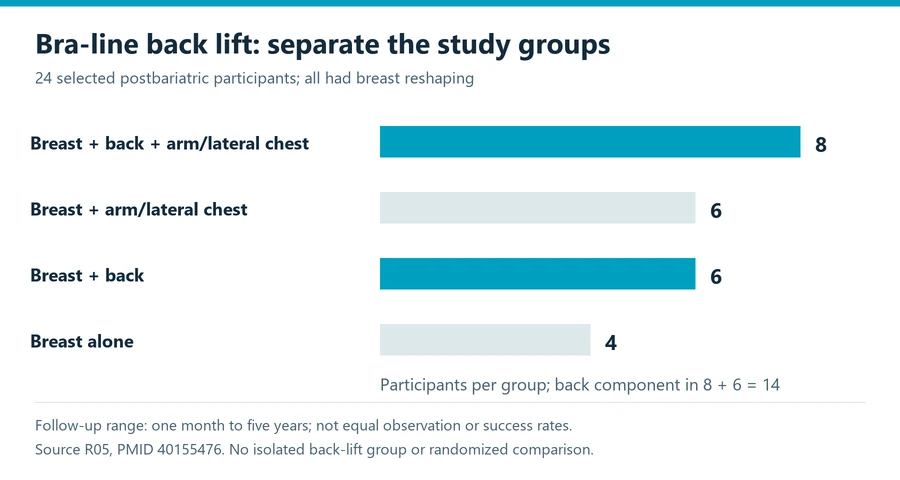
A 2025 observational report included 24 selected postbariatric patients undergoing breast autoaugmentation with differing combinations of upper-body procedures. Eight had breast reshaping, a bra-line back lift and arm/lateral-chest surgery; six had breast reshaping with arm/lateral-chest surgery; six had breast reshaping with a back lift; four had breast reshaping alone. Follow-up ranged from one month to five years. These are treatment groups, not success categories. Original upper-body shaping study, Table 1 and results
The chart makes one source-derived calculation explicit: eight plus six equals 14 people whose recorded operations included a back lift. The other ten did not have that component. All 24 had breast reshaping. Therefore, the entire series should not be described as 24 isolated back lifts, nor as a randomized comparison between back lifting and another treatment. It cannot separate the back component’s contribution from the other operations or establish your personal complication probability.
The longest observation is not everyone’s follow-up
A range ending at five years does not mean that every participant was evaluated at five years. The table includes much shorter observations. This distinction matters when a study is summarized using its longest timepoint: the phrase long-term can conceal how differently participants were observed. For a result that interests you, ask which participants supplied the measurement and when it was obtained.
This report helps explain why upper-body planning can involve several regions, but it is not proof that combining operations is preferable for everyone. It is also not evidence about all people with upper-back folds: its selected postbariatric population and combined procedures limit generalization. The older procedure review uses optimistic descriptions without providing a cohort denominator in its accessible abstract. Such wording should not become a universal satisfaction claim in your decision.
| Evidence item | What it actually describes | What it does not establish |
|---|---|---|
| 2025 series, 24 participants | Selected combined upper-body treatment experience | Twenty-four isolated back lifts |
| Back-lift component in 14 participants | Eight combined with arm surgery, six without that component | Fourteen comparable isolated operations |
| Follow-up range of one month to five years | Unequal observation periods | Every participant followed for five years |
| 2018 online technique review | Procedure description and authors’ experience | A universal success rate or personal prediction |
Keep combined treatment scope visible in consent and quotes
A back lift may be discussed alongside breast, arm or other torso procedures. Write down each component separately, with its intended change and the concern it is meant to address. This prevents a broad package name from replacing an understandable treatment plan. If a proposed component does not match a priority you have expressed, ask why it is being included and what would happen if it were deferred.
Compare one-stage and staged proposals as complete plans, not simply as the number of surgery dates. Ask how each proposal changes the areas needing care, the expected restrictions, the follow-up arrangements and responsibility for any later concern. The answer must come from the treating team; a published combined series does not establish an optimal sequence for your health or circumstances. You should be able to describe the chosen scope accurately without remembering a marketing label.
Photographs used to explain a combined plan need the same transparency. If breast and arm procedures appear in an example, identify them before attributing the overall silhouette to back surgery. Likewise, if a back view is the main example, ask how the side-chest boundary and any connected scar were handled. These questions help you evaluate relevance rather than comparing your untreated whole torso with an unexplained multi-procedure result.
Candidacy is a health assessment, not a garment test
ASPS’s general body-contouring guidance emphasizes stabilized weight, health compatible with healing, nonsmoking and realistic goals. These are broad assessment considerations, not a checklist that grants automatic approval. The surgeon needs to evaluate your current circumstances and the proposed scope. A back fold that can be covered by a band is not, on its own, evidence that surgery is appropriate or that the planned scar will heal acceptably. ASPS body-contouring candidacy
Make the weight history understandable: distinguish an intended future change from the course that has already occurred. Tell the team about prior torso procedures and what records are available. If the proposal draws on a study of people after bariatric surgery, ask whether that population resembles your own situation. Matching a procedure name is weaker evidence of relevance than matching the actual concern, health context and treatment combination.
A practical decision also requires workable support. Identify who can help with activities the team expects you to avoid, how you will reach follow-up appointments and how you will obtain advice outside office hours. These arrangements do not remove surgical risk. They make the proposed care plan real enough to assess before booking, especially when several areas would be treated together.
Risks need both definitions and a response plan
ASPS lists body-contouring risks including bleeding, fluid collection, infection, wound-healing problems, altered sensation, unfavorable scars, remaining laxity and serious clot-related complications. The list supplies categories, not a numerical risk for an isolated bra line back lift. A technique description is not evidence that an important complication is impossible. Ask how the team discusses each relevant category for the actual operation being proposed. ASPS body-contouring risks
When a practice gives you its experience, clarify what was counted. Were the observations from isolated back procedures, combined upper-body operations or a broader contouring population? Did the report count people, wound events or later procedures? Was a revision for scar appearance separated from treatment of an early complication? These distinctions matter more than a reassuring percentage without a definition.
Request written instructions for concerns that need a call, urgent assessment or emergency care. The treating team should supply the relevant symptoms and contacts for your procedure and health context. Do not use a general article to decide whether a new postoperative problem is safe to watch. Arrange the response plan before surgery so that uncertainty is not compounded by an unavailable office or an unclear after-hours number.
Recovery planning should match upper-back demands
ASPS describes dressings, possible temporary drainage tubes and individualized wound-care and follow-up instructions for body contouring. The details depend on the operation. A published statement about a particular closure or drain practice should not be converted into a promise about your own aftercare. Ask the team to explain the actual plan, including whether another procedure changes the instructions you would otherwise receive. ASPS recovery guidance
Make a task list based on your life: dressing, reaching for shelves, fastening a garment, handling a backpack, doing your job and caring for others. Then ask which activities require help or clearance and how you will know when to reassess them. The value lies in translating restrictions into specific arrangements, not borrowing a recovery calendar from someone whose operation and work demands were different.
Separate wound checks, activity clearance, scar assessment and contour assessment. They answer different questions and may belong to different visits. Before travel or returning to demanding work, confirm how the relevant decision will be made. An attractive early photograph does not establish readiness for every activity or a final scar outcome.
Compare the cost of the same operation
ASPS notes that body-contouring costs vary with procedure scope, surgeon and location. No defensible national total price for this exact isolated procedure was verified for this guide. A quote should therefore be evaluated as a written description of services, not measured against an invented average. Keep the surgeon’s fee separate from the full amount you are expected to pay. ASPS cost context
| Quote field | Information to request | Why it matters |
|---|---|---|
| Procedure scope | Isolated back lift or named additional components | Different operations cannot be compared as the same purchase |
| Professional and facility charges | What is included and what is billed separately | A surgeon fee is not necessarily a total |
| Follow-up care | Included visits and responsibility after travel | The care arrangement continues beyond surgery day |
| Later treatment | Terms for scar concerns, complications or elective changes | Revision language can refer to different situations |
Add time away from work, transport and help at home to your own budget without presenting them as a surgical fee. If a staged proposal is being compared with a combined operation, keep each stage and its assumptions visible. Ask for missing items to be identified rather than assuming they are free. The meaningful decision is whether the examined concern, accepted scar tradeoff and complete care plan justify the commitment for you.
For related planning, explore liposuction, breast lift, recovery planning and questions to ask a plastic surgeon.
Sources and review scope
Plastic Surgery Editorial Team. Source records checked through October 12, 2026. Review scope: source and editorial checks for general education. No individual clinical assessment is represented.
- Bra-Line Back Lift: original technique review. pubmed.ncbi.nlm.nih.gov. Source date: 2018-10-22. Checked 2026-10-12.
- ASPS body-contouring overview. plasticsurgery.org. Publication/update date not stated. Checked 2026-10-12.
- FDA non-invasive body-contouring technologies. fda.gov. Publication/update date not stated. Checked 2026-10-12.
- ASPS body-contouring incision-planning context. plasticsurgery.org. Publication/update date not stated. Checked 2026-10-12.
- Integrated Approach to Upper Body Shaping: Long Time Results. pmc.ncbi.nlm.nih.gov. Source date: 2025-03-28. Checked 2026-10-12.
- ASPS body-contouring candidacy. plasticsurgery.org. Publication/update date not stated. Checked 2026-10-12.
- ASPS body-contouring risks. plasticsurgery.org. Publication/update date not stated. Checked 2026-10-12.
- ASPS body-contouring recovery. plasticsurgery.org. Publication/update date not stated. Checked 2026-10-12.
- ASPS body-contouring cost context. plasticsurgery.org. Publication/update date not stated. Checked 2026-10-12.