
Autologous breast reconstruction rebuilds breast form using tissue from your own body. It can be worth considering when you want to understand alternatives to an implant, but the decision involves two places: the reconstructed breast and the area supplying tissue. A useful plan explains both, fits the cancer treatment plan and describes the expected sequence of care. It should also leave room for choosing a different reconstruction method or remaining flat. There is no single own-tissue operation that answers every person’s priorities.
Start with the question you want reconstruction to solve. Is your main concern breast shape in clothing, avoiding a permanent device, minimizing operations, retaining function at a donor site, or understanding a previous reconstruction problem? Those goals can point in different directions. The most informative appointment is one where you can explain your priorities and hear how the proposed method addresses them, including what it cannot provide. A technique name alone does not tell you whether the entire course is a good fit.
This guide addresses the own-tissue family of options. It does not assume that everyone needs reconstruction, that a preferred donor area is usable, or that one study can predict an individual’s experience. Its planning tools separate anatomy, treatment sequence, complications and patient-reported outcomes so that those questions remain visible rather than disappearing behind a general satisfaction score.
What counts as own-tissue reconstruction?
The National Cancer Institute describes reconstruction using skin, fat, blood vessels and sometimes muscle from another part of the body. A flap may remain connected to its original blood supply or be transferred with its vessels reconnected. Donor locations include the abdomen, back, thigh and buttock. Own-tissue reconstruction can also be combined with an implant; “flap” does not always mean device-free. NCI reconstruction guidance
For your own decision, separate three descriptions that are often compressed into one label. First is the donor location. Second is how the tissue receives its blood supply after transfer. Third is whether a device remains part of the breast reconstruction. Someone can understand one of those descriptions while still being unclear about the others. Writing them on separate lines makes it easier to identify an unanswered question before consenting to a particular course.
For example, asking whether a reconstruction is “natural” is less precise than asking whether it uses your tissue, whether it includes an implant and what changes are expected at the donor area. The first question can invite an appealing but ambiguous description. The second set produces information you can compare. Likewise, a familiar acronym should not be treated as a shorthand for an easy recovery, a particular final appearance or freedom from additional treatment.
Location, blood supply and device status are separate choices
The American Society of Plastic Surgeons describes different flap techniques and the monitoring needed when transferred tissue depends on reconnected blood vessels. Its techniques page is an introduction, not a personalized suitability test. ASPS reconstruction techniques
The following comparison is a question map rather than a ranking. It asks for the missing details that matter to the whole treatment course. It deliberately does not assign a best donor location or reproduce an operation recipe.
| Description you hear | What to clarify | What the label alone cannot establish |
|---|---|---|
| Abdominal tissue | Exact flap, muscle involvement, scars and donor-site plan | That every abdominal option has the same functional burden |
| Back tissue | Tissue contribution and whether a device is included | That the reconstruction is automatically implant-free |
| Thigh or buttock tissue | Usable tissue, scar location and expected functional assessment | That an alternative donor location is appropriate for everyone |
| Free flap or pedicled flap | Blood-supply strategy and monitoring arrangements | That one category guarantees a better personal outcome |
| Own tissue plus implant | Which goal each component addresses and device follow-up | That using a flap removes all device responsibilities |
Build a two-site decision, not a breast-only comparison
A breast-only picture can make an own-tissue plan look more straightforward than it is. Instead, create two parallel lists. The breast list contains the changes you hope to achieve and the uncertainties you want explained. The donor list contains the activities and physical commitments you do not want overlooked. Neither list needs to be long, but both should be specific enough to change the conversation if a proposed method conflicts with your priorities.
On the breast side, describe the situations that matter to you: wearing a particular kind of clothing, handling differences between sides, understanding nipple options or managing the appearance of existing scars. Do not reduce those goals to the word “normal.” That word can conceal very different expectations. Asking what will be reconstructed, what will remain different and which finishing steps are optional gives you a clearer account of the proposed result.
On the donor side, think about ordinary demands rather than athletic labels alone. Your work may involve lifting, prolonged sitting, reaching or unpredictable physical tasks. Caring for a child or another adult may present different practical constraints from office work. The purpose of describing these activities is to obtain an individualized recovery and function discussion, not to decide for yourself which tissue is safe to transfer. The clinical assessment still has to establish that.
Put unresolved questions in writing. If an answer is “it depends,” ask which finding it depends on and when that finding will be known. A useful conditional answer might distinguish an issue settled during examination from one resolved by further assessment. An unqualified promise, by contrast, can leave you unable to understand why a plan later changes. Keep the conditions attached to the answer when you compare alternatives.
Coordinate reconstruction with the cancer plan
NCI describes immediate and delayed reconstruction and explains that cancer treatment can affect the choice and timing. The ASPS overview also frames reconstruction as a process that may involve more than one procedure. Those descriptions do not supply a universal calendar for an individual patient. ASPS reconstruction overview
A practical planning record has a cancer-treatment column beside the reconstruction column. Record who is responsible for decisions in each column and who will communicate changes between teams. This is particularly useful when a treatment decision is not final at the first consultation. You need to know whether the proposed reconstruction is a complete recommendation or a provisional plan that will be revisited when additional information is available.
Ask how the alternatives would be explained if the treatment plan changes. That question is different from asking a reconstruction team to promise that nothing will change. It seeks a decision process: what would be reconsidered, which team would explain the implications and how you would participate. A written contingency discussion can help prevent an unexpected change from feeling like a decision made without you.
Do not use this guide or a general online timeline to delay prescribed cancer care. The relevant schedule is the one agreed by the treating teams for your situation. Equally, do not assume that choosing later reconstruction means you have made an inferior choice. Ask what the timing decision is intended to achieve, what tradeoffs accompany it and which questions remain open. A reasoned plan is more useful than a slogan about acting early or waiting.
Understand the whole course before counting operations
“One operation” can mean the main tissue transfer, while “the reconstruction” may refer to a longer course. Before comparing counts, ask what each count includes. Does it include finishing work, an optional symmetry procedure or later treatment for a complication? Is the number describing a proposed course or reporting what happened in a study? Without that definition, two seemingly comparable numbers may answer different questions.
Use a stage record to distinguish agreed treatment from possibilities. Give each possible step a reason, a decision point and a responsible team. Mark an optional step as optional. Mark a contingency as a contingency. This avoids turning every conceivable future procedure into a certainty, while also avoiding an overly simple account that leaves you unprepared for further decisions.
The same distinction matters when looking at photographs. A photograph may represent a particular point in a course, but without context it does not reveal the operations included, the donor-site experience or the person’s priorities. Ask what a documented example can illustrate and what it cannot tell you. Do not use an attractive breast image as evidence that someone else had an uncomplicated recovery or achieved your preferred outcome.
What complications should the conversation cover?
ASPS lists concerns including bleeding, infection, healing problems, anesthesia risks and partial or complete loss of a tissue flap. Its safety discussion also addresses changes in sensation and risks that apply when an implant is included. This is a topic list for an individualized explanation, not a numerical prediction. ASPS reconstruction safety information
Ask the team to connect each relevant concern to the proposed course. Which concerns involve the breast, which involve the donor site and which could affect both? How will the team explain a change in the plan if tissue does not behave as expected? Who provides instructions after discharge, and who is available when you need to report a problem? Clear arrangements matter even when no one can promise an uncomplicated course.
Request the actual discharge instructions rather than using an internet symptom list as a substitute. You should know how to reach the treating service and when that service wants you to seek urgent assessment. If there is an immediate emergency, use emergency care rather than waiting for an online answer. The guide cannot diagnose a postoperative concern or establish a safe waiting period from a description.
Be careful with percentages supplied during a consultation. Ask for the endpoint, the patients included and the time period. A count of any recorded complication is different from a count of total flap loss. A return to an operating room is not automatically the same as a failed reconstruction. Do not subtract a complication percentage from one hundred and label the remainder a satisfaction rate. Those are different measurements.
Reading the patient-reported evidence honestly
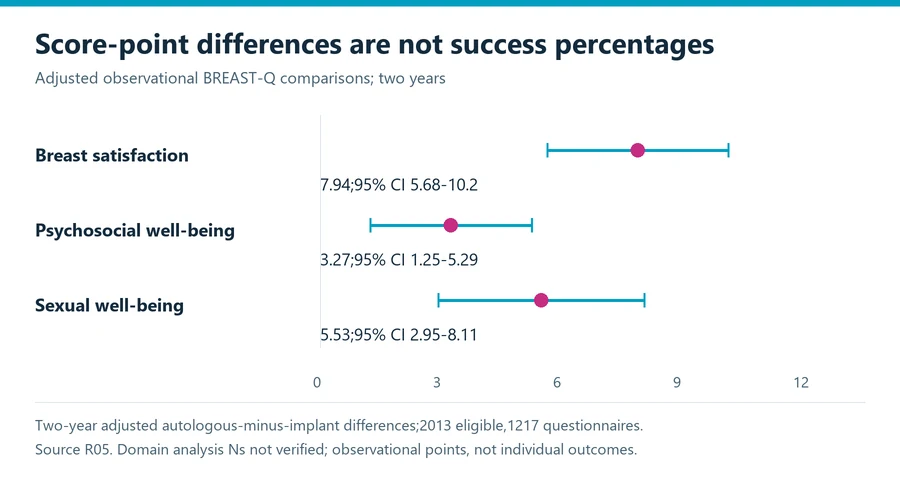
An original multicenter observational study compared immediate postmastectomy reconstruction outcomes. It included 2,013 eligible women: 1,490 in the implant group and 523 in the autologous group. At two years, 1,217, or 60.5%, completed questionnaires. On the BREAST-Q, whose scores run from zero to one hundred with higher scores indicating better outcomes, adjusted autologous-minus-implant differences were 7.94 points for breast satisfaction, 3.27 for psychosocial well-being and 5.53 for sexual well-being. The corresponding 95% confidence intervals were 5.68–10.20, 1.25–5.29 and 2.95–8.11. Original two-year patient-reported outcomes study
A point difference on a questionnaire is not a percentage chance of success. The distinction matters because the numbers can look superficially like percentages. A breast-satisfaction difference of several points does not mean that the same fraction of people were satisfied, that everyone improved by that amount or that a person choosing a flap will obtain that advantage. Keep the scale units visible whenever the result is summarized.
The study also does not turn the entire own-tissue family into a single interchangeable operation. It compares groups within a defined setting. Your donor-site options, priorities and treatment context still require separate discussion. Treat the findings as useful evidence about what the investigators measured, rather than a shortcut around the questions that determine whether a particular plan is suitable for you.
Questionnaire completion deserves equal attention. The people without completed two-year questionnaires cannot be counted as satisfied, dissatisfied or clinical failures merely because their responses are missing. Missing responses limit how confidently a summary represents everyone eligible. A responsible graphic therefore shows the completion context alongside the point estimates. It does not hide the denominator behind a celebratory headline.
Because the comparison was observational, the chart is not a randomized assignment of techniques. Differences between groups and the reasons people received particular methods remain relevant to interpretation. Ask whether a newer result covers your specific question, especially if your reconstruction would be delayed, hybrid or undertaken after a previous problem. Do not replace the study’s actual population with a broader label simply because the label is easier to read.
| Evidence question | What this study supplies | What remains a separate question |
|---|---|---|
| Which setting was studied? | Immediate postmastectomy reconstruction in a multicenter cohort | Whether the findings fit a delayed or revision course |
| How was experience measured? | Separate BREAST-Q domains at two years | Your particular functional, appearance and donor-site priorities |
| What do the plotted numbers mean? | Adjusted between-group differences in score points | A personal probability, individual change or procedure guarantee |
| Were all eligible participants represented at follow-up? | A reported questionnaire-completion count and proportion | How missing responses affect the comparison |
| Does the comparison select a specific flap? | A family-level autologous comparison | The most suitable donor source and technique for you |
Cost means a defined course, not an isolated fee
This guide does not present a national price because a defensible estimate would need a dated source and a clearly defined treatment course. Begin with a written estimate stating what is covered and who is billing. Ask whether the estimate refers to the main operation alone or to a proposed reconstruction sequence. Keep the coverage decision separate from the clinical recommendation so that an administrative answer is not mistaken for a treatment judgment.
For each possible stage, record the facility, professional and other stated charges, along with the assumptions behind the estimate. If a service is described as included, ask what that includes in practice. If a later decision is unresolved, request an explanation of how its cost would be assessed rather than treating a guessed amount as a commitment. The goal is a usable record of uncertainty, not an artificially exact total.
Consider practical costs as well: travel, assistance at home and time away from work. These are personal planning categories, not amounts this guide can calculate. Explain your constraints to the treating team and ask for the information you need to plan responsibly. If coverage is uncertain, confirm the relevant requirements with the payer before relying on a general statement about reconstruction benefits.
| Estimate item | Record to request | Why the distinction matters |
|---|---|---|
| Main reconstruction | Included services, billing parties and assumptions | A single quoted fee may not define the full course |
| Finishing or symmetry work | Whether proposed, optional or undecided | A possibility should not be represented as either guaranteed or free |
| Care after an unexpected problem | Stated financial policy and payer process | Clinical contingencies and financial responsibilities are separate |
| Travel and practical support | Your actual arrangements and constraints | Personal expenses cannot be inferred from a national surgery figure |
Make the final discussion usable
Bring a short summary of your priorities rather than a demand for a particular acronym. Include the activities you need to protect, the uncertainties you most want explained and any practical limitations on a staged course. Ask the team to identify which priorities the proposed method serves and which require compromise. If two plans are reasonable, compare them using the same questions rather than allowing the presentation style to decide for you.
Leave with a written description of the donor site, blood-supply category, device involvement, timing assumptions and next decision point. Record unresolved issues as unresolved. An honest plan can contain uncertainty and still be useful, provided you know what the uncertainty concerns and how it will be addressed. That is more informative than a confident description that quietly omits the donor site or the rest of the treatment course.
Autologous breast reconstruction is best understood as an individual course of care, not a promise attached to the words “own tissue.” Its value for you depends on the goals it can realistically address and the commitments you are willing and able to accept. Keep breast form, donor-site burden, cancer coordination and evidence interpretation together throughout the decision. None of those questions should be traded away for a single appealing score.
For related planning, see the procedure guide library, questions to ask a plastic surgeon and recovery planning.
Sources and review scope
Plastic Surgery Editorial Team. Source records checked through October 12, 2026. Review scope: source and editorial checks for general education. No individual clinical assessment is represented.
- NCI breast reconstruction after mastectomy. cancer.gov. Source date: 2025-12-02. Checked 2026-10-12.
- ASPS reconstruction overview. plasticsurgery.org. Publication/update date not stated. Checked 2026-10-12.
- ASPS reconstruction techniques. plasticsurgery.org. Publication/update date not stated. Checked 2026-10-12.
- ASPS reconstruction safety. plasticsurgery.org. Publication/update date not stated. Checked 2026-10-12.
- Original multicenter patient-reported outcomes comparison. pubmed.ncbi.nlm.nih.gov. Source date: 2018-06-20. Checked 2026-10-12.