
An auto augmentation breast lift uses assessed existing breast tissue as part of a reshaping and lifting plan. Its central distinction is redistribution rather than the automatic addition of an implant or fat from another region. The phrase does not name one standardized operation or guarantee a particular cup size. Ask what tissue is being used, which shape goal it serves and whether the proposal includes any additional material or procedure.
Start with the appearance you want assessed: breast position, central projection, upper fullness, overall size or a difference between sides. These are related but separate goals. A person who wants to preserve their existing size while changing shape has a different question from someone who wants substantially more volume. An examination should connect those preferences to the proposed course instead of treating augmentation in the name as a promise of added size.
This guide explains the material and evidence distinctions that help you evaluate a proposal. It does not supply a home suitability test, a tissue-transfer recipe or an implant-free safety guarantee. A clear plan should state its limitations, scar tradeoff and care responsibilities. It should also leave room to decide that the proposed change does not match your preferences.
What autoaugmentation means in the actual proposal
Redistributing tissue is different from adding material. Ask the clinician to explain whether the plan reshapes tissue already within the breast, adds transplanted fat, adds an implant or combines components. Autologous describes your own tissue, but it does not by itself distinguish local rearrangement from fat taken elsewhere. The written description should make that distinction explicit.
ASPS describes a breast lift as raising and reshaping the breasts by addressing excess skin and surrounding tissue. This general description helps distinguish a lifting goal from a size goal, but it does not establish the outcome of every autoaugmentation method. The actual plan needs an explanation of the tissue and region involved. ASPS breast-lift scope
Words such as internal support or autoprosthesis should also be explained in ordinary language. Do not assume that a name containing prosthesis means a manufactured implant, or that a name containing auto means no additional material of any kind. Ask which components are actually proposed and which are absent. A precise description is more useful than trying to infer scope from a label.
| Proposed component | Material question | Goal to clarify |
|---|---|---|
| Existing-tissue rearrangement | Tissue already in the breast | Shape and distribution rather than automatic new size |
| Added fat | Tissue taken from another region | Separate donor and breast goals |
| Implant | Added manufactured device | Device-specific size and care discussion |
| Combined course | Every included component | Which change is attributable to which part |
An implant-free preference is valid, but it should not replace assessment. Explain why that preference matters to you and ask what shape change is feasible without an implant. If the proposal cannot address a desired endpoint, the discussion should say so. You can revise the goal, consider another option or choose no operation without treating one marketing term as the only acceptable answer.
Position, projection, upper fullness and size are different endpoints
Describe a lifting concern separately from an upper-fullness concern. A breast can be evaluated for position while the upper contour is discussed as another feature. A clinician should explain how the proposed method relates to each. The word lift alone does not supply a measured amount of projection or tell you whether your preferred overall size will change.
Use your own clothing and appearance priorities to make the distinction practical. You may care about how the breast sits in a particular type of top, its shape without a bra or a difference between sides. Those preferences should be described individually. A cup-size label does not adequately express all of them, and a photograph cannot guarantee a particular retail garment fit.
Ask what is intended to remain unchanged. You may prefer the existing volume or want to avoid additional donor-site treatment. Another person may prioritize a different contour and accept a broader course. The plan should connect the assessed anatomy to that preference rather than treat all people seeking a lift as having the same goal.
If measurements are discussed, identify the endpoint and reference. Projection, position and volume use different observations. A change in one should not be automatically reported as an equivalent change in another. You do not need to choose measurement equipment yourself, but you should understand what the practice’s claimed result actually represents.
For a comparison described as upper fullness, ask which view and measurement define the upper region. A whole-breast size description may leave that particular feature unanswered. Similarly, an increased preference rating does not establish how much tissue was retained or moved. The explanation should use the endpoint actually observed and state what was not measured. This keeps a shape-focused discussion from drifting into an unsupported claim about a specific amount of new volume or an exact future bra size.
What a selected historical series can and cannot show
An original report published in March 2010 described 34 selected patients who underwent one autoaugmentation method. Mean follow-up was 24 months. All 34 stated that they were very satisfied with postoperative shape and size, while two developed seromas. The report concerned a selected group with particular shape goals and a preference to avoid an implant. Original thirty-four-patient series
The satisfaction statement and the complication count can overlap. They should not be turned into mutually exclusive success and failure groups. Satisfaction also does not prove that every measured aspect of breast shape remained unchanged for a fixed period. A small historical series is context for a discussion, not a personal guarantee or a universal technique ranking.
Satisfaction is not a volume measurement
A person’s rating of shape and size answers a different question from a measured change in breast volume. A study may report one without supplying the other. When a result is described as augmentation, ask whether that means a preferred distribution of existing tissue, a measured volume increase or simply the authors’ procedure name. Those interpretations should not be merged.
The average observation period also needs context. It does not imply that every participant was assessed at the same date or that the appearance is guaranteed for that duration. An operation interval identifies when cases were performed; follow-up describes subsequent observation. Keep those clocks separate when reviewing claims about durability.
If a practice cites a result from selected patients, ask how that selection relates to your assessment. Similar goals do not establish identical anatomy, and a shared preference to avoid implants does not supply a full clinical comparison. Evidence becomes more useful when the population and endpoint are visible alongside the claimed benefit.
A current comparison still has population and design limits
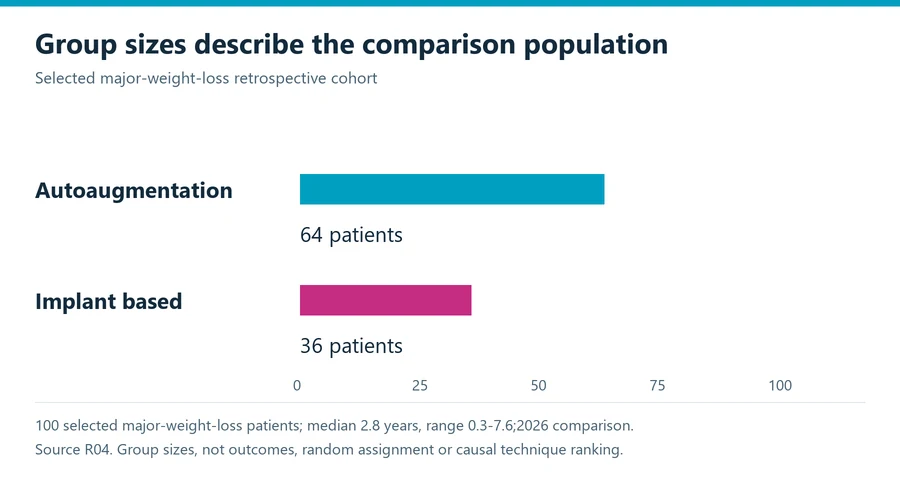
A study published online on July 28, 2026 retrospectively compared 100 consecutive patients after major weight loss: 64 underwent autoaugmentation and 36 implant-based augmentation mastopexy. Median follow-up was 2.8 years, with a range of 0.3 to 7.6 years. The abstract reported favorable breast-specific and aesthetic associations in the autoaugmentation group, while the general health survey showed no significant group difference. Original major-weight-loss comparison
That population and retrospective design belong with the result. The study is not a randomized demonstration that one approach is best for every person considering a breast lift. It does not justify transferring a group association directly to your expected outcome. Individual selection and the proposed goal still need an assessment.
The abstract does not provide the numerical scores or event counts needed to construct a faithful outcome-rate chart. A graphic can show the actual group sizes, but those bars must be labeled as sample counts. They should not be colored as success probabilities or converted into an invented risk reduction. A median follow-up also differs from a fixed common endpoint for all participants.
| Evidence detail | Faithful interpretation | Overstatement to avoid |
|---|---|---|
| 64 and 36 treatment-group patients | Actual sample composition | Success or complication percentages |
| Major-weight-loss population | Context of the comparison | All people seeking breast reshaping |
| Retrospective comparison | Observed group associations | Randomized causal superiority |
| Median 2.8 years; range 0.3–7.6 | Variable observation periods | Every result measured at 2.8 years |
Read breast-specific satisfaction separately from a broader health score. A difference in one does not establish a difference in every aspect of quality of life. Similarly, a finding of no significant difference is not proof that groups are identical in every relevant respect. The useful question is which endpoint supports the claim being made.
Ask how isolated and combined results are attributed
A proposal may involve existing-tissue reshaping alone or additional components. Ask which evidence corresponds to the actual course. If a published group includes added fat, its result cannot be automatically assigned to rearrangement alone. If a photographed patient had several breast or body procedures, the image needs that context before it is used to illustrate a narrower plan.
For each added component, request its goal, tradeoff and care implications. A preference to avoid an implant does not automatically authorize fat collection elsewhere. A request for improved breast position does not automatically authorize additional size. Clear scope prevents a broad term from concealing choices that deserve their own discussion.
If the course is staged, identify which decision belongs to each stage. Ask what will be reviewed before a later intervention and whether that later procedure remains optional. A staged plan should not be described as one completed outcome before all of its components have occurred. Its quotation and follow-up arrangements should use the same scope description.
Photographic comparisons should also separate shape from overall presentation. Clothing support, stance, lighting and camera perspective can influence the impression of upper fullness. Request consistent documentation of the region that matters to you. A selected attractive example can illustrate a goal without establishing the expected result for another person.
The scar tradeoff remains part of an implant-free lift
Avoiding an implant does not mean avoiding a surgical scar. Ask about the scar consequences of the actual lift plan and how they relate to your priorities. A proposal should explain location and uncertainty without promising an invisible line. Your preference about clothing coverage or visible scarring deserves a separate discussion from breast size.
Ask how the team evaluates an unfavorable scar, an asymmetry or a contour that falls short of the intended goal. These concerns are not interchangeable with medical complications, but each can matter to the decision. A satisfaction statement from a study should not replace a clear plan for assessing your own result.
If nipple or areola changes belong to the proposal, specify the intended endpoint. Position, outline and size are different features. Consent to a lift should not leave you uncertain about which of them is expected to change. Ask what will be preserved and what the team cannot guarantee.
Future appearance should be discussed with uncertainty visible. A label suggesting internal support is not a promise that no later change can occur or that additional treatment will never be considered. Request the evidence for durability claims and the observation period it actually covers. Do not treat a selected follow-up image as a permanent result.
No implant does not mean no surgical risk
ASPS lists breast-lift risks including bleeding, infection, fluid accumulation, poor healing, shape irregularity, sensation changes, possible nipple-and-areola tissue loss and possible further surgery. Serious circulatory, cardiac or pulmonary complications are also included. These are broad lift consent categories, not measured probabilities for a particular autoaugmentation method. ASPS breast-lift risks
Discuss your actual history and proposed course with the team. Avoid interpreting the use of your own tissue as proof that the operation is free of risk. Conversely, a broad risk list does not determine your personal likelihood of each event. The clinician should explain the assessed context and the care plan rather than let you infer it from the word natural.
If sensation, feeding or other function matters to you, raise it explicitly. A shape study does not establish a functional guarantee, and a favorable photograph cannot answer those questions. Ask what the proposal could mean for the specific function you care about and where evidence is limited. Keep function separate from appearance ratings.
Obtain the follow-up and contact arrangements before proceeding. Ask which concerns require prompt assessment and who can evaluate them outside routine hours. The appropriate instructions come from the treating team. This guide should not be used to select medication, wound care or activity restrictions for an individual operation.
Plan recovery around your actual responsibilities
Explain your work, transport, exercise, caregiving and available help. The team should provide a plan for the components actually proposed. A return-to-work claim for another lift or an implant course may not describe your situation. Ask about the relevant activities rather than relying on one general label such as back to normal.
Separate permitted activity from comfort and from the final appearance assessment. Those milestones answer different questions. The ability to resume one responsibility does not prove that every endpoint is ready to be judged. Obtain clear instructions and a review plan instead of treating an advertising timetable as a personal schedule.
If treatment is far from home, discuss travel and local assessment. A messaging service cannot be assumed to provide every form of follow-up. Ask how records will be shared and who will evaluate a concern when you are away from the original team. Practical coordination is part of the proposed care, even when the aesthetic goal is carefully defined.
Compare quotes by components and total scope
This guide supplies no invented average price. Ask for the professional fee and the included or separate setting, anesthesia and other specified costs. A plan using existing tissue alone should not be financially compared with a combined lift-and-fat course as if they were the same service. The quotation should match the clinical description.
Clarify what follow-up is included and how later assessment or additional treatment is handled. A financial policy can describe charges without guaranteeing satisfaction or a permanent shape. Keep the written terms separate from outcome claims and avoid assuming that the absence of an implant removes every possible later cost.
| Quote detail | Information to retain | Comparison purpose |
|---|---|---|
| Material and components | Existing tissue, added fat or device | Compare the actual planned course |
| Fee versus total | Included and separate charges | Avoid mistaking one fee for the full commitment |
| Follow-up | Visits, contact and review terms | Understand the stated care arrangement |
| Additional treatment policy | Written conditions and exclusions | Separate financial terms from outcome guarantees |
Before deciding, summarize the intended shape change, the material involved and the tradeoffs you accept. If those statements remain unclear, seek clarification rather than assume the procedure name answers them. A useful auto augmentation breast lift plan makes its specific goals and limitations understandable.
Use the breast-lift guide, breast-augmentation guide and consultation questions for context. Your decision should follow the assessed proposal and your priorities, with evidence interpreted in its actual population and endpoint.
Sources and review scope
Plastic Surgery Editorial Team. Source records checked through October 12, 2026. Review scope: source and editorial checks for general education. No individual clinical assessment is represented.
- ASPS lift scope. plasticsurgery.org. Publication/update date not stated. Checked 2026-10-12.
- ASPS lift risks. plasticsurgery.org. Publication/update date not stated. Checked 2026-10-12.
- Original34-patient autoaugmentation series. pubmed.ncbi.nlm.nih.gov. Source date: 2010-03. Checked 2026-10-12.
- Original2026 postmajorweightloss retrospective comparison. pubmed.ncbi.nlm.nih.gov. Source date: 2026-07-28. Checked 2026-10-12.