
Arm lift recovery needs an individual plan for reaching, carrying, dressing, personal care, work and driving. ASPS describes individualized instructions for dressings, possible garments or drains, medicines and return to activity. Its recovery page does not establish one universal work date or lifting limit. Ask the surgeon about your actual brachioplasty and the tasks you need to perform, especially if both arms or another region were treated. ASPS arm lift recovery
This guide concerns surgery to remove or reshape excess upper-arm tissue, rather than arm liposuction alone or an injectable treatment. Its practical focus is dependency: a routine activity may use the arms even when it is not called exercise. A desk role, a shower, a bag and a household task all require their own questions. The goal is a workable plan and access to assessment, not a self-directed rehabilitation program or a guaranteed recovery date.
What should an arm lift recovery plan identify?
Ask which areas were treated and whether the operation includes liposuction or another procedure. Confirm where the care items and incisions are and which instructions apply to each. You do not need to interpret a technique yourself, but your discharge sheet should match the actual surgery. A short label such as arm lift may leave details unresolved when you are trying to manage bilateral arm use at home.
For arm lift recovery, tell the team about baseline mobility, hand function and any activity that is already difficult. Explain whether someone can help with dressing, hair care, meal preparation and transport. If both arms are involved, avoid assuming that you can simply use the other arm for every restricted task. The team should address the actual circumstances rather than a generic picture of a person with unrestricted assistance.
Request instructions in a format you and your helper can follow. Ask which actions you perform yourself, which need assistance and which require clinical staff. If you are taught a care task, ask the team to check that you understand it. This article does not prescribe a method for washing an incision, emptying a drain or using a compression garment. Those instructions should reflect your operation and equipment.
Keep clinic contact information and appointment details where you can access them without relying on a helper’s memory. Ask what to do outside office hours or if the surgeon is unavailable. The plan should include an urgent assessment route as well as routine follow-up. If you recover away from the operating facility, clarify who will evaluate a concern locally and how the necessary information will be shared.
Which arm lift recovery decisions should remain separate?
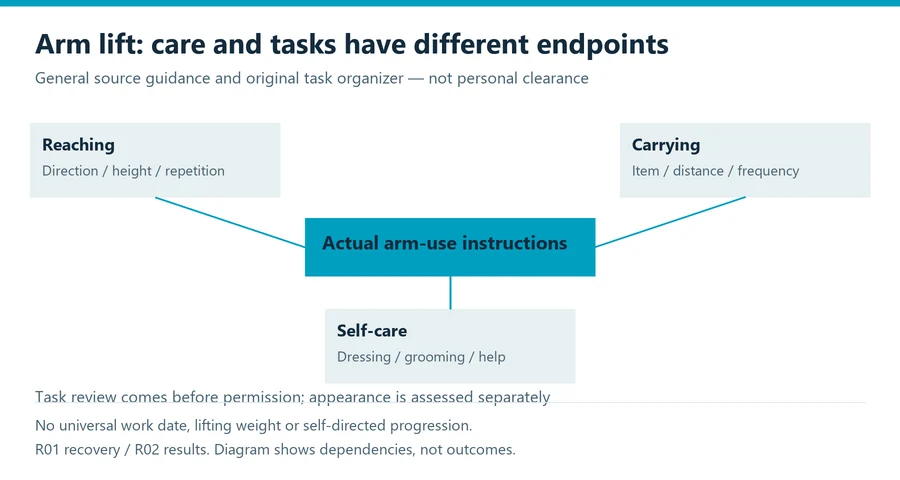
The task diagram separates reaching, carrying and self-care from clinical review and appearance. It deliberately supplies no invented weekly work progression. A numerical lifting limit or work date would require evidence and an individual instruction that the inspected ASPS page does not provide. Keeping a question unresolved is more accurate than filling it with a familiar number from another person’s operation.
| Arm lift recovery task | Details to explain | Individual answer needed |
|---|---|---|
| Reaching | Direction, height, repetition and equipment | Which movement is permitted and when it will be reviewed |
| Carrying | Actual item, distance and frequency | The surgeon’s restriction, not a universal weight from the internet |
| Self-care | Dressing, washing, grooming and assistance available | How to carry out the task within your instructions |
| Work and driving | Duties, controls, journey and medicines | Task-specific readiness and applicable requirements |
| Appearance | Swelling, bruising or a particular concern | Assessment separate from permission for arm use |
ASPS notes that early contours can be obscured by swelling and bruising and that an incision scar remains. It also stresses protecting healing incisions from excessive force, abrasion or motion. ASPS appearance and incision context Those general statements do not diagnose a new symptom or establish readiness for a task. Ask your team when it intends to assess your particular concern.
For arm lift recovery scheduling, distinguish a review from an assured new permission. At an appointment, the clinician may continue a restriction or request another assessment. If an employer or helper needs a calendar, show which tasks are confirmed and which remain pending. This prevents a practical booking from becoming the reason to assume that you have been medically cleared.
Appearance preferences also need a separate place in the plan. You may want to rearrange a photographed event or change clothing for a social reason even when a task is permitted. State that preference directly without inventing a medical restriction. Conversely, wanting to wear a particular outfit cannot establish permission for movement or a garment change that remains subject to clinical advice.
How can reaching and personal care be discussed before discharge?
Think through the movements in an ordinary morning: getting out of bed, dressing, using the bathroom, preparing breakfast and handling a phone. Ask which actions need help and how the team wants them performed. This resource offers no reaching angle, lifting test or exercise to try afterward. A movement feeling possible once cannot independently establish that it is appropriate for healing incisions.
During arm lift recovery, describe the location of frequently used items as part of the consultation. A cupboard, bathroom shelf or overhead storage area may create a specific question. Ask what arrangement would let you follow the instructions rather than designing your own movement workaround. The planning exercise identifies a dependency; the team provides the clinical advice about it.
Plan assistance by action, not by the label light help
Someone who can bring groceries may not be able to assist with personal care. Name the actual task and ask whether help is required. Discuss privacy preferences so assistance can be practical without leaving a necessary instruction unaddressed. If the person helping you needs training or an explanation, arrange that with the team. A broad promise to be available can conceal uncertainty about what support will actually be provided.
Ask about hair washing, grooming and clothes that require arm movement. Explain your usual routine and any uniform requirement. This article does not prescribe a clothing style or bathroom-care method. If the team recommends an adaptation, confirm how it fits the instructions and what to do if it is not workable. Avoid buying an accessory because it is marketed for recovery before clarifying the real need.
Consider meals and everyday containers as well as formal chores. Opening, carrying and reaching may be separate questions even when the object seems light. Describe the task to your team and arrange help with any restricted part. These organizational suggestions are not measured methods of improving healing. Their purpose is to prevent an essential daily activity from being overlooked when discussing only exercise.
What should be clarified about dressings, garments and drains?
ASPS describes possible dressings, an elastic bandage or compression garment and a temporary drain after brachioplasty. It calls for individualized care and follow-up instructions. ASPS postoperative care questions A possible item in the overview is not a requirement for every operation. Ask the team to identify what you actually have and what responsibility it creates at home.
For arm lift recovery care items, record the name, purpose, prescribed action, responsible person and next review. If advice changes, keep the new version with the plan. This helps avoid a helper continuing an earlier routine without knowing it has been revised. It also makes an outside appointment easier to coordinate because you can describe the actual item rather than a generic request for wound care.
If a garment or bandage seems problematic, contact the team rather than changing pressure or fit according to a video. Describe the region, what changed and whether the issue is progressing. This resource prescribes no compression pressure, sizing rule or removal timetable. A product used by someone after a different operation cannot establish suitability for your incision pattern and current care.
For a drain or closure review, confirm who handles it and where. Do not remove something because a date from another person’s timeline has passed. If care will occur outside the operating clinic, arrange the record transfer and appointment beforehand. An instruction to have it reviewed later is not complete until the service and next action are clear enough to carry out.
Ask about showering and skin products separately from garment advice. Your usual cleanser, lotion or scar product should not be presumed appropriate immediately after surgery. If the team recommends an item you cannot obtain, ask for an approved alternative. Keep medicines in the plan your prescriber supplies; this guide does not recommend an antibiotic, pain regimen, supplement or clot-prevention prescription.
How should work and driving be planned?
Work planning for arm lift recovery should describe repetition as well as effort. Keyboard use, equipment handling, overhead reaching, carrying and sustained positions may create different questions. A desk job is not automatically free of arm demands. Explain a normal shift, including its journey and the items you carry, so the surgeon can address the actual task rather than a simplified job title.
Ask whether a temporary administrative arrangement is possible if your clinical instructions require it. A changed duty or staged workload may be worth discussing with your employer. This is a planning option, not a medical recommendation for a particular schedule or an entitlement to leave. Find out what documentation the workplace needs and keep its requirements distinct from your clinician’s assessment.
For arm lift recovery and driving, describe the controls, movements and journey involved. Ask about anesthesia, medicines, arm use and safe control of the vehicle; check applicable insurer and legal requirements. A comfortable passenger trip or ability to use a laptop does not establish driving readiness. This resource offers no universal date on which every reader may drive independently.
If you need transport to a review, arrange it separately from your hoped-for driving date. A future appointment may continue a restriction rather than end it. Make an alternative plan that does not depend on permission being granted at that visit. This practical step can reduce the administrative difficulty of a changed schedule without claiming to alter the medical course of healing.
Work from home can change logistics but does not remove care restrictions. Ask about the actual remote tasks and equipment you use. If a task remains unanswered, keep it pending rather than treating a flexible location as clearance. Share the specific advice with anyone coordinating your schedule, so a broad statement about being able to work does not silently extend to other duties.
What should be discussed about lifting, caregiving and exercise?
For arm lift recovery, lifting questions should identify the object, height, distance and frequency. Carrying a child, handling a laundry basket and using gym equipment are not one activity. Ask your surgeon which instructions apply to each. Do not infer a universal weight limit from another procedure’s care sheet or test readiness by trying a heavier object until it becomes uncomfortable.
Caregiving can involve unpredictable effort. Tell the team about transfers, bathing, car seats, pet handling or tasks that may need a sudden response. Arrange a named substitute for restricted actions and a backup if the person cannot attend. A general intention to do less may not protect the specific task the team has asked you to avoid. The plan needs to match the responsibilities you actually have.
Ask about exercise by naming the activity and intensity. Swimming, resistance training, yoga and contact sport may involve different demands or contact with equipment. The inspected ASPS guidance asks for individualized return-to-activity advice, so no fixed gym progression is provided here. If several procedures were performed together, ask which restrictions control the combined plan rather than borrowing the earliest timeline from one component.
Errands may include arm tasks even when they are not called exercise. Bags, cleaning equipment and repetitive handling are useful examples to discuss. Arrange help according to the clinical instruction rather than relying on your subjective impression that the task is easy. If an instruction cannot be followed because of an essential responsibility, explain the conflict to the team instead of inventing a workaround.
Travel should also address access to care and the demands of luggage, transport and accommodation. A booked trip is a constraint to discuss, not evidence of readiness. Ask who would evaluate a concern away from the clinic and how records would be shared. No universal flight interval is established here. Keep unresolved permissions visible before making commitments that depend on them.
Which symptoms need attention before routine follow-up?
New breathing difficulty, chest pain or fainting requires immediate emergency help; in the United States, call 911. CDC identifies these as possible clot warning symptoms, while new limb swelling, pain, warmth or discoloration needs prompt assessment. CDC blood-clot warning guidance This is general symptom guidance, not an arm-lift risk percentage or a diagnosis. A routine message to the clinic must not delay an emergency response.
Contact the treating team about an unexpected or worsening surgical-site concern using the instructions it provided. The fact that swelling or bruising can occur after surgery does not let this article determine that your change is expected. Say where the problem is, when it began, whether it is progressing and what advice you have already received. Ask whether an examination is needed and where to obtain it.
If the team is unavailable and a problem needs prompt assessment, use an appropriate urgent medical service. Do not tighten or loosen a garment, remove a device, add a product or change medicine to experiment with the cause. If the clinic requests an image, use its approved private channel without delaying care. A photograph is communication material, not a guarantee that every concern can be evaluated remotely.
Keep a revised instruction or additional appointment in the current plan after assessment. A change to the schedule should not be treated as a failure to follow an internet timeline. The organizer supports actual care; it should not force recovery toward a deadline the surgeon has not given. Share the updated practical answer with anyone helping you so advice remains consistent.
What should follow-up make possible?
Bring the tasks still needing an answer and the care sheet you have been following. Ask what is permitted now, what remains restricted and when another review is needed. For arm lift recovery, permission about keyboard use should not automatically authorize carrying, driving or exercise. Record the particular action so a helper or workplace can understand the practical plan without guessing.
Ask separately about appearance and scar concerns and when they should be assessed. If advice changes, keep the current version accessible. Leave an unanswered permission pending rather than inserting a universal week number. The original diagram connects ordinary tasks to clinical review and a specific answer; it is an editorial aid, not a validated rehabilitation method or prediction of a patient outcome.
For related procedure context, read arm lift and the plastic surgery recovery guide.
Sources and review scope
Plastic Surgery Editorial Team. Source records checked through October 12, 2026. Review scope: source and editorial checks for general education. No individual clinical assessment is represented.
- ASPS arm lift recovery. plasticsurgery.org. Publication/update date not stated. Checked 2026-10-12.
- ASPS arm lift results. plasticsurgery.org. Publication/update date not stated. Checked 2026-10-12.
- CDC: About venous thromboembolism. cdc.gov. Source date: 2025-03-05. Checked 2026-10-12.