
Arm lift cost should identify the assessed brachioplasty task, its related expenses and which clinically specified supplies are included. A lower professional fee can produce a higher complete obligation when required items are separately purchased. Ask the surgeon what the actual plan requires, then ask the billing office how those items are counted. Do not choose, replace or omit postoperative supplies solely to improve a financial comparison.
This guide provides an original hypothetical inclusion worksheet. It compares a package with specified supplies included against a lower professional component with those supplies excluded. Every example dollar amount is an invented arithmetic input, not an actual practice price or a complete national average. The model does not prescribe a garment, quantity, compression level or duration. Those are clinical questions for your own treatment team; the worksheet explains the financial effect of the answer.
What does the published arm lift cost average cover?
The ASPS arm-lift cost page, checked October 12, 2026, displays a $6,192 average for brachioplasty. It identifies a partial average excluding anesthesia, operating-room facilities and other related expenses. Its underlying fee year is not verified here. It is useful partial context, but it does not establish a current complete national total or a personally appropriate budget.
The published amount does not tell you whether a particular office includes specified postoperative supplies in its professional component. It also does not establish an allowance for your transport, time away from work or other arrangements. A quote near the partial average may still contain substantial separately payable amounts. Obtain those amounts and their inclusion rules before describing a proposed operation as within a complete budget.
Do not add a guessed percentage to the partial figure and call the result a national total. Related expenses depend on the actual assessed plan and billing arrangements. Nor should you compare a package including facility and anesthesia directly with the partial average as if both described the same financial obligation. The useful comparison matches the components that each document actually names and leaves unresolved lines visible.
Why arm lift cost needs a surgical scope first
The ASPS procedure overview describes addressing excess upper-arm skin and underlying tissue, with localized fat also relevant to the operation. That is not the same task as purchasing a garment or selecting a generic fat-reduction service. Ask the surgeon what correction is proposed for your arms and how any separately discussed liposuction relates to that plan.
Record the assessed areas, the intended correction and any additional task before comparing estimates. Different proposed incisions or extents of work can reflect different clinical plans, not simply different prices for an identical service. This guide does not tell you which technique to choose or infer that the smallest operation has the best financial value. Your goals, examination and informed clinical discussion determine the proposal.
If two estimates name different tasks, keep the difference explicit. A package that addresses additional tissue cannot be normalized merely by deleting its extra charge. Conversely, a lower quote should not be assumed incomplete because its professional amount is lower. Ask what each assessment proposes, then compare financial inclusion fields for the actual plans. Scope matching is an evidence task before it is a spreadsheet task.
Which supplies belong in arm lift cost planning?
The ASPS recovery guidance discusses dressings or bandages and possible compression garments, with specific instructions from the treating surgeon. It does not establish one universal purchase list. Ask your team which items, if any, are specified for your plan and whether they are supplied by the office or purchased separately. Do not infer a mandatory quantity from the illustrative model below.
Make a list separating clinically specified items from optional retail products. For each specified item, record whether it is included, its actual required quantity, the approved purchasing process and who answers fit or replacement questions. A brochure naming “postoperative care” is too broad to establish all those fields. Ask for clear financial inclusions while leaving clinical choices and adjustments with the team responsible for your care.
| Arm lift cost inclusion field | Question to resolve | Financial record |
|---|---|---|
| Specified item | Is this actually part of my clinical plan? | Clinician-confirmed requirement |
| Quantity | How many are specified for my circumstances? | Confirmed number, not a model assumption |
| Package inclusion | Does the quote supply that quantity? | Included quantity and any separate purchase |
| Purchase expense | What is the actual payable amount? | Item, tax and delivery where applicable |
| Fit or replacement | Who handles a change if needed? | Office process and any confirmed charge |
| Optional products | Are these separate from required care? | Separate optional spending |
Keep unknowns as unknowns. If an office has not confirmed a required quantity or price, the complete supply obligation is pending. Zero is appropriate only when there is no separately payable amount under the actual inclusion rule. An included item should not be added again at its imagined retail price, while an excluded item should not disappear merely because another quote describes it inside a package.
Original arm lift cost worksheet: inclusion changes the result
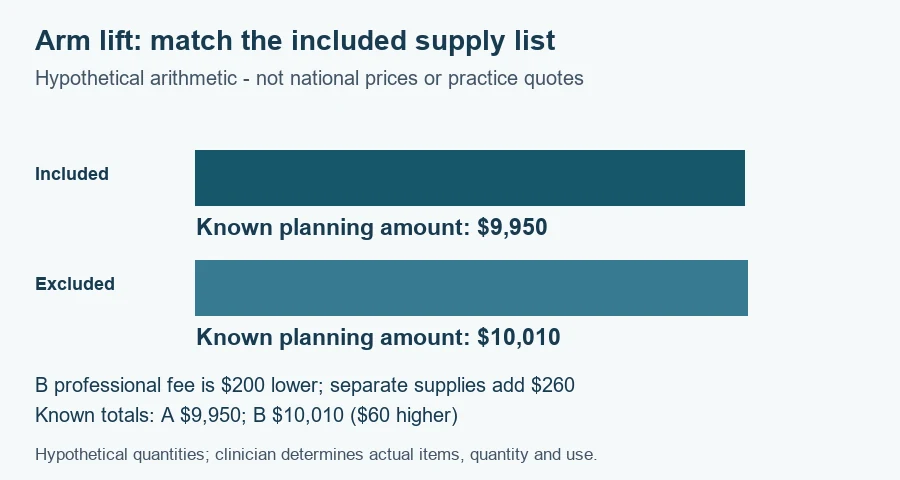
Assume two hypothetical estimates for a clinically matched task. Package A has a $6,500 professional component that expressly includes all supplies specified in this model. Package B has a $6,300 professional component but excludes them. Both include separately payable facility of $1,800, anesthesia of $900, tests of $150 and personal logistics of $600. These are fictional inputs with no claim about usual local charges or a standard treatment setting.
For this arithmetic only, assume the clinician has specified two items in Package B, each purchased at $120, with $20 total delivery. The separate supply obligation is therefore $260. This quantity is an input, not a clinical recommendation or a claim that two garments are necessary after every arm lift. Package A incurs no extra supply amount because the stated package inclusion already covers the model’s specified list.
| Hypothetical line | A: specified supplies included | B: specified supplies excluded |
|---|---|---|
| Professional | $6,500 | $6,300 |
| Facility | $1,800 | $1,800 |
| Anesthesia | $900 | $900 |
| Tests | $150 | $150 |
| Separate specified supplies | $0 additional | $240 |
| Supply delivery | $0 additional | $20 |
| Personal logistics | $600 | $600 |
| Known planning total | $9,950 | $10,010 |
Package B advertises a $200 lower professional component, but its separate $260 obligation reverses that difference. Its complete known total is $60 higher. The financial comparison is not evidence that Package A has better clinical care, materials or outcomes. It shows that matched required items must be counted consistently. Without the supply line, a reader would mistake a partial $200 difference for a complete saving.
The reversal threshold is the professional difference: B remains lower only while its extra supply obligation is below $200, equal at $200 and higher above $200, with the other entered lines unchanged. This is an arithmetic threshold, not a target spending limit for necessary care. Ask the clinician what is required and enter its actual cost. Do not reduce a medically specified purchase to keep an offer below the threshold.
How does quantity uncertainty affect arm lift cost?
If the actual specified quantity were one $120 item plus $20 delivery, B would total $9,890 under the model’s unchanged assumptions. It would be $60 lower than A. If the specified quantity were three items plus the same delivery, B would total $10,130, or $180 higher than A. Those scenarios illustrate sensitivity to a financial input, not alternative care plans that the reader can choose independently.
The underlying formula is B total equals $9,750 before separate supplies, plus $120 times the confirmed quantity, plus the assumed $20 delivery. An actual quote may use different prices, delivery rules or inclusions, so replace those values rather than retaining the formula’s example numbers. If an item has already been included in a separate care package, do not add it again. Record the scope of that care package before reconciling the bill.
| Quantity sensitivity, hypothetical | Separate items plus delivery | B known total | Difference from A |
|---|---|---|---|
| One specified item | $140 | $9,890 | $60 lower |
| Two specified items | $260 | $10,010 | $60 higher |
| Three specified items | $380 | $10,130 | $180 higher |
| Quantity unconfirmed | Pending | Complete total unresolved | No confident comparison |
This table should prompt a confirmation request, not a purchase decision. The treating team determines the item and quantity; the billing office or actual seller confirms the financial terms. Ask whether delivery, tax or a fit-related exchange has a separate charge when relevant. Do not substitute a cheaper unapproved product or assume a return is available. Those choices could change the clinical plan as well as the financial inputs.
How should arm lift cost handle a supplied item that does not fit?
Ask the office about its actual process for an item that is unsuitable or needs adjustment. A package inclusion may describe the initial item while leaving replacement conditions unspecified. Clarify who evaluates the problem, who supplies any replacement and whether a charge applies. This guide does not establish that every patient will need a replacement, that an exchange is free or that any seller accepts used medical items.
Keep a confirmed replacement expense separate from the initial purchase ledger. If a previously paid item is refunded, count the actual refund once; if it is exchanged without a new amount, do not invent a second purchase charge. If the clinical team requires another item and there is a separately payable amount, record it clearly. The point is reconciliation of actual obligations, not forecasting an arbitrary future replacement allowance.
Do not let a financial inclusion dispute delay an appropriate clinical question. If you have a concern about fit, comfort or postoperative care, contact the treating team for instructions. A cost worksheet cannot determine whether a garment is appropriate, whether swelling is expected or whether a symptom needs assessment. Handle the care question first while obtaining a clear explanation of the associated billing process.
Which expenses must stay separate from arm lift cost supplies?
Facility and anesthesia should retain their own pricing rules and issuing entities. An included garment does not fix those amounts. Ask whether they are confirmed, estimated by time or subject to another stated adjustment. If they remain provisional, label the complete known total accordingly rather than calling the supply-normalized result a fixed ceiling. The worksheet isolates one inclusion difference; it does not eliminate every uncertainty in an actual quote.
Tests, medicines and follow-up should also be described according to the actual plan. A prescribed medicine is not automatically included because the office includes supplies, and a listed visit is not necessarily an additional bill. Obtain the inclusion boundary for each. Necessary care should remain visible in both comparisons. Optional retail products can be recorded separately without treating their purchase as a prerequisite to a hypothetical package total.
Personal arrangements require your own inputs and the clinician’s advice about restrictions. Transport, time away from paid work and assistance at home vary by circumstance. The example’s $600 logistics amount does not establish what you will need or how long recovery takes. Use verified arrangements where available and mark unresolved scheduling assumptions rather than assigning a universal recovery expense to every patient.
Can insurance or financing lower the arm lift cost comparison?
The ASPS cost page notes that most health plans do not cover arm-lift surgery or its complications. This general statement does not decide an individual’s benefits. Do not subtract assumed reimbursement from a self-pay quote or describe weight loss alone as a coverage entitlement. If a particular medical circumstance is being assessed, obtain the actual plan’s requirements and written response before including a benefit in the financial ledger.
Financing changes the payment arrangement and may change the total obligation. A lower installment does not establish a lower complete operation cost. Keep the clinical quote separate from the actual credit agreement, and inspect its disclosed total payments and applicable charges if you are considering borrowing. This guide does not recommend a lender, assume eligibility or supply a financing rate. No credit product is linked or endorsed here.
A supplied item advertised as complimentary also does not establish its independent retail value or prove an overall saving. Compare the actual included list and separately payable amounts. Avoid subtracting a promotional “value” from the operation total when no separate purchase would otherwise be required. An inclusion is useful information about scope; it is not automatically a cash discount or evidence of better clinical outcomes.
How can you reconcile receipts against arm lift cost inclusions?
Retain the estimate, the clinician-confirmed supply list and each actual purchase receipt together. For each item, record whether the office provided it, whether you paid separately and whether a credit or refund has actually occurred. A model can identify an exclusion before payment, but receipts establish what was paid afterward. Keep an expected reimbursement separate until it is confirmed; do not use a promise as if cash has already been returned.
If the office updates the specified list, preserve the earlier version and ask how the financial inclusion changes. An additional item may be covered by the package, separately payable or still pending clarification. Those possibilities require different ledger entries. Record the actual response rather than assuming that any update invalidates every earlier amount or that the phrase “supplies included” covers an unlimited quantity forever. The clinician can explain the care change while the office explains the financial boundary.
Check for a second counting error when a package includes a separately described supply allowance. A descriptive line showing the allowance may already form part of the professional total; it is not automatically an additional bill. Ask which total includes it before summing the rows. Conversely, a listed allowance may cover only part of an actual purchase. In that case, record the confirmed remaining obligation without subtracting the allowance twice. This reconciliation is specific to included items and actual receipts; it does not assign a general retail value to clinical care or rank offices by their marketing language.
Arm lift cost questions before accepting a package
Does a lower surgeon component mean the complete quote is lower? Only after matching related charges and specified inclusions. In the original model, a $200 professional reduction is outweighed by $260 of excluded supplies and delivery. Use the actual required list, inclusion rules and payable amounts instead of treating the model’s result as a general judgment about packages.
Should I buy fewer items to make the lower quote win? No financial threshold determines appropriate care. Ask the treating team what your actual plan requires and enter that answer. The quantity table reveals why an unconfirmed input prevents a confident comparison; it does not provide a menu of postoperative care options or authorize substituting an item.
For the clinical overview, see the arm lift guide. For the financial decision, retain one dated list of the assessed task, related charges, clinician-specified items, included quantities, separately payable amounts, actual credits and pending inputs. Recompute only after those fields are clear. That record makes arm lift cost comparisons more useful without turning an inclusion worksheet into clinical advice.
Sources and review scope
Plastic Surgery Editorial Team. Source records checked through October 12, 2026. Review scope: source and editorial checks for general education. No individual clinical assessment is represented.
- ASPS brachioplasty partial fee scope. American Society of Plastic Surgeons. Publication/update date not stated. Checked 2026-10-12.
- ASPS arm-lift surgical task. American Society of Plastic Surgeons. Publication/update date not stated. Checked 2026-10-12.
- ASPS individualized postoperative supply scope. American Society of Plastic Surgeons. Publication/update date not stated. Checked 2026-10-12.