
Areola reconstruction recreates the appearance of the pigmented area around the nipple as part of an assessed reconstructive plan. It is different from creating a projecting nipple and different from rebuilding the breast mound. Medical tattooing can address color and visual detail, while a tissue-based proposal has other consequences that need a surgical discussion. The right starting point is which feature you want restored in appearance, what you prefer to avoid and how that goal fits the care you have already received.
A three-dimensional-looking tattoo does not create physical nipple projection. Likewise, adding projection does not by itself establish a color match. Ask the team to separate those endpoints before comparing options. You may want pigment alone, a broader nipple-and-areola course, a removable option or no additional procedure. Reconstruction should follow an informed preference rather than an assumption that every person must complete the same sequence.
This guide explains options and the evidence used to discuss color change. It does not provide a tattooing recipe, a universal pigment formula or a promise to restore the original breast’s function or appearance exactly. Cancer treatment and ongoing breast care remain separate clinical priorities. The reconstructive team should determine whether and when an additional appearance procedure is appropriate in your actual course.
The areola is an appearance region, not the whole reconstruction
Begin with the goal that matters to you. You may want a colored outline around an existing reconstructed nipple, a visual nipple-and-areola appearance on a flat surface or a discussion of physical projection. Describe that preference in ordinary language. A procedure name should not force you to accept another component you did not request.
Cambridge University Hospitals explains that tattooing can be performed after nipple reconstruction or by itself to create areola color. Its leaflet also describes tissue-based areola reconstruction with a donor-site scar, a stick-on prosthetic option and the choice to have no further nipple procedure. These are distinct options, not a ranking that applies to every person. CUH reconstruction options
The Christie distinguishes shading that produces a three-dimensional appearance from actual projection through clothing. That difference is useful when reviewing photographs: an image may show a convincing visual effect without demonstrating a physical shape. Ask which result is intended, how it is assessed and what it will not change. The Christie pigment and projection guidance
| Goal or option | Feature being discussed | Separate question to retain |
|---|---|---|
| Medical tattooing | Color, outline and visual shading | Physical projection is a different endpoint |
| Nipple reconstruction | Projecting form | Areola color may require a separate discussion |
| Tissue-based areola proposal | Reconstructed pigmented-region appearance | Donor and recipient consequences need explanation |
| Removable option or no further procedure | Your preferred appearance and burden | Availability and personal suitability need assessment |
Keep breast-mound shape outside the pigment promise. If the concern involves the wider breast contour, identify that separately. A tattoo-focused consultation should not imply that color work will correct every shape difference. Similarly, a satisfactory mound reconstruction does not decide whether you personally want an areola appearance procedure.
Make color matching a discussion rather than a fixed formula
Ask what the color is being matched to. If there is an opposite areola, it may provide one reference; your own preferred appearance is another part of the conversation. If there is no opposite reference, the team should explain how choices are made without inventing an ideal. Neither an internet swatch nor a photograph on an uncalibrated screen establishes the appropriate pigment for your skin.
Separate outline, size, position and shading in the discussion. You may be satisfied with one feature and uncertain about another. A sample that looks attractive in isolation may not answer how the planned area relates to the reconstructed breast. Ask to review those relationships in a way that lets you understand and express your preference before proceeding.
Document what was discussed rather than relying on a vague request for something natural. The word natural can mean a closer color match, a softer outline, less obvious symmetry or a convincing visual projection effect. Those are different preferences. Naming them helps the team explain which is feasible and where uncertainty remains.
Do not assume that the first visible appearance is the long-term endpoint. A color discussion should address when the team evaluates the result and how it decides whether another session is appropriate. That review needs actual observation and the team’s instructions. It should not become a home pigment adjustment or a schedule copied from another person’s reconstruction.
Fading and satisfaction measure different things
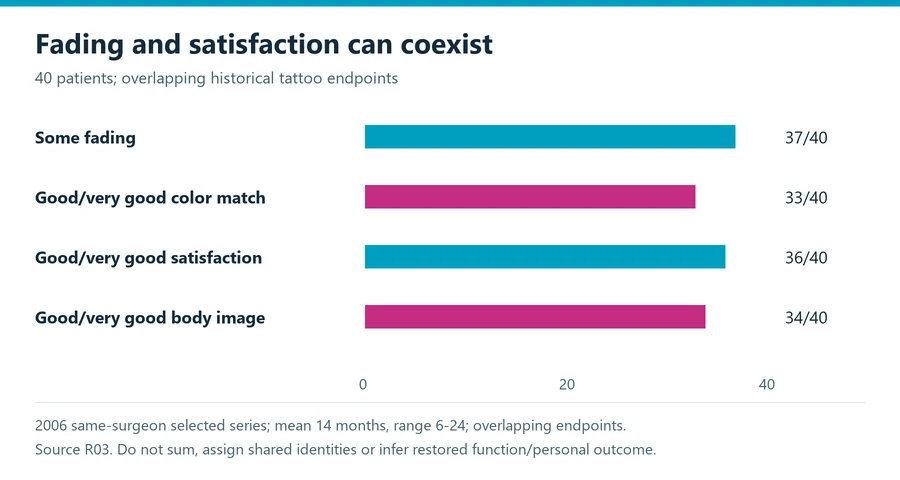
An original study published online on June 12, 2006 reported 40 consecutive patients who underwent nipple-areola tattooing by the same surgeon. Thirty-seven reported some color fading. Good or very good ratings were given by 33 for color match, 36 for overall satisfaction and 34 for enhancement in body image. Mean follow-up was 14 months, with a range of 6 to 24 months. Original forty-patient tattoo study
Fading and satisfaction can coexist. The endpoints are not exclusive categories that divide the sample into success and failure. A person can notice a color change while still preferring the reconstructed appearance. An honest graphic shows separate observed counts, keeps the denominator visible and avoids assigning unreported combinations to particular participants.
This historical series does not forecast your result or establish that one technique is superior. It also does not describe every patient at a single common follow-up date. Its useful contribution is the explicit separation of color change, color match, overall satisfaction and body image. When discussing evidence, ask which endpoint is being used rather than accepting satisfaction as a substitute for every other outcome.
| Endpoint | What the question concerns | What it does not establish |
|---|---|---|
| Some fading | Whether a color change was noticed | Automatic dissatisfaction or repeat treatment |
| Color match | Relationship to the intended reference | Restored physical projection or function |
| Overall satisfaction | A person’s broader assessment | Absence of every adverse event |
| Body-image rating | Perceived appearance-related effect | A universal emotional response |
Use this distinction when reading a retouch claim. A color change, a request for another session and a medically indicated intervention are different events. Their counts should not be treated as interchangeable. The practice should explain its own assessment and follow-up policy without converting an older series into a promise about your future needs.
What a prospective color study adds
A study published on June 19, 2024 prospectively followed nipple-areola tattoos at 60 sites in 59 Japanese patients using standardized photographs and color measurements. Its abstract reports continuing fading between 6 and 12 months and luminance 9% brighter than the opposite nipple-areola complex at 12 months. This is a measured color comparison in a defined population, not a satisfaction percentage or a universal pigment-retention forecast. Original prospective tattoo-color study
Luminance is not a satisfaction percentage
Brightness, color channels and a person’s rating answer different questions. A claim that an image measurement differs by a percentage should retain the reference and timepoint. It should not be translated into an equally sized loss of pigment, an equally sized probability of needing a retouch or an equally sized change in satisfaction. Those conversions require evidence that the measurement itself does not supply.
The count of sites is also different from the count of people. Some research analyses use a subset with observations available for a particular endpoint. Before drawing a curve, confirm the actual number contributing to each measurement and the timepoints reported. A starting count is not permission to portray every site as having a complete series of identical observations.
The two studies should not be joined into one long-term trajectory. Their populations, methods and endpoints differ. The older patient ratings and newer standardized color measurements offer complementary questions for a consultation, but a combined line would imply a shared dataset that does not exist. Keep each source’s context attached to the result.
Discuss the wider care course and timing
Tell the reconstructive team about prior breast procedures, ongoing treatment and any unresolved clinical concerns. The team should decide how these affect the appearance plan. A pigment procedure should not be considered in isolation from the skin and treatment history on which it would be performed, and a general article cannot determine readiness for an individual person.
Ask which decisions remain before the proposed session. If breast shape or nipple position is still being reviewed, the plan should explain how that relates to pigment placement. Do not interpret a hospital’s illustrative timetable as a universal rule. The meaningful milestone is the team’s assessment of your actual care course and the endpoint it intends to evaluate.
If the proposal is staged, separate the purpose of each stage. Physical nipple reconstruction, areola pigment and later color review need not be described as one indistinguishable operation. Ask what consent covers now, what will be discussed later and whether you can reconsider a subsequent appearance step. Completing one stage should not be treated as automatic commitment to every later option.
Keep elective appearance choices separate from necessary medical follow-up. A change in preference about areola reconstruction does not mean abandoning ongoing breast care. Ask the team how appointments and responsibilities are organized so that choosing or declining an appearance procedure does not leave the wider plan unclear.
Tissue-based and pigment-based plans have different consequences
If tissue reconstruction is proposed, request an explanation of both the treated region and the donor site. A discussion limited to the visible areola appearance would omit an important part of that plan. Ask what scars and care responsibilities belong to each site and what the method is intended to achieve. You do not need an operative recipe to understand its scope.
If tattooing is proposed, ask about the pigment and appearance goal, the team’s assessment of the skin and how further color review is handled. The absence of a donor-site operation is not a guarantee of exact match, permanent color or freedom from adverse effects. The plan should make its limitations understandable without borrowing the outcome claims of a different reconstructive method.
If you are considering a removable option, clarify practical use and availability with the team. Do not assume that a hospital leaflet’s description establishes that every clinic offers the same service or that every device is suitable for you. Keep the visual preference, ongoing use and medical suitability as separate questions rather than treating removable as automatically preferable or inferior.
Choosing no additional procedure is also a decision that deserves respectful discussion. You do not need to want a nipple-and-areola appearance to justify satisfaction with your existing reconstruction. Conversely, wanting this appearance does not make your earlier reconstruction inadequate. The relevant goal is your own informed preference within the assessed clinical context.
Understand risks and obtain the actual aftercare plan
CUH’s leaflet discusses bleeding, infection, wound-healing concerns, possible tissue survival problems in surgical nipple reconstruction, changes in projection and tattoo fading. Exact color matching is not guaranteed. These are scope-specific topics for discussion; the leaflet is not a personal complication calculator or proof that every option has identical risk.
Ask which risks belong to the actual procedure being proposed. A surgical projection concern should not be assigned to pigment alone without explanation, and a color-change concern should not be treated as a complete account of surgical care. If the plan includes both, the consent discussion needs both sets of endpoints and responsibilities.
Obtain written instructions directly from the treating team. Clarify wound or skin care, activities, follow-up and the contact route for concerns. Do not use this guide to choose a home treatment, pigment product or timing for a new session. If a concerning change occurs, seek the team’s assessment rather than assuming it is ordinary fading.
Explain any travel, work or home-support constraints before the plan is finalized. A small appearance region does not make communication or follow-up unimportant. Ask who will evaluate a concern if you are away from the treatment location and how your reconstructive care records will be available when needed.
Compare scope, sessions and costs without invented averages
There is no invented price figure in this guide. Ask whether a quote concerns pigment alone, nipple surgery, tissue-based areola reconstruction or a combined course. The same headline phrase can describe different services. A fair comparison begins with the actual proposed method and what is included in its stated care plan.
Record the number of planned sessions and the terms for later review without treating them as guarantees. A planned session count does not establish that no further color adjustment will ever be considered. Ask what a subsequent session would involve financially and how the decision would be made. Keep the assessment policy separate from a promise of permanent match.
| Planning item | Information to obtain | Why it helps |
|---|---|---|
| Appearance scope | Pigment, projection or both | Prevents comparing different endpoints as one service |
| Session plan | Current course and later review terms | Distinguishes planned care from future uncertainty |
| Total estimate | Included and separate charges | Prevents a single fee from appearing to cover everything |
| Clinical coordination | Treating team and follow-up responsibilities | Keeps appearance work connected to wider care |
If coverage is relevant, obtain the actual insurer or health-system decision for your proposed service. An NHS educational leaflet does not establish United States coverage, and a general description of reconstruction does not decide every billing question. The care team and payer should clarify the particular course rather than leave you to infer reimbursement from an article.
Read visual examples with their limits visible
When reviewing an example, ask whether it depicts pigment alone or pigment over an already reconstructed nipple. A front photograph may make those situations appear similar, while they answer different questions about physical projection. The caption should explain the actual treatment and the time since it was performed. Do not infer a physical feature solely from shadow or shading.
Color examples need a meaningful viewing context. Lighting, camera settings and the display on which you see an image can affect the impression. A clinical measurement study may standardize its photographs, but a promotional image does not automatically use that method. Ask what the practice’s documentation is intended to show and avoid treating a screen swatch as a promise of an exact match.
An educational portrait or neutral illustration can explain the region and options without being a patient result. It should be identified accordingly. Neither a generated portrait nor an anatomical drawing is evidence of restored sensation, emotional benefit or treatment success. Actual outcome claims require the relevant source and endpoint rather than a beautiful image alone.
Review the result you actually want
Before deciding, state the intended appearance in terms of color, outline, position and projection. Identify which of those belongs to the current proposal and which does not. Review the uncertainty about matching and fading alongside the care plan. A convincing illustration can explain the options, but it cannot demonstrate your eventual result.
Ask how the team will document and evaluate your priorities over time. A useful review may involve an appearance discussion as well as measurements, while preserving the distinction between them. Avoid a single success label that conceals different endpoints. The decision can remain individualized even when research provides helpful context.
The site’s procedure guides, consultation questions and recovery planning guide can help organize the discussion. Use them alongside your reconstructive team’s advice. Areola reconstruction is an optional appearance decision within a wider clinical course, and a clear plan should respect both.
Sources and review scope
Plastic Surgery Editorial Team. Source records checked through October 12, 2026. Review scope: source and editorial checks for general education. No individual clinical assessment is represented.
- CUH reconstruction options. cuh.nhs.uk. Source date: 2020-08-20. Checked 2026-10-12.
- The Christie flat tattoo versus projection. christie.nhs.uk. Source date: 2024-02. Checked 2026-10-12.
- Original40-patient tattoo outcome study. pubmed.ncbi.nlm.nih.gov. Source date: 2006-06-12. Checked 2026-10-12.
- Original prospective Japanese tattoo color study. pubmed.ncbi.nlm.nih.gov. Source date: 2024-06-19. Checked 2026-10-12.