
Alar base reduction changes part of the lower nose around the nostrils. It may address outward flare, base width or a combination, but those are different findings that need an individual examination. A narrower appearance is not automatically better, and a cosmetic change should be considered alongside nasal function. The useful starting question is which feature you want changed, which feature you want preserved and what the proposed operation actually includes.
Alar flare, nasal base width and nostril rim shape are separate questions. A 2023 original study of a modified approach specifically distinguished reducing flare from changing the base more broadly. Its eight-patient cohort is useful for understanding what was assessed, but much too small to provide a personal guarantee. The procedure name alone does not establish incision location, scar outcome, symmetry or breathing after surgery. Original modified alar base study
Describe the concern without assigning yourself a diagnosis
Write down what you notice in the view that concerns you. Is it the overall lower-nose width in a front view, the outward contour of the nostril sides, the shape seen from below or an existing difference between sides? These descriptions help communicate a goal without pretending that a photograph can determine the correct operation. Ask the examiner to explain which observed structure corresponds to each concern.
Include what you want preserved. That might be a recognizable family feature, the natural curve of the nostril, your current expression or the way the nose relates to the rest of your face. A narrow nose on another person does not define a suitable target for you. No ethnic category, gender or trending portrait supplies a universal proportion that should override your preferences and functional assessment.
ASPS describes rhinoplasty as potentially addressing nostril size and position, asymmetry and breathing concerns. It also cautions that perfect symmetry is not assured. This broader context matters because lower-nose surgery can be part of a larger operation, while your actual question may be limited to one feature. Make sure the proposal identifies that feature rather than assuming that every aspect of rhinoplasty is included. ASPS rhinoplasty scope
A useful record pairs the concern with the intended change and the limitation discussed. For example, a request for less conspicuous flare should have its own explanation rather than automatically become a request to reduce every dimension of the nostril. Leave the assessment and treatment recommendation to the examiner. Your role is to make sure the language answers the question you brought.
Width, flare and the rim need their own explanation
An original analysis published online in September 2024 separated three elements: flare, a wide base and a drooping ala. It reported a small twenty-patient series, not a rule that every patient has all three findings. The distinction illustrates why a single measurement or operation label can be inadequate. A change planned for one element may have different aesthetic implications from a change planned for another. Original three-part analysis
Ask for front and basal views to be discussed separately. The basal view is the view from below, where nostril shape is visible; it is not simply a front photograph cropped differently. A proposal should explain the intended relationship between the two views. If a change is attractive in one view, ask what it is intended to look like in the other, without treating a computer simulation as a guaranteed surgical outcome.
| Feature to discuss | Clarification to obtain | Limit to retain |
|---|---|---|
| Lower-nose width | Which part of the base is being evaluated | One width measurement does not define the whole shape |
| Outward flare | What contour change is intended | Less flare does not require the same approach for everyone |
| Nostril rim or drooping contour | Whether this is a separate finding or treatment component | A base-reduction label does not explain every rim change |
| Difference between sides | Starting findings and the proposed individual plan | Perfect symmetry is not assured |
Be cautious with diagrams that imply an exact strip of tissue should be removed from every nose. An educational diagram can identify regions, but it should not serve as a personalized excision template. The amount, placement and method of surgery are clinical decisions. You need an understandable explanation of the proposal, not an online recipe for designing it yourself.
Keep breathing on a separate assessment record
Report breathing symptoms even if the appointment began as a cosmetic consultation. ASPS states that obstructed-airway surgery requires careful structural evaluation in relation to airflow. A photograph showing a smaller nostril does not measure that function. Ask how the existing symptoms are being assessed and which proposed changes are cosmetic, functional or both. ASPS airway assessment context
If a wider rhinoplasty or septorhinoplasty is proposed, request separate explanations for the components. A functional improvement after a combined operation cannot automatically be attributed to the alar base component. Conversely, a cosmetic goal should not be presented as evidence that breathing will improve. Keep the claimed benefit matched to the assessment and the actual procedure intended to produce it.
Ask how breathing concerns would be evaluated after surgery and whom to contact if they occur. ASPS lists difficulty breathing among rhinoplasty risks. That general category does not establish the risk for an isolated alar procedure, but it reinforces the need to discuss function rather than assume that a small external change has no functional relevance. ASPS risk information
The aim is not to choose a breathing diagnosis from a list. It is to make sure the concern is assessed and documented. If the explanation relies only on a cosmetic mock-up or reassurance that the incision is short, ask for the missing functional explanation. Appearance and airflow are different endpoints, and each should be considered on its own terms.
What eight patients can tell you about scar satisfaction
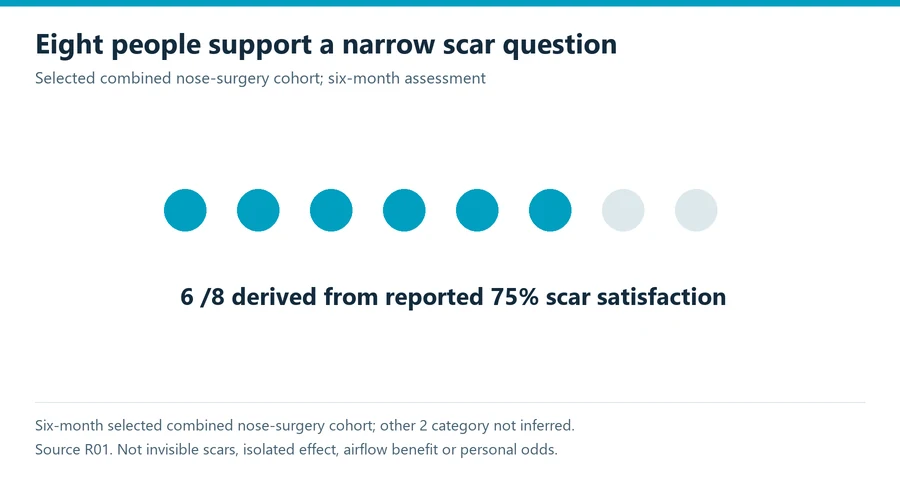
The 2023 modified-technique study included eight people having rhinoplasty or septorhinoplasty with the alar procedure. At six months, 75% reported satisfactory scar appearance. Its mean Stony Brook scar assessment score was 4.7, with a reported standard deviation of 0.74. The report also described overall appearance satisfaction in 75% of participants. These are distinct assessments in a very small combined-procedure cohort, not a guarantee of an invisible scar. Original scar and satisfaction assessments
For the six-month scar-satisfaction figure, 75% of eight corresponds to six people. That calculation helps reveal how small the denominator is. It does not justify extrapolating six satisfied people into a precise prediction for hundreds of future patients. The professional scar scale and the person’s own satisfaction report also answer different questions; they should not be treated as interchangeable success scores.
A scar score is not a breathing test
The study’s scar assessments are relevant to scar questions. They do not establish nasal airflow, satisfaction with every facial feature or lifelong durability. If someone uses the figure to support another claim, ask which endpoint was actually measured. This is especially important when several procedures were performed together and the report does not isolate every component’s contribution to the overall appearance rating.
| Evidence item | What was reported | What it does not establish |
|---|---|---|
| Modified-technique cohort | Eight patients with accompanying nose surgery | A universal result for isolated alar base reduction |
| Scar satisfaction at six months | 75%; calculated equivalent of six out of eight | An invisible scar or personal probability |
| Scar assessment scale | Mean 4.7, SD 0.74 | Breathing function or the same endpoint as personal satisfaction |
| Overall appearance satisfaction | 75% reported | Which component of combined surgery caused satisfaction |
Read the larger and newer studies without declaring a winner
A 2023 original article described 436 consecutive rhinoplasties, with alar base surgery in 214. Its abstract reported that no revision was required in that series. That observation is not the same as proving that revision is impossible, and the abstract does not provide a verified standardized follow-up duration for this claim. It also represents one surgeon’s experience within rhinoplasty, rather than a randomized comparison of every alar approach. Original alar rim and base series
Newer comparative evidence was published online in January 2026. It included 927 rhinoplasty patients, with 827 receiving the BAYAD visual-landmark approach and 100 receiving traditional ruler-based planning. The abstract reported satisfaction of 94% versus 85% and revision surgery of 3.1% versus 7%. The abstract does not establish randomized allocation or a verified outcome-assessment timepoint. It should not be converted into a personal recommendation from the percentage difference alone. Original prospective comparative study
These papers add information, but their sample sizes and endpoints differ. The eight-patient paper focuses on a modified approach and scar assessments; the larger series reports one surgeon’s combined rhinoplasty experience; the newer comparison evaluates two planning approaches in a particular setting. They cannot be merged into a single pooled success rate without establishing that the interventions, observation periods and outcomes are compatible.
Ask what makes a cited study relevant to the proposed procedure. Does it include isolated alar surgery or accompanying rhinoplasty? Is the technique the same? Is the endpoint scarring, appearance satisfaction, revision or function? If follow-up is not verified, leave it unverified. Recruitment between January 2022 and January 2025 is a treatment window, not proof that every participant had three years of outcome observation.
A measured facial ratio is not an ideal target
The twenty-patient three-part study reported an average interalar-to-intercanthal distance ratio decreasing from 1.15 to 1.01. This describes a measured relationship in its selected cohort. It does not establish that every person’s nose should be narrowed to that ratio, or that a value near one is a universal aesthetic or functional requirement. A research average cannot replace an individual goal and examination. Original measurement study
When discussing a ratio, ask what the measurement is intended to answer. Is it being used to describe a starting feature, compare a postoperative observation or prescribe an aesthetic target? Those uses are different. The reference points and photographic conditions also matter. A phone photograph taken from an unfamiliar angle cannot simply be substituted for a study’s assessment method.
Keep cultural identity and personal preference visible in the discussion. You may want a specific contour change while preserving a recognizable nasal character. That is a legitimate goal to describe without assigning a single shape to an ethnic group. A useful explanation says how the proposal relates to your wishes and findings; it does not claim that your face must conform to a population average.
Discuss incision and scar trade-offs directly
Ask where the proposed scars will lie and how they relate to the nostril rim and surrounding contour. An incision-location sketch should be clearly identified as a planning explanation, not a postoperative result. Ask which changes are intended and which adverse changes are being considered. “Hidden” and “minimal” are insufficient descriptions if they are not connected to the actual site and approach.
ASPS includes poor healing, scarring, sensation changes, infection, swelling and possible revision in general rhinoplasty consent information. Discuss the categories relevant to your exact operation rather than import rates from a different procedure. If your main concern is a visible scar, request a specific explanation of scar assessment and follow-up; a satisfaction number from a small combined series does not answer every scar question. ASPS consent categories
Previous surgery belongs in this discussion. Share the operative information you have and describe existing concerns before a new plan is made. The absence of those records should be acknowledged rather than filled with assumptions about what was removed or changed. A revision proposal is easier to understand when the examiner distinguishes known history, current findings and information that remains unavailable.
Compare a standalone proposal with combined rhinoplasty carefully
A complete quote should identify whether the alar procedure is standalone or part of a broader nose operation. It should also identify anesthesia, facility charges and included follow-up. ASPS explains that its general rhinoplasty surgeon fee excludes some expenses. A general rhinoplasty average is not a verified current price for isolated alar base reduction, and it should not be relabeled as one. ASPS fee scope
| Proposal field | Information to obtain | Why it matters |
|---|---|---|
| Exact scope | Standalone alar surgery or accompanying rhinoplasty components | The same headline label may describe different operations |
| Appearance and function | Separate goals and assessments | A cosmetic change does not prove an airway benefit |
| Anesthesia and setting | Planned services and separate fees | A surgeon fee is not necessarily the total |
| Follow-up and revision terms | Included reviews and how concerns are assessed or billed | The financial agreement should define continuing responsibilities |
If the plan changes after examination, request an updated description and quote. A standalone estimate should not quietly become a combined-surgery estimate without the scope being clear. Likewise, a combined proposal should identify which concerns it addresses beyond the alar base. Financial clarity is useful because it keeps the operation you understand aligned with the agreement you are considering.
Keep the baseline record interpretable
Before comparing an after photograph with a before photograph, ask what was recorded at each visit. Was the nose photographed at rest, in the same view and under comparable conditions? Was a different facial expression used? A still image may communicate shape while omitting how the person describes breathing, scar comfort or satisfaction. Keep those observations beside the photograph as separate records rather than assuming the picture contains all of them.
The date of an image matters as much as the date of the operation. A picture taken during early healing should not be silently described as a final result. If the date is unavailable, record it as unavailable. Similarly, a picture after combined nose surgery cannot show what would have happened after the alar component alone. The uncertainty is about attribution, even when the visible result is attractive.
For functional questions, ask how the treating team intends to document the starting concern and assess it later. Do not invent a home breathing score or assume that measuring the opening on a photograph supplies the answer. A useful explanation identifies the symptom or finding, the planned assessment and the endpoint being followed. This makes a later statement about improvement easier to interpret than a general claim that the nose looks more balanced.
Preserve the original goal statement too. If the discussion moves from reduced flare to a wider rhinoplasty plan, keeping that statement helps reveal which additional goals were introduced and why. You can then decide whether those additions match your wishes. Changing the plan may be reasonable, but a revised plan should remain understandable rather than be justified by an outcome photograph from an unrelated combination of procedures.
Recovery needs the actual operation’s instructions
ASPS general rhinoplasty recovery information describes individualized wound care, medications, concerns, follow-up and activity questions. Combined nose surgery can include additional supports and a longer process of contour refinement. Do not assume that the instructions for a full rhinoplasty apply identically to an isolated alar procedure, or that a small incision supplies a universal return-to-work date. Obtain the actual plan for the procedure offered. ASPS recovery guidance
Ask about incision care, planned suture assessment, normal activities and contact arrangements for concerns. Avoid borrowing scar products or wound care routines from another patient’s account. Your calendar should distinguish looking presentable, wound assessment and activity clearance rather than combine them into one recovery deadline. Ask the treating team to explain how any accompanying nose procedures change those milestones.
Before deciding, keep a concise record of your preferred change, preserved features, functional concerns, precise scope, evidence limits, scar discussion and complete costs. Our rhinoplasty guide explains the broader operation, while the consultation question guide helps organize unanswered questions. The sound decision rests on an understood individual proposal, not the smallest advertised ratio or the most confident-looking simulation.
Sources and review scope
Plastic Surgery Editorial Team. Source records checked through October 12, 2026. Review scope: source and editorial checks for general education. No individual clinical assessment is represented.
- Original modified alar base reduction prospective cohort. pubmed.ncbi.nlm.nih.gov. Source date: 2023-08-25. Checked 2026-10-12.
- ASPS appearance and airway scope. plasticsurgery.org. Publication/update date not stated. Checked 2026-10-12.
- Original three-part alar analysis cohort. pubmed.ncbi.nlm.nih.gov. Source date: 2024-09-25. Checked 2026-10-12.
- ASPS general consent categories. plasticsurgery.org. Publication/update date not stated. Checked 2026-10-12.
- Original alar rim/base single-surgeon series. pubmed.ncbi.nlm.nih.gov. Source date: 2023-05-24. Checked 2026-10-12.
- Original BAYAD prospective comparative study. pubmed.ncbi.nlm.nih.gov. Source date: 2026-01-30. Checked 2026-10-12.
- ASPS fee versus total. plasticsurgery.org. Publication/update date not stated. Checked 2026-10-12.
- ASPS individualized nose aftercare. plasticsurgery.org. Publication/update date not stated. Checked 2026-10-12.
- ASPS clinical history and goal assessment. plasticsurgery.org. Publication/update date not stated. Checked 2026-10-12.