
Accessory breast tissue removal addresses assessed breast tissue outside the usual breast region, often in the underarm. It is not a diagnosis for every underarm bulge or lump. First establish what the tissue is and whether a new or changing finding needs investigation. Once that assessment is complete, an elective plan should explain the tissue being removed, the intended symptom or appearance change, the scar and the effect on ordinary arm activities.
The decision is more specific than choosing between a small incision and a large one. Fat, glandular tissue and overlying skin are different components. Ask which components have been identified, which the proposed procedure will address and which may remain. A technique’s name alone does not explain how that plan matches your anatomy or your priorities. This guide helps you compare those answers without diagnosing a lump or choosing an operation from a photograph.
An unexplained lump comes before an appearance plan
NCI includes a lump or firm area under the arm among breast changes that should be discussed with a doctor. Most breast changes are not cancer, but a recent normal mammogram does not remove the need to follow up on a new change. If the reason for seeking treatment is a newly noticed lump, start with clinical assessment rather than a cosmetic promise to remove underarm fat. NCI breast and underarm changes
NHS guidance likewise advises assessment of a breast or armpit lump and describes examination, imaging and sometimes biopsy as possible parts of investigation. The clinician decides which tests fit the finding; this is not a checklist of tests every person must obtain. Do not assume that a surface bulge, a symptom linked to clothing or an online resemblance establishes its cause. NHS breast lump assessment
Ask what diagnosis has actually been established and what remains uncertain. If a previous assessment occurred elsewhere, bring the report rather than relying on a remembered label. Explain when you noticed the area, whether it has changed and what symptoms prompted attention. These details help keep a diagnostic question separate from a later elective contouring question. They do not turn this guide into a method of self-examination or a way to rule out disease.
A plan to improve the underarm contour should follow an explanation of the tissue being treated. If a cosmetic consultation identifies a question that needs breast assessment, ask who will coordinate that next step and when the appearance discussion can resume. Deferring an operation to clarify a finding is a meaningful decision, even when the original reason for the appointment was discomfort with clothing or appearance.
Describe the problem in terms that can be evaluated
Accessory tissue is described in surgical research as ectopic breast tissue outside the usual region. A 2024 report of 35 women undergoing axillary surgery identified both breast and adipose tissue in the removed specimens. That finding concerns the participants in that report; it does not establish the composition of every reader’s underarm fullness. Original axillary tissue surgery study
After assessment, distinguish the feature you want changed from the name of the operation. You might prioritize discomfort during an activity, a particular contour in clothing or the visibility of a defined area. Explain the circumstances clearly. An underarm appearance at rest and the same region with the arm raised are different views, and neither alone captures every practical concern. Ask how the proposed plan will be evaluated in the positions that matter to you.
Avoid making perfect bilateral identity the only definition of improvement. Instead, identify the features you notice on each side and ask which are expected to change. A plan may differ between sides because the assessed tissue or skin differs. If both sides are proposed for treatment, ask for a separate explanation of each rather than assuming that a bilateral label means identical anatomy, identical removal or an identical result.
| Feature to clarify | Useful assessment question | What the answer should distinguish |
|---|---|---|
| An underarm lump | What diagnosis is established and what investigation remains? | Diagnostic assessment from elective contouring |
| Fullness | Which components are fat and which are breast tissue? | Tissue composition from surface appearance |
| Overlying skin | Is skin removal part of this proposal? | Tissue removal from the skin and scar plan |
| A nipple-like feature | Has this been identified and included in the proposed scope? | The feature’s assessment from assumed removal |
| Different sides | What is planned on each side and why? | Bilateral treatment from an identical operation |
Use the table to record the explanation, not to assign yourself a tissue type. If the answers remain general, ask for the specific components to be stated in the written plan. That record makes later discussions about contour, scars or residual tissue more precise. It also prevents a broad term such as underarm reduction from hiding differences between two otherwise similar-looking estimates.
Understand what the proposed technique includes
The published literature includes combined excision and liposuction as well as approaches involving removal of skin and glandular tissue. These reports describe techniques used in selected groups; they do not establish one universally superior plan. Ask the surgeon to explain why each component is included in your assessed case and what a different approach would leave unresolved. A technique should answer a tissue and goal question, not merely carry an appealing name.
If liposuction is proposed, ask what it is expected to change and how any identified glandular component will be handled. If excision is proposed, ask what tissue will be removed, whether skin is included and what that means for the scar. Do not infer from the word minimal that the operation has minimal risk, or from the word excision that every visible fold will necessarily disappear. The meaningful explanation concerns scope and limitations.
The 2024 report used a skin-and-tissue removal approach and observed participants for six months. It recorded hypertrophic scarring, fluid collections called seromas and axillary cording among complications. The checked abstract does not supply event counts, so these findings should not be converted into complication percentages. They identify issues worth discussing, not a personal prediction or proof that another method avoids them.
Skin removal is its own decision
Ask why skin removal is being included or omitted and what uncertainty remains about the eventual contour. Request a plain explanation of the proposed scar location with the arm relaxed and raised. An incision described as hidden may still matter in your usual clothes or activities. This guide does not prescribe where to place an incision or claim that a particular scar will remain invisible.
When two proposals differ, compare their objectives before comparing the scar length. One may attempt a greater immediate change in skin contour; another may prioritize a smaller initial scar or a different extent of tissue removal. Ask what each tradeoff means in the actual plan and whether further treatment is a possibility. Do not treat the prospect of a second discussion as proof of failure, but do ask that it be made clear before consent.
Read outcome numbers without turning them into promises
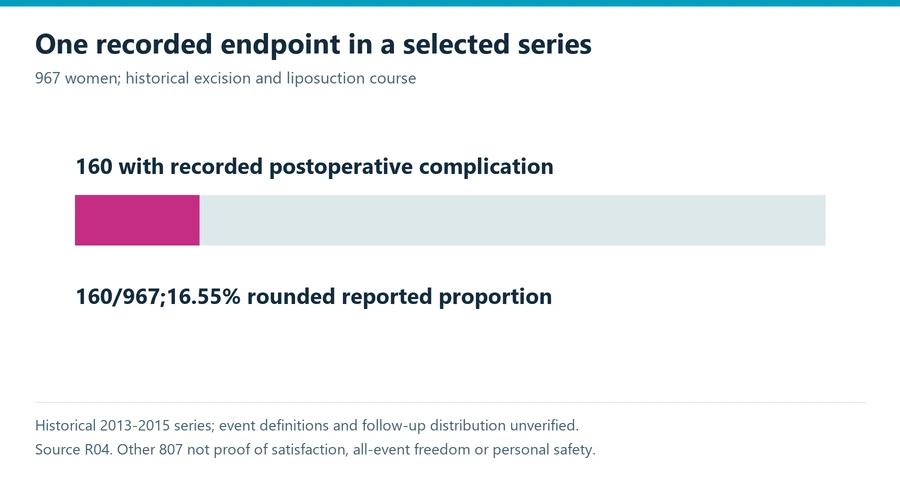
A retrospective report published online in December 2016 examined 967 women treated from September 2013 through December 2015 with excision and liposuction. It recorded postoperative complications in 160 participants, or 16.55%. The checked abstract does not establish the detailed follow-up distribution or all event definitions. This is a historical selected surgical series, not a current national complication rate. Original 967-patient accessory tissue series
The same report described cosmetic satisfaction, but that is a different endpoint from complications. A participant can be satisfied and still have needed care for an adverse event. Conversely, an absence of a listed complication does not by itself tell you whether the appearance met the person’s goal. Keep the outcome categories separate rather than subtracting one percentage from another and labeling the remainder failures.
The denominator also matters. A bilateral operation may involve two underarms but one person. The historical 967 figure counts participants, not 1,934 independently observed people. If another paper reports axillae rather than patients, do not merge the numbers without understanding how both sides and events were counted. A larger denominator cannot make unlike units comparable merely because they concern the same procedure name.
| Research detail | Why it matters | What not to infer |
|---|---|---|
| Retrospective selected patients | Describes a particular treated group | A randomized comparison of all available options |
| 160 of 967 with recorded complications | Gives the reported participant denominator | Your individualized likelihood of an event |
| Cosmetic satisfaction | Measures a different question | That all satisfied participants had no complications |
| Six-month observation in the separate 35-person report | Defines that report’s time window | Lifetime freedom from scars or residual concerns |
| No verified event counts for the smaller report | Identifies a source gap | A calculated complication rate or zero-event claim |
If a consultation presents a success percentage, ask what success means, when it was measured and how many people were included. Was the endpoint contour, symptoms, satisfaction, a wound event or a later revision? Ask whether the evidence concerns the proposed combination of tissue and skin treatment. A single attractive percentage should not substitute for the details that explain how it applies.
Include movement and daily use in the scar discussion
Underarm surgery occurs in a region you use during ordinary activities. Tell the team about tasks that matter to you: reaching shelves, lifting at work, exercise equipment or caring for someone who needs physical help. Ask how the specific operation affects the plan for these tasks and what assessment will determine progression. This guide does not provide a universal lifting limit, stretching routine or return-to-work date.
Clarify which activities need help initially and who will explain changes in the plan. A job title alone may conceal very different duties; desk work with occasional heavy deliveries is not the same as uninterrupted sitting. Similarly, an exercise label may include arm movements that the team needs to understand. Describe the actual action rather than seeking a single calendar date that supposedly covers everything.
Ask how discomfort, restricted movement or a concern about the scar will be evaluated. The presence of cording in the surgical literature makes it a reasonable topic for the consent discussion, but it does not mean every tight feeling represents that complication. Request a written contact and reassessment plan. Do not diagnose a postoperative problem from a chart or try an exercise copied from another person’s recovery.
Photographs used for planning should have a clear purpose. Ask which views will document the region and how later images will be compared. Arm position, clothing and framing can change what is visible. A useful record should help answer your agreed question rather than simply produce a more flattering image. No illustrative portrait or conceptual diagram on this page is a patient outcome photograph.
Separate this operation from other breast procedures
An accessory tissue proposal should identify its own region and purpose even when another breast operation is being discussed. Ask whether the underarm work is included in a reduction or lift estimate, or is a separate component. Do not assume that reducing the usual breast region automatically addresses an assessed accessory area. The plan should state what is and is not part of the proposed operation.
If combining procedures is offered, ask how the combined plan changes care, practical support and the way outcomes will be evaluated. A single anesthetic event does not make the components identical or remove the need to consent to each. Obtain an explanation of the reasons for combining or separating them. This guide does not assert that a combined operation is always safer, cheaper or more effective.
Ask how removed tissue will be handled and how any report will be communicated. The 2024 study sent specimens for histological analysis, but a report from that study is not a universal protocol for every future operation. Your own team should explain the proposed handling, expected reporting process and follow-up responsibility. Keep a diagnostic or pathology question separate from whether you like the eventual contour.
Compare the total scope of the estimate
The checked primary evidence does not establish a contemporary national total price for accessory breast tissue removal. Obtain a dated estimate that specifies side, region, tissue components, skin treatment, anesthesia and facility arrangements. A price described simply as underarm liposuction cannot be assumed equivalent to a plan including assessed glandular tissue and skin removal. Neither label supplies the full scope on its own.
| Estimate component | Detail to record | Question it resolves |
|---|---|---|
| Region and side | Right, left or both, with assessed target | Whether proposals cover the same area |
| Tissue and skin scope | Each planned component | Why two estimates may differ |
| Anesthesia and facility | Named arrangement and included fees | Whether the quoted figure is a total |
| Tissue reporting and follow-up | Included services and responsibility | What occurs beyond the operation |
| Unexpected care or further treatment | Written policy and potential charges | Which costs remain uncertain |
If insurance is being considered, ask for the actual payer’s requirements and a clear explanation of which service is being submitted. Symptoms, a diagnostic assessment and an appearance goal are related but distinct issues. Do not assume that a diagnosis guarantees coverage, or that a cosmetic estimate explains the cost of earlier investigation. A general internet rule cannot replace the policy and authorization applicable to you.
Compare value using the assessment, clarity of scope and care arrangement as well as price. A smaller initial estimate may omit services included elsewhere; a higher estimate does not prove a better outcome. Record what has been clarified and what is still unknown. There is no provider ranking here and no claim that an operation’s price can certify technical quality.
Decide on a defined change with an honest tradeoff
One practical way to compare proposals is to write two separate descriptions: your current concern and the proposed change. For example, a concern about how one underarm area sits against a particular sleeve is not identical to a request to change the entire side of the chest. Ask the team to connect the assessed target to the concern rather than expanding the region simply because a broader contour package is available. This is a way to clarify scope, not an example of a prescribed treatment.
Also discuss what an acceptable result would leave unchanged. You may be willing to retain a fold while prioritizing another feature, or you may consider a visible scar a more important tradeoff than a modest contour difference. Those preferences should be stated before the operation, not introduced only when the eventual appearance is assessed. A diagram can help describe the region, but it cannot show your personal healed contour or settle which tradeoff you should choose.
If the team recommends postponing the appearance decision until a diagnostic report is complete, ask what information that report is intended to resolve. Clarifying that purpose makes the next appointment more useful. It prevents an investigation from being treated as a mere administrative obstacle and keeps the sequence tied to the actual unanswered question about your tissue.
Accessory breast tissue removal is best understood as a specific operation after tissue assessment, with a stated goal and a consent discussion about scope, scars, function and uncertainty. The published series provide bounded observations, not an individualized guarantee. Ask for an explanation you can repeat accurately: what will be treated, why that approach fits, what may remain and how follow-up will assess the result.
Keep the diagnostic reports and written plan together so later questions do not depend on an imprecise memory of underarm reduction. Proceeding, deferring or deciding against elective surgery can each be reasonable after assessment and discussion. The useful endpoint is an informed decision about your own priorities, with unresolved questions made visible rather than concealed by a technique name or an unqualified success rate.
For related preparation, see questions to ask a plastic surgeon, plastic surgery cost and the procedure guide index.
Sources and review scope
Plastic Surgery Editorial Team. Source records checked through October 12, 2026. Review scope: source and editorial checks for general education. No individual clinical assessment is represented.
- NCI breast cancer signs and symptoms. cancer.gov. Source date: 2025-12-02. Checked 2026-10-12.
- NHS breast and armpit lump assessment. nhs.uk. Source date: 2023-06-28. Checked 2026-10-12.
- Original surgical axillary tissue hypertrophy study. pubmed.ncbi.nlm.nih.gov. Source date: 2024-01-10. Checked 2026-10-12.
- Original 967-person excision and liposuction series. pubmed.ncbi.nlm.nih.gov. Source date: 2016-12-28. Checked 2026-10-12.