
Abdominal etching is targeted liposuction intended to accentuate visible abdominal contours. It changes the appearance of the tissue overlying the abdominal muscles; a more defined appearance should not be confused with a measured improvement in strength, fitness or metabolic health. The decision is whether selective contouring suits your anatomy and preferences, with acceptable surgical risks. It is not simply whether a photograph shows a convincing six-pack. An original 2019 clinical report describes the approach and a small patient series. Original abdominal etching study
Three questions should lead the assessment: what fat contour is being targeted, how the skin is expected to respond and whether a separate abdominal wall or skin-removal concern exists. Definition, skin removal and functional muscle goals are separate objectives. A proposal that promises all three under one vague label needs clarification. Standard liposuction, etching and a tummy tuck have different scopes, even when more than one is considered in the same consultation.
What etching means, beyond “high definition”
The useful definition concerns the intended contour rather than the device name. Etching selectively emphasizes lines and transitions instead of merely aiming for a broadly smaller abdominal profile. Ask whether the proposal is general abdominal liposuction with additional selective definition, and which areas are included. A description such as high-definition or sculpting should be followed by a clear account of the planned visible changes, their limitations and the treatment regions.
ASPS describes liposuction as removal of localized excess fat and explicitly distinguishes it from obesity treatment or a substitute for diet and exercise. It also warns that skin quality affects the result and that extra skin may require additional surgery. Those distinctions are especially important when an etching proposal is presented as a comprehensive abdominal transformation. Fat removal cannot be assumed to answer every reason an abdomen looks or feels different. ASPS liposuction scope and limitations
Ask what the word six-pack means in your own proposal. Does it describe a subtle outline, sharper grooves or a more extensive contouring plan? The term is a shorthand for appearance, not a standardized surgical endpoint. You do not need to request the most conspicuous version to have a legitimate goal. A softer result may be closer to your preference, and deciding against surgery remains an option when the proposed appearance does not fit it.
Men and women should have the same opportunity to describe an individual preference. A presentation that automatically assigns sharply defined lines to men and one prescribed shape to women is not a substitute for that discussion. Record what you actually want rather than adopt a template because it appears repeatedly in marketing. The operation should be explained in relation to your assessed anatomy and wishes, not as a way to conform to one ideal body.
Separate fat, skin and abdominal wall concerns
Bring a description of the concern rather than a self-diagnosis. Localized fullness, loose skin and a question about abdominal wall function deserve separate answers during examination. You cannot identify the correct treatment simply by pinching tissue at home or matching a photograph to a published patient classification. The examiner should explain the relevant findings and what the proposed operation would leave unchanged.
A tummy tuck addresses excess skin and fat and, in many cases, weakened or separated muscles, according to ASPS. That scope differs from selective fat contouring. If loose skin is the main concern, ask why etching is being proposed and whether skin removal is being considered separately. If functional symptoms concern you, ask for an appropriate clinical assessment rather than treat an aesthetic contour diagram as a functional diagnosis. ASPS tummy tuck scope
| Goal or concern | Explanation to obtain | What should not be assumed |
|---|---|---|
| Broad abdominal fullness | Regions and scope of localized fat contouring | That visible definition is automatically included |
| More visible abdominal lines | Intended degree of selective definition | That appearance measures strength or physical fitness |
| Loose or excess skin | Expected skin response and any separate removal proposal | That removing fat necessarily removes extra skin |
| Abdominal wall or functional symptoms | Examination findings and appropriate evaluation | That an etching label establishes a diagnosis or repair |
Why skin assessment is more than a number
A newer classification paper illustrates why assessment cannot be reduced to one BMI threshold. Published online in October 2024 and in a 2025 volume, it reviewed 62 patients treated by one surgeon. Its proposed categories used body habitus, skin quality and a skin-fold assessment rather than BMI alone. This was a nonrandomized retrospective series, not a validated self-selection tool or a universal eligibility rule. Original classification study
That distinction gives you a useful question: which findings, beyond a weight measurement, support this recommendation? Ask how the examiner is considering the skin, previous operations and your actual treatment goals. Avoid using a study category as proof that you qualify. A classification designed within one technique and practice does not establish the same decision for every practitioner, every device or every patient.
The ASPS educational interview on etching published in May 2025 describes one practitioner’s preferred candidate profile and device sequence. It is helpful context for how a practice may approach selection, but it does not prove a universal BMI cutoff or that every etching operation requires the same equipment. Nor should its optimistic device language be turned into a guarantee against contour irregularity or swelling. ASPS educational discussion
Keep the explanation in words you can revisit. “Your skin finding is relevant because…” is more useful than a category label with no explanation. If an additional skin operation is suggested, have it named and described separately. If etching is advised against, ask which limitation drives the recommendation and which alternatives, including leaving the area untreated, are reasonable to consider. The purpose is understanding the rationale, not persuading the examiner to override it.
What the 50-patient report can and cannot tell you
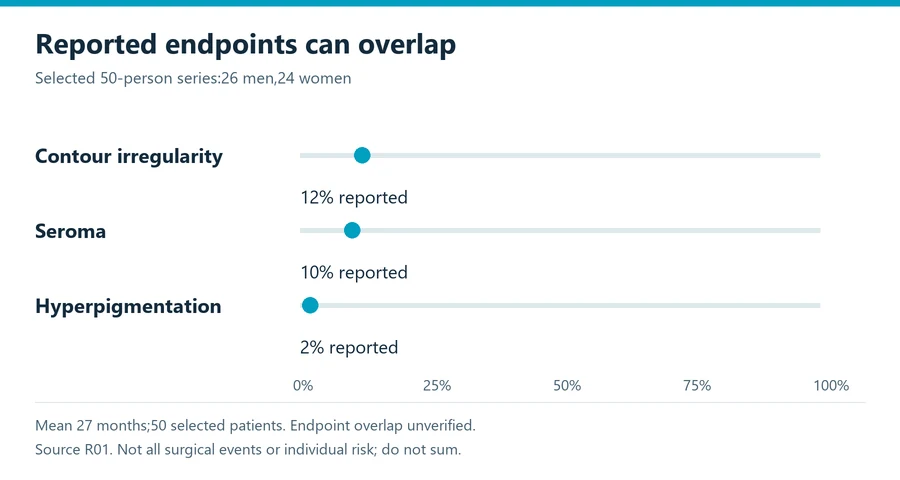
The original 2019 report reviewed 50 consecutive patients, including 26 men and 24 women, with an average follow-up of 27 months. It reported contour irregularities in 12%, seromas in 10% and hyperpigmentation in 2%. The reported satisfaction figure was 98%. These observations belong to that particular series; they are not a promise about your result or a universal risk table for all etching techniques. Original cohort results
The study did not provide a randomized comparison against conventional liposuction, a tummy tuck or no treatment. Consequently, its satisfaction number does not establish which option would be best for you. A cohort can document what happened after one approach without resolving how the same people would have rated a different approach. Ask whether a comparison being offered is based on comparable patients and outcomes or only on selected examples.
Satisfaction and complications are different endpoints
A satisfaction percentage is not the complement of a complication percentage. Someone can report satisfaction and also experience a complication. The three reported complication categories should not be added into one overall rate unless the paper establishes whether the groups overlap. They also should not be subtracted from 100% to invent a complication-free rate. A chart can show separate category frequencies without implying mutually exclusive groups.
An average follow-up does not mean everyone was observed for that exact duration. It is also not evidence of lifetime stability. When someone says the study proves a long-lasting result, ask what follow-up was reported and what outcome was measured at that time. A clear response should retain the distinction between an average observation period and a guarantee about all future weight changes, skin changes or patient satisfaction.
| Reported endpoint in the 2019 series | Reported figure | How to read it |
|---|---|---|
| Contour irregularity | 12% of the 50-patient cohort | Separate complication category, not a personal forecast |
| Seroma | 10% of the cohort | Do not assume categories are mutually exclusive |
| Hyperpigmentation | 2% of the cohort | Not a complete list of every possible adverse outcome |
| Satisfaction | 98% | Different endpoint from freedom from complications |
| Follow-up | Mean 27 months | Not identical observation duration for every person |
The newer classification study also acknowledges a limitation in its satisfaction questionnaire: it was not validated. That matters when comparing its scores with a different paper’s percentages or photographs. They may not represent the same question, scale or assessment time. Retain each instrument’s identity rather than convert unlike outcomes into a ranking of techniques. Study limitations
What would stronger evidence need to measure?
For someone choosing between broad contour reduction and selective etching, the most useful comparison would describe both groups’ starting concerns, procedures and follow-up. It would also specify what counts as a satisfactory result and how complications are collected. Without those details, a high satisfaction number can leave the actual decision unanswered. You may care most about subtle definition, whereas a study’s participants may have sought a much sharper appearance.
Ask whether any outcome offered as evidence matches your priority. A photograph can document appearance at a stated time, a questionnaire can describe a person’s reported experience and a functional test can address a specific physical capability. These are different measurements. A claim about fitness requires an appropriate fitness endpoint; it cannot be established by relabeling a visual contour assessment. Likewise, an attractive contour does not answer how many people required additional care.
Separate the timing of those observations. An early satisfaction assessment, a later photograph and a record of a complication may refer to different visits. They should not be blended into one event simply because they appear in the same paper. When a follow-up interval is missing, keep it missing rather than infer it from the publication date. A paper published several years after recruitment does not prove that every participant was observed for all those years.
It is also reasonable to ask how people who did not return were handled. A convincing-looking collection of later photographs may represent those available for follow-up rather than every person originally treated. This is an evidence-reading question, not a claim that a particular series lost participants. Record the actual denominator and assessment method if they are provided, and label them unverified when they are not.
This approach leaves room for useful clinical experience while resisting an unsupported guarantee. The absence of a definitive comparison does not establish that etching is ineffective; it limits the certainty of choosing it over another option from the published figures alone. Your decision should therefore combine an individual assessment with an honest explanation of what the available measurements can answer.
Ask about adjuncts as additional interventions
An etching proposal may mention an energy-assisted device, fat transfer or another body contouring operation. Each addition needs its own indication, risks and explanation. A device brand does not define the whole procedure. If an adjunct is being recommended, ask what problem it is intended to solve and whether the evidence being discussed actually includes that adjunct in a comparable setting.
Do not assume that muscle-looking volume means a measured improvement in muscle function. If fat transfer is proposed, ask where it is planned and what objective is being claimed, without using an online article as an injection recipe. The proposal should identify its scope independently of the etching label. A photograph after several interventions cannot isolate the contribution of each one.
The same principle applies to an additional skin procedure. Ask whether its purpose is skin removal or another stated goal, and whether it changes the recovery plan and total quote. You should be able to distinguish the base operation from optional additions. A recommendation may be appropriate while still requiring a separate explanation; “included in the package” is a financial phrase, not an assessment finding.
Surgical risks do not disappear with a fitness-oriented name
ASPS lists anesthesia risks, fluid accumulation, irregular contours, pigmentation changes, persistent sensation changes, infection, poor healing and possible revision among liposuction concerns. It also identifies deeper structure injury and serious cardiopulmonary or clot-related complications. These categories remain relevant to discussing an operation marketed for athletic appearance. A healthy-looking subject in a promotional photograph does not establish the safety of your proposed surgery. ASPS liposuction risks
Ask for the setting, anesthesia plan and postoperative arrangements alongside the operation’s artistic description. The process should cover your medical history, medications, substances and previous procedures. ASPS includes these matters in its consultation guidance. Share the actual information rather than decide that it is irrelevant because the proposed incisions are small or the goal is cosmetic. ASPS consultation topics
If you are worried about an irregular or overly emphasized contour, make that concern explicit before treatment. Ask how a subtle versus strong definition preference is recorded and how a postoperative concern would be assessed. Do not accept a reassurance based solely on the absence of major complications in one small series. Failure to observe a rare event in that series is not proof that the event cannot occur elsewhere.
Compare costs by matching the treatment scope
A complete etching quote needs more detail than a general liposuction fee. It should state the treatment regions, whether broad contour reduction accompanies selective definition, any adjuncts and the anesthesia and facility arrangements. ASPS explains that its general liposuction surgeon fee excludes other expenses. An undated general amount should not be relabeled as a current, complete abdominal etching price. ASPS fee limitations
| Quote field | Detail to request | Common comparison problem |
|---|---|---|
| Regions and definition scope | Abdomen, flanks or other areas; degree of contouring discussed | Two offers may cover different regions |
| Adjuncts | Any energy device, transfer or separate skin procedure | Additions may change both risks and price |
| Anesthesia and facility | Included services and separate charges | Surgeon fee alone is not the full bill |
| Follow-up and unexpected care | Included reviews, garments and revision terms | A low headline price can omit continuing responsibilities |
Compare the written descriptions before comparing totals. If one offer includes another procedure, create a separate line for it rather than calculate that one practice is cheaper for the same operation. Ask how an assessment-driven change in scope would alter the estimate. Financial clarity cannot guarantee a result, but it can prevent an avoidable mismatch between the treatment you understand and the bill you receive.
Recovery is not permission to resume abdominal training
ASPS describes compression, incision care, medications, follow-up and activity questions as part of individualized liposuction recovery. Its general timeline is not personal clearance for strenuous abdominal exercise. Obtain the actual plan for your procedure, including any additions, and ask who will assess readiness for different activities. A social-media photograph showing an early contour does not establish wound healing or safe exercise intensity. ASPS recovery guidance
Separate appearance from function on your recovery calendar. Returning to desk work, wearing particular clothing, travelling and returning to training are different tasks. Ask about the tasks you really perform rather than request a single date for being normal again. Record garment instructions and the process for reporting concerns as given by the treating team; do not borrow a massage or compression schedule from another practice’s interview.
Make the contour preference specific without inventing an outcome
Reference images can help explain a preference, but record what they show and what is unknown. Are the subject, procedure combination and follow-up time documented? Do pose, lighting or active muscle contraction change the visible definition? If those conditions are unclear, use the image only to describe the aesthetic feature you like. It cannot establish an achievable personal result or the procedure required to obtain it.
Your final record should identify the goal, relevant examination findings, procedure scope, separate adjuncts, evidence limits, complete cost and aftercare responsibilities. A strong proposal explains what remains uncertain as well as what is intended. Compare the wider options through our liposuction guide, tummy tuck guide and tummy tuck versus liposuction comparison. The useful decision is whether a well-defined operation fits your priorities, not whether it adopts the most dramatic label.
Sources and review scope
Plastic Surgery Editorial Team. Source records checked through October 12, 2026. Review scope: source and editorial checks for general education. No individual clinical assessment is represented.
- Original abdominal etching 50-patient case series. pubmed.ncbi.nlm.nih.gov. Source date: 2019-04. Checked 2026-10-12.
- ASPS localized fat versus obesity and skin limits. plasticsurgery.org. Publication/update date not stated. Checked 2026-10-12.
- ASPS abdominal skin and wall scope. plasticsurgery.org. Publication/update date not stated. Checked 2026-10-12.
- Original classification series and limitations. link.springer.com. Source date: 2024-10-01. Checked 2026-10-12.
- ASPS practitioner educational interview. plasticsurgery.org. Source date: 2025-05-30. Checked 2026-10-12.
- ASPS liposuction consent categories. plasticsurgery.org. Publication/update date not stated. Checked 2026-10-12.
- ASPS health and scope history. plasticsurgery.org. Publication/update date not stated. Checked 2026-10-12.
- ASPS surgeon fee versus complete costs. plasticsurgery.org. Publication/update date not stated. Checked 2026-10-12.
- ASPS individualized recovery tasks. plasticsurgery.org. Publication/update date not stated. Checked 2026-10-12.