
CoolSculpting is a branded cryolipolysis treatment that uses controlled cooling to reduce a localized fat bulge without incisions. Liposuction surgically removes fat from selected areas. Both are contouring decisions, not substitutes for treating obesity or managing overall weight. The useful CoolSculpting vs liposuction comparison asks whether the assessed concern is localized fat, loose skin or another anatomical issue; how much change you expect; and whether you accept the obligations and risks of the proposed procedure. The ASPS nonsurgical fat-reduction overview identifies cooling as one modality, while its liposuction overview describes surgical fat removal.
A nonsurgical approach is not automatically appropriate merely because you prefer to avoid an operation. A surgical approach is not automatically appropriate merely because you want a larger change. An examination has to establish what is causing the contour concern and what the proposed method can plausibly address. Start by describing the specific area and the change you hope to notice. Then ask the clinician to explain how that request relates to the tissue being treated, rather than compare two package names in isolation.
Identify the contour problem before choosing a method
Localized fat, skin excess and a change in the underlying abdominal wall are different assessment questions. Do not assume that reducing fat will also remove loose skin or correct every cause of a protruding contour. ASPS notes that liposuction is not an obesity treatment, is not effective for cellulite and has limits where the skin does not reshape well. That distinction prevents a fat-removal proposal from becoming a promise to solve concerns it does not actually target.
For an abdominal concern, ask what part of the appearance is being attributed to the fat layer that the treatment can reach. Describe previous surgery, scars and any known hernia or muscle separation. The treating professional should decide how those details affect the plan. This article cannot determine from a photograph whether a bulge is suitable for cooling or surgery. It can help you recognize when a consultation has not yet answered the anatomical question.
Write an appearance goal that can be discussed without implying a guaranteed result. “Reduce a particular waistband bulge” is more specific than “make my body smaller.” Ask how the proposed assessment will distinguish a local contour change from a weight change or variation in posture. A person can value a modest improvement, but the size and location of that improvement should be part of the discussion before purchasing a treatment course.
| Concern to clarify | Information needed | Assumption to avoid |
|---|---|---|
| Localized bulge | Tissue and treatment-area assessment | Every bulge is accessible fat |
| Loose skin | Skin quality and separate treatment scope | Fat reduction removes excess skin |
| Overall weight | Appropriate weight-management discussion | Contouring treats obesity |
| Cellulite or surface texture | Exact diagnosis and endpoint | Liposuction resolves every texture concern |
| Prior abdominal surgery | Scars, structural history and examination | A device can be used wherever a bulge appears |
This table is not a self-screening test. Its purpose is to show why the clinician’s explanation matters more than an appealing applicator image or surgical brand. If the recommendation includes another procedure, identify the additional task and consider its risks separately. A plan that combines fat removal with skin removal is no longer a comparison of liposuction alone with cooling alone. That may be appropriate for some goals, but the broader scope should be explicit.
Keep the device, applicator and treatment area visible
CoolSculpting is not the name of every cryolipolysis device. Research on a different cooling system cannot automatically establish the performance of the exact system offered to you. Ask for the device model, proposed applicator and intended area. The FDA body-contouring guidance explains that authorization concerns intended uses and body sites. A general statement that a technology is cleared does not resolve whether the proposed use matches the actual device’s authorization.
Ask an office to explain what it means by a session, cycle and area in both its clinical plan and its bill. Those units may describe different things. A visit might include more than one application, and a body region may require a defined arrangement rather than one universal exposure. Do not infer the number you need from an advertisement or from another patient’s receipt. The count belongs to your assessed plan, along with the reassessment process before further treatment.
The surgical proposal also needs a specific identity. “Lipo” does not tell you which areas are included, what anesthesia and facility arrangements are planned, or whether another procedure is being added. Request the boundaries of the operation in plain language. If an energy-assisted method is proposed, ask which part of the intervention it changes and which evidence supports the added component. An equipment name should not silently become a guarantee of tighter skin, easier recovery or fewer complications.
Read small studies without converting them into promises
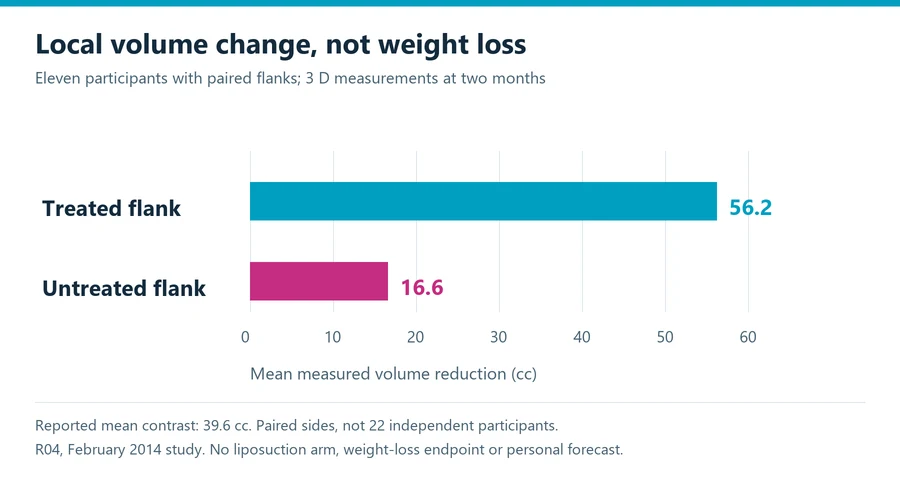
A 2014 original volumetric study enrolled eleven participants and treated one flank in each person, leaving the opposite flank untreated. At two months, mean measured volume reduction was 56.2 cubic centimeters on the treated side and 16.6 on the control side. The reported mean difference was 39.6 cubic centimeters. These were three-dimensional photographic measurements in a small paired study, not liters of fat surgically removed, a weight-loss outcome or a comparison with liposuction.
The supporting plot shows the two reported means on a common volume-change axis. Eleven participants contributed paired flanks; the study did not contain twenty-two independent people. No confidence interval for the paired difference or predicted range for your result is supplied by this plot. A small controlled measurement can be informative while remaining too narrow to answer a different body-area or treatment-course question.
A separate randomized trial published online July 26, 2019 allocated thirty-four healthy women to treatment or no treatment, seventeen per group. It assessed the lower abdomen at thirty, sixty and ninety days after one application and reported no significant treatment-control differences in the measured thickness and circumference outcomes. Its original methods identify Crio Top Body Redux equipment, not CoolSculpting. The finding concerns that device and protocol, not a direct test of the branded proposal or of liposuction.
These studies should not be forced into a single universal percentage. They assessed different body areas, devices, designs and endpoints. One used paired flank volume; the other compared separate groups using abdominal measurements. Neither had a liposuction arm. A fair comparison explains those differences instead of averaging unrelated numbers or treating one result as a guarantee that every cooling system succeeds or fails.
The untreated-side change is part of the interpretation, not an extra benefit attributable to treatment. Looking only at the treated-side mean would omit the comparison the investigators deliberately included. The source-reported contrast subtracts the two means, but it still does not establish what a surgical operation would have removed. A volume estimated from a surface measurement also has a different meaning from material physically collected during surgery. Keep both the measurement method and the comparison condition beside a quoted number. That makes the evidence easier to assess without inflating a small local change into an overall body-transformation claim.
Separate measured change from satisfaction and safety
Volume, thickness, circumference and satisfaction answer different questions. A measured local change does not identify how many people considered it worthwhile, and a satisfaction result does not establish a complication rate. If a clinic cites a percentage, ask which endpoint it represents. Keep the denominator and assessment time beside it. A response measured after a short course should not acquire a claim of lifelong permanence simply because the treatment is described as destroying fat cells.
Similarly, a report of no unexpected events in a small study cannot exclude an uncommon delayed problem. The observation window and number of treated people matter. Ask for safety evidence relevant to the actual device and use, not only the efficacy photograph. An article can support a cautious discussion without supplying a defensible personal probability. The uncertainty is part of the decision rather than a reason to replace the evidence with an advertisement.
Include delayed cooling complications in the plan
The FDA describes paradoxical adipose hyperplasia, or PAH, as growth of fatty tissue rather than shrinkage in the treated area after fat freezing. Reported cases developed two to five months after treatment. It does not resolve on its own and may require surgery; surgery may not fully resolve the complication. Other possible cooling complications include pain, persistent numbness and severe freeze burns. Avoid interpreting “no incision” as “no lasting harm,” or assuming an early uneventful visit excludes a later problem.
Ask how the office documents the exact applicator and treatment locations and how it assesses a persistent or enlarging bulge. The answer should identify who reviews concerns and how follow-up is arranged, including after the usual initial appointment window. Do not try to diagnose PAH yourself from a photograph or assume that another application is the right response to an unexpected contour. Get an assessment from the treating professional and a clear explanation of next steps.
The FDA recall database lists five legacy ZELTIQ applicator recalls posted July 11, 2022. That historical record is a reason to identify the actual applicator and check its status; it is not a statement that every current CoolSculpting system is recalled. Ask the office how it verifies device and applicator eligibility for use. A historical brand name alone cannot establish what equipment is being offered today.
Do not calculate a personal PAH probability from isolated adverse-event reports or a recall list. Those records do not supply the complete treatment denominator needed for such a calculation. A reported event, a complaint count and a rate from a defined study are different kinds of evidence. Ask what source supports any numerical risk quoted to you, which applicators and years it covers and what follow-up was used. If those fields are unavailable, the figure should remain uncertain.
Compare surgical obligations fairly
The ASPS liposuction safety guidance includes anesthesia-related risks, infection, contour irregularities, sensation changes, persistent swelling and more serious complications, including thromboembolic and internal-injury risks. Ask how the specific operation and any combination procedure affect the consent discussion. The presence of a surgical facility or a particular technique name does not eliminate the need to understand the risks and response arrangements.
A useful comparison considers how you would handle both an imperfect contour and a medical complication. Who assesses a concern? Where is care delivered? What expenses are included, and what would require a separate agreement? These are not just questions for surgery; they also matter when a nonsurgical treatment can require corrective surgery. Compare the pathways honestly instead of treating one option’s complications as theoretical and the other’s as inevitable.
Your preference about incisions and anesthesia is relevant, but it should be discussed alongside the likelihood that the chosen method addresses the goal. Avoid selecting a procedure solely because its initial appointment seems easier to fit into your schedule. If a proposal is unlikely to deliver the change you want, repeated convenient appointments do not automatically make it the better choice. Equally, wanting more change is not a reason to bypass an assessment of surgical suitability.
Normalize the quote around the whole plan
For CoolSculpting vs liposuction, a per-cycle price and a surgical fee are not comparable totals. Record the number of proposed applications and visits, which areas they cover and when further treatment is conditional on reassessment. For surgery, record the areas, facility, anesthesia and follow-up scope. Do not invent a national break-even point. Actual quoted components and the clinician’s proposed course are needed before comparing what you would pay.
| Quote component | Cooling proposal | Surgical proposal |
|---|---|---|
| Treatment scope | Device, applicator, areas and applications | Areas, operative components and added procedures |
| Initial course | Visits and planned reassessment | Operation and scheduled postoperative reviews |
| Additional services | Assessment, products or separate visits | Facility, anesthesia, tests, medications or garments |
| Unexpected outcome | Assessment and further-treatment policy | Assessment and revision or complication policy |
| Payment commitment | Package conditions and cancellation | Deposit, exclusions and additional agreements |
Ask whether the price includes only the intended treatment or also the reassessment needed to judge its effect. A low headline number can be accurate yet incomplete for your particular plan. A higher quote may cover additional scope rather than a more effective intervention. Identify the difference before deciding. The worksheet is most useful when both offices answer in the same units and identify which fields do not apply.
Also consider the nonmedical obligations without pretending they are universal dollar amounts. You may need transport, help with responsibilities or flexibility for follow-up. Those requirements depend on the actual plan and your life. Include them in your notes so they are not overlooked when comparing an appointment fee with an operation total. An honest budget can leave uncertain fields open; it should not hide them inside a promotional package.
Use two follow-up calendars
Plan separately for short-term care and later outcome assessment. Cooling research often assesses changes over weeks or months, while a surgical recovery plan has its own care and activity instructions. Neither clock establishes your personal clearance date. Ask when the team expects to evaluate the contour, what could prompt earlier assessment and which everyday tasks need modification. A procedure that is nonsurgical still needs a plan for unexpected symptoms and delayed changes.
Describe your work and home duties specifically. Driving, lifting, prolonged activity, travel and caring for dependents create different planning questions. Obtain written instructions from the treating team rather than borrow a recovery routine from another procedure. If another operation is included, the combined plan may have obligations that a liposuction-only description does not capture. The comparison should be updated to reflect the actual scope before you arrange time away.
| Follow-up question | Why it matters | Record to retain |
|---|---|---|
| When is the contour assessed? | Early appearance may not be the measured endpoint | Planned assessment timing and method |
| What needs earlier review? | Unexpected symptoms require a defined response | Written contact and escalation instructions |
| Who reviews delayed changes? | Cooling complications can appear later | Named care service and access arrangements |
| What tasks need modification? | Everyday demands differ between people | Individual instructions and practical support |
| When is another treatment considered? | Repeating treatment needs reassessment | Rationale, new scope and separate consent |
Keep a record of the proposed area, equipment or operative plan and follow-up arrangements. This helps a later clinician understand what was done if your care changes. It also makes an outcome discussion more specific than “the treatment did not work.” Ask how the team distinguishes insufficient improvement, asymmetry, a new concern and a complication. These situations may require different assessments; a generic additional-session offer does not explain them.
Choose a coherent plan rather than a universal winner
The best comparison for you names the contour problem, two actual proposals and the tradeoffs you accept. It does not promise weight loss, treat all cooling devices as one product or claim that a small noncomparative study proves superiority over surgery. If the principal concern is loose skin or another structure, clarify whether either proposal addresses it. If your desired change exceeds the explained scope, revise the plan before purchasing a course.
A reasonable decision may be to proceed with one assessed option, to seek clarification or to postpone while the goal remains uncertain. What matters is that the explanation, evidence and follow-up fit together. A treatment name should not do the work of an examination or a complete proposal. Compare the expected task, limitations and practical commitments in the same document, then ask the treating professional to resolve the remaining questions.
For related planning, see the procedure guide hub, questions to ask a plastic surgeon and plastic surgery cost planning.
Sources and review scope
Plastic Surgery Editorial Team. Source records checked through October 12, 2026. Review scope: source and editorial checks for general education. No individual clinical assessment is represented.
- ASPS nonsurgical fat-reduction overview. plasticsurgery.org. Publication/update date not stated. Checked 2026-10-12.
- ASPS liposuction overview. plasticsurgery.org. Publication/update date not stated. Checked 2026-10-12.
- FDA non-invasive body-contouring technologies. fda.gov. Publication/update date not stated. Checked 2026-10-12.
- Three-dimensional volumetric quantification of fat loss following cryolipolysis. pubmed.ncbi.nlm.nih.gov. Source date: 2014-02. Checked 2026-10-12.
- Effects of cryolipolysis on lower abdomen fat thickness: randomized controlled trial. pubmed.ncbi.nlm.nih.gov. Source date: 2019-07-26. Checked 2026-10-12.
- FDA legacy ZELTIQ applicator recall records. accessdata.fda.gov. Source date: 2022-07-11. Checked 2026-10-12.
- ASPS liposuction risks and safety. plasticsurgery.org. Publication/update date not stated. Checked 2026-10-12.