
A chemical peel uses a chemical formulation to resurface skin; a laser uses light energy. Neither category is one standardized treatment. A useful chemical peel vs laser comparison identifies the actual skin concern, peel formulation and intended depth, or laser device and treatment mode. Then it compares the endpoint you want, the recovery demands and the risks for your skin. A light peel and an intensive resurfacing laser are not equivalent simply because both are advertised for a smoother complexion. The ASPS peel overview and ASPS laser overview explain the two broad approaches.
Start with a diagnosis rather than a technology preference. “Uneven skin” may describe color, texture, active lesions or scars, and those are different assessment tasks. Ask the treating professional to name the concern being targeted and what would count as a meaningful improvement. A clear answer might identify a specific scar score or a defined photographic assessment. A vague promise to refresh everything makes both the proposed benefit and the treatment comparison harder to evaluate.
Specify the peel and laser in the same sentence
The word “peel” does not establish how intensive treatment will be. ASPS distinguishes light, medium and deep approaches in its chemical peel procedure guidance. These describe different treatment depths and preparation or recovery considerations. The intended depth needs to be discussed together with the formulation and your skin history. A percentage on a bottle, by itself, does not define a safe personal treatment plan, and this guide does not provide an application recipe.
Laser proposals need similar precision. Ask for the device or wavelength, whether the procedure is ablative or nonablative and whether the treatment is fractional. These terms describe different aspects of a treatment; they are not interchangeable brand names. A proposal that only says “laser facial” leaves the comparison unfinished. A device name is also incomplete if the intended use, area and course are unclear. Request a plain-language explanation of what the planned treatment does to the skin and why it matches the assessed concern.
Do not assume that every light-based treatment is the laser resurfacing procedure described in a particular paper. The ASPS resurfacing overview lists several modalities, including laser and intense pulsed light. Ask an office to distinguish its offered treatment from a study’s treatment before using that study to compare results. Marketing can group services under “rejuvenation,” but evidence has to remain attached to the actual intervention that investigators used.
| Proposal field | Peel information to record | Laser information to record |
|---|---|---|
| Target concern | Diagnosed problem and area | Same problem and area |
| Treatment identity | Named formulation and intended depth | Named device or wavelength and mode |
| Course | Planned sessions and reassessment | Planned sessions and reassessment |
| Endpoint | How improvement is judged | Comparable assessment where feasible |
| Recovery | Wound care, appearance and activity implications | Instructions for the specific modality |
This worksheet does not tell you which settings or concentrations to request. Its purpose is to prevent an undefined category from becoming a promise. If one proposal is for active acne and another is for established acne scars, they are addressing different tasks even if both use photographs of clearer skin. If one covers a small region and the other covers the entire face, ask whether the difference is intentional. A comparable quote starts with comparable scope, not a matched promotional slogan.
Match the endpoint to the problem
Color change, scar texture and wrinkles should not all be collapsed into a single “improvement” percentage. Ask what the proposed treatment is expected to change and what will probably remain. If acne scars are the target, find out whether the clinician is discussing particular scar features or an overall rating scale. If discoloration is the target, ask how the diagnosis affects the choice and how new pigment changes will be monitored. A clearer endpoint also makes later reassessment more useful.
Keep appearance preferences separate from clinical observations. You may care most about how your skin looks in everyday light, while a study uses a scored examination or standardized photograph. Both can be relevant, but they answer different questions. Ask how a statistically measured change relates to the kind of change you hope to notice. The presence of a measured result does not guarantee that every person finds that result worthwhile.
It is also worth recording what the treatment is not intended to do. A resurfacing proposal should not quietly become a plan for every cause of facial asymmetry, volume change or loose tissue. If another procedure is recommended, ask what separate problem it addresses and whether the comparison now includes a combination. This protects the decision from drifting into a package whose benefits, risks and price cannot be attributed to the original peel or laser alone.
Read the actual acne-scar comparison
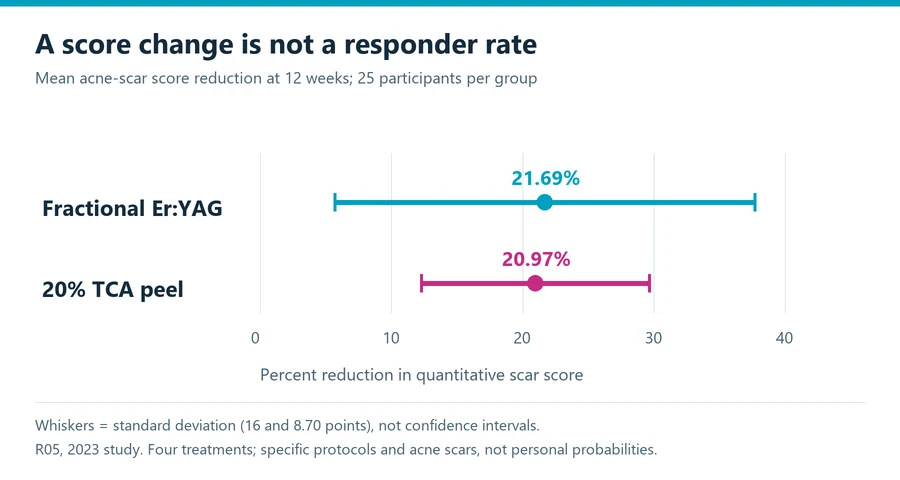
One original comparative study in the 2023 October–December journal issue examined fractional Er:YAG laser versus 20% trichloroacetic acid peeling for acne scars. It enrolled fifty people, allocated twenty-five to each group and used four treatments at twenty-one-day intervals. At twelve weeks, mean percentage reduction in the Goodman and Baron quantitative scar score was 21.69% for the laser group and 20.97% for the peel group. Reported standard deviations were 16 and 8.70 percentage points, respectively.
Those values describe changes in a scoring system, not the percentage of people whose scars vanished. The supporting plot displays each mean with its standard deviation and labels the twenty-five-person group size. A mean score change is not a responder rate, and standard deviation is not a confidence interval. The study compared these particular protocols for acne scars. It cannot rank every peel against every laser, establish long-term durability or predict a particular person’s improvement.
The numerical gap between the two means is small in this study, but similar averages do not prove universal equivalence. A short comparative study is not permission to assume the same tradeoffs for another device, formulation, condition or population. Do not translate the plot into a shopping instruction to purchase a particular acid concentration. The treatment details identify what investigators studied; they are not an unsupervised-use recommendation.
Keep the clock and denominator visible
The twelve-week endpoint is measured from the treatment course, not twelve weeks after an unrelated single session. The fifty participants belong to two parallel groups, not fifty people receiving both treatments on different sides of the face. These details matter when comparing the result with a split-face paper or a longer follow-up report. Before combining findings, ask whether the assessments and units are actually comparable. A source title alone cannot establish that.
If a promotional claim cites an improvement percentage, ask for the scale and timepoint. If it cites satisfied patients, ask how many were assessed and how the question was worded. If it cites absence of a complication, ask how many people were observed and for how long. These are distinct measures. Keeping them separate prevents a modest study result from acquiring a certainty or breadth the investigators did not establish.
A more detailed reading also distinguishes a within-group change from a between-group comparison. Improvement relative to each group’s starting score addresses whether that group changed over the study period. Comparing groups addresses a different question: whether the observed changes differ under the studied protocols. One analysis cannot silently substitute for the other. Ask which comparison a claim describes before interpreting a statement such as “statistically significant improvement” as evidence that one treatment outperformed the other.
The chart’s whiskers make another distinction visible. They describe reported variability in score changes, not a minimum and maximum improvement that every patient experienced. They also do not identify how many people were satisfied or how many had a complication. A reader who wants those outcomes needs those specific measurements and their denominators. The score data can inform the discussion while leaving other important questions unresolved. That is more useful than turning a narrow result into a combined promise of effectiveness, safety and satisfaction.
For your own comparison notes, copy the endpoint name rather than just the number. Beside it, write the number of participants, timing and exact treatment identity. Then add the question it does not answer for you: durability, a different skin concern, personal pigment risk or noticeable change in ordinary light. This small evidence record makes it easier to recognize when another source is addressing a genuinely different question instead of confirming the same claim.
Treat supervision and safety as part of the comparison
The FDA issued a chemical peel safety warning on July 30, 2024. It warns against purchasing or using certain peel products without appropriate professional supervision because of serious skin-injury risks. Concentration, number of applications and contact time affect penetration and injury. The fact that a product can be bought online is not evidence that using it yourself reproduces a supervised study. Burns, wounds and scarring are reasons to take this distinction seriously.
The ASPS peel safety guidance addresses infection, scarring, temporary or permanent pigment changes and the relevance of cold-sore and unusual-scarring history. Give the treating professional an accurate account of prior procedures, reactions and medicines. Do not conceal a previous adverse reaction because the new treatment has a different name. The relevant question is how that history affects the actual planned intervention.
The ASPS resurfacing safety guidance similarly discusses burns, scarring, healing problems, infection and pigment irregularities. A technology being nonsurgical does not eliminate the need for consent and a complication plan. Ask how unexpected pain, wounds or color changes are assessed and who provides follow-up. Do not rely on a general assurance that a device is advanced or that a peel is natural.
Avoid categorical promises based solely on skin color. The assessment needs to address the specific procedure, skin history and pigment-related risks. Ask what experience and evidence support the proposed method for people with relevant characteristics, and what uncertainty remains. A photograph showing a person with a similar complexion is not a substitute for those details. It may help discuss an appearance goal but cannot establish an individualized safety profile.
Compare courses rather than individual appointments
A single appointment price does not establish what a complete course costs or requires. Ask how many sessions are proposed, which are conditional on the early response and when the clinician reassesses whether continuing is worthwhile. This matters when comparing a lighter repeated approach with a more intensive procedure. Neither a larger session count nor a higher initial fee automatically indicates better value. The comparison should connect the proposed investment with the endpoint you actually care about.
Record what happens if the first treatment produces less change than expected or a reaction that alters the plan. Is the next session automatic, reassessed or canceled? Would a different modality be recommended, and would it require new consent and payment? Ask before buying a prepaid course. A package can simplify billing while still leaving the clinical decision unresolved. The ability to pause and review is part of understanding the proposal.
| Course component | Information to request | Why it changes the comparison |
|---|---|---|
| Initial assessment | Diagnosis, area and proposed endpoint | Establishes whether options address the same task |
| Session plan | Number, interval and review points | Single-visit prices may describe different commitments |
| Added treatments | Names and separate purpose | Combination results cannot be assigned to one component |
| Aftercare | Required products, visits and exclusions | Advertised fee may leave practical expenses unresolved |
| Change of plan | Reassessment, cancellation and further fees | An uncertain response should not be hidden by a package |
Use actual written prices rather than an invented national range. If an office quotes only a treatment fee, clarify any assessment, anesthesia, facility, medication or aftercare charges relevant to that proposal. Some items may not apply; record that explicitly instead of assuming they are missing. Do not compare a full course total with another office’s single-session figure. A transparent worksheet can reveal a scope difference without suggesting that either price is unreasonable.
A useful cost discussion also identifies what you are willing to pay for: a particular assessed concern, a specified course and access to appropriate follow-up. Paying more does not establish that all risks are lower or that the result will last longer. Paying less does not establish equivalent supervision or treatment scope. Consider the completeness of the plan alongside the fee, and ask for unresolved fields to be clarified before committing.
Plan recovery on more than one calendar
“Downtime” can mean several things: discomfort, visible redness or peeling, wound care, time away from work and restrictions on ordinary products or activities. Ask the clinician to distinguish these rather than provide one reassuring number. Someone who can work remotely may still have demands related to outdoor exposure or caregiving. Someone whose skin appears less red may still need specific protection or follow-up. The procedure label alone cannot establish readiness for every task.
Describe your real schedule. If a major event is the reason for considering treatment, explain the date and the appearance you hope to have by then. Ask whether the proposed timeline is realistic and what uncertainty could affect it. Do not use a study’s endpoint as an event-readiness guarantee: a measured score at twelve weeks is not the same outcome as having no visible reaction on a particular day. Leaving room for reassessment is more useful than treating a promotional deadline as fixed.
| Planning clock | Question for the treating team | What not to assume |
|---|---|---|
| Healing and care | What instructions and assessment are required? | Feeling better ends all care needs |
| Visible appearance | What changes may remain noticeable? | Clinical improvement means no redness or peeling |
| Work and activities | Which specific duties need modification? | All jobs have the same demands |
| Outcome assessment | When will the target concern be evaluated? | Immediate appearance is the final endpoint |
| Further sessions | What response or reaction changes the schedule? | Every prepaid visit must proceed unchanged |
This is a discussion framework, not a substitute for written aftercare. Do not copy a cleansing, topical or medicine schedule from a different modality. Ask which products to stop or resume and when, and have the treating team address your actual regimen. If the instructions seem to conflict with another clinician’s advice, resolve that conflict directly. A general article cannot safely choose between instructions without knowing the clinical context.
Judge photographs and claims with the same precision
Useful comparison photographs identify the treatment course and timing and use sufficiently consistent conditions to make interpretation possible. Ask whether the images show the same person and whether another procedure was performed. A dramatic image does not identify how typical the result is. Neither a photograph nor an isolated patient story provides the denominator needed for a reliable probability estimate. Treat images as examples to discuss, not proof that your skin will behave identically.
Also ask whether the claimed benefit concerns the same diagnosed problem you want treated. A smoother-looking image may reflect a change that a particular scar scale does not capture, or a color improvement rather than a structural scar change. A score can be clinically informative while failing to answer your appearance priority. Compare the evidence and the preference openly rather than assuming either automatically validates the other.
The most useful chemical peel vs laser decision names two actual proposals, explains their scope and leaves uncertainty visible. If the diagnosis, mode, endpoint or follow-up is still unclear, complete those fields before deciding. If both could plausibly address the concern, discuss the tradeoffs you value rather than search for a universal winner. If neither proposal supports the outcome you expect, revise the expectation or seek clarification instead of buying a stronger-sounding treatment name.
For related planning, see the procedure guide hub, questions to ask a plastic surgeon and plastic surgery cost planning.
Sources and review scope
Plastic Surgery Editorial Team. Source records checked through October 12, 2026. Review scope: source and editorial checks for general education. No individual clinical assessment is represented.
- ASPS chemical peel overview. plasticsurgery.org. Publication/update date not stated. Checked 2026-10-12.
- ASPS laser skin resurfacing overview. plasticsurgery.org. Publication/update date not stated. Checked 2026-10-12.
- ASPS chemical peel procedure and depth guidance. plasticsurgery.org. Publication/update date not stated. Checked 2026-10-12.
- ASPS skin rejuvenation and resurfacing overview. plasticsurgery.org. Publication/update date not stated. Checked 2026-10-12.
- Fractional Erbium YAG laser versus 20% TCA chemical peeling for acne scars. pubmed.ncbi.nlm.nih.gov. Source date: 2023-10. Checked 2026-10-12.
- FDA warns against peel products without professional supervision. fda.gov. Source date: 2024-07-30. Checked 2026-10-12.
- ASPS chemical peel risks and safety. plasticsurgery.org. Publication/update date not stated. Checked 2026-10-12.
- ASPS skin resurfacing risks and safety. plasticsurgery.org. Publication/update date not stated. Checked 2026-10-12.