
An arm lift removes excess upper-arm skin and reshapes the tissues beneath it; liposuction reduces localized fat. They therefore answer different problems, even when both are used during one operation. For arm lift vs liposuction, the useful starting question is what the proposed plan will change: skin hanging below the arm, fat contributing to its fullness, or both. A smaller arm and a less hanging skin envelope are not interchangeable goals. ASPS arm-lift guidance ASPS liposuction guidance
Choosing between them also means comparing the scar you would accept, the area the surgeon intends to treat, and the care you can arrange afterward. A combined operation should be described as a combined operation, rather than sold as evidence that fat removal alone lifts loose skin. This guide gives you a way to read an arm-contouring proposal without assuming a particular treatment is necessary. Deferring surgery remains a valid choice when the expected change does not justify its burdens for you.
Define the arm change before discussing a technique
Describe what bothers you in ordinary terms before translating it into an operation. Perhaps a sleeve feels tight around the upper arm, or a fold remains visible when your arm is raised. Perhaps the underarm contour matters more than the circumference near the elbow. These observations describe your goal; they do not diagnose the tissue responsible. Keep them separate from a photograph you admire, since another person’s scar tolerance, starting anatomy and treatment may be different.
ASPS describes brachioplasty as addressing the underside of the upper arm from the underarm toward the elbow, including excess skin, supporting tissues and localized fat. Liposuction addresses fat deposits, with skin quality an important consideration. Neither description establishes your eligibility from a photograph or home examination. A consultation should connect your particular concern to the tissue and area the surgeon proposes to change. Arm-lift scope Liposuction scope
An original planning exercise is to write two separate sentences: “I want less fullness in this area,” and “I want less hanging skin in this area.” Cross out whichever does not describe your concern. If both matter, ask how the proposal addresses each. This avoids a common comparison error: accepting a treatment that may change volume while judging its success by an unaddressed skin goal. It also makes disagreement productive. The surgeon can explain why an expected change is realistic, limited or outside the planned procedure.
| Your stated goal | What needs clarification | Useful written deliverable |
|---|---|---|
| Less localized fullness | Which tissue and exact arm area are targeted? | A defined treatment area, not a whole-body promise |
| Less hanging upper-arm skin | What skin removal is planned and what scar accompanies it? | An individually explained scar plan |
| Better contour near the axilla and arm | Does the proposed operation include both regions? | A boundary statement showing included and excluded areas |
| Both less fullness and less excess skin | Is liposuction an adjunct to excision or a separate stage? | An itemized combined or staged plan |
Skin removal and fat reduction are different tradeoffs
Liposuction and brachioplasty should not be compared simply as the same result through a small versus large opening. That framing leaves out the reason skin excision is proposed. The meaningful tradeoff is whether the expected benefit of removing skin warrants accepting an excision scar. If your main concern is hanging skin, a plan focused on fat reduction needs an explicit explanation of the change it can and cannot reasonably produce.
ASPS describes arm-lift incisions as varying with the amount and location of excess skin. They may run along the inner or back aspect of the arm, sometimes from the axilla toward above the elbow; limited incisions may be appropriate in some circumstances. Fat can be treated through excision or liposuction within an arm-lift plan. These are descriptions of possible scope, not instructions for selecting an incision yourself. ASPS procedure information
Ask the surgeon to explain a proposed shorter scar in relation to your actual goal. “Shorter” is a description, not proof that the same area will be corrected. Likewise, a longer scar is not proof of a better result. Request a plain explanation of what would remain if you chose the less extensive plan. That lets you compare two honest compromises: accepting a scar for a specified change, or accepting residual contour concerns to avoid that scar. You do not have to treat either compromise as a failure.
Read a combined operation accurately
A liposuction-assisted arm lift includes skin surgery. Seeing that name in a paper or quote does not turn it into liposuction alone. When comparing plans, identify the shared components first. If both include skin excision, the question may be whether adding a particular fat treatment changes the operation, rather than whether an arm lift can be replaced entirely. This distinction matters because many published arm-contouring studies examine combinations.
An original registry analysis published in February 2013 included 144 people after substantial weight loss: 64 had arm liposuction with brachioplasty and 80 had excision alone. The authors did not find statistically significant differences in the reported complication categories. Both groups nevertheless underwent brachioplasty. The abstract does not verify each event’s analysis denominator or the overall follow-up interval, so its percentages should not be reverse-engineered into precise event counts. Original concurrent-liposuction study
The practical implication is about interpreting the question, not promising safety. That study cannot tell you that standalone liposuction removes the same skin or that adding it is risk-free. Ask whether the research offered to support your plan contains the same operative components as your proposal. A useful explanation names the shared skin surgery, the added fat treatment and the patient population. A claim that merely says “studies show liposuction works” is too vague to resolve your choice.
Why published complication percentages can disagree
Before comparing a percentage, find out what counted as an event and when it was recorded. A small wound issue managed in an office and an emergency hospital admission belong to different endpoints. A thirty-day observation cannot answer a question about the later appearance of a scar. Those distinctions are especially important in arm surgery, where your concerns may span wound care, arm contour, sensation and scar acceptability.
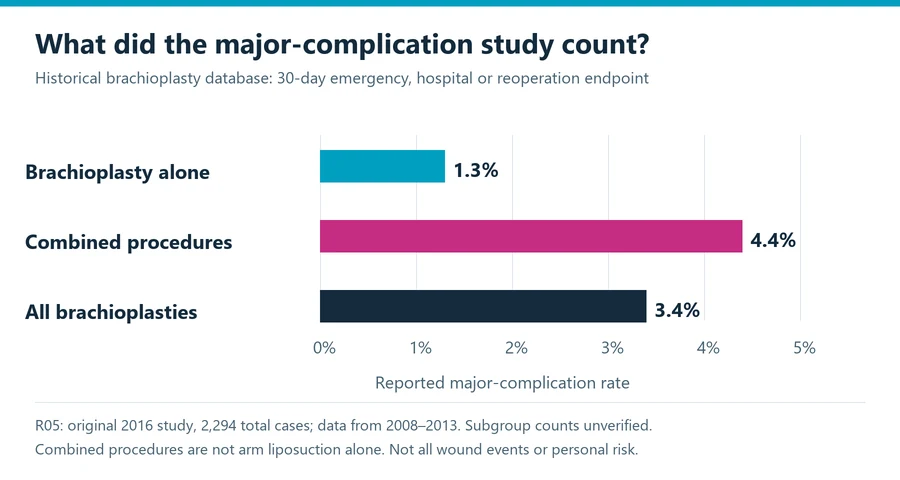
One original database study examined 2,294 brachioplasties performed from 2008 through 2013. Its endpoint was a major complication requiring an emergency-room visit, hospital admission or reoperation within thirty days. It reported 3.4% overall, 1.3% for brachioplasty alone and 4.4% with combined procedures. The checked abstract does not supply exact subgroup denominators; “combined” is broader than adding arm liposuction alone. These figures do not measure every wound problem, scar concern or later revision. Original major-complication analysis
Read the companion chart as a description of that database, not a personal risk estimate or a causal comparison. Selection into combined surgery was not randomized. An overall rate averages different plans and people; it does not describe your particular arm, medical history or planned additional procedures. When someone quotes a reassuring number, ask whether it includes the events you actually worry about. The answer may reveal that the number is accurate but answers a narrower question than the advertisement suggests.
| Evidence question | What the checked study establishes | What it does not establish |
|---|---|---|
| Thirty-day major complications | A defined emergency/hospital/reoperation endpoint in a historical database | All minor wound events, later scars or personal risk |
| Adding arm liposuction to a lift | An observational comparison in a weight-loss registry | Equivalence to standalone liposuction or guaranteed safety |
| A smaller combined-operation pilot | Feasibility and measured observations in a selected sample | Which component caused the change or long-term comparative superiority |
Check whether the study resembles your arm problem
Research after substantial weight loss is useful, but its starting situation deserves attention. A paper about people needing skin removal after weight loss is not automatically evidence for someone seeking a small change in localized fullness. Rather than treating all arm-contouring studies as one category, identify the starting problem, treatment components and measurement. This is a way to decide how much a study contributes to your conversation, not a reason to dismiss it solely because its participants differ from you.
A 2024 pilot studied a combined axillary and upper-arm operation in fifteen women after major weight loss. Median follow-up was six months, with a four-to-twelve-month range. It had no untreated or alternative-treatment control group. The authors also described approximately one centimetre of measurement uncertainty for their circumference assessments. The observed course therefore cannot isolate liposuction’s contribution or establish the same outcome for men or other populations. Original combined-operation pilot
Ask what would count as a meaningful improvement for your own goal: a particular clothing issue, a contour concern, or acceptance of a scar. A measured circumference and a satisfaction response answer different questions. Neither should silently stand in for the other. If a presentation combines them into one “success” claim, request the original definitions. There may be useful evidence behind the claim, but it should remain possible to see what was measured and what was simply hoped for.
Plan around the arm’s everyday workload
Think about the tasks your arms perform before asking for a return-to-work date. Office work may include commuting, carrying a laptop, lifting a bag onto a shelf and reaching for a seat belt. Home routines may include washing your hair, moving cookware, walking a dog or helping another person dress. A job title alone does not capture these demands. Make a task list and use it to request individualized instructions rather than borrowing a calendar from somebody else’s recovery.
ASPS notes that arm-lift recovery can involve dressings, compression, drains and specific instructions about medicines, activity and follow-up. Whether each item applies depends on the plan. This guide does not supply a universal removal date or lifting limit, and a liposuction-only plan should have its own instructions rather than inherit a lift’s schedule. ASPS recovery guidance
For planning, separate help with transport from help with household tasks and help with prescribed care. One person may be available for a ride but unable to stay overnight or assist with dressings. Clarify those differences while deciding, before booking around an assumed easy recovery. Ask the practice to explain which responsibilities you should arrange and how to reach the team if your course differs from the instructions. A realistic support plan is more valuable than an optimistic promise that a smaller-looking incision means no disruption.
Use a task-based recovery discussion
Bring your actual daily activities, not a preselected number of days off. Ask for instructions covering reaching, carrying, exercise, hygiene, clothing and the journey to follow-up appointments. Record who will answer questions and how restrictions will be reviewed. Treat a proposed schedule as a plan requiring the treating team’s assessment, rather than a clearance issued by an article.
Compare risks without reducing them to one score
ASPS lists arm-lift risks including bleeding, infection, fluid accumulation, poor wound healing, altered sensation, injury to deeper structures, persistent pain, scarring and possible revision. Liposuction also has surgical risks, including contour irregularity and other complications. A smaller scar does not erase the need for informed consent. The two procedures should each be explained in the context of what is actually proposed. Arm-lift risks Liposuction risks
Separate three discussions: what could require urgent care, what could complicate healing, and what could leave you dissatisfied despite an uncomplicated medical course. A technically healed arm may still have a scar or contour you dislike. Conversely, an aesthetic improvement does not make a wound event irrelevant. A single satisfaction score or complication rate cannot substitute for all three conversations, because each concerns a different consequence.
Ask how the team records these outcomes in its own follow-up and how a proposed revision would be evaluated. Requesting an explanation is different from demanding a guarantee. Be wary of a risk comparison that switches endpoints halfway through: major events for one operation, every minor issue for another, or patient satisfaction in place of safety. The comparison should use explicit definitions even when no valid matched data exist. “We do not have a directly comparable estimate” is a more useful answer than an unsupported numerical ranking.
Compare quotes for the same scope
An arm lift and arm liposuction quote are only comparable after their treatment areas and components are clear. Ask whether the estimate includes both arms, which areas are covered, what anesthesia and facility charges are included, and which follow-up services are part of the price. Do not assume a phrase such as “arm contouring” specifies all of these. A quote can be accurately priced while describing a different operation from the one you had in mind.
This comparison does not assign a national total or invent a local price. Use a written worksheet with separate fields for the surgeon’s fee, anesthesia, facility, garments or prescribed supplies, and any anticipated additional services. Mark each as included, excluded, separately estimated or not applicable. Do not add blank fields as if they were zero. The resulting total is a source-derived calculation from your actual quotes, not a forecast from this guide.
For a staged proposal, ask for the scope and estimated expenses of each stage and what determines whether the second stage is needed. For a combined proposal, ask which components are included in the single estimate. Also clarify the financial policy for follow-up concerns or revision without assuming those services will be required. The goal is to compare understandable commitments, not to make an operation seem economical by ignoring the assistance, travel or time away you personally need to arrange.
| Quote field | Lift plan | Liposuction plan | Combined or staged plan |
|---|---|---|---|
| Exact treated area and both-arm scope | Request written boundary | Request written boundary | Identify each component’s boundary |
| Surgeon, anesthesia and facility fees | Identify inclusions | Identify inclusions | Separate stages where relevant |
| Garments, care supplies and follow-up | Record actual included items | Record actual included items | Avoid counting shared items twice |
| Revision and additional-stage policy | Request conditions | Request conditions | State what triggers an additional stage |
Assess photographs and marketing descriptions critically
An arm photograph is easier to understand when the accompanying information identifies the operation. Was there skin removal, fat treatment, both, or another body procedure? At what point was the photograph taken? Is the arm positioned similarly in each image? These are questions about the evidence being presented, not a method for diagnosing yourself from a picture. If the operative scope is missing, the photograph cannot settle a comparison between lift and liposuction.
Ask to see the relevant scar discussion as well as the contour discussion. A carefully selected view may emphasize the change you want while leaving the tradeoff outside the frame. That does not automatically make the image deceptive, but it makes it incomplete for your decision. You need enough context to understand both the intended benefit and what you would be accepting to pursue it.
Terminology deserves the same scrutiny. “Minimally invasive,” “advanced” and “scar minimizing” do not define a treatment area, endpoint or follow-up period. Ask what those words mean in this specific proposal and which component they describe. If a device is involved, ask how its role changes the plan rather than assuming its name establishes superior results. Avoid converting a technology label into a guarantee about skin behavior, scar visibility or complication risk. An explanation that names its limits gives you more to evaluate than an attractive label alone.
Bring the comparison back to a written decision
You should leave the discussion able to explain the proposal in a few sentences: which concern it addresses, which tissues and areas it treats, what scar or other burdens accompany it, and what it is not expected to change. If you cannot do that yet, ask for clarification before choosing. The decision need not be immediate, and a proposal can be technically feasible without being worthwhile for your priorities.
Consider three possible conclusions rather than a forced winner. You may accept a skin-excision plan because the skin goal matters enough to justify its scar. You may prefer a fat-focused plan while knowingly accepting a limit on skin change. Or you may defer treatment because the available tradeoff does not suit you. These are decision pathways, not clinical recommendations; the examination and individualized risk discussion belong with the treating team.
Keep the study evidence attached to its actual question. A combined-operation cohort is not proof that standalone liposuction replaces a lift. A thirty-day major-complication rate is not a complete healing or scar forecast. A small pilot does not establish personal success. The strongest comparison is a transparent match between your goal and the proposed scope, supported by evidence whose population, endpoint and time period remain visible. That approach makes room for uncertainty without abandoning a practical decision.
For related planning, see the procedure directory, questions to ask a plastic surgeon and plastic surgery cost guide.
Sources and review scope
Plastic Surgery Editorial Team. Source records checked through October 12, 2026. Review scope: source and editorial checks for general education. No individual clinical assessment is represented.
- ASPS arm lift: skin, supporting tissues and localized fat. plasticsurgery.org. Publication/update date not stated. Checked 2026-10-12.
- ASPS liposuction: localized fat and skin considerations. plasticsurgery.org. Publication/update date not stated. Checked 2026-10-12.
- ASPS arm-lift procedure and variable incision scope. plasticsurgery.org. Publication/update date not stated. Checked 2026-10-12.
- Original registry study of concurrent arm liposuction and brachioplasty. pubmed.ncbi.nlm.nih.gov. Source date: 2013-02. Checked 2026-10-12.
- Original major-complication study of 2,294 brachioplasties. pubmed.ncbi.nlm.nih.gov. Source date: 2016-05-23. Checked 2026-10-12.
- Original pilot of combined axillary and arm contouring after weight loss. pmc.ncbi.nlm.nih.gov. Source date: 2024-10-29. Checked 2026-10-12.
- ASPS arm-lift risks and informed consent. plasticsurgery.org. Publication/update date not stated. Checked 2026-10-12.
- ASPS arm-lift recovery and individualized instructions. plasticsurgery.org. Publication/update date not stated. Checked 2026-10-12.
- ASPS liposuction risks. plasticsurgery.org. Publication/update date not stated. Checked 2026-10-12.