
How long does fat transfer breast augmentation last? There is no universal expiry date or guaranteed retained volume. A portion of the initial change may be lost, and later appearance can change with other influences. A small prospective MRI study followed patients for up to three years and modeled volume stabilization rather than a lifetime result. The useful answer distinguishes early fullness, measured retained volume, desired shape and satisfaction, then connects those endpoints with your actual clinical plan and follow-up.
How long does fat transfer breast augmentation last in the available study?
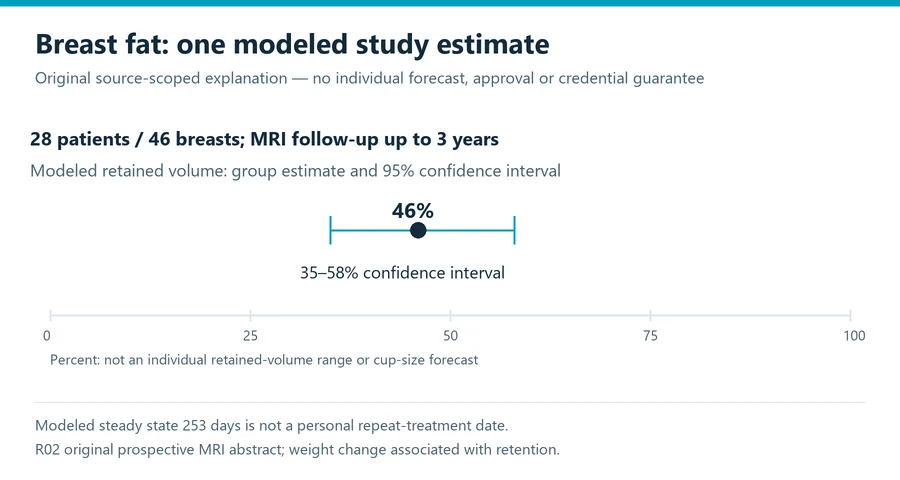
An original prospective study by Ørholt and colleagues included twenty-eight patients and forty-six breasts, with MRI assessment before treatment and for up to three years afterward. Its model estimated volumetric steady state at 253 days and retained volume at 46%, with a 95% confidence interval of 35% to 58%. These are study-level findings, not a personal retained-volume range or an automatic date for further treatment. Original prospective MRI study
Keep the patient and breast counts distinct when discussing the evidence. Ask how the study handled its observations rather than assuming that forty-six breasts represent forty-six separate people. A larger-looking denominator does not remove the limits of the actual sample.
The article appeared in the June 1, 2025 journal issue after online publication October 28, 2024. Its follow-up description is up to three years, which should not become a claim that every participant was observed for exactly three years or that results end at that point. The abstract was inspected for this resource; no full-text assessment or exhaustive systematic review is claimed.
Postoperative weight changes were associated with the measured retention. That finding complicates interpretation of a long-term volume figure and does not prescribe weight gain or weight loss. The study cannot supply a target body weight to improve a result. Any weight-related medical plan belongs with the appropriate clinician and should not be designed around an isolated graft-retention number.
When asking “How long does fat transfer breast augmentation last?”, identify which endpoint the answer describes. A model of retained volume is different from how long you will like the appearance, whether another session will be discussed or whether the overall breast shape will remain unchanged. The study contributes information, but it cannot settle every part of an individual decision.
What does the word last actually measure?
Visible fullness is an appearance observation. An imaging-based volume assessment is a measurement with a baseline, method and follow-up. Satisfaction describes a person’s response to the result. These can inform one another, but they are not interchangeable. A photograph does not count surviving fat cells, and a numerical volume change does not guarantee that a specific appearance goal has been achieved.
Ask what quantity a quoted percentage refers to. Is it modeled retained graft volume, an overall breast-volume change, an estimate from photographs or another endpoint? Ask what the denominator is and whether the number comes from the same procedure and population being discussed. A statement about one measurement should not silently turn into a promise about every aspect of the result.
Do not convert the reported 46% finding into a cup-size forecast or an instruction to double the amount transferred. The study-level endpoint does not supply that calculation. The clinician must explain the proposed scope, its limits and how the actual result will be assessed. This page gives no dose, injection technique or volume target for an individual.
Keep endpoint, population and follow-up together
Write those three details beside a number before using it in a consultation. Include the method where known and identify the source. This original planning step prevents a precise-looking percentage from losing the conditions that make it meaningful. It is not a diagnostic formula or a new clinical measurement protocol.
How long does fat transfer breast augmentation last compared with early fullness?
An early postoperative appearance should not be assumed to represent the final assessed result. Ask the surgeon when the actual outcome will be discussed and what changes they expect to evaluate. The MRI study’s modeled stabilization time is research context, not a personal waiting period, clearance date or universal permission to schedule another procedure.
If you are concerned about a change, describe it to the treating team and ask what assessment is appropriate. Do not infer a retained fraction from a photograph or decide that every decrease means treatment failed. The clinician interprets the actual situation, including the procedure, examination and any relevant follow-up information.
For comparison photographs, record the treatment date and the interval before each image. Identify other procedures performed at the same time or afterward. An undated image cannot establish duration, and images from different stages may answer different questions. Ask what the comparison demonstrates and what it cannot predict for another person.
The question “How long does fat transfer breast augmentation last?” is more useful when paired with the intended assessment point. You may be asking about long-term appearance while an advertisement shows an early result. Keeping the timing explicit allows an honest discussion of the evidence without inventing a universal stabilization schedule or dismissing a concern that needs clinical attention.
How long does fat transfer breast augmentation last when weight changes?
The prospective study found an association between postoperative weight change and modeled volume retention. That means the observed outcome cannot be interpreted only as a fixed fraction of the original injected amount unaffected by later circumstances. Ask the clinician how your actual history and plans affect interpretation of the proposed result and its follow-up.
Avoid treating a statistical association as a personal instruction. It does not establish that deliberately gaining weight will produce the shape you want, and it does not show that a particular weight change causes every person’s dissatisfaction. The study provides a reason to discuss uncertainty, not a method for controlling the result through an online body-weight formula.
If substantial future weight-related care is planned, bring that information to the consultation. Ask whether it affects the recommendation, timing or goals. The clinician can explain the appropriate assessment in your circumstances. This page does not recommend changing a medical weight-management plan to preserve a cosmetic outcome.
An unchanged-looking image also cannot prove a stable biological retained fraction. Appearance and measured volume have different limits. When asking “How long does fat transfer breast augmentation last?”, keep the actual goal and available evidence visible rather than assuming that any later change must represent disappearance of the graft or permanent success of the technique.
Does retained volume guarantee the preferred shape?
No single retained-volume measure answers every appearance question. Ask the surgeon what the actual proposal is intended to change and what remains outside its scope. If fullness, asymmetry or another goal is discussed, identify the specific intended outcome rather than treating a volume figure as a complete description of success.
ASPS explains that breast augmentation may involve implants or fat transfer and that augmentation does not by itself correct severe drooping. A lift may be discussed separately when appropriate to the clinical assessment. That general explanation is not a personal recommendation or a promise that another procedure is required. It identifies why volume and shape questions need their own discussion. ASPS augmentation scope and limits
If a combined plan is proposed, ask what each component contributes and how the result will be evaluated. A photograph of combined treatment does not isolate the duration of the transferred fat. The actual procedure description should make the goals understandable, and the consent discussion should explain the relevant risks and limitations of the complete plan.
The answer to “How long does fat transfer breast augmentation last?” should therefore avoid equating more retained volume with the ideal result for every person. Your goals and the clinician’s assessment remain necessary. This resource provides no aesthetic standard, ranking of techniques or assurance that one measured endpoint guarantees satisfaction.
How long does fat transfer breast augmentation last before touch-up is discussed?
ASPS notes that touch-up treatment may be needed to maintain an improved shape after breast fat transfer. That counseling statement does not supply a mandatory second session, a probability of further treatment or a repeat date. Ask why any additional care is being considered and what actual finding or goal it addresses. ASPS fat-transfer risks and touch-up context
Clarify whether another session was part of the original proposed course or is a new recommendation. If it was discussed as a possibility, ask what would determine the decision. The label touch-up can conceal a substantial medical and financial choice. It should receive its own explanation rather than be assumed to be automatic, minor or included in the first fee.
Ask about the intended benefit, limitations, risks, alternatives and follow-up of the proposed additional procedure. You can request clarification or another clinical assessment before deciding. Uncertainty about duration is not an instruction to undergo further surgery. A recommendation should connect the actual concern with the proposed care and preserve the limits of what it can achieve.
For planning, keep a possible additional session visibly conditional. Do not use a study average to calculate how many treatments you will need or to promise that a second session will produce a specific retained amount. Those calculations require assumptions the available evidence does not supply. The clinician explains the actual course; the office explains its financial terms.
What risks remain relevant even though the tissue comes from your body?
ASPS lists risks including cysts, infection, microcalcification and death of transferred fat cells. The fact that the tissue is your own does not remove those concerns or establish a risk-free procedure. Ask which risks apply to the actual plan and how findings or symptoms after treatment will be assessed. This resource supplies no incidence estimate or personalized probability.
If a new lump, pain or another change concerns you, contact an appropriate clinician for advice rather than assigning it to expected graft loss from an online duration article. The cause and urgency need clinical assessment. A retention claim cannot diagnose a finding, and an appearance-focused follow-up image cannot replace evaluation of a care concern.
Ask how the treatment history should be communicated to clinicians involved in your breast care and imaging. The actual record can help them understand what was performed. This page does not prescribe a screening test or interval for fat transfer; individual assessment and usual breast-care recommendations require the appropriate professional discussion.
When asking “How long does fat transfer breast augmentation last?”, retain the distinction between durability and safety. A long-lasting appearance does not prove that every relevant risk has been excluded, and a complication discussion does not supply a universal lifetime forecast. Each question needs the evidence and clinical interpretation appropriate to its scope.
Which records make a follow-up assessment useful?
Bring the treatment date, operative information if available, proposed recipient areas and previous follow-up records. If other procedures were performed, identify them and their dates. Describe the actual concern and the change you want assessed. A concise history is more useful than a collection of percentages from unrelated procedures or informal estimates of how much fat remains.
Ask how the result will be evaluated and what baseline is available. If imaging is proposed, clarify what question it addresses. If the discussion uses photographs or satisfaction measures, ask how their limits will be explained. The method should match the concern rather than be selected only because it produces a precise-looking number.
The ASPS consultation guidance recommends discussion of the proposed procedure, reasonable outcomes, risks, help during recovery and management of complications. Apply those questions to the actual plan and follow-up. This article does not verify a particular clinician or certify a facility. The goal is an informed conversation, not a score that claims to guarantee a result. ASPS consultation question framework
Write down what is known, what remains uncertain and what the next assessment will accomplish. Ask who will interpret any new findings and how you will be contacted. This original organizer is not a diagnostic checklist or a personal treatment recommendation. It keeps the longevity question connected to actual care rather than allowing a research statistic to replace the clinical discussion.
How should a complete-course budget handle uncertain durability?
Ask whether the estimate concerns one procedure or a discussed course of care. Identify professional, anesthesia and facility arrangements where provided, plus separately billed services. If another session is a possibility, ask how it would be evaluated and priced. Do not assume that a potential later treatment is free, inevitable or already included in a package.
Keep confirmed expenses separate from hypothetical scenarios. A useful planning note may show the actual first estimate and leave an additional-session amount unresolved until supplied. It should not calculate cost per permanently retained volume from a group study. That ratio would combine a financial assumption with a biological forecast the evidence cannot establish for you.
If financing is considered, review the total repayment terms independently of the medical decision. Credit availability does not establish suitability for surgery or a guaranteed duration. Ask for clarification if the financial proposal assumes further care you have not decided to accept. You can consider postponement or another consultation while obtaining the missing information.
The practical question is what the actual proposal commits you to now and what remains a later decision. This organization helps you compare scopes without claiming a universal total price or a predetermined number of sessions. It is an editorial planning tool, not financial advice or a recommendation to choose a particular procedure.
How long does fat transfer breast augmentation last: what can the evidence establish?
The table preserves the distinction between a study endpoint and a personal outcome. It contains no invented lifetime curve or universal retained range. The confidence interval describes uncertainty around the reported estimate in that study; it is not an individual guarantee or an approval criterion for treatment.
| How long does fat transfer breast augmentation last: evidence | Actual scope | Limit |
|---|---|---|
| Prospective MRI study | 28 patients, 46 breasts, follow-up up to three years | Small study; abstract inspected |
| Modeled steady state | 253 days in the study model | Not personal timing or repeat permission |
| Retained volume estimate | 46%; 95% confidence interval 35–58% | Not a personal retained range or cup-size forecast |
| ASPS counseling | Risks and possible touch-up discussed | No fixed schedule or guaranteed result |
The answer to “How long does fat transfer breast augmentation last?” should identify the endpoint and follow-up before making a promise. Read the fat-transfer breast augmentation guide for underlying procedure context. Sources were checked October 12, 2026 with journal and online publication dates retained separately. No biological permanence, patient result, personal retained-volume forecast or qualified clinical review is invented.
Sources and review scope
Plastic Surgery Editorial Team. Source records checked through October 12, 2026. Review scope: source and editorial checks for general education. No individual clinical assessment is represented.
- ASPS breast fat transfer safety. plasticsurgery.org. Publication/update date not stated. Checked 2026-10-12.
- Orholt et al three-year prospective MRI study. pubmed.ncbi.nlm.nih.gov. Source date: 2025-06-01. Checked 2026-10-12.
- ASPS breast augmentation scope. plasticsurgery.org. Publication/update date not stated. Checked 2026-10-12.
- ASPS patient-safety consultation questions. plasticsurgery.org. Publication/update date not stated. Checked 2026-10-12.