
Does insurance cover skin removal surgery? Some plans provide criteria for a particular medically assessed operation, while appearance-focused changes may be excluded. Coverage cannot be inferred from major weight loss, a rash or the broad phrase skin removal. Identify the actual procedure, clinical findings and applicable benefit contract. Aetna’s panniculectomy policy and a local Medicare example show why abdominal criteria should not be transferred to every body region or treated as personal approval.
Does insurance cover skin removal surgery in the area you mean?
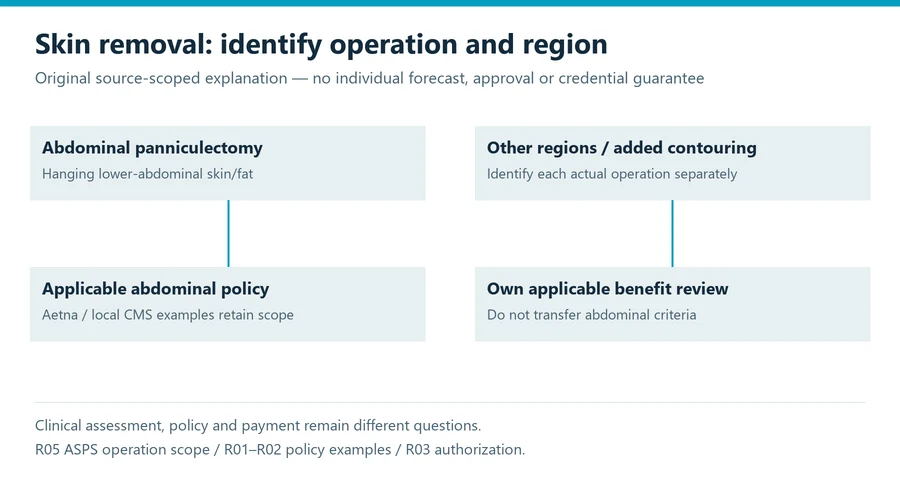
Skin removal is a broad description rather than one standardized operation. A proposed abdominal panniculectomy, tummy tuck, arm procedure or thigh procedure may involve different work. Ask the clinician to name the operation and explain its purpose before requesting a benefit determination. An insurer cannot be assumed to review every service under a single informal label.
ASPS describes panniculectomy as removal of hanging skin and fat from the lower abdomen. It explains that, unlike a tummy tuck, the abdominal muscles are typically not tightened during this procedure. That difference is relevant to the clinical proposal and to an itemized request. The description does not establish medical necessity or coverage for your situation. ASPS panniculectomy scope
If your concern involves several regions, obtain a separate description of the proposed work in each. Abdominal criteria do not automatically answer a question about arms, thighs or a combined body-contouring plan. Ask which policy would apply to each requested service. A favorable answer about one operation should not be expanded to a larger package whose additional components have not been reviewed.
When asking “Does insurance cover skin removal surgery?”, describe both the region and actual operation. A phrase such as post-weight-loss reconstruction may still leave the scope unclear. The written proposal should identify what is intended to address the clinical concern, what additional appearance changes are being considered and what is outside the request.
Which policy examples help explain the distinction?
Aetna Clinical Policy Bulletin 0211 lists specific panniculectomy requirements involving a documented abdominal pannus, persistent or recurrent skin problems despite appropriate medical treatment, and weight-stability or post-bariatric context. It classifies abdominoplasty or lipoabdominoplasty as cosmetic and panniculectomy as cosmetic when its criteria are not met. Its displayed last review was August 18, 2026 when checked October 12, 2026. This is one insurer’s policy, not every contract. Aetna abdominal procedure policy
CMS local determination L39506 also describes limited abdominal panniculectomy coverage, with documented skin or functional concerns and weight-related conditions. It applies to CGS Administrators jurisdiction J15 in Kentucky and Ohio. Its criteria and time requirements should not be silently combined with Aetna’s to create an invented universal checklist. The actual plan and procedure determine which document matters. CMS local panniculectomy policy
The current CMS revision was effective May 21, 2026, but its revision history identifies a repaired bibliography hyperlink. That date does not establish a new benefit expansion. Save the applicable version and its scope rather than using the copyright or retrieval year as evidence that all criteria recently changed. A policy’s effective date and the date you inspected it answer different questions.
Ask the plan for the exact benefit provision and policy governing your request. The clinical bulletin may assist review but is not itself the benefit contract. An office’s experience with other plans, or a previous patient’s approval, cannot settle the terms of yours. Use those accounts to identify questions, then obtain a response about the actual proposed service.
Does insurance cover skin removal surgery after substantial weight loss?
Weight loss alone does not establish coverage for every excess-skin operation. The policy examples contain more specific clinical and documentation requirements. Ask which findings are relevant to the proposed service and whether the plan has requirements concerning the timing and stability of weight. Do not treat a particular amount lost as a universal qualifying threshold when the actual policy does not support that conclusion.
Bring an accurate history of weight-related care if it is relevant, including the date of bariatric treatment and any records already available. The clinician and payer may need different parts of that history. Ask what is required rather than obtaining an arbitrary collection of records or assuming one number in an advertisement answers the entire eligibility question.
If the policy includes a time condition, clarify what event starts the interval and what documentation it requests. A duration measured after a procedure is not automatically the same as a duration of stable weight. Do not combine dates from different policies or interpret them as permission to operate. The clinician assesses timing and suitability; the plan applies its own actual benefit rules.
The question “Does insurance cover skin removal surgery?” should therefore be linked to the specific operation and documented concern, not simply to a before-and-after weight history. Accurate records can support a review, but they cannot guarantee an outcome. An excluded aesthetic service may remain self-pay even when substantial weight loss has occurred.
What should an assessment of skin problems establish?
Describe the actual problem to a clinician: where it occurs, how it affects ordinary activities, when it began and what evaluation or care has already occurred. A policy’s mention of intertrigo or another skin finding does not diagnose the concern. The clinician determines what is present and what management is appropriate, including whether the proposed operation addresses it.
Keep treatment records truthful and specific. If a payer asks about previous medical care, provide the actual visits, findings and treatment history. Do not invent unsuccessful therapy or continue a problem untreated to create an apparent qualification. The purpose of clinical care is to evaluate and manage the concern; benefit documentation should accurately describe that care rather than direct it through an online checklist.
Ask whether the requested records are missing or whether the documented situation does not meet a policy requirement. Those are different issues. Missing notes may be obtainable from the relevant clinician. A condition that has not been diagnosed should not be assigned merely because a coverage form contains that term. If further assessment is needed, clarify who will arrange it and how results will be explained.
Symptoms deserve appropriate medical attention while coverage questions are being resolved. A payer determination does not explain the cause of a skin problem or decide how it should be treated. This guide supplies no medication regimen, diagnostic photograph test or instruction to postpone care until an insurance threshold is reached.
Does insurance cover skin removal surgery with added contouring?
Ask the surgeon to separate the operation addressing a documented concern from any additional appearance-focused work. A combined proposal may include services with different benefit status. Performing them together does not, by itself, turn the whole package into covered care. The response should make clear which component has been submitted and which parts remain outside the reviewed request.
For an abdominal proposal, clarify whether the plan concerns panniculectomy, abdominoplasty or another service. If muscle-related work or a possible hernia is discussed, ask for its separate clinical explanation rather than assuming it is an included cosmetic or insured component. This article cannot diagnose an abdominal finding or determine the benefit status of a service that has not been identified.
Request an itemized financial explanation for any mixed proposal. It should connect the named services with the professional, anesthesia and facility arrangements. A package total may conceal which portion is anticipated to be reimbursed and which portion is self-pay. Leave any uncertain payment contribution visibly unresolved instead of treating it as guaranteed money.
If you decide against an aesthetic addition, ask whether that changes the recommended clinical plan, estimate or review request. You should understand the actual available choices without being told that a larger package is automatically necessary for coverage. The clinician explains the medical recommendation; the office and payer explain their respective financial and benefit information.
Does insurance cover skin removal surgery based on photographs?
The policy examples discuss documentation, including clinical photographs in specified circumstances. Ask the clinician what is appropriate and who will obtain and submit it securely. A photograph can support an identified record but is not a home eligibility test. Do not assume that sending an image to an insurer, practice or online community proves a diagnosis or completes every policy requirement.
Ask how personal records will be handled and who will receive them. Use the actual care team’s process rather than an informal social-media request for images. If you already have relevant documentation, identify its date and clinical context. A photograph taken for a different concern or an older operation may not answer the question in the current request.
Prepare a dated list of relevant assessments, findings and proposed services. Include the payer’s policy identifier and response alongside the clinical proposal. This original organizer makes it easier to identify whether the office and plan are discussing the same operation. It is not a diagnostic questionnaire, a mandatory photo protocol or a substitute for the record the clinician actually needs.
When a plan asks for additional information, clarify precisely what is missing and why. A vague instruction to provide more proof can otherwise produce unrelated material while the actual issue remains unresolved. Ask whether the request concerns a clinical finding, treatment history, benefit provision or service description. The answer helps identify the responsible person and next task.
Does insurance cover skin removal surgery after preauthorization?
Preauthorization may be required under a plan, but it is not a promise of payment. HealthCare.gov describes it as a medical-necessity decision and makes that payment limit explicit. Ask what review is required for the proposed service and what a favorable response would establish. The contract, network and financial responsibility still need their own explanation. Preauthorization definition
Check the named operation, provider, facility and time window. Ask whether the response includes every service you are considering or only one component. If the proposal changes, ask whether the previous review remains applicable. An answer about one region or operation should not be transferred to another because both are described informally as skin removal.
Find out who submits the request, tracks unanswered questions and notifies you of the decision. A pending or incomplete request is different from approval or denial. Ask what information is still needed and whether it already exists. Keep copies of the submission and response so later conversations can address the same scope rather than a remembered summary.
Before accepting financial terms, ask what remains yours if the claim is denied or paid differently from the estimate. Identify deposits, cancellation rules and possible changes when a benefit year or plan changes. The written agreement should concern your actual proposal. A general assurance that the office works with insurance does not answer these practical questions.
Does insurance cover skin removal surgery after a denial review?
Identify the stated reason: an excluded cosmetic service, missing documentation, a clinical-policy requirement, network information or another issue. Ask for the specific provision used and the instructions for responding. A denial of an authorization request and a denial of a claim after treatment may involve different steps. Do not infer the entire appeal process from the broad word denied.
HealthCare.gov describes general health-plan internal and external review pathways and explains that denial notices should identify the reason and how to dispute the decision. Your actual notice and plan documents supply the applicable process and deadlines. This source is not Medicare appeals guidance or a personal legal interpretation. Retain each response and the accurate material submitted with it. General health-plan appeal guidance
Address the actual issue. The clinician can clarify genuine findings and proposed scope, while the plan can explain how a benefit provision applies. More photographs cannot be assumed to overcome an excluded aesthetic service, and a letter should not describe treatment or symptoms that did not occur. An appeal is most useful when the relevant discrepancy is clearly identified.
If coverage remains unavailable, ask about the real self-pay scope and terms without abandoning appropriate care for the original concern. You may seek clarification, another clinical assessment or postpone an elective commitment. A payer response is a financial determination within its rules, not a declaration that your symptoms are unimportant or that a specific operation is the only option.
What should a complete-course financial comparison include?
List each proposed operation and the services included in its estimate. Identify the surgeon’s fee, facility, anesthesia arrangements and follow-up scope where provided. Ask whether consultations or investigations are separate. Comparing one complete package with another practice’s professional fee alone can produce a misleading conclusion even when both numbers are accurately quoted.
Keep estimates for staged operations separate and dated. Do not add a speculative insurance payment for a later service merely because an earlier one was approved. Each stage may have its own proposal and review requirements. Ask what is known now, what will be determined later and whether the quote assumes services that you have not decided to accept.
Mark uncertainty before making a commitment
Use confirmed, estimated, excluded and unresolved labels in your own notes. This original budgeting method does not calculate benefits or make a quote binding. It helps prevent an unknown charge from being entered as zero and an anticipated reimbursement from being treated as certain. Ask the responsible organization to clarify the missing item rather than fill the gap with another patient’s cost.
If financing is considered, review the total repayment terms separately from the medical estimate. A monthly payment does not establish a lower total price, appropriate surgery or later insurer reimbursement. Keep the decision about borrowing distinct from the clinical recommendation. An understandable financial plan can include choosing to wait while more information is obtained.
Does insurance cover skin removal surgery: what remains to be checked?
Use the table to keep the stages distinct. It contains no required weight-loss amount, approval probability or self-diagnostic threshold. Actual policies and records govern the request; this is an original question organizer. Completion of one row does not establish that the whole plan has been clinically or financially approved.
| Does insurance cover skin removal surgery: question | Evidence to request | Boundary |
|---|---|---|
| Which operation and region? | Actual clinical proposal | Abdominal criteria not every body region |
| What findings support it? | Accurate examination and treatment records | No invented diagnosis or failed care |
| Which rule applies? | Contract and current applicable policy | Policy examples not universal coverage |
| What did review establish? | Written response for the service | Not guaranteed payment |
| What could remain self-pay? | Itemized complete-course estimate | Unknown items stay unresolved |
The practical answer to “Does insurance cover skin removal surgery?” comes from the actual operation, documented assessment and applicable plan response. For procedure context, read the panniculectomy guide and the tummy tuck guide. Sources were checked October 12, 2026 with review and effective dates preserved separately. No personal diagnosis, medical clearance, coverage guarantee or invented provider verification is supplied.
Sources and review scope
Plastic Surgery Editorial Team. Source records checked through October 12, 2026. Review scope: source and editorial checks for general education. No individual clinical assessment is represented.
- Aetna CPB0211 skin removal and abdomen. aetna.com. Source date: 2026-08-18. Checked 2026-10-12.
- CMS local policy L39506. cms.gov. Source date: 2026-05-21. Checked 2026-10-12.
- HealthCare.gov preauthorization. healthcare.gov. Publication/update date not stated. Checked 2026-10-12.
- HealthCare.gov appeal guidance. healthcare.gov. Publication/update date not stated. Checked 2026-10-12.
- ASPS panniculectomy scope. plasticsurgery.org. Publication/update date not stated. Checked 2026-10-12.