
Breast implants and breastfeeding can be compatible, but the ability to make enough milk depends on the actual surgery and other feeding factors. Many people after breast surgery can produce some milk without necessarily producing a full supply. Plan lactation support and infant growth monitoring rather than assuming either that exclusive breastfeeding is guaranteed or that implants automatically prohibit it. Concerns about an infant’s feeding, weight or jaundice belong with the infant’s clinician promptly, not at a later cosmetic follow-up.
What is known about breast implants and breastfeeding?
The CDC’s breast-surgery guidance explains that surgery may affect milk production by changing nerves and ducts. The actual effect varies. A procedure name does not identify every relevant detail, and an attractive surgical result does not establish future milk supply. Previous reduction, augmentation, nipple surgery or other operations may also matter. A useful discussion begins with the known operative history and your feeding goals, while leaving room for assessment after the baby is born.
The CDC also describes limited research about silicone implants and infant feeding. It notes no recent reports of clinical problems in infants of mothers with silicone implants and refers to a 2001 American Academy of Pediatrics conclusion that evidence was insufficient to classify implants as a contraindication to breastfeeding. Those statements should be preserved within their scope. They are not proof of zero exposure or risk, an exhaustive 2026 research review or a promise that every person will have a full supply. A clinician can help interpret the information in the context of your actual medical and feeding situation.
Read the CDC guidance after breast surgery.
Why does the actual operation matter?
Nerves, ducts and functioning breast tissue contribute to milk production and transfer. An implant is one part of the history, not a complete description of what surgery changed. Ask whether operative records explain the incision, placement and any additional breast or nipple procedures. If you have had more than one operation, keep their dates and scopes separate. A later implant exchange does not necessarily describe what happened during the original surgery.
For breast implants and breastfeeding, the record can inform a support plan but cannot predict the outcome perfectly. Some effects may be uncertain even when the documents are available, and nonsurgical feeding factors still matter. Do not infer that a visible scar proves ducts were severed or that an absence of a particular scar guarantees normal supply. If records are missing, say so when arranging care. The lactation and infant-care teams can still plan monitoring and support without requiring you to reconstruct internal anatomy from photographs or remember technical details from an operation years earlier.
Does placement above or below the muscle make a difference?
The CDC states that implants below the muscle usually affect milk production less than implants above the muscle. That is a general distinction, not a guarantee for an individual. It does not establish that every below-muscle placement permits exclusive breastfeeding or that every above-muscle placement prevents it. The rest of the operation, previous surgery and the feeding situation can still affect the assessment. Ask what the actual records show rather than choosing a category from the shape of the breast.
Breast implants and breastfeeding planning should use that distinction as context, not a reason to abandon monitoring. If you are considering surgery before a future pregnancy, discuss feeding goals and the proposed approach with the surgeon before deciding. Ask what can and cannot be predicted and how alternatives affect the overall decision. A page about feeding does not establish that one surgical plane is best for every cosmetic or reconstructive situation. Neither implant placement nor a reassuring preoperative conversation replaces the need to observe how the infant feeds and grows after birth.
What does an incision around the areola tell you?
The CDC explains that a scar around the areola does not necessarily mean the nipple and areola were completely detached. Scar location alone therefore cannot establish what happened to nerves or ducts. An operative report and clinical assessment may provide more useful information. Avoid turning a surface observation into a definitive answer about supply, particularly when previous procedures or different techniques may have been involved.
For breast implants and breastfeeding, ask the clinician to explain the known surgical details in ordinary language and identify uncertainty honestly. You do not need to assign yourself a technical operation type from a photograph. If the report describes additional tissue removal or nipple work, share that information with the feeding-support team rather than assuming it is irrelevant because the main procedure was called augmentation. Conversely, do not decide that breastfeeding is impossible merely because an incision was near the areola. The point of obtaining the record is to guide realistic support and monitoring, not to produce a yes-or-no prediction unsupported by the available facts. The breast augmentation guide explains that procedure and its consultation questions separately.
What does the feeding-support map separate?
| Question | Useful information | Boundary |
|---|---|---|
| What surgery occurred? | Actual operation and device records | A scar cannot predict supply |
| How is feeding going? | Clinical feeding assessment and infant growth | Breast appearance is not a milk-volume test |
| Is more intake needed? | Individual clinician-directed support or supplementation | No universal volume prescription here |
| Who follows up? | Infant clinician and lactation support | Cosmetic review does not replace infant care |
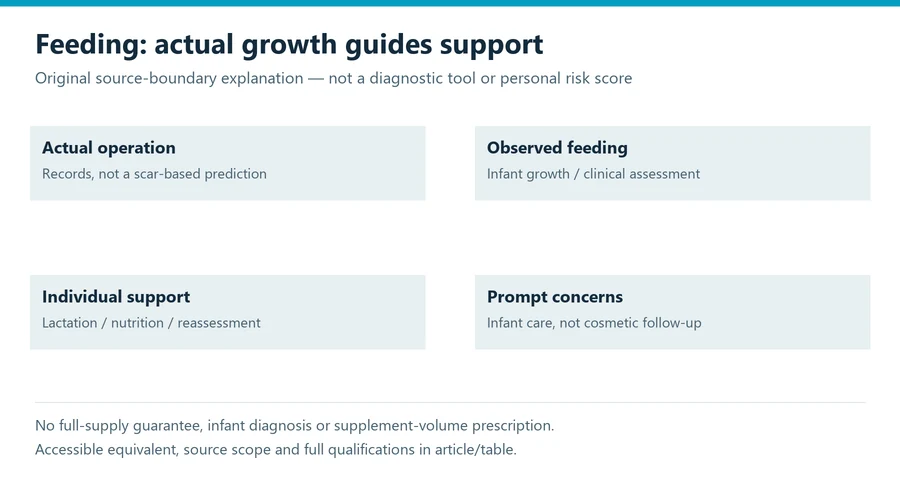
The map organizes breast implants and breastfeeding questions without treating exclusive feeding as the only successful outcome. The immediate priority is that the infant receives appropriate nutrition and that feeding difficulties are assessed. A person’s preferred feeding goal can be supported while the care team responds to the actual intake and growth findings. Supplementation, if recommended, is not proof of personal failure or proof that an implant caused the difficulty.
The original chart is an explanation, not a validated milk-supply score. It contains no observed patient results, infant feeding volumes or forecast of how much milk remains possible after a named operation. An equivalent table keeps its meaning accessible without the image. Use it to identify the information and people involved in care, then ask the clinicians to supply the plan that fits the parent and infant. A generic chart cannot replace direct assessment of feeding effectiveness, hydration concerns or growth.
How should infant growth and intake be assessed?
The CDC recommends close monitoring of adequate infant weight gain when breastfeeding after breast surgery. Its newborn guidance also discusses swallowing, feeding effectiveness, age-appropriate diaper patterns and weight as useful observations. Those signs belong in a clinical assessment rather than a single home threshold that overrides other concerns. An infant’s age and history matter, and a general newborn example should not be applied automatically to every infant or older child.
Breast implants and breastfeeding support should therefore include the infant’s care team, not only the surgeon who placed the device. Ask how growth will be followed, who will assess feeding if concerns arise and how to contact that person between visits. Keep records the clinician asks you to maintain, but do not use an informal online checklist to declare intake sufficient when the infant has concerning signs. The cosmetic appearance of the breast, the sensation of fullness or another parent’s account cannot establish your infant’s intake. The goal is an assessment based on the actual feeding and growth findings with a clear route for reassessment. For separating breast-surgery sensation concerns from other outcomes, see breast surgery and nipple sensation.
Which feeding concerns need prompt contact?
The CDC’s newborn guidance advises contacting the infant’s clinician right away for concerns such as poor latch, inability to hear swallowing, persistent weight loss or jaundice. These examples are not an exhaustive list or a diagnosis. If you believe the infant has a medical emergency, seek emergency care. Do not wait for a cosmetic-office appointment or finish searching implant safety forums before obtaining appropriate infant assessment.
For breast implants and breastfeeding, a concern about supply can be discussed without assuming its cause. Tell the clinician about the feeding pattern, observed changes, relevant infant history and the breast surgery. Ask what to do now and when the infant should be reviewed again. A lactation consultation may be helpful, but it should be coordinated with medical care when growth or illness concerns exist. This article supplies no individualized feeding interval, supplemental volume or treatment for jaundice. Those decisions need the actual infant assessment. A reassuring general statement about implants is not a reason to postpone care for a baby who is not feeding effectively.
Read the CDC’s newborn feeding guidance.
When might supplementation be part of the plan?
The CDC explains that some people after breast surgery may need additional support and supplementation with formula or pasteurized donor human milk when appropriate. The specific plan depends on the infant’s needs and available clinical services. This is different from a universal instruction that everyone with implants must supplement, and different from a promise that supplementation will never be needed. Ask the care team how it will decide and how the plan will be reviewed.
Breast implants and breastfeeding decisions should allow both realistic goals and timely nutrition. If supplementation is recommended, clarify the product or source, preparation instructions, quantity and follow-up with the infant’s clinicians. This page does not prescribe those details. Do not adopt another family’s volume or obtain unassessed milk through an informal arrangement because a general article mentions donor milk. A coordinated plan can also address support for ongoing breastfeeding when that is desired and clinically appropriate. The important point is that the infant’s actual needs determine the response, rather than a cosmetic-device label or a belief that one feeding method proves the operation’s success.
Can supply problems be predicted before delivery?
An operation history may identify reasons for additional support, but it cannot guarantee what will happen in a particular feeding relationship. The CDC notes that factors beyond surgery affect production and that remaining functional ducts and nerves matter. A pre-birth conversation is useful for arranging help and clarifying goals, not for assigning a definitive volume forecast. Avoid paying for a service that claims to measure future milk supply from breast photographs or implant dimensions alone.
For breast implants and breastfeeding, make the preparation practical: identify the infant clinician, available lactation support and the records that may help them. Ask what happens if feeding is difficult after discharge and how an appointment can be arranged promptly. Consider how support will be accessible around work, travel or other children, without turning those plans into a prediction that difficulties will occur. These are original planning questions rather than evidence that a checklist prevents feeding problems. The relevant result is observed after birth through the actual feeding assessment and infant growth, with adjustments directed by the care team.
What if another breast operation is being considered?
Discuss present or future feeding goals before a new operation. The actual proposal may involve implant removal or exchange, tissue removal, nipple changes or a combination. A generic label such as revision does not establish how those components might affect the decision. The surgeon can explain the proposed scope and its uncertainties; a lactation or infant-care professional can help address current feeding questions where appropriate.
Breast implants and breastfeeding should remain distinct from other implant decisions. Implants are not lifetime devices, and complications or preferences may lead to surgery for reasons unrelated to feeding. Neither this article nor a general device warning tells you when a nonurgent operation should occur in relation to pregnancy or feeding. Ask for individualized advice about timing, medicines, anesthesia, recovery and infant care rather than inferring a universal interval. The FDA’s decision information supports understanding the actual device and ongoing responsibilities, but does not supply a personal milk-supply guarantee. Record the agreed plan and who will coordinate it if the situation changes. For preparing implant-related mammography disclosure and imaging questions, see breast implants and mammograms.
Read the FDA’s implant decision information.
What should you bring to a support appointment?
Organize parent history and infant observations separately
Bring the available operation summary and device history, any current medicines, and the infant information requested by the care team. Separate what you know from what is uncertain. A long surgical document may be useful to retain, while a concise timeline makes the first discussion easier. Do not substitute a social-media success story for the actual records or assume that a person with a similar scar had the same operation.
For breast implants and breastfeeding, ask who will assess latch or transfer, how infant growth will be reviewed and what contact route applies if concerns arise. If advice from different professionals conflicts, request coordination rather than choose the instruction that seems easiest. Keep your feeding preferences visible while allowing the plan to respond to the infant’s actual needs. Broader operation context is available through the site’s procedure guides, but the useful outcome of this appointment is a clear, individualized support and follow-up plan rather than an internet clearance that predicts exclusive feeding.
How can a mixed feeding plan remain coordinated?
Consider a family whose care team recommends supplementation while supporting continued breastfeeding. Clarify who will review infant growth, who will help with feeding technique and how changes to the plan will be communicated. The recommendation does not identify the cause of a supply concern by itself. This is a hypothetical coordination example, not a prescription for a particular infant or a report of a parent treated for this article.
For breast implants and breastfeeding, keep the immediate nutrition plan separate from longer-term goals. Ask which observations the clinicians want reported and when the next review occurs. If a supplement recommendation is misunderstood, request clarification instead of quietly increasing, reducing or stopping it based on a general source. Preserve room for the plan to change as the infant’s needs and actual feeding become clearer. A coordinated approach supports preferences without making exclusive feeding a test of personal effort, surgical success or the legitimacy of needing additional help.
How should you interpret the source dates and limits?
The CDC breast-surgery page is dated December 8, 2025. The newborn page visibly identifies an October 18, 2024 review; other metadata dates are not used here to invent a newer clinical review. These pages and the FDA decision information were inspected on October 12, 2026. That inspection does not establish qualified clinical review of this article or an exhaustive review of every subsequent implant and feeding study.
For breast implants and breastfeeding, the most useful source-supported message is individualized support with attention to actual supply and infant growth. Limited evidence without recent reported infant clinical problems is not proof of zero risk, and possible production effects are not a blanket contraindication. Preserve operation details, arrange appropriate feeding support and contact the infant clinician promptly about concerns. You do not need to prove that surgery caused a difficulty before seeking help. A realistic plan supports your goals while ensuring that actual feeding effectiveness, nutrition and follow-up determine the decisions as the infant’s needs become clear.
Sources and review scope
Plastic Surgery Editorial Team. Source records checked through October 12, 2026. Review scope: source and editorial checks for general education. No individual clinical assessment is represented.
- CDC breastfeeding after breast surgery. cdc.gov. Source date: 2025-12-08. Checked 2026-10-12.
- CDC newborn breastfeeding basics. cdc.gov. Source date: 2024-10-18. Checked 2026-10-12.
- FDA things to consider before implants. fda.gov. Publication/update date not stated. Checked 2026-10-12.