
Breast implant rupture means a tear or hole in an implant’s shell. Saline leakage can cause a noticeable loss of breast size or shape, while silicone rupture is often silent and cannot reliably be excluded by appearance or physical examination alone. A change, a scan result and a treatment recommendation are different pieces of information. The next step is appropriate clinical assessment using the actual implant history, rather than diagnosing yourself from a photograph or assuming every implant needs the same operation. FDA rupture and deflation information
What is breast implant rupture, and why does the implant type matter?
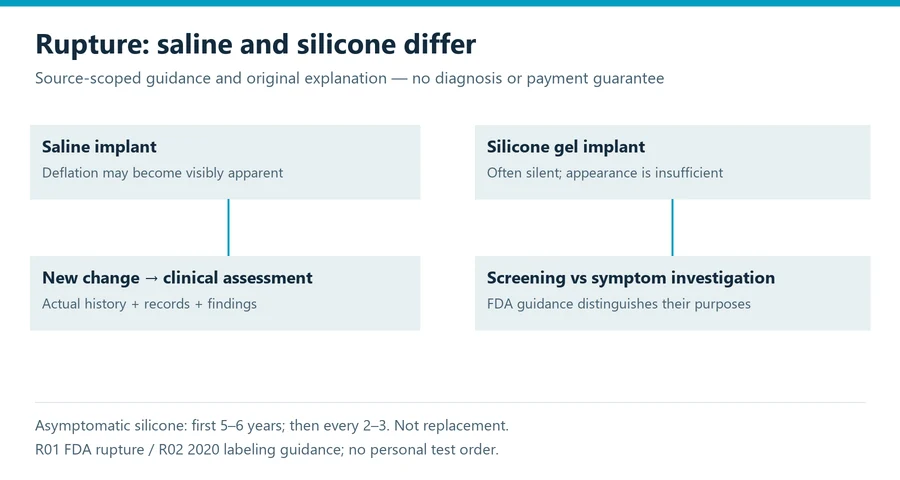
The FDA describes rupture as a tear or hole in the shell. Saline and silicone implants behave differently when the shell fails. With saline, fluid can leak and the implant deflates; a change in size or shape may appear immediately or over several days. Silicone rupture may occur without an obvious external change. The FDA says most silicone ruptures are silent, making a reassuring appearance an insufficient way to rule one out.
Silicone findings also need precise description. Intracapsular rupture refers to silicone remaining within the surrounding scar-tissue capsule. Extracapsular rupture involves silicone outside that capsule. The FDA notes that silicone can be difficult to remove and may migrate beyond the original area. Those descriptions do not tell a reader, without an examination and records, which finding they have or which operation is appropriate.
Possible changes described by the FDA include altered size or shape, lumps, pain, swelling and changes in sensation. Such concerns deserve clinical evaluation, but they do not individually establish breast implant rupture. Other explanations may need consideration. Do not use this list as a diagnosis checklist or assume that the absence of every listed change proves an implant is intact.
Begin by identifying the implant fill, manufacturer and available device details. If you do not know them, ask the original practice or facility for the operative record and implant information. An incision pattern, implant age or another person’s scan cannot identify your device. Keep any uncertainty explicit while arranging assessment rather than filling gaps with a guess about the implant type.
Can you detect breast implant rupture by looking or feeling?
Visible deflation can be an important clue with a saline implant, but a change still needs to be interpreted in clinical context. Note when it began and whether it developed suddenly or gradually. Describe associated concerns accurately when you contact the clinician. A series of photographs may help document a change, but it does not replace an examination or establish the complete condition of the implant and surrounding tissue.
With silicone, an unchanged appearance is especially limited. The FDA explains that examination alone may not detect a silent rupture. It identifies MRI as the most effective method for detecting silent rupture and ultrasound as an acceptable alternative for screening people without symptoms. That information concerns imaging roles; it does not mean an online article can select the test or interpret a report for an individual.
Avoid repeated squeezing, attempts to manipulate the implant or other home experiments intended to prove whether the shell is intact. Such actions do not provide a validated diagnostic result. Instead, bring a clear history and existing records to the clinician. If a prior study was performed, obtain the actual report and, where available, the images so the new assessment can address the evidence rather than a remembered summary.
If a report uses uncertain language, ask what that uncertainty means and what follow-up is proposed. An equivocal finding is not the same as confirmed rupture, and a negative study has meaning within the test’s clinical context. Ask who will reconcile the imaging result with the examination and device history. Understanding that responsibility is more useful than attempting to settle a technical disagreement through online comparisons.
How is breast implant rupture screening different from symptom investigation?
FDA labeling guidance issued September 29, 2020 recommends that people with silicone gel-filled implants and no symptoms have their first ultrasound or MRI five to six years after implantation, followed by screening every two to three years. This is surveillance guidance for asymptomatic silicone implants. It is not a replacement deadline, a guarantee against rupture between studies or the routine schedule for saline implants. FDA implant-labeling guidance
The same guidance recommends MRI when symptoms occur or an ultrasound result is equivocal. A new concern therefore has its own assessment path; it should not simply be deferred until the next routine screening anniversary. Contact an appropriate clinician to discuss the concern and needed evaluation. This page cannot determine how urgent a particular situation is from an implant age or a short description alone.
Rupture surveillance is also separate from breast-cancer screening. Ask how your usual screening arrangements and any implant-related imaging should be coordinated. Do not assume that a previous mammogram is the same examination as an MRI or ultrasound performed to evaluate shell integrity. A report should make the purpose of the study understandable so that one kind of screening is not mistaken for completion of another.
If you are overdue for an implant-related discussion, assemble the known implantation date and previous imaging history. Ask the clinician which current device information and recommendations apply. The FDA guidance is a general labeling framework, not a personal test order. Individual assessment, the actual product and the clinical situation remain necessary when deciding what to arrange next.
What should you do when a new change or concerning symptom appears?
Contact the surgeon or another appropriate clinician with the timing, nature of the change and any relevant recent care. Explain whether there has been visible deflation, discomfort, swelling, a new lump or another concern. If you cannot reach the original surgeon, ask an appropriate healthcare service how to obtain assessment rather than assuming the only option is to wait for that specific practice.
Do not delay urgent medical care while trying to confirm insurance coverage or locate an old implant card. Severe, rapidly worsening or otherwise urgent symptoms require appropriate medical attention. The clinician determines the cause and urgency; this general instruction is not a statement that those symptoms prove rupture. Financial and record questions can be handled alongside care rather than used as a reason to postpone needed evaluation.
The NHS breast-implant guidance advises contacting the original clinic promptly for unexpected pain, a burning sensation, unusual swelling or skin-colour changes after surgery. These signs do not prove rupture. The UK guidance supports seeking assessment, while the clinician determines the cause and urgency in your situation. NHS advice for problems after breast implant surgery
Avoid treating a suspected breast implant rupture as a settled explanation for every symptom. Tell the clinician about concerns beyond the breast and any other conditions or treatment being considered. A shell finding does not establish that all unrelated symptoms share the same cause. The assessment should remain open to the actual clinical situation rather than narrow prematurely around one online description.
Ask for a clear follow-up plan if an initial assessment does not resolve the question. Who will review the imaging, contact you with results and explain any recommended next step? What should you do if a concern changes before that appointment? A practical communication plan is useful whether the final conclusion is rupture, another explanation or a finding that needs additional investigation.
Which records make a breast implant rupture appointment more useful?
The implantation date, manufacturer, fill type and device information help establish what is being evaluated. An implant card is useful if you have one, but it may not contain every operative detail. Request the original operative report and available device records when possible. If previous replacement or revision occurred, distinguish each operation rather than assuming the first date describes the implants currently present.
Bring previous imaging reports and note why each study was performed. A routine screen, investigation of a symptom and follow-up of an uncertain result may address different questions. Record whether a recommendation was made and whether it was completed. This timeline helps the clinician understand the sequence without requiring you to translate technical terms from memory.
The FDA maintains a labeling registry for approved implants that distinguishes original approval documents from current patient labeling. The actual product identity is needed to find the applicable information. Do not treat an old approval study, a generic manufacturer’s brochure or this article as proof that you have checked the latest label for your own device. Ask which current materials the clinician is using. FDA implant-labeling registry
Prepare a concise list of questions rather than searching for a complete surgical answer before the appointment. Useful questions include whether rupture is confirmed, what evidence supports the finding, where silicone is described if relevant, and what the proposed management addresses. Keep the list flexible so the discussion can incorporate findings you did not anticipate. No amount of record organization supplies personal clearance for a procedure.
Does confirmed breast implant rupture require the same operation?
No universal operation can be chosen from the word rupture alone. Ask the clinician to explain the recommendation in relation to the actual implant, imaging and examination. Removal, replacement and work involving surrounding tissue are different parts of a possible surgical plan. The discussion should identify what is being proposed and why, rather than presenting every component as an automatic consequence of a shell finding.
If silicone is outside the capsule or in another location, ask how that finding affects the proposed scope and its limits. The FDA warns that silicone can be difficult to remove. That should prevent a promise that every trace can always be removed or that a specific operation is risk-free. Ask what the clinician can reasonably address and what uncertainty remains in the actual case.
If replacement is discussed, consider it as a separate decision with its own information and consent. A recommendation to address an existing complication does not settle whether another implant matches your goals. Ask about the alternatives and the expected implications of each proposed plan without treating an online preference or a quoted price as a medical recommendation.
Do not accept an assurance that one named technique will solve every symptom. Clarify which outcome is being discussed: addressing a damaged implant, changing appearance, removing specified tissue or evaluating another concern. Those are different aims. An accurate consent conversation describes the intended task and its limits; it does not turn a complicated situation into a guaranteed cosmetic or systemic result.
How do implant age and rupture statistics affect an individual decision?
The FDA says rupture can occur at any time and its likelihood increases as implants age. That statement does not give a precise forecast for an individual device. Age helps organize the clinical history, but it cannot confirm rupture, rule it out or select a replacement date. Ask how your current findings and device information affect the recommendation rather than relying on a universal anniversary.
Be cautious with percentages detached from the device, study population and follow-up period. A cumulative observation over several years is not automatically a risk for the next year, and a result for one implant or surgical group may not apply to another. A clear explanation should name the source and endpoint before a number is used to support a personal decision.
The FDA’s labeling guidance includes illustrative examples for communicating risks. Those examples should not be represented as current measured probabilities for your device. This page intentionally supplies no invented annual rupture rate or universal ten-year risk. If you want product-specific evidence, ask the clinician to identify the current relevant label and explain how its population and follow-up compare with your situation.
Routine surveillance and symptom assessment are complementary questions, not competing explanations of safety. Having a schedule does not make a new concern irrelevant; having no obvious symptoms does not settle the integrity of a silicone shell. A practical plan uses the correct purpose of each assessment and leaves room for new information rather than assuming one reassuring fact answers every question.
What financial questions matter during breast implant rupture assessment?
Ask what services the proposed estimate covers, including professional work, facility arrangements, anesthesia and follow-up. If imaging or consultations are billed separately, identify them before comparing surgery quotes. Different scopes can produce different totals, so a lower number is not necessarily a price for the same care. The actual treatment recommendation should be clear before it is translated into a financial comparison.
Contact the payer about the proposed service using the actual plan information and documentation. Medicare’s general cosmetic-surgery page describes broad exclusions and defined exceptions, but it is not a specific rupture coverage guarantee. Other plans require their own benefit review. Clinical need, coverage and the amount you owe are separate questions, even when they arise during the same assessment. Medicare general coverage limits
If someone mentions a manufacturer warranty or assistance program, ask for the current terms and what they actually cover. A device allowance is not necessarily payment of every related charge. Do not assume eligibility from the brand name alone or treat a program as a substitute for medical assessment. Keep any written response with the quote so unresolved expenses are visible.
Financial uncertainty should be discussed without postponing care that a clinician considers necessary or urgent. Ask who can help coordinate records, benefits and scheduling. You can seek clarification about costs while continuing the assessment. This article cannot determine your claim eligibility or recommend a medical delay based on a deposit, deductible or anticipated reimbursement.
What should a breast implant rupture conversation establish?
Use the table to separate the questions. It is an editorial planning aid, not a diagnostic test or measured patient pathway. There is no approval probability, guaranteed treatment result or mandatory operation attached to a branch. Your clinician interprets the findings and explains the appropriate next step for the actual situation.
Questions to clarify with the responsible professional
| Breast implant rupture question | Useful information | Important boundary |
|---|---|---|
| Which implant is present? | Device and operative records | Appearance does not identify the product |
| Is there a new concern? | History and clinical assessment | Symptoms alone do not confirm rupture |
| What did imaging establish? | Actual report and clinical interpretation | Equivocal is not confirmed |
| Is screening due? | Silicone guidance and prior studies | Not a replacement deadline |
| What treatment is proposed? | Specific scope and consent discussion | No universal operation or cure promise |
For the related longevity question, read breast augmentation and implant questions. For a distinct scar-tissue complication, see capsular contracture. Breast implant rupture remains a question about shell integrity and clinical findings; these related concerns should not be treated as interchangeable diagnoses. Sources were checked October 12, 2026, with the FDA risks page’s displayed December 14, 2023 update distinguished from the 2020 labeling-guidance issue date.
Sources and review scope
Plastic Surgery Editorial Team. Source records checked through October 12, 2026. Review scope: source and editorial checks for general education. No individual clinical assessment is represented.
- FDA implant rupture and deflation. fda.gov. Source date: 2023-12-14. Checked 2026-10-12.
- FDA implant labeling guidance. fda.gov. Source date: 2020-09-29. Checked 2026-10-12.
- Medicare cosmetic surgery coverage. medicare.gov. Publication/update date not stated. Checked 2026-10-12.
- FDA approvedimplantlabeling registry. fda.gov. Publication/update date not stated. Checked 2026-10-12.
- NHS breast enlargement: problems after surgery. nhs.uk. Source date: 2023-09-21. Checked 2026-10-12.