
Breast implant illness, often called BII, is a term used for systemic symptoms that some people report with breast implants. The FDA says the causes and relationship to implants remain unclear, and the term is not a formal diagnosis with a specific test or recognized diagnostic criteria. That uncertainty does not make a person’s symptoms unimportant. The useful next step is clinical assessment that takes the symptoms seriously, considers their possible explanations and separates symptom evaluation from a decision about implant surgery.
Reported improvement after implant removal does not guarantee that removal will relieve your symptoms or establish what caused them. This guide explains the evidence limits and helps organize a clinical conversation. It does not diagnose BII, prescribe testing, recommend a capsule-removal technique or promise an outcome. Local breast changes, systemic symptoms and a confirmed implant-associated diagnosis can require different questions and different clinical decisions.
What does breast implant illness mean in FDA information?
The FDA systemic-symptom report resource describes reports involving fatigue, concentration difficulties, joint or muscle pain and other symptoms. It distinguishes those reports from a proven causal explanation. A symptom list is not a self-diagnostic checklist, and sharing several listed symptoms does not by itself establish that implants are the cause.
Use the term to communicate the concern you want assessed, while also describing your actual experience. Tell a clinician which symptoms matter, when they began and how they affect your day. A short description of a real change can be more useful than choosing every item on a long internet list. You do not need to prove a cause before seeking help for symptoms.
Ask how the clinician will approach the assessment and which information is needed about the implants and your health. This article does not select a laboratory panel or rule out other explanations. The clinical discussion should identify what is known, what remains uncertain and who is responsible for the next step.
Keep experience and explanation separate
You can accurately report that you feel unwell without claiming to know why. A clinician can acknowledge that experience while still investigating the cause. Those two positions can coexist. If a conversation feels dismissive or unclear, ask for the assessment plan and the reason behind it, rather than treating certainty about implants as the only sign that your symptoms are being taken seriously.
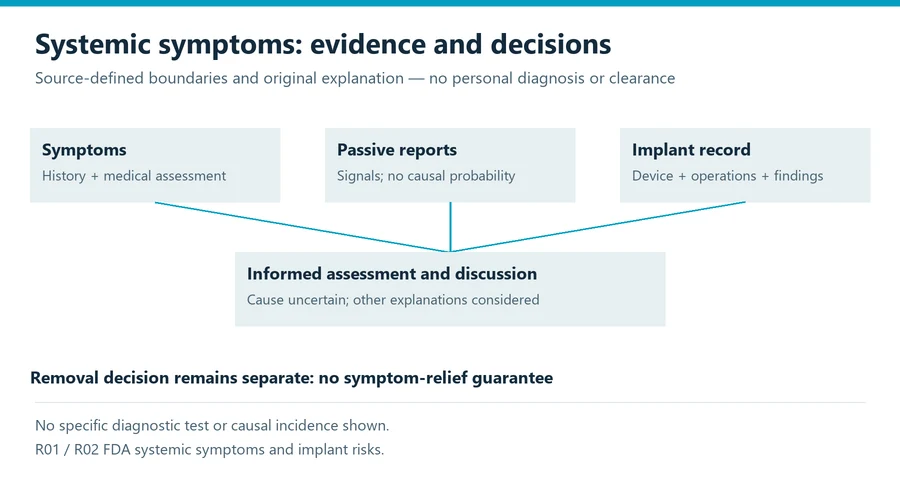
What can breast implant illness reports establish?
FDA medical-device reports are a passive safety-surveillance source. The agency explains that underreporting, possible duplicates, incomplete information and lack of a device-use denominator prevent the reports alone from establishing incidence, prevalence or causation. Its inspected review covers reports through June 30, 2024; that coverage date is not a count of every person with symptoms today.
| Breast implant illness evidence question | What a report can contribute | What it cannot establish alone |
|---|---|---|
| A symptom was reported | A potential safety signal and a described experience | That the device caused the symptom |
| A symptom appears often in a report table | Its frequency among selected reports | The probability for all implant recipients |
| Symptoms improved after removal | A reported course deserving investigation | A guaranteed benefit or a causal diagnosis for another person |
| A person needs care | A reason to seek individual assessment | A ready-made testing or surgical plan |
When reading a number, ask who is in the denominator. Reports meeting a search definition are different from all people with implants followed in a study. A percentage of reports mentioning a symptom should not be relabeled as your chance of developing that symptom. This guide intentionally does not turn a report table into a personal risk calculator.
The limitations also do not mean reports have no value. FDA uses reports alongside other evidence to identify potential safety issues. The practical distinction is between a signal that deserves investigation and a conclusion that a single reporting system can prove. Keeping that distinction helps you evaluate a claim without either dismissing symptoms or overstating what is known.
How can a breast implant illness assessment be prepared?
Make a concise symptom record for the visit. Identify onset, whether the symptom is constant or changing, what it prevents you from doing and any other information the clinician requests. Avoid turning the record into a test you must pass. Its purpose is to help a healthcare professional understand your experience, not to assign a BII score or prove a diagnosis.
Gather the implant information available: device card, manufacturer and model, implantation or revision dates and relevant operation records. If information is missing, ask the original facility how to obtain it. Do not guess the implant type from a photograph or assume that the same surgeon always used the same device. A factual record can support clinical assessment and any later device discussion.
Tell the clinician about other health concerns, medicines and evaluations as requested. Ask what questions the assessment will address and how results will be communicated. This article does not suggest stopping a medicine or delaying other care while deciding whether implants are involved. The clinician should coordinate the actual plan.
For breast implant illness concerns, it may help to distinguish three lists: symptoms you want assessed, implant-related questions and decisions about possible surgery. Those lists can overlap without becoming one decision. You may need an assessment of a symptom while still being uncertain about surgery. You may also have a local implant issue that deserves evaluation independently of a systemic-symptom explanation.
How do local breast changes differ from systemic symptoms?
A local change near an implant should be described directly. Explain swelling, a mass, pain, a change in shape or another concern rather than placing every observation under the general BII label. A clinician must determine what assessment is appropriate. This guide does not decide that firmness is contracture, that a lump is transferred tissue or that an implant is intact because it looks unchanged.
The FDA BIA-ALCL questions and answers discusses persistent swelling, a mass or pain near an implant and recommends evaluation of such changes. BIA-ALCL is a distinct lymphoma issue, not another name for breast implant illness. Symptoms do not establish that diagnosis, but the distinction matters because a confirmed diagnosis may change treatment.
Ask whether the local concern and the systemic symptoms need separate assessments, and who will coordinate them. A single appointment may not resolve every issue. If testing or another referral is suggested, ask what question it is intended to answer. Do not assume that one normal result settles every symptom or that every test result points to implants.
Do not let a broad label hide a specific concern
When requesting an appointment, mention an actual new breast change rather than saying only that you want to discuss BII. That gives the office information for its clinical triage process. If you believe you are experiencing a medical emergency, use emergency services; call 911 in the United States. A routine implant consultation is not an emergency assessment service.
Does implant removal establish a breast implant illness cure?
The FDA implant risks resource acknowledges reports of systemic-symptom improvement after removal while describing the underlying uncertainty. That does not provide a guaranteed benefit for an individual. A decision about removal needs its own discussion of the reason for surgery, alternatives, operative scope, risks and expected follow-up.
Ask what outcome the proposed operation is intended to address. Is the clinician responding to a local implant complication, a confirmed diagnosis, a preference to remove implants or a concern about systemic symptoms? Those reasons are not interchangeable. A promise that removal will solve every symptom should be examined carefully rather than accepted as a substitute for an assessment plan.
If capsule surgery is proposed, ask what is planned and why it is appropriate for your situation. This article does not recommend partial, total or en-bloc removal. Terms describing operations should be explained in relation to the actual medical need, not treated as a universal BII cure recipe. The recovery and risks depend on what is actually performed.
For breast implant illness questions, also ask what happens if symptoms persist. A responsible conversation can include uncertainty and a follow-up plan. It should not imply that ongoing symptoms prove a failed operation or that improvement proves one particular cause. The current evidence limits leave room for individual assessment without requiring an outcome guarantee.
What questions help compare surgery and assessment plans?
Ask the clinician to explain the current findings, what further assessment is needed and which decision is being made now. An evaluation plan and an operation proposal may be discussed together, but they should be understandable separately. You can ask what information would change the plan and whether a decision can remain open while a clinical question is being addressed.
If surgery is considered, clarify the exact operation, whether implants would be replaced, what would happen to the capsule and what care obligations would follow. Discuss appearance separately from systemic-symptom expectations. A cosmetic change after removal is not the same endpoint as an improvement in fatigue or concentration, and neither should be guaranteed by this guide.
Practical questions include time away from duties, help at home, follow-up access and how another clinician will receive the operation information. These are logistical considerations, not reasons to choose surgery without understanding the clinical tradeoffs. Ask for the actual recovery plan rather than using a general explant timeline as personal clearance.
You may want another qualified opinion if the diagnosis or proposed operation remains unclear. Share the actual records and questions rather than asking the second clinician to confirm a predetermined explanation. This article does not identify, rank or endorse providers. The useful comparison concerns the reasons, scope and limits of the plans being discussed.
How should online breast implant illness stories be interpreted?
A personal story can help someone feel less alone, but it does not establish how another person’s symptoms should be diagnosed or treated. The details of health, operation and follow-up may be incomplete. You can bring a claim to a clinician as a question without treating it as evidence that the same outcome will occur for you.
When a post uses a report count or symptom percentage, ask whether it is describing a reporting database, a clinical study or an individual experience. Those sources answer different questions. Be cautious about a conclusion that skips from a reported association to a guaranteed cause, from improvement after surgery to a cure promise, or from a symptom list to a diagnosis.
For breast implant illness, a useful evidence discussion names uncertainty rather than using it as a reason to stop investigating. Ask what the source actually observed, what comparison was available and what outcome was measured. This guide does not claim that an internet debate can settle the cause of your symptoms. The clinical assessment remains the practical route for your situation.
Privacy also deserves consideration. You can record symptoms for your clinician without publishing photographs or joining a public group. If you choose to share an experience, distinguish what you experienced from what a clinician diagnosed. That keeps communication accurate without requiring you to disclose details you would rather keep private.
What should reporting and follow-up accomplish?
Ask how a suspected device-related problem can be reported if appropriate. FDA reporting contributes to safety surveillance, but submitting a report does not prove causation or replace clinical care. A report should distinguish observed symptoms, confirmed findings and your concern about the device. This guide does not submit reports or invent an event on anyone’s behalf.
For clinical follow-up, ask who will review results, when you should expect the next discussion and what to do if symptoms change before then. An unresolved symptom should have a next step rather than disappearing into a long-term appearance appointment. If another clinician is involved, clarify who is coordinating the information and the decisions.
For breast implant illness concerns, keep a short record of the current plan. It may list an evaluation question, the clinician responsible, a pending result and the next decision. This is an original communication aid, not a validated diagnostic instrument. It should not become a score that determines whether symptoms are real or an automatic instruction to remove implants.
If a treatment or surgery occurs, continue to describe symptoms accurately rather than treating each day as proof for or against a cause. Ask how the team will assess progress and what other care remains necessary. A meaningful follow-up conversation can acknowledge an improvement while still avoiding a guarantee for someone else.
How can an assessment plan remain useful while the cause is uncertain?
Uncertainty does not require doing nothing. A useful plan identifies who is evaluating the symptoms, what information is needed and how the findings will be discussed. If several clinicians are involved, ask which professional coordinates the overall assessment and which evaluates implant-specific concerns. This avoids treating a surgical consultation as a complete investigation of every systemic symptom.
Prepare a brief account of what has changed and how it affects ordinary tasks. Keep the symptom onset, implantation dates and later operations separate; chronological proximity alone does not prove causation. Bring information about prior assessments and tests when available. Do not order a collection of tests because an online checklist calls them a definitive breast implant illness panel: the FDA says there are no specific diagnostic tests or established criteria for that label.
A proposed removal operation also deserves its own explanation. Ask what it aims to address, which uncertainties remain and how continuing symptoms would be assessed afterward. Planning should include the possibility that symptoms may not resolve, without dismissing the person’s experience or predicting an individual result. The FDA’s reports of improvement after removal are not a cure guarantee.
Keep the decision and the evidence in separate columns in your personal notes. You may decide to pursue another opinion or discuss surgery while the causal evidence remains incomplete. That choice does not turn passive reports into a measured incidence or prove that another patient should choose the same operation. An understandable plan can acknowledge both the concern and the limits of what is known.
What is a practical next step for breast implant illness concerns?
Request assessment of the symptoms that matter to you, bring available implant records and ask for a clear explanation of the plan. You do not need to decide every surgical question in advance. Separate the evidence about reports, your individual findings and any proposed operation so each can be discussed on its own terms.
At the visit, ask what is known now, what remains uncertain and which change would prompt earlier contact. If you receive a recommendation, ask about its purpose, alternatives and limitations. A precise explanation is more useful than either a blanket reassurance or a promise that one operation will resolve all symptoms.
The breast implant removal guide addresses the broader operation, and the breast augmentation guide explains implant-related procedure context. Breast implant illness concerns deserve serious, individualized assessment. The evidence supports keeping reported symptoms, uncertain causes, local breast findings and surgery decisions distinct, with an actual plan for care and follow-up.
Sources and review scope
Plastic Surgery Editorial Team. Source records checked through October 12, 2026. Review scope: source and editorial checks for general education. No individual clinical assessment is represented.
- FDA systemic symptom reports. fda.gov. Publication/update date not stated. Checked 2026-10-12.
- FDA implant risks and complications. fda.gov. Source date: 2023-12-14. Checked 2026-10-12.
- FDA BIA-ALCL questions. fda.gov. Publication/update date not stated. Checked 2026-10-12.