
Botulinum toxin counterfeit products cannot be reliably identified by a pleasing result, familiar brand name or convincing carton alone. Ask about the actual prescribed product, licensed trained administration and authorized sourcing. Trouble breathing or swallowing after an injection requires immediate medical care, not an online authenticity investigation. The FDA’s counterfeit warnings and the CDC’s closed investigation describe specific historical events; they do not measure your individual risk or certify the current status of every seller.
What are botulinum toxin counterfeit products?
A counterfeit product misrepresents its identity or origin. That is one concern among several involving illegally marketed, unapproved, misbranded, adulterated or improperly handled products. These categories are not interchangeable. An unauthorized source can create uncertainty even when a package looks familiar, and a genuine product still needs appropriate prescribing, storage and administration. You cannot resolve all those questions by comparing one photograph to an example from an official alert.
The FDA’s November 2025 warning release discusses illegal marketing of botulinum toxin products and emphasizes use of approved products through licensed, trained professionals and reliable authorized sources. That does not mean every procedure using an approved product is free of adverse effects. Approved toxins have important warnings too. Keep identity, sourcing, clinical suitability and administration as separate questions. This page does not provide a buying guide or instructions for obtaining or injecting a toxin. Its purpose is to help someone understand what records and explanations matter before treatment, and why medical assessment comes first if symptoms develop afterward.
Read the FDA’s November 5, 2025 warning release.
What did the 2024 alert establish?
The FDA alerted the public on April 16, 2024 to counterfeit BOTOX found in multiple states. A May 1 update included authentic-product images. The alert discussed unsafe products purchased from unlicensed or unauthorized sources and administration in both licensed and unlicensed settings. Those observations mean a location’s professional appearance does not, by itself, settle the sourcing question. They do not establish that every provider in a named state or every low-priced treatment uses a counterfeit.
For botulinum toxin counterfeit products, dates and scope are essential. Specific packaging examples from that alert describe a known event, not an exhaustive catalog of all possible counterfeit versions. A package that does not match those examples has not therefore been proven authentic. Conversely, a consumer’s uncertain visual comparison is not enough to accuse a clinician of using a particular illegal product. Record the actual information and ask for clarification from appropriate professionals or regulators. The published alert can inform the questions, but it does not replace a traceable product history or a medical assessment of someone who has already received an injection.
Read the FDA alert and its dated update.
Why is packaging not proof of authenticity?
A carton can be photographed, copied or separated from the product actually used. A logo or familiar name does not establish where a medicine was purchased, how it was stored or whether the documented vial was the one administered. Even a convincing comparison with an official image answers only a narrow appearance question. This is why an authenticity discussion should focus on the actual product and supply pathway rather than become a home inspection exercise.
Botulinum toxin counterfeit products may be deliberately designed to appear familiar. Ask how the treating practice identifies the prescribed medicine and obtains it through the appropriate source. Request the information relevant to your treatment record rather than attempting to buy a vial yourself as a workaround. If an answer remains unclear, postponing an elective treatment while clarification is obtained is different from making an accusation or performing a technical test. A responsible explanation should acknowledge what can be documented and what remains unresolved. This article does not certify packaging, sellers, distributors or individual clinics, and it should not be used to approve a product from an uploaded photograph.
Which treatment records are useful?
Ask for the actual product name, treatment date, administered areas and the clinician responsible. Product and lot documentation may help the treating practice or investigating authority trace an exposure. Keep the receipt and any record the practice provides, but do not assume a receipt saying Botox identifies every relevant medicine detail. The word is often used informally to describe a category; the medical record should identify what was actually administered.
For concerns about botulinum toxin counterfeit products, organize known facts separately from guesses. Write down the provider and location, when symptoms began and any official information you received. If you do not have a lot number, say so rather than reconstructing one from a promotional photo. Medical care should not be delayed while you pursue paperwork. After immediate needs are addressed, ask the practice how records can be shared with the clinician evaluating you. This record organizer is an original practical suggestion, not a validated exposure-detection tool, and it cannot determine whether a product was counterfeit or whether it caused a particular symptom.
What does the evidence and response map distinguish?
| Question | Useful evidence | Limit |
|---|---|---|
| What was used? | Actual treatment and product records | A brand word alone is insufficient |
| Where did it come from? | Authorized sourcing explanation | Packaging appearance is not proof |
| Are symptoms concerning? | Prompt medical assessment | Do not wait for authenticity research |
| What do alerts mean? | Dated official investigations | No personal probability or current seller certification |
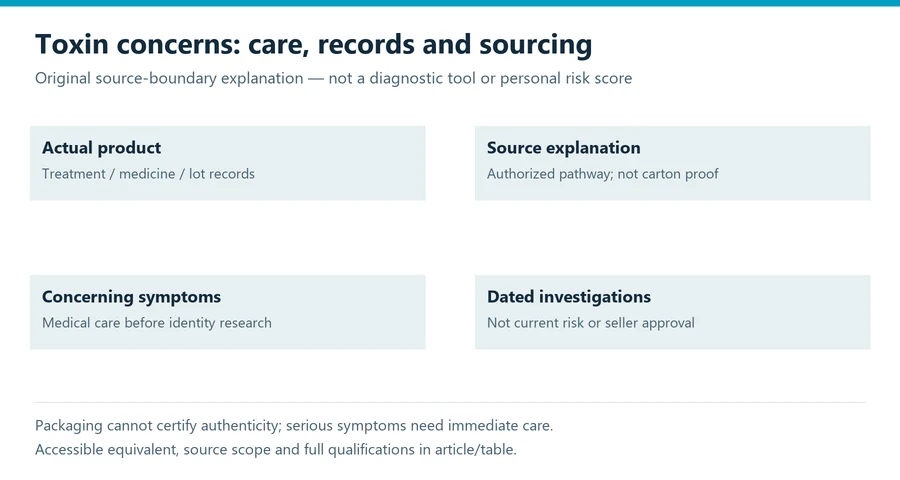
The map separates documentary uncertainty from a clinical problem. Botulinum toxin counterfeit products can require reporting and tracing, while a person with serious symptoms needs medical care whether or not the product identity has been established. A confirmed authentic product does not make every symptom harmless. An uncertain source does not identify the cause of a symptom without assessment. The two investigations can inform one another, but neither should be used as a reason to postpone the other when it is needed.
The diagram is an original explanation with an equivalent text table. It contains no photograph of an actual counterfeit, no manufacturer logo and no score that rates a provider’s legitimacy. It helps you keep the questions in order: care needs first, then accurate records, source clarification and appropriate reporting. It does not authorize an injection, diagnose botulism or give a technical method for testing or administering a product.
Which symptoms call for immediate medical care?
The FDA warning release highlights trouble swallowing or breathing after botulinum toxin injections as reasons to seek immediate medical care. The counterfeit alert and CDC investigation also discuss symptoms including blurred or double vision, drooping eyelids, weakness and difficulty holding the head up. The clinical significance depends on the actual situation. A website cannot distinguish a localized adverse effect from a more serious systemic problem using a brief description or image.
For botulinum toxin counterfeit products, do not wait for a seller’s reply, a refund decision or a carton comparison before seeking care for serious symptoms. Tell the evaluating clinician about the injection, timing, product information if known and any relevant medicines or medical history. If you believe there is an emergency, use emergency services. Contacting the cosmetic practice may help obtain records, but it is not a substitute for the needed assessment. Do not attempt to counteract a toxin with an online remedy or another injection. Treatment choices belong to the medical team evaluating the actual findings, not to an authenticity checklist.
Can genuine approved toxins also cause harm?
Yes. The FDA’s 2025 release notes that approved botulinum toxin products carry important warnings about toxin effects spreading beyond the injection area. Authenticity and clinical risk are different matters. An approved medicine needs an appropriate indication, assessment and administration; it is not an ordinary beauty product that can be used independently because its box is genuine. Likewise, finding an approved brand name in a treatment record does not prove that every event afterward is unrelated to the treatment.
Botulinum toxin counterfeit products are an additional concern, not the only reason to take symptoms seriously. Discuss the actual medicine’s risks and the plan for questions or adverse effects before treatment. Do not transfer units, doses or instructions between different toxin products based on a shared category name. This page supplies no dose conversion or injection technique. If you have previously received a different product, provide that history to the treating clinician. A reasonable consultation can explain why a particular prescription product and indication are proposed while retaining the distinction between approval, authenticity and the person’s own clinical suitability.
What does the closed CDC investigation tell us?
The CDC’s December 17, 2024 update describes a closed investigation that began in April 2024. Its displayed summary includes 17 cases, 13 hospitalizations, no deaths and nine states. Those are the scope and definitions of that historical investigation. Earlier public updates had different counts as information and case classification developed. Do not combine successive updates as if they describe separate groups, or turn the final summary into a current count of every harmful injection through 2026.
For botulinum toxin counterfeit products, the investigation demonstrates why adverse reactions and supply concerns merit attention. It does not establish the likelihood of harm for a person receiving an injection now. The absence of deaths in that investigation is not proof that a product or procedure cannot be life-threatening. Closure means the particular investigation was closed; it is not a universal safety clearance for all current sellers. This page uses the source to explain the event and response, with its date intact, rather than present an outbreak dashboard that pretends to monitor current cases. For separating possible resistance from other explanations for a disappointing response, see botulinum toxin resistance.
Read the closed CDC investigation summary.
How should you evaluate a low-priced offer?
Price alone neither proves counterfeit use nor proves authenticity. An attractive promotion still needs an explanation of the actual product, clinician, assessment and sourcing. A higher price does not automatically supply those answers. Keep the financial decision separate from the medical and documentary questions so that a discount deadline does not push you to treat an unresolved issue as settled. You can request clarification without having to make a public allegation.
Botulinum toxin counterfeit products should not be addressed by choosing an online seller and self-administering a supposedly safer vial. That removes rather than resolves important professional responsibilities. Nor should a referral incentive or familiar influencer endorsement replace product information and a qualified consultation. If a practice cannot explain the medicine and source appropriately, decide whether to postpone treatment or seek another professional assessment. This article names no seller, supplies no purchase link and ranks no provider. Its contribution is an organized set of questions and evidence limits, not a marketplace of unverified products or personal endorsements.
What should reporting accomplish?
Official adverse-event reporting can help regulators identify safety signals and investigate concerns. It does not diagnose the problem or arrange emergency treatment. Report the known facts accurately, including product and treatment information when available, and label uncertainties. A suspected counterfeit report and an adverse-reaction report may concern related questions, but an unconfirmed suspicion should not be presented as a verified laboratory or regulatory finding.
For botulinum toxin counterfeit products, reporting comes alongside appropriate care and record preservation. Ask the evaluating clinician or relevant authority what information is useful and how to submit it through an official channel. Keep copies of the report and available medical records. Avoid relying on a public social-media post as the only way of alerting a regulator or obtaining medical advice. Do not discard uncertain records merely because they are incomplete; they may help clarify the timeline. The purpose is accurate information that can be investigated, not a consumer investigation promising to establish manufacturing origin or causation without the necessary evidence.
What should you ask before another treatment?
Establish the actual proposal and responsibility
Ask what medicine is proposed, why it is appropriate for the indication, who will prescribe and administer it, and how sourcing is handled. Clarify the follow-up contact and instructions for concerning symptoms. If you have had a previous reaction or uncertain exposure, discuss that history before scheduling another elective injection. The earlier event should not be treated as irrelevant merely because the next offer uses a different brand word or a more familiar practice setting.
Botulinum toxin counterfeit products are one reason to seek reliable documentation; they do not supply a universal waiting time after an adverse event or permission to repeat treatment. Ask the clinician to resolve the actual medical questions and record gaps. Keep duration expectations separate: how long an intended cosmetic effect may last does not identify a product’s authenticity. Broader context is available through the site’s procedure guides, but the decision about another prescription treatment needs the person’s actual history, examination and professional assessment rather than a calendar rule from a general resource. For separating reported Botox duration from a personal retreatment forecast, see how long does botox last.
What if the treatment record uses only a category name?
Suppose a receipt lists a cosmetic injection without identifying the actual medicine. Ask the treating practice for the relevant treatment record and explain why clarification is needed. Do not assume the category word proves a particular brand, and do not substitute a product photograph from the practice’s social account. This hypothetical paperwork problem illustrates a documentation gap; it does not establish that an illegal product was used.
For botulinum toxin counterfeit products concerns, preserve the original receipt and distinguish subsequent explanations from information recorded at treatment. If symptoms are present, provide the known facts to the evaluating clinician while the practice retrieves additional details. A lack of complete records should not delay needed medical care or lead to an invented lot number. Once the immediate clinical questions are addressed, ask how unresolved identity information should be pursued through an appropriate professional or official channel. The task is accurate clarification, not a home investigation promising certainty from incomplete paperwork.
How should dated warnings be used now?
The cited official pages were inspected on October 12, 2026. The counterfeit alert is dated April and May 2024, the CDC summary December 2024, and the FDA illegal-marketing release November 2025. Retrieval does not make them current case surveillance, an exhaustive list of counterfeits or a statement that every company mentioned in an old letter has the same legal status today. This article does not infer convictions or current regulatory outcomes from warning-letter publication.
When discussing botulinum toxin counterfeit products, preserve the distinction between a known official warning, a person’s actual treatment records and an unresolved suspicion. Keep appearance, sourcing, approved status and clinical suitability separate. Take serious symptoms to medical care promptly, even while identity questions remain unanswered. For elective decisions, request an explanation you can understand before committing. That combination of accurate records, qualified administration, source transparency and appropriate response is more useful than an unsupported promise that a carton photo, provider logo or higher price eliminates every risk.
Sources and review scope
Plastic Surgery Editorial Team. Source records checked through October 12, 2026. Review scope: source and editorial checks for general education. No individual clinical assessment is represented.
- FDA counterfeit BOTOX alert. fda.gov. Source date: 2024-05-01. Checked 2026-10-12.
- FDA illegal toxin marketing warning. fda.gov. Source date: 2025-11-05. Checked 2026-10-12.
- CDC closed harmful reactions investigation. cdc.gov. Source date: 2024-12-17. Checked 2026-10-12.