
Blood thinners and plastic surgery require a plan agreed by the surgical team and the clinician managing the reason for treatment. Do not stop, reduce, substitute or restart a prescribed medicine from a general article or a standard cosmetic-surgery handout. The useful next step is to identify the exact medicine, its indication, the proposed operation and who will issue your individual instructions. Bring those details to the preoperative assessment before committing to a surgery date.
The familiar phrase covers different medicines. Anticoagulants and antiplatelet drugs are not interchangeable, and temporary interruption creates a different question from treating postoperative bleeding. A consultation can therefore end with continuation, an individualized interruption plan, a changed operation or postponement. None of those outcomes can be predicted from whether a procedure is advertised as minor. This guide helps organize decisions and resolve conflicting instructions; it does not supply a medication schedule.
Why do blood thinners and plastic surgery need more than a stop date?
There are two interests to protect: the reason a medicine was prescribed and the ability to control bleeding during and after the proposed operation. Concentrating only on bruising can miss the first interest. Concentrating only on the existing prescription can miss the second. Ask the team to explain both in relation to your own history rather than ranking one risk from a photograph, an online review or another patient’s experience.
The CHEST perioperative guideline release describes different recommendations for vitamin K antagonists, direct oral anticoagulants and antiplatelet medicines. It also distinguishes procedures and the strength of recommendations; many are conditional. That is evidence against treating every prescription as the same perioperative problem. The release is not a personal dosing instruction, and this page does not convert its example intervals into a cosmetic-surgery calendar.
An acceptable plan explains what is happening, who authorized it and what to do if circumstances change. A remembered verbal instruction is harder to reconcile when a rescheduled operation, new prescription or unexpected symptom enters the picture. Request a written version that identifies your medicine and the specific operation. A clinic’s general preparation sheet can remain useful, but an individual prescription question needs an individual answer recorded where both teams can see it.
What information should you bring about blood thinners and plastic surgery?
Prepare a medication list using the labels on the actual containers. Include the generic and brand names if available, strength, usual timing, prescribing clinician and what you understand the treatment to be for. Record additional medicines rather than selecting only the one described as a blood thinner. Include nonprescription pain relievers, supplements and products you use occasionally, because an incomplete list can make an otherwise careful discussion misleading.
If you are uncertain about the indication, write that uncertainty down instead of assigning yourself a diagnosis. The prescribing office or anticoagulation service can clarify the record. A past clot, heart procedure, rhythm problem or other condition may be relevant, but the surgical team needs the actual history and current treatment plan. Dates and names from your medical record are more useful than the phrase “a heart issue years ago.”
The NHS anticoagulant considerations page advises telling healthcare professionals before surgery and stopping only on professional advice. It also warns that other medicines and remedies can interact. Use that advice to prompt a complete review, not to choose a replacement pain medicine yourself. If two offices have different lists, ask them to reconcile the discrepancy before anyone issues instructions based on an outdated version.
Who should coordinate the medication decision?
Ask the surgeon’s office how it obtains input from the clinician responsible for the prescription and how anesthesia assessment fits into the process. The answer should name a role and a communication route. “Ask your doctor” leaves a gap if each office thinks the other is deciding. You can help by sharing contact details and records, but you should not have to invent a compromise between incompatible medical instructions.
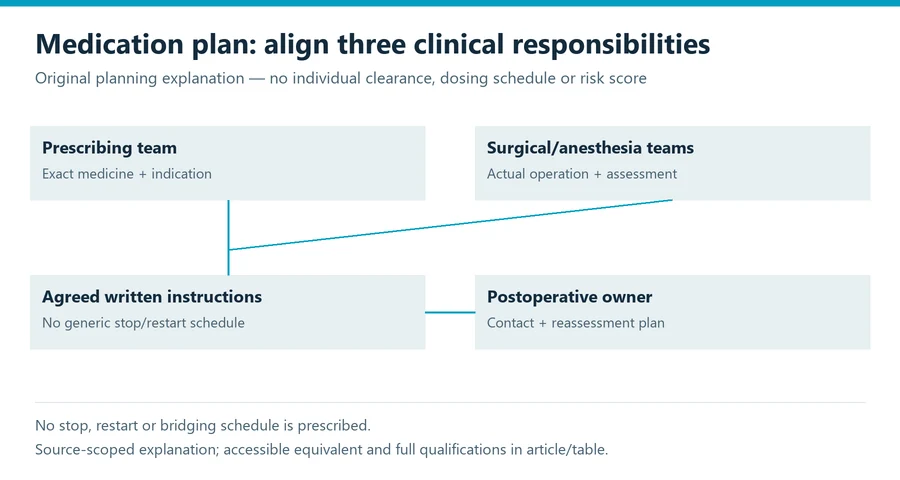
For blood thinners and plastic surgery, identify who writes the final plan, who answers questions before the operation and who manages the return to the usual regimen afterward. Those may be different people. Confirm whether a pharmacist or anticoagulation clinic is involved and how they will receive the operation details. The aim is consistent instructions, not a patient collecting separate opinions and choosing the least inconvenient one.
When a surgeon requests a form of “clearance,” ask what question the form needs to answer. A letter saying that someone has been evaluated may not describe the exact medication action, procedure or follow-up responsibility. Likewise, a medication plan does not by itself establish fitness for every proposed operation. Keep the prescription decision, anesthesia assessment and consent for the operation connected while preserving what each document actually establishes.
How does the proposed operation change the discussion?
Bring the actual operation names and the areas being treated. A package label such as body contouring can conceal several separate tasks. Ask whether the proposal includes skin removal, liposuction, an implant procedure or a revision, and whether everything is planned in one session. The medication team cannot assess the same proposal as the surgeon if one is considering a small isolated task and the other a combined operation.
Do not assume local anesthesia removes the need for review. It describes one part of the care plan, not the entire bleeding question or your underlying reason for treatment. Equally, an outpatient setting does not mean that postoperative contact and reassessment can be omitted. Request an explanation of the proposed setting, expected observation and the arrangements if the procedure or anesthesia changes on the day.
A useful question is whether the decision depends on keeping the operation within the originally assessed scope. If an additional procedure is suggested later, return that change to the medication and anesthesia teams. An earlier plan may have been reasonable for the earlier proposal. Documenting the change prevents an old approval from being interpreted as permission for a materially different operation simply because it takes place at the same appointment.
What should the written plan for blood thinners and plastic surgery contain?
| Plan element | Record to request | Who confirms it |
|---|---|---|
| Prescription identity | Exact medicine, strength and indication | Prescribing team |
| Operation identity | Actual procedures, setting and anesthesia proposal | Surgical and anesthesia teams |
| Medication action | Individual continuation or change instructions | Responsible clinicians |
| After surgery | Restart responsibility and conditions for reassessment | Named postoperative contact |
| Unexpected change | Contact route for postponement, symptoms or conflicting advice | Coordinating office |
The table is an editorial organizer, not a protocol that authorizes treatment. Leave an unresolved field visibly unresolved and ask the responsible office to complete it. Do not fill in an interval from a search result to make the document look finished. A complete record should also show when it was issued and whether it applies to the current surgery date, especially after a cancellation or a change in health.
For any individual change, ask how the instructions relate to the usual prescription label. Also ask what to do if you cannot take a medicine as planned, rather than improvising at home. A team may need to reassess the situation. The correct response to uncertainty is a contact pathway that works before the next decision is due, not a generic recommendation to skip or double a dose.
Is bridging always needed if a medicine is interrupted?
No general rule in this guide makes bridging automatic. Bridging is a specific clinical strategy, not another name for all clot prevention around surgery. The CHEST release includes recommendations against bridging in several defined circumstances. Its examples also show why a person’s diagnosis, medicine and procedure matter. Do not interpret an interruption as a requirement to obtain an injectable substitute, and do not conclude that every injection is a bridge.
Ask the team to explain any proposed additional medicine in plain language: what is it intended to prevent, how does it relate to the existing prescription and who will manage it? If no substitute is recommended, ask where that decision is documented. The explanation should concern your own plan rather than suggest that a single guideline sentence covers all possible histories and all plastic operations.
This distinction matters when considering blood thinners and plastic surgery after discharge. A postoperative preventive measure and long-term treatment can have different purposes and responsibilities. Keep the written instructions for each visible, and request help if the names or timing are confusing. A relative assisting with medicines needs the finalized instructions, not a collection of old messages from before the operation was assessed.
How should you handle contradictory preparation instructions?
Suppose a clinic preparation sheet says to stop all blood-thinning products, while your prescribing clinician says to continue your medicine. That is a conflict to resolve between the offices. It is not evidence that either instruction is safe for you in isolation. Send the actual wording to the coordinating office, identify the medicine and ask for one confirmed plan that both teams recognize.
Request a response before the relevant decision point. If the offices have not resolved the conflict, tell the clinic that the plan remains incomplete. Do not hide the uncertainty to protect a booked surgery date or a nonrefundable travel reservation. Administrative staff can help route the question, but an administrative acknowledgment does not substitute for the clinician who is responsible for the medication decision.
Save the final message and make it available at preoperative assessment. If another instruction arrives afterward, check whether it intentionally replaces the earlier one. Note who sent it and when. The purpose of this record is practical: preventing different people from acting on different versions. It does not make you responsible for determining which medical recommendation is superior.
What changes after surgery require contacting the team?
Before discharge, ask who can reassess bleeding, medication questions and the restart plan outside normal office hours. Explain whether you will be recovering at home, in a hotel or far from the prescribing office. A postoperative phone number is useful only if you understand what it is for and what alternative to use when an urgent problem cannot wait for a routine callback.
The NHS adverse-effects guidance calls for immediate medical attention for severe or recurring bleeding, bleeding that will not stop, major accidents and significant head injuries. Those are not situations for waiting for the next cosmetic follow-up or choosing a medication adjustment from this article. Tell the assessing clinician which medicines you take and when your operation occurred; do not drive yourself if you are unwell or impaired.
The CDC travel-thrombosis chapter describes possible clot symptoms such as a swollen painful limb and unexplained breathlessness, chest pain or fainting. These symptoms are nonspecific and need clinical assessment. Sudden breathing difficulty or chest pain warrants emergency care. This guide cannot decide whether a symptom is ordinary postoperative discomfort, a clot, bleeding or another condition.
How can blood thinners and plastic surgery affect travel and home support?
Tell the team about flights, long car trips and periods when you expect to be alone. Travel planning is a separate decision from agreeing to an operation or receiving a medication plan. Do not add aspirin, change a prescribed anticoagulant or buy compression products as a self-designed substitute for postoperative travel assessment. Ask how any proposed preventive measure fits the existing prescription and surgical restrictions.
Arrange practical help with collecting prescriptions, reading the finalized instructions and reaching appointments. If you normally manage medicines independently, consider how you will keep the schedule understandable while recovering. Use the team’s directions for storage and administration. A simple written record of what was actually taken can help answer a clinician’s question without relying on memory during a stressful postoperative call.
If recovery occurs away from home, check where records will be available and which local service can assess an urgent problem. The original clinic and the prescribing office should know how to contact each other. Avoid a plan that depends on flying back for every concern or assumes an unfamiliar urgent-care service can reconstruct the history from a package name alone.
What if the proposed surgery is postponed or changed?
A changed date can affect the usefulness of instructions that were tied to the original schedule. Ask the responsible team how to proceed rather than repeating the old sequence automatically. Explain what you have already done, if anything, and whether there are new symptoms or medicines. Being explicit gives the clinician the information needed to replace the old plan safely.
For elective blood thinners and plastic surgery, postponement can create time to clarify an incomplete assessment or coordinate care. It is not a judgment about your commitment to the procedure. Ask what needs to be resolved before rescheduling, who will confirm it and whether the revised plan requires another discussion. Keep administrative refund questions separate from medical instructions so a financial deadline does not become a reason to improvise treatment.
You can also ask whether a different operation, staged treatment or no operation would better fit the assessed risks and your goals. Those are consultation options, not recommendations from this guide. Request enough explanation to understand what changes and what remains uncertain. A consent discussion should let you reconsider the proposal once you understand the medication and follow-up responsibilities.
Can you prepare a record without deciding treatment yourself?
Keep the actual decision and current instructions together
Yes. For blood thinners and plastic surgery, organizing the record is a useful patient task; deciding an interruption or restart is a clinical task. Keep copies of the prescription list, actual operation proposal and final instructions together. Add the contact details for the offices that contributed. Mark older versions as replaced so a caregiver does not accidentally use an outdated message. If blood thinners and plastic surgery are discussed again after a new appointment, bring the same record and ask what changed. This makes the conversation easier to follow without turning the organizer into an authorization to alter medicine.
What is a useful final consultation checklist for blood thinners and plastic surgery?
Before treating the plan as settled, check that every team is discussing the same medicine and the same operation. Confirm the final written instructions, contact route, postoperative responsibility and handling of unexpected changes. Ask which questions remain open. The strongest preparation for blood thinners and plastic surgery is a shared record that makes unresolved decisions visible, not an apparently tidy calendar built from general intervals.
Bring that record to the operation and share it with the person helping you afterward. Keep emergency assessment separate from routine medication clarification. If a new instruction contradicts the plan, request reconciliation before acting on a guess. The desired outcome is coordinated care with clear responsibility, while preserving the treatment needs that existed before the cosmetic consultation.
For procedure scope and broader recovery planning, explore the procedure guides. Use the specific operation’s advice alongside the individualized medication plan; neither a general recovery article nor this organizer provides personal medical clearance.
Sources and review scope
Plastic Surgery Editorial Team. Source records checked through October 12, 2026. Review scope: source and editorial checks for general education. No individual clinical assessment is represented.
- CHEST perioperative antithrombotic guideline release. prodweb01.chestnet.org. Source date: 2022-08-11. Checked 2026-10-12.
- NHS anticoagulant considerations. nhs.uk. Source date: 2024-09-09. Checked 2026-10-12.
- NHS anticoagulant adverse effects. nhs.uk. Source date: 2024-09-09. Checked 2026-10-12.
- CDC2026 Yellow Book travel thrombosis. cdc.gov. Source date: 2025-04-23. Checked 2026-10-12.