
How long do lip fillers last? The answer depends on the actual product and the endpoint being discussed. AAD gives a general four-to-twelve-month range for hyaluronic acid fillers, but that is not a guarantee for every lip product or person. An FDA lip-specific VOLBELLA XC approval packet reports benefit through one year in a majority of study participants. Early swelling, a later fullness assessment and the decision to repeat treatment are different questions. Ask for the current labeling of the actual product proposed for your lips.
This guide does not prescribe an injection amount, a repeat interval or a method to dissolve filler. It does not treat a general filler-class estimate as approval for every product in the lips. The useful next step is a product- and area-specific conversation that explains expected effect, uncertainty, reassessment and symptoms needing care. A duration claim is not a guarantee that another injection will be needed or appropriate when a calendar reaches a particular month.
How long do lip fillers last for a specific product?
Start with the product name, not only the word filler. The FDA dermal filler resource explains that products have different intended uses and expected durations, and recommends discussing the labeling for the specific product. FDA review of a product for one area does not establish its use or duration in every other area.
Ask the clinician which product is being proposed for lip treatment and what evidence supports the duration estimate. Clarify whether the estimate describes visible fullness, a clinical rating, satisfaction or another endpoint. It should not be assumed to measure the amount of material remaining in the tissue. This distinction matters when someone interprets fading appearance as proof that every part of the filler has disappeared.
Keep the treatment date and product information available. If you later see another clinician, that record is more useful than a recollection that you had one syringe of filler. Do not infer the material from a price, package name or photograph. The treating office should explain what was actually used and what information it can provide.
Ask for the current intended-site labeling
A brand may include several products, and a single product may have more than one intended treatment area. Ask for the labeling that matches the actual use being discussed. A marketing page can be a starting point for questions, but it does not replace the clinical explanation of the current product and its limits.
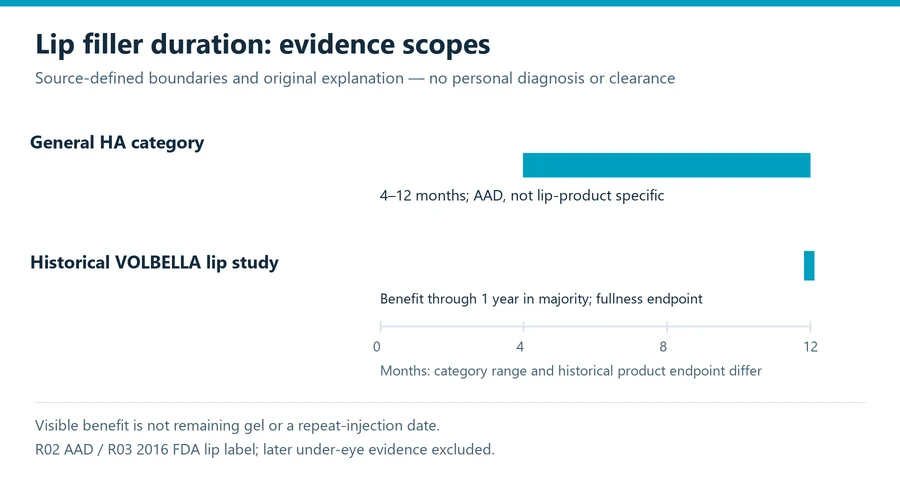
How long do lip fillers last compared with general filler estimates?
The AAD filler FAQs gives a general hyaluronic acid filler range of four to twelve months and advises asking how long the recommended filler should last in the area being treated. That class-level range is broader than a lip-specific trial. It should not be used to compare every filler material as if all were appropriate choices for the lips.
| How long do lip fillers last: evidence type | Useful context | Important limit |
|---|---|---|
| General hyaluronic acid class | AAD: four to twelve months | Not a guarantee for every lip product or individual |
| VOLBELLA XC lip approval study | Benefit through one year reported in a majority | Specific historical trial and endpoint; not complete gel disappearance |
| A different facial area | Its own evidence may describe another duration | Cannot be transferred automatically to lips |
| Repeat treatment | Requires assessment and a clinical decision | Not an automatic consequence of a month estimate |
The FDA-hosted VOLBELLA XC lip patient labeling comes from its 2016 approval packet. The study allowed a touch-up and assessed lip fullness and related outcomes. It is an example of product-specific evidence, not a statement that this document is the latest labeling or a recommendation to choose that product. Ask about the current label for your intended treatment.
When asking “How long do lip fillers last?” in practice, request both the evidence estimate and its uncertainty. A clinical result observed at a follow-up point is different from a promise that every participant retained the same appearance until that day. This guide intentionally avoids turning a trial endpoint into an individual redosing calendar.
Why are early swelling and longer-term fullness different questions?
A first impression after injection does not necessarily represent the later appearance used to assess duration. FDA guidance describes early swelling and bruising as possible effects, while also recognizing that some problems can appear later. Ask the treating clinician when it wants to assess your result and what early changes should prompt contact rather than routine observation.
If you are concerned about fullness, describe the treatment date and what looks different. A photograph can help explain the question if the team requests one, but angle, lighting, expression and camera distance can change the comparison. This article does not provide a home measurement of filler volume or a method to determine whether material has moved or disappeared.
Keep an appearance question distinct from a symptom. Pain, a skin-color change or a vision concern should not be placed only on a cosmetic checklist. The appropriate care route depends on the actual symptom. A statement that fillers last months does not decide whether a new change is expected, and it should not delay assessment of a concerning change.
Clarify the review’s purpose
Ask whether a proposed visit is intended to assess healing, discuss the result or consider another treatment. Those purposes can overlap, but an assessment does not automatically mean another injection. Knowing the purpose helps you bring the right question and avoids treating every early concern as a request for more filler.
How long do lip fillers last before repeat treatment is appropriate?
A duration estimate does not choose the date of another treatment. Ask the clinician to assess the existing result, goals, actual material and any concerns before deciding whether more treatment is appropriate. This guide does not recommend a maintenance schedule or say that a subscription or prepaid package establishes clinical need.
If an effect seems to fade, explain what you notice rather than assuming that no material remains. You may be asking about visible fullness, symmetry or your satisfaction with a particular shape. Those observations should be assessed in the context of the treatment record. The clinician can discuss the options without the article deciding whether additional material is needed.
The question “How long do lip fillers last?” before another appointment can be answered as two questions: when assessment is useful and whether treatment should occur. You can arrange a clinical discussion without committing to an injection. Ask what happens if the clinician recommends waiting or decides that a different concern should be evaluated first.
If changing clinicians, share the previous product and treatment records. Do not assume that a new brand or a larger amount will necessarily last longer or resolve an appearance concern. This guide does not rank products, recommend mixing materials or provide a conversion between syringes and months. The decision needs the actual clinical history and treatment plan.
How long do lip fillers last if the same brand is used elsewhere?
Evidence from another facial area should not be imported into the lips simply because the product name is the same. The FDA VOLBELLA S053 overview concerns an infraorbital-hollow indication. Its under-eye study is not the source of a lip-duration estimate in this guide. Intended site and study endpoint matter.
Ask which study or labeling supports the claim being made for your lips. If a page lists several treatment areas, identify the relevant one before comparing a duration. A headline that combines different products or sites may omit the distinctions needed for an informed discussion. This guide does not treat a later approval for another area as a new lip trial.
The same caution applies to general filler materials. A long duration listed for another material does not establish that it is appropriate, approved or reversible in the lips. The clinical discussion should begin with the intended use and safety, not only with the longest number on a chart. This article does not recommend permanent material for lip treatment.
A useful comparison asks what result is intended, what evidence is relevant, what limitations apply and how a concern would be assessed. The number of months is one part of that discussion. It cannot replace product identity, clinician assessment or a clear explanation of alternatives, including choosing not to proceed with another treatment.
Can habits or an injection amount guarantee longer-lasting lips?
This guide provides no formula that converts an injection amount into a fixed duration. If a clinician discusses how your plan may affect the result, ask what evidence and assumptions apply. A larger amount is not automatically the right response to a desire for durability, and a duration target does not determine the appropriate treatment for an individual.
Do not buy filler or attempt self-injection to maintain an effect. FDA treats dermal filler injection as a medical procedure and advises against products sold directly to the public. Product authenticity and trained clinical care matter independently of how long you want the appearance to last. An online purchase is not a safe scheduling workaround.
When asking “How long do lip fillers last?” with a particular routine, describe the actual habit or product you are wondering about. The clinician can address the question in context. This article does not prescribe supplements, pressure, massage or a home regimen to extend duration. It also does not say that a shorter effect proves you did something wrong.
Keep aftercare instructions with the treatment record and ask the office about uncertainty. Do not substitute a general longevity article for the instructions you received. A routine intended for another product, area or procedure may not answer your care question. The useful next step is clarification rather than adding more unprescribed steps.
Which symptoms need immediate attention instead of a duration discussion?
FDA advises immediate medical attention for unusual pain, vision changes, white, gray or blue skin near the injection site, or stroke symptoms during or shortly after treatment. Call 911 in the United States for an emergency. Do not wait for swelling to settle or for a duration estimate to run out before seeking appropriate help.
This warning concerns possible serious complications, not a prediction that your treatment will cause one. An appearance concern without those symptoms still deserves the clinical contact route appropriate to the issue. Ask the treating team how to report other unexpected or worsening changes and what to do if it cannot be reached.
The question “How long do lip fillers last?” cannot diagnose a lump, an uneven appearance or a new symptom. Explain the change, treatment date and actual product if known. A photograph may help when requested, but it does not guarantee that examination is unnecessary or that a message will be read immediately. Do not delay urgent care to retrieve a perfect comparison image.
If you want filler reduced or removed, ask for an assessment of the material and concern. This guide supplies no dissolution or injection instructions. The duration of a cosmetic effect is not a guarantee of effortless reversibility. A clinician must discuss what is possible and what risks or limits apply to the actual material.
What should the durability question change in your next appointment?
Use a duration estimate to organize a discussion rather than automatically reserve a repeat injection. Bring the actual product name, treatment date and treated area. Explain what you currently notice and whether your concern is appearance, an unexpected symptom or a future treatment goal. These are different questions even when they arise at the same visit.
When asking “How long do lip fillers last?”, clarify the endpoint behind the clinician’s answer. Is the discussion about a study’s fullness rating, your satisfaction, an observed contour or the appropriateness of another treatment? A visible effect measured at a follow-up visit is not a laboratory measurement of every remaining particle or a guarantee that another injection is needed then. The product-specific labeling and your current assessment remain relevant.
If an appointment is suggested near a particular month, ask whether it is a review or a proposed treatment and what would change that proposal. An assessment may support proceeding, waiting, choosing another option or investigating a concern. This guide does not predict which conclusion applies. A booking policy is not evidence that the earlier filler has disappeared.
For someone comparing online advice, keep the body area visible in your notes. A lip-product study and an under-eye indication can have different populations, methods and outcomes even within a brand family. The historical FDA lip-label evidence used here is identified as historical; it does not substitute for obtaining the current labeling for the exact product a clinician proposes today.
You can also ask how an unexpected change will be handled between routine visits. Know which practice receives the record request, who assesses a concern and when emergency care is required. Product history makes that conversation more useful; an appearance photograph cannot establish the material or replace the FDA warning response.
Planning around a special occasion should include uncertainty about early reactions and later appearance. Tell the clinician what matters to you without asking a general duration range to guarantee a particular photograph or treatment date.
How can the next lip-filler conversation be made practical?
Bring the product record and identify the decision you need help making. You may want to understand the current appearance, discuss a longer-term goal or decide whether another treatment is appropriate. Keep those questions separate from a symptom that needs earlier assessment. That gives the clinician a clearer starting point than a request to repeat whatever was done last time.
Ask what the proposed duration estimate describes. If it comes from a study, ask about the product, treated area, endpoint and whether touch-up treatment was part of the study. You do not need to interpret a research paper alone; the clinician should explain how the evidence informs the plan. A study result remains different from a guarantee for you.
If planning around an event, state the date and goal without asking for certainty about a photograph. Ask how review and unexpected concerns would be handled. This guide does not recommend an injection immediately before an event or promise that a particular booking produces a particular appearance. Clinical suitability and cosmetic scheduling should remain distinct.
See the lip filler guide for the broader treatment decision and the dermal filler guide for product context. The answer to “How long do lip fillers last?” is an evidence-based range for a particular product and endpoint, followed by individual reassessment. It is not a universal expiration date or an automatic instruction to add more filler.
Sources and review scope
Plastic Surgery Editorial Team. Source records checked through October 12, 2026. Review scope: source and editorial checks for general education. No individual clinical assessment is represented.
- FDA dermal filler guidance. fda.gov. Publication/update date not stated. Checked 2026-10-12.
- AAD filler FAQs. aad.org. Publication/update date not stated. Checked 2026-10-12.
- FDA VOLBELLA XC lip patient labeling, S018. accessdata.fda.gov. Source date: 2016. Checked 2026-10-12.
- FDA VOLBELLA S053 indication overview. fda.gov. Publication/update date not stated. Checked 2026-10-12.