
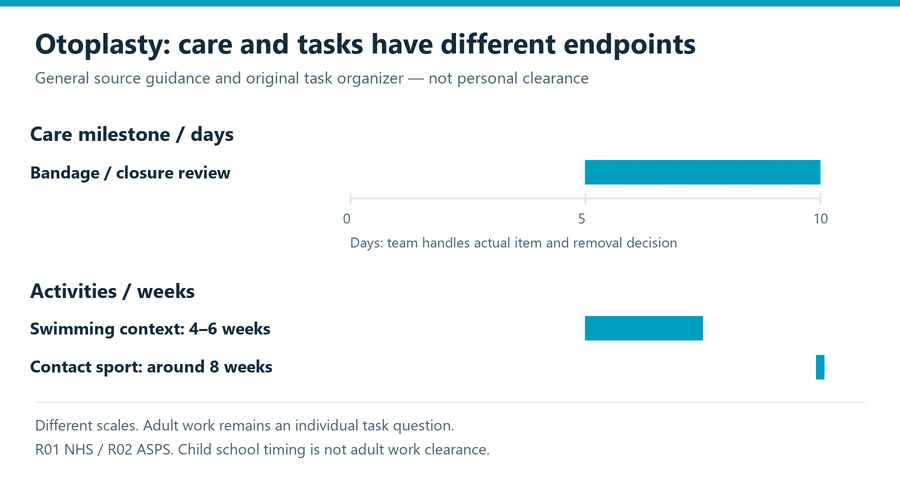
Otoplasty recovery needs separate answers for bandages, sleep, headwear, work and activities that can contact the ears. NHS guidance gives approximate milestones of five to ten days for clinician-managed bandage or stitch removal, four to six weeks for swimming and around eight weeks for contact sport. Those estimates are general context, not your removal instructions or personal clearance. Its one-to-two-week school estimate specifically concerns children and should not be presented as an adult work guarantee. NHS ear correction recovery
This guide focuses on adults recovering from surgical ear correction. Infant ear molding, earlobe repair and reconstruction after an injury may need different instructions. If your operation includes another ear procedure, ask the team to identify its care requirements. The useful goal is a practical plan for everyday tasks and follow-up, with a clear response to unexpected symptoms. A general timeline cannot assess an individual ear or tell you which activity your surgeon has permitted.
What should an otoplasty recovery plan identify?
Begin with the name of the operation and which ears were treated. Ask whether there is an incision, a dressing, a closure or another item that requires follow-up. Do not assume that a technique described as incisionless needs the same care as another operation, or that the word minimally invasive means every ordinary activity can resume immediately. The team should explain your actual operation in terms that make the care instructions understandable.
For otoplasty recovery at home, request instructions on bandages, headwear, hair washing, medicines and the next appointment. Ask who will handle anything that must be removed or changed. A general date on a web page cannot establish that you should remove a bandage yourself. If an instruction is unclear, obtain a specific answer before discharge rather than relying on a video from someone whose operation may differ.
Think through items that normally rest around the ears: glasses, headphones, hearing devices, masks, helmets and uniform headwear. These are questions to raise, not a universal list of prohibited objects. Explain which item you need, where it contacts the ear and how long you normally use it. The clinician can then advise on the actual situation. A product described as comfortable does not independently establish suitability after your operation.
Arrange the support your clinic requires after anesthesia and surgery. Be clear about transport, help with tasks the team restricts and access to the next review. If you live alone, tell the clinic before the operation so the plan reflects your circumstances. These practical arrangements are original organizational suggestions. They are not a measured strategy for improving ear correction outcomes or a substitute for the clinic’s discharge requirements.
How should the otoplasty recovery milestones be read?
The chart separates care milestones from activity discussions. Bandage review concerns a care item; swimming concerns an activity; contact sport creates another kind of exposure. None is a universal finish line. The companion visual uses parallel lanes to show those distinctions and keeps adult work as an individual question. Its intervals summarize guidance rather than observations from a patient group or probabilities of being ready.
| Otoplasty recovery question | Published general context | What needs your team’s answer |
|---|---|---|
| When are bandages or stitches reviewed? | NHS: commonly five to ten days, if applicable | Who handles removal, actual closure and current healing |
| When can swimming resume? | NHS: approximately four to six weeks | Your operation, wound assessment and intended activity |
| When can contact sport resume? | NHS: around eight weeks | The sport, protective equipment and surgeon’s permission |
| When can adult work resume? | No universal adult work interval established here | Duties, headwear, medicines, travel and appearance preferences |
Do not extend the NHS child school estimate to adult employment without assessment. A classroom, a driving shift, an industrial setting and a public-facing role ask different things of a recovering person. Explain the demands of your job to your team and ask what can be planned before surgery. You can discuss a provisional administrative arrangement while still acknowledging that the clinical decision remains individual.
For otoplasty recovery scheduling, distinguish an appointment from a promised new permission. At a review the surgeon can examine the actual course and decide what follows. The fact that a visit is booked does not guarantee that a restricted activity will be allowed afterward. If other people are helping organize your calendar, mark the task as pending review rather than confirmed. This keeps practical commitments from becoming pressure to override advice.
Appearance preferences also differ from task readiness. You might choose to rearrange a photographed event even if a permitted task is manageable. Discuss that concern before deciding on timing, and communicate it accurately. A preference should not be described as a medical restriction unless the team actually gives one. Conversely, wanting an uncovered ear for an event cannot establish permission to remove or alter a care item.
How should bandage and sleeping questions be clarified?
ASPS emphasizes keeping postoperative bandages intact and following the surgeon’s care instructions. It also describes protection from trauma and avoidance of excessive force or abrasion while healing. ASPS ear surgery care If a bandage feels problematic, ask the team what to do rather than removing it to inspect the ear. This guide offers no method of wrapping, tightening, loosening or replacing a bandage.
For otoplasty recovery during sleep, ask about your usual position and any support the team recommends. The NHS notes that a nighttime headband may be needed for several weeks, but the actual item and schedule should be clarified with your surgeon. NHS protection context A headband marketed for surgery is not proof that its fit or pressure is appropriate for your ears.
Make the care item and its responsible person explicit
Write down which item is present, who handles it and the next review. If someone is helping you, have them hear the explanation or use the same written instructions. This prevents different people from improvising different routines. If the plan changes at an appointment, keep the revised version with the original record. The useful outcome is a clear responsibility, not a self-directed assessment of whether the item looks ready to remove.
Ask how hair washing and showering should work with the current bandage. This resource does not supply a washing recipe, recommend a cleanser or prescribe a water-pressure method. If the team asks you to keep something dry, clarify the practical arrangement and what to do if it becomes wet. An instruction from another operation should not fill that gap. Contact the treating team for the method relevant to your own care.
If glasses, a hearing device or another necessary item interacts with the bandage, discuss that before the operation where possible. Explain why you need the item and ask how the team wants the conflict managed. Avoid choosing between hearing, vision and postoperative instructions without help. The clinical team can coordinate a workable plan or identify whom else needs to advise; a generic accessory recommendation cannot do that assessment.
How can headwear and work be planned?
Work planning for otoplasty recovery should describe required equipment and contact around the ears. A helmet, headset or uniform hat raises a specific question that may matter more than whether the job is called sedentary. Bring an example if useful, and ask when its use will be reassessed. Do not assume that a short task using the item establishes permission to use it throughout an entire shift.
Separate the journey from the job. If you normally drive, cycle or use a helmet during the commute, ask about those tasks individually. Driving also requires consideration of anesthesia, prescribed medicines and safe control of the vehicle. Confirm the treating team’s advice and any applicable insurer or legal requirements. This article establishes no universal postoperative driving date and does not treat a passenger trip as equivalent to driving yourself.
For a workplace conversation, identify the temporary function you are asking to change. It might concern equipment, in-person meetings or a physically demanding duty, depending on your clinical advice. Whether an adjustment is possible depends on the employer and the job. This guide does not create an employment entitlement or certify fitness for work. Ask early what documentation is required so the administrative question can be handled separately from medical assessment.
During otoplasty recovery, a remote meeting may offer flexibility but does not remove instructions about headwear or care items. Describe any task that still involves the ears, such as prolonged headset use. The useful plan is specific enough that you and the clinician mean the same thing by returning to work. Avoid making the label work from home a substitute for asking about the actual activity.
Plan an alternative if a proposed return needs to change. A flexible schedule can prevent an uncertain review date from becoming a nonnegotiable commitment. This is organizational advice, not evidence that everyone needs a particular number of additional days. Record what remains undecided and who will answer it. That makes the plan more understandable for a manager or helper who was not at the consultation.
What should be discussed about sport and ordinary social routines?
For otoplasty recovery and sport, name the sport and how the ears could be contacted. A swimming session, helmeted activity and contact sport need separate answers. Ask how the team’s restriction applies and what review is needed before resuming. The published milestones should start that conversation, not act as a test date on which you try the activity yourself to see whether it is comfortable.
Tell the team about equipment, collisions, water exposure and any competition date. If a coach needs an administrative plan, explain that permission is pending rather than presenting a broad timeline as a clearance certificate. Protective equipment may be required by the sport, but it should not be assumed compatible with a healing ear until the clinical question is resolved. Neither the equipment label nor another athlete’s experience can grant permission for your operation.
Ask separately about routine grooming appointments and accessories. Haircuts, styling, earrings and other items may involve contact near a treated area. Describe the action rather than only naming the appointment. This article does not provide a piercing or salon return date because the inspected sources do not establish a universal interval for those services. Obtain an answer before booking something that depends on unresolved permission.
Social situations may also involve unplanned contact. Tell people helping you which practical precautions the team has explained, without requiring you to disclose more surgical detail than you want. If children or pets are likely to interact closely, ask how to manage your usual activities during the restriction period. A calm plan for ordinary interactions is more useful than an unsupported rule that everything is safe once the bandage is off.
Keep travel and access to follow-up in the discussion. If you expect to leave the area, ask how a concern would be assessed and who would coordinate your records. A ticket or hotel booking should not define medical readiness to travel. No universal fit-to-fly interval is given here. Your care plan should state how to obtain help even when a routine appointment is not immediately available.
Which symptoms should change the response?
Contact the operating clinic promptly for severe pain or unexpected symptoms rather than waiting for a calendar milestone. That follows the NHS ear-correction contact advice. General descriptions of tenderness or bruising do not let this article identify the cause of a worsening problem. Tell the team what changed and follow its assessment advice. Do not remove a bandage or manipulate the ear to decide for yourself whether the concern is serious.
New difficulty breathing, chest pain or fainting requires immediate emergency help; in the United States, call 911. CDC identifies these as possible clot warning symptoms, while new limb swelling, pain, warmth or discoloration needs prompt assessment. CDC warning symptoms This is general emergency guidance, not an otoplasty-specific clot risk or a diagnosis. A routine clinic message should not delay emergency evaluation.
For a non-emergency concern, have the operation date, current instructions and contact information available. Describe whether the change is progressing and any advice already received. Ask where to obtain assessment if your surgeon is unavailable. If the team requests a photograph, use its approved private channel. Sending an image should not replace an examination the clinician recommends or postpone care that needs to occur urgently.
If you cannot reach the clinic and the problem needs prompt evaluation, use an appropriate urgent medical service. Avoid adding topical products, changing prescribed medicine or altering a care item as an experiment. The task organizer is meant to support your care, not maintain the original schedule at any cost. A new restriction or appointment after assessment is information to incorporate into the plan.
What should each follow-up settle?
If you normally use a hearing device or specialized headset, ask who should advise on its return and how that answer will be communicated. Do not let an unresolved equipment question disappear when a bandage is reviewed. Keep the device requirement visible in the task list so the next appointment can address your actual hearing or occupational needs without substituting another person’s routine.
Bring a short list of practical questions: what remains in place, what activities are permitted, which items need review and when to contact the team again. For otoplasty recovery, permission about one task should not silently extend to every activity involving the ears. Record the specific answer and share it with anyone helping you. If the question remains unresolved, leave it pending instead of inserting a number from another person’s timeline.
Ask about appearance concerns separately from the work or sport plan. The team can explain when it intends to assess the result and what changes it wants reported sooner. Keep any requested private images within the clinic’s approved method. A public progress story or before-and-after photograph is not necessary to justify asking for clinical assessment of your own concern.
The useful endpoint is a current plan that connects a task to its instruction and next review. Otoplasty recovery may involve more than one adjustment to ordinary routines, and the chart helps you see those dependencies. It does not certify an ear as healed, grant permission or predict symmetry. Your treating team’s assessment remains the basis for the decisions a general guide cannot make.
For related procedure context, read otoplasty and the plastic surgery recovery guide.
Sources and review scope
Plastic Surgery Editorial Team. Source records checked through October 12, 2026. Review scope: source and editorial checks for general education. No individual clinical assessment is represented.
- NHS ear correction surgery. nhs.uk. Source date: 2023-09-22. Checked 2026-10-12.
- ASPS ear surgery recovery. plasticsurgery.org. Publication/update date not stated. Checked 2026-10-12.
- CDC: About venous thromboembolism. cdc.gov. Source date: 2025-03-05. Checked 2026-10-12.