
Neck lift recovery requires individual instructions for head position, movement, incision care and everyday tasks. ASPS recommends keeping the head elevated above the heart and straight, avoiding excessive twisting or bending, and specifically warns against applying ice to the neck because it can compromise blood flow. Its neck-lift recovery page does not establish one return-to-work or driving date. Ask your surgeon for a task-specific plan rather than borrowing a two-week clearance from another operation. ASPS neck lift recovery
This resource concerns a surgical neck lift. Chin liposuction, a facelift, an injectable treatment and an energy-based tightening procedure have different scopes. If several procedures are combined, your written instructions need to address the combination. The purpose of this guide is to prepare practical questions, organize support and distinguish task readiness from appearance settling. It does not prescribe a neck position, exercise routine, medication plan or method of treating a postoperative concern.
What should a neck lift recovery plan identify?
Ask the team to state the operation’s exact scope and the location of any incisions or care items. Confirm whether a face procedure, liposuction or another treatment is also included. You do not need to interpret an operative technique to plan daily life, but you do need to know which instructions apply to which area. If the written sheet only names one procedure in a combined operation, ask the team to clarify the missing information before discharge.
List the daily tasks that normally involve turning or bending your head: dressing, reading, using a phone, driving, cooking, caring for children and working at a screen. Ask how the team’s movement guidance applies to those tasks. A general instruction to be careful is difficult to translate into a busy day. The aim is to obtain concrete advice from the clinicians who know the operation, rather than infer a permitted movement from your comfort.
For neck lift recovery support, arrange help around the tasks the team actually restricts and the discharge support it requires. Name the person who can provide transport, the person handling errands and the backup if either is unavailable. This is a household planning suggestion, not a measured intervention that guarantees easier healing. Explain any limitations in your support arrangements before surgery so the clinical plan is based on your real situation.
Keep the daytime and after-hours contact routes accessible. Ask what to do if swelling or another concern changes between appointments, and where urgent assessment would take place. If you are recovering away from the operating facility, ask how that location affects access to care. A scheduled review does not answer what happens at night or when your surgeon is unavailable; those are separate practical questions worth resolving in advance.
Which neck lift recovery milestones need separate answers?
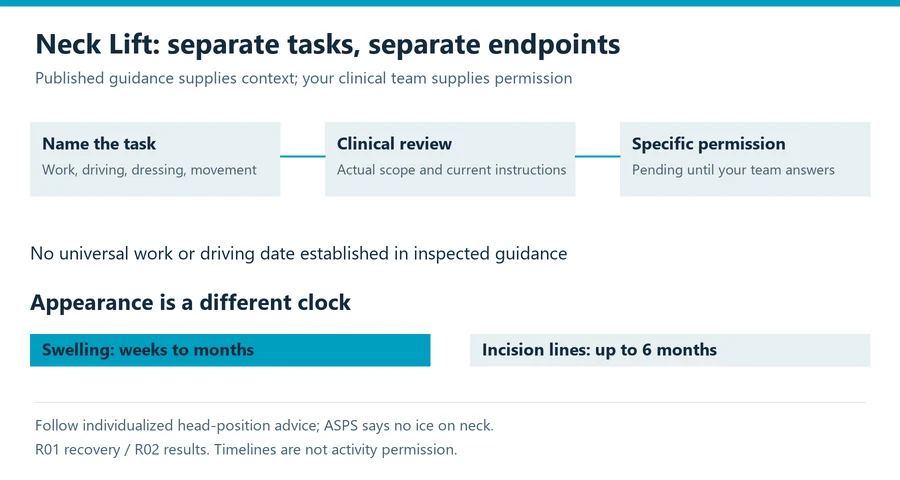
The inspected ASPS guidance provides movement and care principles rather than a universal numerical work or driving timetable. That evidence gap should remain visible. The companion diagram therefore uses decision gates for everyday tasks and a separate appearance horizon. It does not place an invented return date on a calendar, label a patient cleared or plot a probability of uncomplicated healing.
| Neck lift recovery decision | What the inspected guidance establishes | What your own team must clarify |
|---|---|---|
| Head and neck protection | ASPS advises elevation, a straight head position and avoiding excessive movement | How to follow this in your home and with other medical needs |
| Driving | No universal date established on the inspected page | Movement, medicines, safe vehicle control and applicable requirements |
| Work and childcare | No universal permission interval established here | The real demands of each task and any temporary adjustment |
| Swelling and appearance | ASPS: swelling may take weeks to months to dissipate | Your course and the appropriate time for assessment |
| Incision-line maturation | ASPS: up to six months | Your incision concerns and follow-up plan |
ASPS describes a longer horizon for appearance than many everyday scheduling questions: swelling can take weeks to months to dissipate and incision lines up to six months to mature. ASPS neck lift results Those statements are general context. They do not establish that a particular symptom is harmless, that every incision will follow that course or that an activity is permitted before or after a given month.
For neck lift recovery scheduling, distinguish a review from a guaranteed change in restrictions. A booked appointment is an opportunity to assess what has happened and decide what comes next. It may result in continued advice or another review. If an employer or family member needs a plan, describe the task under discussion and when you expect the team to assess it, rather than promising clearance at the appointment.
An appearance preference is another separate endpoint. You might feel able to perform a permitted task but prefer to delay a photographed event. Tell your team about that concern before deciding on surgery timing. A personal preference should not be represented as a medical restriction unless the clinician actually gives one. Similarly, wanting to look ready for an event cannot establish readiness for movement, driving or strenuous activity.
How can head-position instructions be made practical?
Ask for a demonstration suited to your mobility, usual sleep arrangements and any other medical condition. This article does not prescribe a pillow stack, a sleeping angle or a method of holding the head. Generic recovery accessories may not resolve your particular needs. If a suggested position cannot be maintained comfortably or conflicts with another instruction, tell the team and obtain a coordinated answer.
During neck lift recovery, consider tasks that draw your gaze down or require frequent turning. A phone, laptop, reading material and work station are useful examples to discuss. Ask the team how to arrange those activities within its advice rather than making an ergonomic rule yourself. The goal is to identify an obstacle before it becomes a reason to ignore the restriction, not to create a new self-directed rehabilitation program.
Discuss dressing and the route through your home
ASPS advises avoiding clothing that must be pulled over the head while incisions are healing. ASPS incision protection guidance Ask what garments work with your own dressing and incision arrangement. Before buying something, consider whether you can put it on as instructed and whether help is needed. A garment advertised for comfort does not prove suitability for a surgical area.
Look at the ordinary items you use repeatedly: shoes, food storage, bathroom supplies and a charger. Ask which tasks you should avoid and arrange help with those tasks rather than planning to test them afterward. An item being accessible does not make every movement to reach it permitted. This planning exercise is organizational; your clinicians should provide the actual movement advice and any restriction that applies to your operation.
Do not add ice or heat because a general cosmetic-surgery routine recommends it. The ASPS neck-lift page explicitly cautions against ice on the neck. If you are uncomfortable, use the team’s contact route for the instructions relevant to your operation. A different procedure’s compress advice cannot resolve a neck-lift question, even if both procedures involve swelling. This guide offers no compress temperature, duration or placement recipe.
What should be clarified about dressings, drains and medicines?
ASPS describes the possibility of a gentle bandage and temporary drain after a neck lift, with individualized instructions for care and follow-up. ASPS postoperative care overview A possible item in a general overview is not proof it will be used in your operation. Ask which items you actually have, which you should handle and which must be managed by clinical staff.
For neck lift recovery care instructions, record the item, the action, the responsible person and the next review. If you are taught a task, ask the team to check that you understand it. This article does not explain drain emptying, dressing removal or wound cleaning because those instructions need to reflect the actual device and operation. An online routine should not fill a gap in your own discharge instructions.
If a bandage, garment or care item seems problematic, contact the team rather than tightening, loosening or replacing it based on another person’s advice. Describe the problem and ask whether you should be assessed. If a clinician tells you to make a change, keep the updated instruction with the care plan. This avoids a helper continuing an older routine without knowing that advice has changed.
Keep prescribed medicines in the plan supplied by your prescriber. Ask whom to contact if you cannot obtain an item, cannot follow the directions or think it is causing a problem. Do not stop a medicine or add an over-the-counter product because a recovery list recommends it. This guide does not prescribe a pain regimen, antibiotic, supplement or method of preventing blood clots.
Confirm showering, hair care and grooming permissions specifically. A service that involves contact near an incision should be discussed before booking. Ask who will handle any closure review and where it will take place. If another clinician will provide that care, arrange the information transfer beforehand rather than assuming a routine salon or primary-care appointment can perform any requested postoperative task.
How should driving, work and family responsibilities be arranged?
Driving requires a separate decision during neck lift recovery. Explain the journey, vehicle and tasks involved, including looking around and controlling the vehicle. Ask about movement advice, medicines and the team’s assessment of readiness; check applicable insurer and legal requirements. A short passenger trip and independent driving are different questions. This resource supplies no universal day on which either becomes safe for every reader.
For work, describe the real demands rather than the job title. Screen use, repeated turning, physical tasks, public-facing duties and protective clothing can create different issues. Ask which tasks fit your instructions and which should wait for review. A remote role may offer flexibility, but working at home does not remove clinical restrictions. Arrange transport and help for follow-up independently from a proposed work schedule.
For neck lift recovery leave, consider an administrative alternative if the anticipated return needs to change. A staged workload, rescheduled meeting or temporary reassignment may be worth discussing if the clinician supports it and the workplace permits it. Those are planning options, not a certificate of fitness or an employment entitlement. Ask early what documentation the workplace requires so the clinical and administrative questions do not become confused.
Childcare and caregiving should be listed as actual movements and responsibilities. Lifting a child, helping someone transfer, managing a car seat and responding at night may involve different demands. Ask the surgeon about them and arrange a named substitute for restricted tasks. Avoid trying a difficult movement after surgery simply to find out whether it is comfortable. Comfort alone cannot replace the advice for protecting healing tissue.
For exercise, name the activity and intensity you intend. A walking routine, resistance training and a sport with head movement are not one category. Ask how the team will decide on resumption and whether combined surgery changes the plan. This article does not prescribe a rehabilitation schedule or suggest stretching the neck to test readiness. Keep unresolved permissions pending until your team answers them.
Which problems should interrupt the calendar?
New breathing difficulty, chest pain or fainting requires immediate emergency help; in the United States, call 911. CDC identifies these as possible clot warning symptoms, while new limb swelling, pain, warmth or discoloration needs prompt assessment. CDC clot warning symptoms This is general emergency guidance, not a neck-lift-specific risk estimate or a diagnosis of the cause. Do not wait for a routine clinic message when emergency assessment is needed.
Contact your treating team promptly about an unexpected or worsening neck or incision concern, and follow its advice about assessment. A general appearance horizon is not a reason to dismiss a new change. To provide an additional warning framework, MSK’s neck-surgery guidance identifies increasing redness, swelling, warmth or concerning drainage as reasons to contact a clinician. That resource concerns neck dissection for cancer, not cosmetic neck lift; its care routine and recovery timetable are not imported here. MSK neck-surgery warning guidance
When calling, explain what operation you had, when the concern began and whether it is progressing. Mention the instructions you received and any recent change in the plan. Ask where to obtain assessment if the surgeon is unavailable. This article cannot judge swelling from a description or photograph, and an online comparison should not be used to decide that a concern does not need attention.
If the clinic asks for an image, use its approved private method and follow any instruction for in-person care. Sending a photograph should not delay urgent evaluation. Do not try to resolve a concern by changing a bandage, adding pressure, using a compress or altering medicine without advice. If you cannot reach the team and the problem needs urgent assessment, use an appropriate urgent medical service.
How can follow-up clarify the next task?
Before leaving a review, check that a broad instruction has an understandable next step. If the team says to wait, ask what is being reassessed and when to contact them again. If it permits a particular task, ask whether that answer also addresses the equipment or movement you described. Record any remaining question instead of silently extending permission to another activity. This communication step makes the practical schedule clearer without creating a new recovery date.
Bring the current instructions and a short list of unresolved tasks to each review. Ask what is permitted now, what remains restricted and when another assessment is needed. For neck lift recovery, an answer about work should not automatically be extended to driving, exercise or grooming. Recording permissions separately gives you and a helper a clear plan without claiming the entire recovery is finished.
Ask when appearance concerns should be reassessed and which changes should be reported sooner. The longer swelling and incision horizon should help you frame that discussion, not stop you from raising a current concern. If the team revises an instruction, record the revision date and tell anyone helping you. A simple current plan is more useful than several conflicting printouts from earlier appointments.
The planning graphic deliberately shows a task, clinical review and specific permission as separate steps. Its purpose is to expose unanswered questions, not validate a self-directed recovery protocol. Neck lift recovery can involve changes to practical commitments, and maintaining a clear contact route makes those changes easier to coordinate. Your own clinical assessment remains the basis for decisions that a general page cannot make.
For related procedure context, read neck lift and the plastic surgery recovery guide.
Sources and review scope
Plastic Surgery Editorial Team. Source records checked through October 12, 2026. Review scope: source and editorial checks for general education. No individual clinical assessment is represented.
- ASPS neck lift recovery. plasticsurgery.org. Publication/update date not stated. Checked 2026-10-12.
- ASPS neck lift results. plasticsurgery.org. Publication/update date not stated. Checked 2026-10-12.
- CDC: About venous thromboembolism. cdc.gov. Source date: 2025-03-05. Checked 2026-10-12.
- MSK neck-dissection postoperative guidance. mskcc.org. Publication/update date not stated. Checked 2026-10-12.