
Botox vs fillers is not a choice between two interchangeable wrinkle treatments. Botox Cosmetic is a prescription botulinum toxin drug that changes the activity of treated muscles. Dermal fillers are medical devices intended to create a smoother or fuller appearance in specific approved uses. The appropriate discussion starts with what is producing the concern, which change you want and whether a specific product is suitable for that particular site. Neither an injection category nor a brand name is a complete treatment plan.
This guide separates movement, contour and appearance goals, explains why units and syringes cannot be compared as equivalent quantities, and supplies a worksheet for evaluating an actual proposal. It also shows how to read a small combination-treatment study without turning its design into a personal result prediction. Choosing neither treatment, seeking further assessment or limiting treatment to one clearly defined goal remain legitimate decisions.
Describe the change before selecting an injectable
A useful starting description is observable rather than diagnostic. Say where the concern is, when it is visible and what you hope will change. A line that becomes more prominent during expression, a contour you notice at rest and a request for fuller lips are different descriptions. They may call for different assessment, and more than one concern can exist in the same area. Do not assume that every visible line needs volume or that every contour concern can be addressed by changing muscle activity.
Bring separate goals rather than a request for an entirely new face. For example, you may want to preserve your usual expression while discussing a particular line, or you may want a specific contour assessed without increasing fullness elsewhere. The clinician should explain what the proposed intervention is expected to change and what it leaves alone. A modest, clearly defined goal is easier to evaluate than a general promise of rejuvenation.
The inspected Botox Cosmetic prescribing information is product-specific. It includes named cosmetic indications rather than approval for every visible facial concern. The label version checked for this guide was effective October 18, 2024. A current consultation should use the applicable current labeling, not assume that an online summary is the complete prescribing information.
| Your stated concern | What must be clarified | What should not be assumed |
|---|---|---|
| A line that becomes prominent with expression | Whether muscle activity is relevant and what change is acceptable | Every line requires Botox |
| A contour or fullness concern at rest | The underlying concern, proposed material and site-specific indication | Every hollow or fold should be filled |
| Several concerns in one region | A separate purpose and assessment for each component | A combination package is automatically necessary |
| A desire to retain expression or avoid extra volume | How the proposal respects that priority | More product means a more suitable result |
| An uncertain concern | Whether further assessment or observation is preferable | An injection is required at the first visit |
Use these questions to organize the consultation, not to diagnose yourself. A clinician may identify a concern that photographs cannot establish. If the recommendation differs from what you initially expected, ask for the reasoning and alternatives before agreeing to a product. A category comparison becomes useful only when it is connected to your actual priorities and assessment.
Treat filler as a family of products, not one substance
The FDA approved-filler information distinguishes absorbable materials from a nonabsorbable product category. Different materials and products have different indications and labeling. The word filler does not identify what will be placed, where it is intended to be used or what follow-up questions matter. Ask for the exact product name and its patient information.
A description such as hyaluronic acid filler is still incomplete. It names a material family, not every feature of the selected device. Ask which product is proposed, what site and goal it is intended to address, and why that particular choice is being recommended. If an alternative is mentioned, ask what meaningful difference motivates the comparison. A long menu of brand names without an explanation of purpose does not help you decide.
Separate an aesthetic wish from a product indication
An attractive photograph or a widely advertised treatment name is not an approval statement. The FDA consumer guidance describes specific filler uses in adults aged 22 and older and emphasizes knowing both the product and its intended location. That category-level description does not mean every listed material is approved for every site. Request the actual device labeling and discuss the proposed use.
Be especially careful when broad online summaries disagree. An older general page, a new product indication and a clinician’s off-label proposal are different kinds of information. Ask which current, product-specific document supports the proposal and whether the intended use falls within it. This guide does not convert a research result or popular practice into a new regulatory indication.
Write down the product name before comparing another proposal. Keep the original patient information with the date of the consultation. If a later appointment proposes a different material or region, treat that as a new decision requiring an explanation. A previous satisfactory treatment does not supply all the information needed for a different product or purpose.
Compare quantity and cost using the right unit
Botox Cosmetic is measured in its own product units. A filler proposal may describe syringes, volume, treatment regions or a course of visits. Those descriptions cannot be converted into an equivalent amount of another category. A low unit price and a low syringe price do not identify the lower complete treatment cost. First establish what the proposal includes and whether both proposals address the same goal.
The ASPS filler cost page explains that product choice, clinician expertise, treatment scope and location affect fees. Its category averages are not a dated quote for your exact product, amount or region. This guide therefore does not use them as a personal budget or invent current local prices. A real written quote is the appropriate input to the worksheet below.
For a product-unit quote, multiply the proposed product-specific units by the stated fee per unit and add any separate charges actually listed. For a syringe quote, multiply the quoted number of syringes by the quoted price per syringe and identify any separate charges. These are financial calculations, not instructions about how much product should be administered. The clinician must determine the proposed amount and explain its purpose.
| Quote field | Botox proposal | Filler proposal |
|---|---|---|
| Exact product and goal | Record the named drug and intended region | Record the named device, material and intended region |
| Billing quantity | Product-specific units, area or total visit fee | Syringes, volume, area or total visit fee |
| Complete initial cost | Quantity multiplied by actual rate, plus listed charges | Quantity multiplied by actual rate, plus listed charges |
| Included review | What review visit is included? | What review visit is included? |
| Further treatment | What would be separately assessed and charged? | What would be separately assessed and charged? |
| Longer-term planning | Proposed reassessment, not a guaranteed repeat date | Proposed reassessment, not a guaranteed repeat date |
If one quote uses a region fee and another uses a product quantity, request enough detail to understand the difference. Do not assign an imaginary quantity to the region fee merely to make the arithmetic look comparable. Likewise, a consultation fee, review appointment or additional product may be included in one proposal and excluded from another. The lowest visible number can represent the narrowest scope rather than the least expensive equivalent plan.
Avoid turning expected duration into a guaranteed annual purchase schedule. Ask when the result should be reviewed and what would prompt further treatment. If you are considering a longer-term budget, calculate several possible schedules using the clinician’s actual proposal, clearly marking those schedules as planning assumptions. Do not automatically divide one advertised price by a promotional duration and declare a winner.
Read combination evidence by its actual design
Receiving both treatments does not erase the need to understand each component. Ask what the toxin is intended to do, what the filler is intended to do and why both are proposed for the same person. A combination should have separate goals, product information and risk discussion. An offer that bundles two categories together is not itself evidence that both are needed.
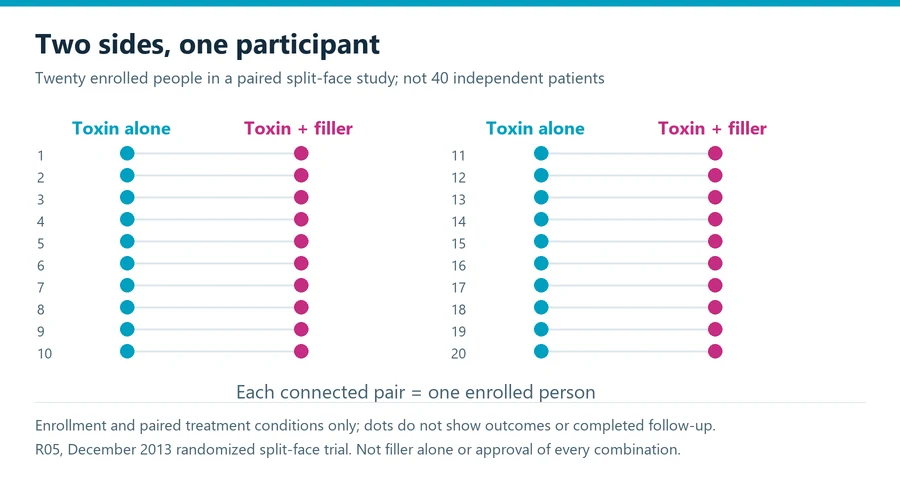
An original December 2013 trial enrolled twenty people with forehead and glabellar concerns. It used a randomized, rater-blinded split-face design: one side received toxin alone and the other a toxin-and-hyaluronic-acid combination. Assessments occurred at two and six weeks and at three and six months. This is a comparison of paired sides in the same people, not forty independent participants or a filler-alone comparison.
The supporting diagram shows those twenty paired participants. Each joined pair represents two treatment conditions within one enrolled person; it does not depict a successful result, complication or retained follow-up response. Knowing the design helps prevent three common mistakes: doubling the patient sample, calling the study a comparison of Botox against filler alone, or treating its particular upper-face protocol as proof about every combination and location.
The authors reported some later differences favoring the combination. That finding does not establish a universal treatment recommendation or quantify rare harms in a small sample. The article’s publication month is recorded accurately; an exact publication day was not verified. Its studied regions also should not be interpreted as establishing a US approval for a particular filler at those sites.
A practical evidence question is whether the measured endpoint matches your goal. A clinician rating of a line, a patient satisfaction score, a movement measure and a safety event are different outcomes. A result on one scale should not be described as a percentage of people achieving every desired change. Ask what was measured, when it was measured and whether the evidence included people and uses similar to the proposed treatment.
Discuss risk by product and site
The FDA filler safety information identifies unintended entry into a blood vessel as a serious concern that can cause tissue injury, vision loss or stroke. It also explains that reducing or removing filler can require additional intervention and may be difficult or impossible for some materials. This is why the phrase reversible should not replace a product-specific discussion of risks and options.
For Botox Cosmetic, read the full prescribing information and discuss the relevant health history with the clinician. Its boxed warning concerns toxin effects spreading beyond the treated area, including potentially serious swallowing or breathing problems. This guide is not a complete contraindication list or an individual clearance assessment. A prior uneventful visit should not be used to dismiss a new symptom, medication change or different treatment proposal.
The FDA advises immediate medical attention for unusual pain, vision changes, white, gray or blue skin near a filler injection, or signs of stroke during or shortly after treatment. Trouble swallowing or breathing after toxin treatment also requires urgent medical help. Do not wait for an aesthetic review appointment or an online reply when an urgent warning sign occurs. Ask in advance how the facility handles concerning calls and how you should obtain emergency care.
A responsible risk discussion includes uncertainty. Ask which complications relate to the particular product and site, what the clinician does if a concerning event occurs, and what further care could involve. Do not accept a claim of zero risk because a product is approved or because a treatment is described as minimally invasive. Approval, appropriate selection and competent care are important parts of the discussion, but they do not make every outcome predictable.
Check sourcing, records and the treatment setting
The exact product should appear in the treatment record and in the information you receive. Ask the clinician to explain how the product is obtained through an authorized supply chain. Seeing attractive packaging is not a consumer authentication test. A social-media promotion, familiar logo or low price cannot independently establish what is inside a vial or syringe.
The FDA warns against purchasing fillers directly for self-injection and against needle-free injection pens. Treatment involves medical assessment and complication management, not merely delivery of a cosmetic ingredient. Do not use this comparison as a shopping list for home administration. If a proposal avoids explaining the product, professional responsibilities or the setting, resolve those gaps before considering treatment.
Bring your previous treatment records if available. Identify products, dates, treated areas and any reactions accurately; do not guess a product name from memory when the record can be requested. Tell the clinician when information is uncertain. A complete history is more useful than assuming all past injectables were the same material or that a previous brand nickname identifies the actual treatment.
After a visit, keep the provided instructions and product details in a place you can find. If another clinician later evaluates a concern, those records can help clarify what was done. They should not be represented as proof that a new symptom is unrelated to treatment. The purpose of records is to support assessment and communication, not to supply a diagnosis at home.
Evaluate the result without inventing a personal guarantee
Before treatment, agree on what will be evaluated and when. Describe the original goal in ordinary language and ask how the clinician will assess change. If photographs are used, discuss consistent expression, lighting and positioning; images taken under very different conditions may not support a fair comparison. A polished photograph is not a substitute for a clear description of the outcome being assessed.
| Review question | What it clarifies | What it cannot prove alone |
|---|---|---|
| Was the original goal addressed? | Whether the assessment matches the stated task | Every facial concern improved |
| Was expression or contour assessed consistently? | Whether comparisons use similar conditions | A photograph gives a complete medical assessment |
| Is a concern expected or needs evaluation? | Who will assess the concern and how | A generic online timeline explains an individual symptom |
| Is further treatment being proposed? | The new purpose, product, cost and risk discussion | More treatment is automatically the next step |
| Are you comfortable choosing observation? | Whether your preferences remain part of the decision | Treatment must continue because it began |
If you are dissatisfied, describe the concern before requesting additional product. Ask whether it requires examination and whether the proposed response addresses the actual issue. A desire for symmetry or a different contour should not automatically become permission for a new injection. Further treatment is another decision, with its own explanation and consent.
Keep ordinary preference separate from a possible medical problem. You can discuss an aesthetic concern at a planned review, while urgent symptoms need prompt medical attention. The facility should explain how to make that distinction and how to reach appropriate care. An online image comparison cannot reliably resolve that question for you.
Keep the financial review separate from the aesthetic assessment as well. A complimentary check does not necessarily include more product, and a proposed additional syringe is not simply a correction to the original bill. Ask whether the proposed change is a response to the original goal, a new goal or evaluation of a concerning symptom. That distinction helps you understand why a new consent discussion or charge may appear. It also prevents a prepaid package from becoming the reason for accepting treatment you no longer want. Your present preferences should remain visible even when an earlier quotation included multiple visits.
Make the final comparison specific
A useful Botox vs fillers decision record fits on one page: your goal, the clinician’s assessment, the exact product, intended site, proposed scope, complete quote, review plan and questions still unanswered. If you are considering both categories, keep separate entries for each. If you obtain another assessment, compare those entries rather than only comparing brands or advertised prices.
The strongest proposal explains why a particular intervention fits a particular task and acknowledges what it cannot promise. It also leaves room to defer treatment, seek further assessment or decline an additional component. You do not need to select an injectable simply because two options exist. The decision is whether a clearly understood proposal meets your priorities with acceptable uncertainty and appropriate professional care.
Continue with the Botox guide, the consultation question guide and the complete-cost planning guide when building your record.
Sources and review scope
Plastic Surgery Editorial Team. Source records checked through October 12, 2026. Review scope: source and editorial checks for general education. No individual clinical assessment is represented.
- Botox Cosmetic prescribing information, DailyMed version54. dailymed.nlm.nih.gov. Source date: 2024-10-18. Checked 2026-10-12.
- FDA approved dermal fillers. fda.gov. Publication/update date not stated. Checked 2026-10-12.
- FDA dermal filler dos and donts. fda.gov. Publication/update date not stated. Checked 2026-10-12.
- ASPS dermal filler cost context. plasticsurgery.org. Publication/update date not stated. Checked 2026-10-12.
- Treatment of forehead/glabellar rhytide complex with combination botulinum toxin A and hyaluronic acid versus botulinum toxin A alone: split-face randomized trial. pubmed.ncbi.nlm.nih.gov. Source date: 2013-12. Checked 2026-10-12.
- FDA dermal filler safety and patient information. fda.gov. Publication/update date not stated. Checked 2026-10-12.