
Botox vs Dysport is a comparison between two named botulinum toxin products, not a choice between equivalent units sold at different prices. Botox Cosmetic contains onabotulinumtoxinA; Dysport contains abobotulinumtoxinA. Both have labeled cosmetic uses for frown lines between the eyebrows, but their product units are not interchangeable. A useful decision compares the same assessed concern, product-specific labeling, expected endpoint, complete treatment quote and the clinician’s plan for follow-up.
Neither brand is a universal winner for every face, site or priority. A faster measured change in one study does not guarantee your personal onset, a longer interval before another appointment or better satisfaction. This guide provides a label-aware comparison, explains an actual corrected randomized trial and shows how to compare written quotes without inventing market prices or prescribing a dose.
Match the indication before comparing brands
The Botox Cosmetic label revised October 2024 lists adult cosmetic indications involving glabellar lines, lateral canthal lines, forehead lines and platysma bands. The Dysport label revised October 2024 lists its cosmetic indication for moderate-to-severe glabellar lines in adults younger than 65. These are the label versions inspected for this guide on October 12, 2026; therapeutic indications and every possible proposed use are not equivalent to these cosmetic indications.
| Comparison item | Botox Cosmetic label inspected | Dysport label inspected |
|---|---|---|
| Named active product | OnabotulinumtoxinA | AbobotulinumtoxinA |
| Glabellar cosmetic indication | Moderate-to-severe lines in adults | Moderate-to-severe lines in adults younger than 65 |
| Other listed cosmetic areas | Lateral canthal lines, forehead lines, platysma bands | Do not assume the same cosmetic indication list |
| Labeled glabellar total | 20 Botox Cosmetic units | 50 Dysport units |
| Unit interpretation | Product-specific, not convertible | Product-specific, not convertible |
The table identifies label information, not the treatment appropriate for you. Ask the clinician which anatomical area, diagnosis or cosmetic concern is being treated and how the proposed use relates to the exact product label. If the proposal falls outside a labeled indication, ask for its rationale and evidence rather than assuming that another brand’s approval transfers to it.
Be precise about what you mean by forehead. Lines between the eyebrows and horizontal forehead lines are different treatment discussions. A quote advertised as one area may cover one, both or a differently defined service. Describe the concern in ordinary language and ask the clinician to name the area in the written plan. Comparing two offers with different targets will not reveal which product provides better value.
Separate a concern about movement from a concern visible at rest. Ask what the assessment suggests and which part of your goal the proposed treatment can reasonably address. A person seeking less visible frowning may have a different priority from someone seeking a change in a persistent crease or overall facial contour. Brand choice should follow that assessment rather than replace it.
Understand why a unit price is not a potency comparison
Both inspected labels state that their units cannot be compared or converted into units of another botulinum toxin product. The labeled glabellar totals in the table therefore do not establish a universal conversion rule. They are product-specific treatment information. This article does not tell you how many units to receive, where to inject them or how to change a clinician’s prescription.
A lower price per unit can still produce a higher total quote. The arithmetic depends on the number of that product’s units in the actual written plan and on additional charges. More units of one product do not automatically mean that it is stronger, weaker or more diluted than another. A unit-price advertisement is a billing detail, not a measurement of comparative biological effect.
If a practice uses an area price, request the named product and what is included. An area price can be easy to understand while leaving treatment scope unclear. If a practice uses unit billing, ask for the estimated total and how a change to the agreed plan affects the bill. Neither billing system alone tells you whether the plan matches the concern or has appropriate follow-up.
Keep the clinical decision separate from a purchase calculation. It would be misleading to choose a unit number at home because it makes two advertisements cost the same. The clinician needs to determine the actual plan. Your role in the cost comparison is to obtain clear service information and understand the resulting total, not to convert a price ratio into an injection instruction.
Read the actual head-to-head trial endpoint
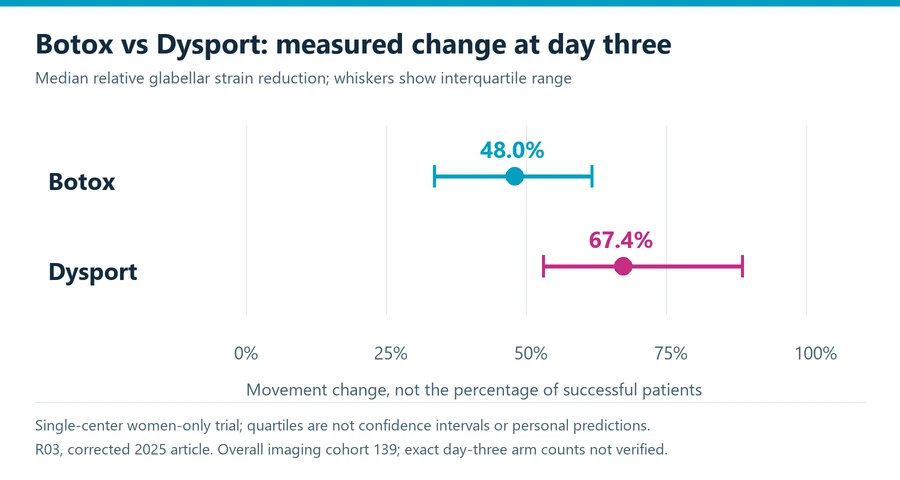
A randomized trial published May 28, 2025 and corrected August 20, 2025 compared four formulations in 143 women aged 30–65 at one center. Its corrected text used 20 onabotulinumtoxinA units and 50 abobotulinumtoxinA units. At day three, median relative reduction in glabellar strain was 48.0% for onabotulinumtoxinA and 67.4% for abobotulinumtoxinA; reported interquartile ranges were 33.6–61.7% and 53.1–88.6%. The imaging analysis excluded four participants at baseline and visits could also be excluded. These are strain-change measurements, not percentages of patients successfully treated. Results are not directly generalizable to men or every facial site; later retention and unadjusted multiple comparisons limit interpretation.
The supporting graphic shows that specific early measurement with its interquartile range. A median is the middle of an observed distribution. An interquartile range describes its middle half; it is not a confidence interval or the full range of possible outcomes. The chart does not state that everyone reaches the median or that either product is guaranteed to look a certain way by an event date.
Separate onset, peak effect and satisfaction
An early assessment, the largest measured change and how a person feels about the result are different endpoints. Ask which one a claim about faster or better treatment refers to. A numerical movement measurement can be useful without answering whether the result matched someone’s preferred expression. Likewise, satisfaction does not necessarily establish the absence of every adverse effect.
For a duration claim, identify the endpoint and timepoint. Does lasting mean that an instrument still detects a change, that a severity scale remains improved, that the person is satisfied or that another treatment was not needed? Those definitions can produce different answers. Avoid treating every reference to several months as the same measured promise.
Keep study dosing and your own treatment plan distinct. An original comparison is evidence about the tested protocol and population. It is not permission to apply its units to another anatomical area, combine them with a different product or assume the same response after repeated treatment. The value of a trial lies partly in showing its limits clearly.
When reading a percentage, identify what is on each side of the calculation. A change in a measured movement value has the person’s baseline measurement as its reference. A responder rate instead counts people who meet a defined threshold and divides by an eligible assessed group. These quantities can share a percent sign while answering different questions. A chart labeled only improvement percentage leaves that distinction unresolved.
Ask whether a claimed difference is based on comparison between products or on each product’s change from its own baseline. Showing that both groups changed does not itself establish that one changed more than the other. Similarly, the absence of a demonstrated difference is not proof that every outcome is identical. These distinctions help interpret the evidence without turning a study summary into a brand ranking.
Use a comparison worksheet with defined endpoints
Create a short worksheet before your consultation. Record the concern, the expression or view in which it matters and the improvement you would regard as worthwhile. Then ask how the clinician would judge that improvement. If you prefer to retain more visible movement, state that preference rather than assuming that the strongest visible change is automatically the best result.
| Question about a treatment claim | Information needed | Misleading shortcut |
|---|---|---|
| Is it faster? | Measured endpoint, assessment day and studied area | A general promise for an event date |
| Does it last longer? | Definition of retained effect and follow-up | Every duration claim treated as time to retreatment |
| Is it stronger? | Product-specific units and actual clinical comparison | Unit count treated as cross-brand potency |
| Is it better? | Your goal and a comparable outcome measure | A brand ranking without an indication |
| Is it cheaper? | Full written quote for the same assessed service | Per-unit price or a different area package |
This worksheet can also clarify why a clinician recommends staying with a product that has previously worked for you. Ask what your own records show: the named product, area, treatment date, observed response and any adverse effects. A remembered brand name without the rest of that information may not explain a difference between visits.
If a previous treatment disappointed you, describe the problem specifically. Was the concern inadequate improvement, an unwanted change in expression, the timing of the effect, discomfort or another issue? Each warrants a different assessment. Changing a brand name alone does not establish that the cause has been identified or that the same issue cannot occur again.
Normalize a quote without fabricating prices
The ASPS botulinum toxin cost page explains that fees vary with treatment scope, product amount and clinician or practice factors. Its category average does not establish separate national Botox and Dysport prices for the same assessed service. This guide therefore uses your written quote fields instead of invented local fees or a brand-specific price range unsupported by a dated sample.
For unit billing, calculate total quoted product charge as the planned product units multiplied by that product’s quoted unit fee. Add the applicable assessment or other fixed charges, then subtract only discounts that actually apply. This is invoice arithmetic. The clinician supplies the product-specific plan; the calculation does not supply a dose or an equivalence ratio.
| Quote field | Botox offer | Dysport offer |
|---|---|---|
| Named product and area | Copy the written scope | Copy the written scope |
| Planned product units | Enter the clinician’s estimate | Enter the clinician’s estimate |
| Product charge | Units × that offer’s unit fee, or stated area fee | Units × that offer’s unit fee, or stated area fee |
| Other applicable charges | Assessment and listed services | Assessment and listed services |
| Included follow-up | Visit, timeframe and policy | Visit, timeframe and policy |
| Total payable | Sum the actual included charges | Sum the actual included charges |
Ask whether a follow-up assessment is included and what happens if additional treatment is proposed. A complimentary assessment is not necessarily complimentary product. Clarify expiry dates, minimum spend and the conditions of an advertised credit. If the two quotes include different services, note the difference rather than forcing them into a single winner.
Longer-term budgeting also requires an assumption about future visits. Do not multiply a favorable advertised duration into a guaranteed annual saving. Instead, label any budgeting scenario as conditional on the clinician’s plan and your observed response. Update it when actual treatment records are available. A product can be affordable per visit while still exceeding the amount you want to spend over time.
Consider two offers written for different services: one covers only the lines between the eyebrows, while the other includes that region and additional areas. Even if the second total is larger, the difference does not establish a higher price for the same treatment. Request a separate comparable quote if the clinician considers that scope appropriate. Do not subtract an assumed value for the extra areas, since package prices may not divide evenly and the clinical plan may change.
Similarly, a prepaid credit is not necessarily the price of a complete visit. Write down the remaining amount payable, the service to which the credit applies and whether the offer requires purchasing additional treatment. If the provider cannot yet specify the total before assessment, record that uncertainty. A truthful incomplete comparison is preferable to a precise total built from missing terms.
A follow-up policy deserves its own line because it can affect both care access and billing. Ask whether it includes examination only, how additional product is charged if proposed and whether the policy changes for a concern about the result. You are comparing responsibilities and services, not buying a guaranteed appearance. Keep the policy version that applied when you accepted the offer.
Check product authenticity and the care setting
In a November 5, 2025 announcement, the FDA warned about illegally marketed, unapproved and misbranded botulinum toxin products. It advises receiving prescription products from a licensed, trained professional using an authorized source. That concern applies before trying to decide which brand’s advertised benefit is preferable. A familiar brand name in an advertisement does not establish the identity or sourcing of the product actually used.
The FDA also issued a counterfeit Botox alert, updated May 1, 2024. It describes a specific investigation; it is not a complete authentication service for a consumer examining a photograph. Do not assume that matching one visible packaging detail proves a product legitimate or appropriately stored.
Ask who will perform the assessment and treatment, how their relevant license can be checked and how product information is recorded. Establish which professional is responsible for follow-up if the person providing an initial consultation differs from the injector. A convenient appointment or a favorable promotion should not leave that responsibility ambiguous.
Do not purchase toxin for self-injection or use a quote worksheet to plan administration. The questions here are intended to make a licensed clinician’s assessment and product sourcing clearer. They do not describe reconstitution, injection sites, needle placement or a way to perform treatment outside an appropriate clinical setting.
Discuss the safety history that matters to you
The ASPS consultation guidance advises discussing health conditions, allergies, medicines, supplements and prior treatment along with goals and risks. Bring an accurate account of prior toxin treatment rather than assuming a new practice has access to it. Identify the product when possible and explain any reaction or unwanted effect.
The Dysport label lists cow’s milk protein hypersensitivity as a contraindication and notes possible trace milk proteins. Tell the clinician about relevant allergies and let them interpret the product-specific information. Do not decide that a different brand is safe solely because one warning does not appear in an abbreviated comparison table. The full labeling and your history need professional review.
Approved toxin products carry a boxed warning about serious effects, including possible spread of toxin effect. The FDA’s November 2025 announcement advises immediate medical care for trouble swallowing or breathing after an injection. A brand comparison should not minimize such symptoms or suggest waiting for a routine cosmetic follow-up if urgent assessment is needed.
Ask for the practice’s instructions about expected effects, contact outside office hours and situations requiring urgent care. Understand what to do if an unexpected change occurs, even if the procedure was brief. Avoid substituting a friend’s experience or a recovery photograph for the response plan supplied by the treating clinician.
Decide with a clear record rather than a universal ranking
A fair Botox vs Dysport decision connects your assessed concern, product-specific indication, desired endpoint, authentic sourcing and complete quote. Record which evidence supports the recommendation and where judgment or uncertainty remains. A study can support a discussion of a specific outcome without proving that a product is best for every person.
If you change products, retain the old and new treatment records so the next comparison has context. Use comparable photographs and note when they were taken, if your clinician recommends documentation. Separate the practical questions of cost and appointment timing from the clinical questions of product choice and treatment scope. That makes it easier to understand what changed rather than attributing every difference to the label on the vial.
You can also decline or postpone treatment if the goal, quote or follow-up plan is unclear. A useful decision does not require accepting a claim of perfect smoothness or matching someone else’s expression. It requires enough clarity to explain what you want, what the proposed product is intended to do and how its limitations fit your priorities.
For related planning, see the Botox guide, cost and quote planner and consultation questions.
Sources and review scope
Plastic Surgery Editorial Team. Source records checked through October 12, 2026. Review scope: source and editorial checks for general education. No individual clinical assessment is represented.
- Botox Cosmetic prescribing information, DailyMed label version 54. dailymed.nlm.nih.gov. Source date: 2024-10-18. Checked 2026-10-12.
- Dysport prescribing information, Galderma DailyMed label version 12. dailymed.nlm.nih.gov. Source date: 2024-10-24. Checked 2026-10-12.
- Comparison of Botulinum Toxin A Formulations for Glabellar Strain Treatment in Women: A Double-Blind Randomized Clinical Trial. jamanetwork.com. Source date: 2025-05-28. Checked 2026-10-12.
- ASPS botulinum toxin cost context. plasticsurgery.org. Publication/update date not stated. Checked 2026-10-12.
- FDA warns companies over illegal marketing of Botox and related products. fda.gov. Source date: 2025-11-05. Checked 2026-10-12.
- FDA counterfeit Botox alert. fda.gov. Source date: 2024-05-01. Checked 2026-10-12.
- ASPS botulinum toxin consultation. plasticsurgery.org. Publication/update date not stated. Checked 2026-10-12.