
Tummy tuck recovery time depends on the operation you actually have and the demands you want to resume. NHS guidance gives about four to six weeks away from work and exercise as a general planning window for abdominoplasty. It is not a promise that every task becomes safe on the same day. Build your plan around the surgeon’s restrictions, your home responsibilities and scheduled reviews, with separate dates for desk work, lifting, driving and exercise.
The most useful question is not simply when you will feel better. Ask what you will need to do on an ordinary day and which parts require assistance. A person working from a laptop has different demands from someone moving equipment or caring for a toddler. This resource helps turn those demands into a practical recovery plan. It does not replace discharge instructions or tell you to change treatment, remove a drain or test a restriction by pushing through discomfort.
Start with the exact abdominal operation
Write down the operation’s name and components in the surgeon’s own terms. Ask whether the plan includes abdominal muscle repair, a change around the belly button, liposuction or another operation. Do not assume a smaller-sounding label gives a fixed shorter timetable. If you already have written instructions, use their actual scope at every planning discussion. A calendar copied from someone who had different abdominal work cannot explain your restrictions.
Keep the procedural record separate from your goals. Wanting a flatter contour explains why you are considering treatment, but it does not describe the operation’s effect on ordinary movement. Ask the surgeon which restrictions arise from which component and when those restrictions will be reviewed. If several procedures are planned together, request one coordinated set of instructions rather than trying to combine the fastest part of several online recovery charts.
The NHS describes both partial and full abdominoplasty, with different operative scope. Its recovery advice is broad guidance rather than a comparison proving that one technique always recovers faster. The same page advises prompt clinic contact for severe pain or unexpected symptoms. NHS abdominoplasty recovery guidance
Make room in the record for a change in the plan. If the operation performed differs from the consultation proposal, ask the discharge team to identify the difference and its practical implications. Your helper should hear the same explanation. It is much easier to arrange an additional ride or extend help when everyone knows which instruction changed than when the household is relying on a remembered preoperative estimate.
Read a timeline as a planning range
Use the published four-to-six-week window to open a leave discussion, not to issue yourself permission. Ask how your team applies that range to the actual procedure and your job. Record an initial estimate, the review that could change it and a backup arrangement. Tummy tuck recovery time becomes more useful when each date has a decision attached to it, instead of one large circle labelled fully recovered.
Separate medical recovery from comfort with appearance. A wound review, a work discussion and a later contour assessment answer different questions. Do not move a lifting task earlier because a photograph looks reassuring, and do not assume you cannot attend a permitted work task simply because a scar is still noticeable. Obtain the relevant answer for the particular activity rather than using appearance as a substitute for assessment.
| Planning item | Published context | Individual question to settle |
|---|---|---|
| Leave from work and exercise | NHS general window of about four to six weeks | Does my operation and actual job require a different arrangement? |
| Driving | NHS describes several weeks and advice from surgeon and insurer | What must be satisfied before I drive, and who will confirm it? |
| Support garment | NHS describes a roughly six-week course | Which garment, schedule and stop decision apply to me? |
| Scar appearance | NHS describes fading over twelve to eighteen months | When will scar care and later appearance be reviewed? |
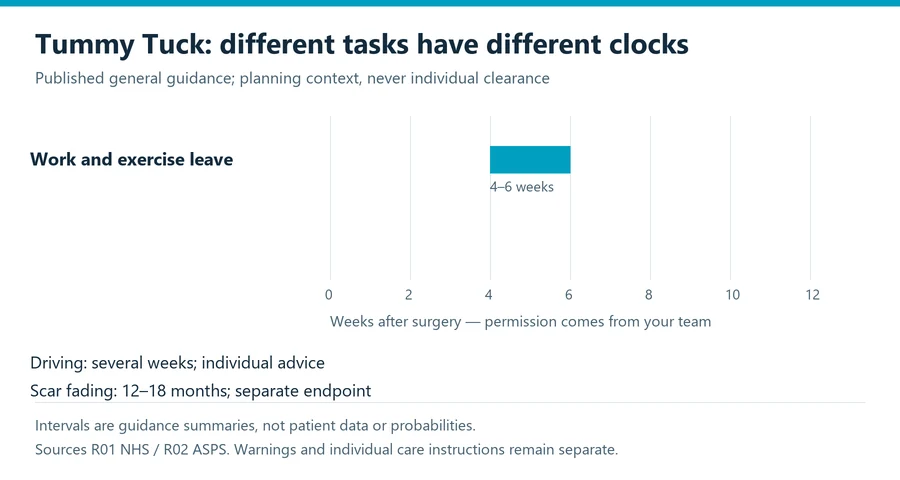
These are different endpoints, not four measures of the same result. The planning graphic accompanying this guide deliberately keeps the leave window, driving decision and scar horizon on separate lanes. Its dates summarize the cited guidance; they are not observed outcomes from a patient group and do not predict your healing. The equivalent table remains available in text so that the key qualifications are not trapped inside an image.
Build a home plan around bending and carrying
Walk through your home before surgery and identify tasks that involve bending, reaching or carrying. Do not rehearse a prohibited movement after the operation to find out whether you can manage it. Instead, describe the task to the team in advance and ask what help should be arranged. Useful examples include moving laundry between machines, collecting parcels, carrying groceries and preparing a meal with equipment stored below a counter.
Choose a reachable place for the items you expect to use, then let a helper handle anything whose movement demands have not been cleared. A practical arrangement is one small station for contact information, written instructions and ordinary personal supplies. Avoid buying a large collection of recovery products before you know what the team recommends. A convenient organizer may help you find instructions; it does not improve healing or substitute for the correct supplies.
Assign names rather than writing a vague request for help. One person may provide transportation, another may handle meals and another may take responsibility for pets. Check the dates and the physical demands with each person. Someone available for an evening visit may be unable to cover a morning school run. Ask what happens if the helper becomes unavailable, and preserve a realistic backup rather than hoping an online timeline will shorten your needs.
If you live alone, tell the team clearly. Ask which arrangements are required for discharge and which parts of home care need another person. Do not describe a taxi booking as equivalent to a complete support plan without checking. Likewise, a relative staying in the same building may not know when you need them. The point of preparing is to make the needed assistance specific enough that everyone can carry out the agreed plan.
Childcare is a collection of physical tasks
The word childcare can hide several different actions: lifting a child, helping with a car seat, carrying school bags, bathing, getting down to floor level and responding quickly at night. List the tasks that actually occur in your household. Ask the clinician about each relevant demand and give the helper enough detail to take over the task. A child who can walk independently may still need sudden physical assistance that cannot be planned away.
Think beyond the first daytime shift. Who handles waking, bedtime, a sick child or an unexpected school closure? A plan that covers meals but leaves lifting undecided is incomplete. Explain the restriction to the people helping you in plain language, using the team’s instructions rather than an invented weight limit. If a job normally belongs to you, agree in advance who will do it until the relevant activity is permitted again.
Avoid making a child’s cooperation the entire backup plan. A toddler may forget a request to climb independently, and a pet may pull unexpectedly. These examples are reasons to arrange help and discuss the task, not reasons to assume a particular movement will cause a complication. The clinician defines the medical boundary. Your contribution is to identify the situations in which the household is likely to encounter that boundary.
Ask for a discharge explanation you can use
ASPS notes that postoperative care may involve dressings, a support garment and temporary drainage tubes, with individualized instructions for care, medicines, concerns and follow-up. Not everyone will have the same equipment. Ask the team to identify what you actually have and which instructions belong to it. ASPS tummy tuck postoperative guidance
Use a teach-back conversation: explain the plan in your own words and let the team correct any misunderstanding. Ask your helper to do the same for the parts they will handle. Keep the written version nearby. If a drain is present, request the team’s demonstration and their recording instructions; this article supplies no removal schedule or home manipulation technique. A device is not ready to be removed because an online chart reaches a particular week.
Keep medicines in the actual prescribed plan, including what to do if you cannot take a scheduled medicine or have a question about it. Do not add an over-the-counter product, stop a medicine or change a dose based on a generic recovery checklist. Write down the appropriate number for medication questions. Separating that number from emergency instructions can help your household contact the right service without treating every uncertainty as the same kind of problem.
Confirm when you should return and what that visit will assess. If you are travelling for the operation, ask how care will continue when you return home and where an in-person examination would occur if needed. A message portal and a scheduled examination are different services. Arrange the ride to the first appointment before discharge, with a backup if the appointment time changes or the planned driver becomes unavailable.
Turn a job title into a work description
Tell the team what your job requires, not just its title. Include the commute, time on your feet, lifting, bending, uniforms, equipment and ability to pause. A desk role with a long drive and no flexible breaks differs from a similar role done at home. Ask your employer which temporary modifications are possible, then ask the clinician whether those modifications meaningfully change the proposed return plan.
A tentative work date needs a review point
Record the date you hope to return, the appointment that will reassess it and the person who needs the updated information. Tummy tuck recovery time should not become a deadline you feel obliged to meet to avoid inconveniencing others. Request the paperwork your employer actually needs and keep private medical details limited to what is necessary. An estimate can be useful without being represented as a guaranteed return date.
For remote work, discuss a short trial of permitted duties with the relevant people rather than assuming home working removes every demand. Meetings, concentration, sitting arrangements and the need to respond quickly may matter to the plan. Agree how you can stop or change the workday if the authorized arrangement is not manageable. This is an employment-planning exercise; it is not a test of healing or a substitute for the clinician’s advice.
For physical employment, give specific examples such as transferring equipment, pushing a loaded trolley or helping another person move. Ask who can temporarily cover those duties. If modified work is unavailable, make that fact explicit at the consultation. A return-to-work note should describe the actual restriction and review plan where appropriate, instead of allowing the employer to interpret a general recovery estimate as permission for every task.
Driving and exercise require separate decisions
Arrange transport for the period discussed with the surgeon, including follow-up visits and essential household trips. Ask about the required conditions for driving and the role of your insurer. Do not decide from the calendar alone or use a quick drive around the block as a safety assessment. If you cannot drive, consider how the change affects the rest of the household, especially appointments that would otherwise depend on you.
Exercise is also a broad label. Describe the activity you intend to resume: walking as directed, swimming, resistance training, a class or a contact sport. Ask which stage requires a clinical review and whether different activities have different instructions. Do not combine permission for one movement with permission for another. The same distinction applies to a physically demanding hobby that you might not normally call exercise, such as gardening or moving furniture.
Keep a brief record of the permission you receive, including the activity and any conditions. If the answer is unclear, ask the team to clarify it before acting. A clear instruction is more useful than trying to reconcile several people’s experiences on social media. Those experiences may offer companionship, but they do not establish what your procedure, examination or individualized plan permits you to do.
Know how to respond when the course changes
Have the clinic’s daytime and after-hours contacts written down before you need them. The NHS advises prompt contact for severe pain or unexpected symptoms after abdominoplasty. Describe what changed, when it started and any other symptoms; do not minimize a change because you expected some discomfort. Ask the team in advance which concerns need immediate assessment and which can be discussed through its ordinary postoperative service.
CDC clot guidance identifies limb swelling or pain as reasons for prompt medical assessment. New breathing difficulty, chest pain or fainting requires immediate emergency help. CDC blood clot warning guidance
Do not wait for a routine follow-up appointment when emergency symptoms occur. For a US reader, call 911 for an emergency. A clinic message, a photograph or a friend checking the wound cannot rule out a serious problem. The warning information is a response plan, not a diagnosis and not an estimate of your individual likelihood of a clot. Do not start prevention medicines or treatments yourself because you have read about a possible complication.
If you contact the team about a non-emergency concern, record the advice and any requested review. Ask what should trigger another call if the situation changes. Do not treat a prior reassuring answer as covering a new symptom indefinitely. Your helper can assist by keeping the information organized, but should not decide that a symptom is harmless based on an internet recovery story. The appropriate service must assess the concern.
Use follow-up to revise the plan
Bring your task list to each appointment. Note which arrangements still need help and which questions affect the next week. Ask whether the current instruction changes, rather than assuming a good visit automatically releases every restriction. If the team extends a restriction, update the household and employer together. That prevents an old calendar estimate from surviving after the medical plan has changed.
A useful recovery record has three columns: the task, the current instruction and the next review. Keep appearance questions on a separate list so that they receive attention without becoming the basis for activity decisions. Ask how later scar and contour concerns will be assessed and when those discussions are most useful. This preserves the difference between getting through the next workday and evaluating the longer course of recovery.
Before the operation, finish one page containing the proposed scope, essential helpers, transportation, follow-up dates and contact routes. After discharge, revise it to reflect the procedure performed and instructions received. The value of this plan is that it remains usable when a date changes. It gives everyone a practical job without pretending that tummy tuck recovery time is the same for every person or every responsibility.
For related procedure context, see the tummy tuck guide and the recovery planning hub.
Sources and review scope
Plastic Surgery Editorial Team. Source records checked through October 12, 2026. Review scope: source and editorial checks for general education. No individual clinical assessment is represented.
- NHS tummy tuck recovery guidance. nhs.uk. Source date: 2023-09-29. Checked 2026-10-12.
- ASPS tummy tuck recovery guidance. plasticsurgery.org. Publication/update date not stated. Checked 2026-10-12.
- CDC about venous thromboembolism. cdc.gov. Publication/update date not stated. Checked 2026-10-12.