
Forehead reduction, in the hairline-lowering sense used here, changes the distance between the eyebrows and the frontal hairline through scalp advancement. It is a surgical appearance decision with a hairline incision, not a treatment for every cause of hair loss or an instruction to conform to an ideal facial ratio. The useful question is whether the proposed change fits your actual hairline, future hair concerns, scar preferences and expectations. A smaller measured forehead alone does not establish that an operation is right for you.
Start by clarifying what the surgeon means by forehead reduction. Hairline lowering concerns the position of hair-bearing scalp. Brow lifting concerns eyebrow position and upper-face appearance; the ASPS brow-lift description identifies that different scope. A proposal to change underlying bone is another discussion again. Ask for the named components of the actual plan rather than assuming that similar forehead-related names describe interchangeable operations. ASPS description of brow-lift goals
Identify the feature you want to change
Describe the concern without immediately choosing a procedure. Is it the central distance above the eyebrows, the shape of the frontal border, a recession at the temples, hair density near that border or the relationship between the hairline and brow position? These descriptions help identify the decision you are trying to make. They are not diagnoses, and one photograph should not settle which treatment, if any, fits the concern.
Bring a preservation list as well as a change list. You may want to keep a particular hairline contour, an uneven feature that feels characteristic or the freedom to wear your hair pulled back. Explain those preferences before discussing a lower line. A requested numerical reduction can be less informative than explaining how you would like the area to look in the hairstyles and situations that matter to you.
There is no need to assign a cosmetic deficiency to yourself because a diagram divides a face into thirds. A proportion can be a description, not a prescription. A study average is neither an ideal forehead measurement nor a personal surgical target. Ask what the proposed measurement is intended to communicate and which appearance choices remain yours. This keeps the consultation focused on your preference rather than treating an aesthetic convention as a medical requirement.
| Concern to describe | Information to clarify | Assumption to avoid |
|---|---|---|
| Central forehead height | The landmarks used and the proposed change | A single number describes the entire hairline |
| Temple recesses | Whether the actual plan addresses them | Lowering the center corrects every recess |
| Hairline density | Whether a separate hair assessment is needed | Advancing scalp treats every thinning pattern |
| Eyebrow position | Whether a different component is being discussed | Hairline lowering and brow lifting are identical |
| Future hairstyle freedom | Incision location and scar expectations | A scar will be hidden in every hairstyle |
Separate a naturally high hairline from a changing one
Tell the clinician whether the hairline has looked similar for years or whether you have noticed recent changes. Bring older unfiltered photographs if available, while acknowledging that angles and hairstyles may differ. Record treatments, previous hair procedures and concerns about shedding or thinning. The purpose is to help an examination address the current situation; old photographs cannot determine the cause or establish that surgery will prevent further change.
The ISHRS explains that hair-loss evaluation should assess the pattern and cause before choosing a treatment plan. That matters here because a cosmetic preference about hairline position and a concern about progressive hair loss are different questions. A diagnosis and treatment discussion may be needed before committing to an appearance operation. Do not choose a medication, transplant plan or scalp operation from a photograph alone. ISHRS discussion of hair-loss assessment
Ask how the clinician thinks possible future change affects the proposed hairline and incision. What observations support the current assessment? What remains uncertain? If the discussion includes transplantation, ask which goal it would address and how that relates to the scalp-advancement proposal. These questions are relevant to adults of different genders and hair patterns; the fact that a study predominantly enrolled women should not substitute for assessing a man or any other individual.
Treat scar visibility as part of the appearance decision
An operation that changes the hairline also requires a discussion about its incision and the healed scar. Ask the surgeon to identify the planned incision on your own scalp and explain what factors may affect its visibility. Discuss your usual part, styling choices and willingness to have a visible line. A close-cropped hairstyle and a hairstyle that falls across the forehead create different appearance priorities, even when the requested lowering is similar.
Do not interpret a photograph with hair covering the incision as proof that a scar will always be inconspicuous. Ask to understand what the photograph shows: its follow-up interval, lighting, hairstyle and whether another procedure was performed. A useful documented example includes those details. An edited image, an immediate postoperative view or an unidentified testimonial cannot establish the mature scar you will have.
If later scar treatment or hair work is discussed, clarify whether it is part of the initial plan or a possible response to an unwanted result. Ask who would assess the concern, what additional commitment might be involved and how charges would be handled. Describing an available secondary option does not guarantee that an unwanted scar can be made invisible. Include that uncertainty in the original appearance decision rather than treating it as an afterthought.
Read the 650-patient study with its follow-up subset visible
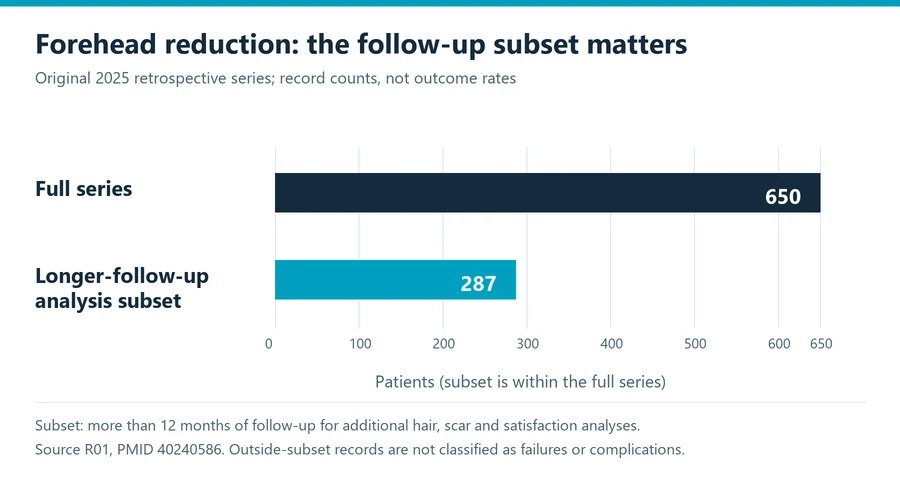
A retrospective study published online April 16, 2025, included 650 forehead-reduction patients treated from April 2018 through May 2023. Its methods identify 287 patients with more than twelve months of follow-up for additional hair, scar and satisfaction analyses. The treatment period is not a five-year follow-up period for every patient. The authors also emphasize limitations involving temple correction, scars and hair-related conditions. These observations come from a selected clinical series, not a randomized comparison with transplantation or no surgery. Original 650-case forehead-reduction study
Enrollment and later assessment answer different questions
Our companion graphic shows the full series and the explicitly identified longer-follow-up subset. It does not turn the remaining records into failures, dissatisfied patients or people who developed a complication. Their status for that particular additional analysis is simply not established by the abstract. Labeling what is unknown is more informative than inventing a reassuring or alarming explanation for the difference.
The abstract reports several complication counts, but the later hair assessments have a separate stated population. Without checking the full methods and relevant denominators, a chart dividing every event count by the full series could misrepresent what was measured. We therefore do not offer a personal complication calculator or a pooled event percentage from that abstract. A number can be precise while its interpretation remains insufficiently specified.
| Evidence feature | What it tells the reader | What it does not establish |
|---|---|---|
| Retrospective 650-patient series | The size of the reported treatment series | A randomized comparison or personal success prediction |
| 287 with more than twelve months of follow-up | A defined subset for additional analyses | Complete long-term assessment of all 650 |
| April 2018 to May 2023 treatment window | When procedures were performed | Five years of follow-up for everyone |
| Hair and scar outcomes assessed separately | Several domains deserve discussion | Every reported event shares one denominator |
| Predominantly female enrollment | The series’ representation has limits | Individual suitability based only on gender |
Understand what a smaller earlier series can add
An original 2019 report retrospectively reviewed 91 hairline-lowering patients and used standardized photographs for measurements. It reported lower forehead measurements at several postoperative assessments, including one and twelve months. That is evidence about the reported technique and selected series, not proof that every fixation method is equivalent or that a particular amount of advancement is suitable for you. The abstract does not provide a complete denominator for each timepoint. Original 91-patient hairline-lowering study
Keep measurement methods visible when comparing reports. An amount of tissue advanced during surgery, a later distance between two landmarks and a ratio between facial regions are different quantities. They should not be placed on one axis as if each were the same result. Ask what the proposed measurement means in your plan and how it will be documented after healing, rather than comparing centimeters quoted without context.
Distinguish a distance from a proportion
A measurement in millimeters or centimeters describes an absolute distance. A percentage describes a relationship to a specified starting value or another quantity. A statement that a distance decreased by a percentage needs that reference value before it can be interpreted. A ratio between facial regions uses yet another reference. Do not assume that a percentage change in forehead length equals the same change in the proportion occupied by the upper part of the face. Ask the person presenting the measurement to name the numerator, denominator and landmarks.
Unit conversion alone does not resolve these differences. Ten millimeters equals one centimeter, but converting a unit does not make an intraoperative advancement equal to a later photograph-based distance. Nor does it establish whether a photographic measure followed the curved surface or a projected image distance. If the methods are unavailable, retain that uncertainty rather than pretending that matching units permit a fair numerical ranking of techniques.
For your own record, label each entry with its location, date and method. Distinguish an intended change from a measured postoperative change. If a proposed line is shown digitally, identify it as a communication image rather than an observed result. These labels make it easier to discuss a difference later without mistaking an illustration, a surgical measurement and a healed appearance for three repetitions of the same evidence. They also preserve room for a shape preference that no single distance captures.
Likewise, a report that participants expressed satisfaction is not a guarantee about your priorities. Ask whether an outcome was formally measured, when it was recorded and who actually supplied the response. A study can inform the questions you ask without resolving every preference. The helpful comparison is whether the evidence addresses the feature, population and follow-up interval relevant to the proposal in front of you.
Compare alternatives by task, not by a winner label
If scalp advancement and hair transplantation are both discussed, request an explanation of what each is intended to change in your case. Include border shape, density, the proposed incision or donor-site implications and the practical sequence. The best comparison begins with the examined concern. An online claim that one operation always looks more natural cannot replace that explanation or establish the availability of suitable tissue for an individual.
A combined plan needs its own rationale. Ask why both components are being offered, what the first is expected to accomplish and what would determine the second. Clarify whether the second component is definitely planned or merely a possible later option. That distinction affects the expected appearance, total expenditure and number of recovery periods. Do not treat an optional future intervention as an included or guaranteed part of the first operation.
Choosing no procedure also belongs in the comparison. You can request information, consider styling options or seek another assessment without deciding on surgery at the initial consultation. The relevant question is whether the expected change is worth the incision, uncertainty and practical commitment to you. A procedure’s technical feasibility does not create an obligation to have it.
Make the proposed change measurable without making it rigid
Ask the clinician to identify the landmarks used to describe the current and proposed hairline. Note whether a distance concerns the center, the sides or another location. A single central measurement can conceal an important preference about the temples or hairline contour. Document the specific concern in words alongside any measurement so a numerical target does not erase the shape discussion.
For photographs, seek a consistent comparison rather than an idealized before-and-after transformation. Record head position, view, hair arrangement and approximate lighting. If later photographs differ, acknowledge that limitation before attributing every visual difference to surgery. A clear measurement record and a fair photo comparison serve complementary purposes: one describes a defined quantity, while the other helps discuss the appearance you experience.
Ask how the proposal may change if the examination or operative findings limit the intended advancement. What priority takes precedence if every requested change cannot be combined? Discuss whether maintaining a preferred border shape matters more than a particular distance. Consent should describe the actual proposed operation and its uncertainties, not imply that a drawn line can guarantee a healed result.
Plan follow-up around hair, scar and appearance separately
Get a written postoperative plan specific to the operation being offered. Ask who will assess the incision, any hair concerns and the longer-term appearance result. Clarify how to contact the team between scheduled visits and what situations require prompt assessment. A general online guide cannot provide the medication, dressing, washing or activity instructions appropriate to your own operation.
When a concern arises, describe it precisely rather than immediately calling the entire operation a failure. Is the concern the scar, hair density, discomfort, border shape or the amount of lowering? Preserve that distinction when speaking with the clinician. The assessment and next step may depend on what is actually observed, the elapsed healing interval and the specific original plan.
Keep follow-up expectations distinct from return-to-work arrangements. Ask about the requirements of your own job, headwear, styling routine and exercise. Obtain instructions for each relevant activity rather than assuming that permission for one establishes permission for all. A practical recovery plan should also identify transport, help at home if needed and how you will attend appointments.
| Planning stage | Record to obtain | Question it should resolve |
|---|---|---|
| Before consent | Named components and agreed appearance priorities | What is actually proposed? |
| Before the operation | Individual instructions and contact arrangements | How will care and concerns be handled? |
| Early follow-up | Incision and recovery assessment | What is being checked at this visit? |
| Later assessment | Comparable photographs and separate hair/scar observations | Which outcomes are being evaluated? |
| Unwanted result | Examination-based explanation and possible options | What is known, uncertain or worth reassessing? |
Obtain a complete quote for the actual plan
Request a written estimate that distinguishes the surgeon’s fee from anesthesia, facility charges and other expected expenses. If transplantation, brow work or another component is proposed, ask how it changes that estimate. Clarify included visits, any separately charged care and the handling of a later elective revision. A quoted starting price or an unrelated national average does not establish the cost of your combined plan.
Compare the scope of quotations before comparing their totals. Two estimates may describe different procedures, included services or later work. Financing also needs a separate explanation of its terms; it does not change the clinical uncertainty or guarantee satisfaction. Our plastic surgery cost guide provides a framework for organizing a complete estimate without inventing a procedure-specific price here.
Leave the consultation with a hairline plan you can explain
You should be able to describe the feature you want changed, the proposed procedure, the incision discussion, any separate hair assessment and how results will be followed. You should also know what the evidence cannot predict. If the explanation depends only on an ideal facial ratio or an impressive average advancement, ask for a clearer connection to your own examined situation and preferences.
Forehead reduction is an appearance choice that should remain specific to the actual person and proposal. Preserve uncertainty about future hair changes, scar visibility and individual outcomes rather than turning a study result into a promise. The procedure library and consultation questions guide can help organize related decisions while the clinician’s examination supplies the individual assessment this article cannot provide.
Sources and review scope
Plastic Surgery Editorial Team. Source records checked through October 12, 2026. Review scope: source and editorial checks for general education. No individual clinical assessment is represented.
- Forehead reduction: original retrospective 650-case study. pubmed.ncbi.nlm.nih.gov. Source date: 2025-04-16. Checked 2026-10-12.
- Hairline lowering: original retrospective 91-patient study. pubmed.ncbi.nlm.nih.gov. Source date: 2019-04-08. Checked 2026-10-12.
- ASPS brow-lift scope. plasticsurgery.org. Publication/update date not stated. Checked 2026-10-12.
- ISHRS hair-loss assessment and treatment planning. ishrs.org. Publication/update date not stated. Checked 2026-10-12.