
Facial scar revision aims to improve an assessed scar, not make a previous injury or operation disappear. Start by identifying what bothers you most: color, a raised or depressed contour, an irregular surface, symptoms or a restriction that needs clinical assessment. Those are different endpoints. A treatment that changes one feature should not be described as correcting every feature, and a flattering photograph should not replace a discussion of symptoms or function.
Improvement is not the same promise as erasure. ASPS explains that scar revision may improve appearance or a poorly healed scar, but a scar cannot be completely erased. Its guidance includes topical, minimally invasive and surgical options, depending on the assessed scar. ASPS scar revision guidance
This guide focuses on facial scars and on interpreting treatment proposals and research endpoints. It does not diagnose a mark from a photograph, select a procedure or provide a home treatment recipe. The practical aim is a clearer record of what you want changed and what a proposed course can reasonably claim to address.
Describe the feature that matters to you
Use ordinary words before a diagnosis label. You can say that a line looks darker than nearby skin, that a particular area appears raised or that a scar feels uncomfortable. Give the location and when the original injury or procedure occurred, and describe any change you have noticed. These observations help communicate your concern; they do not establish its cause or the correct intervention.
ASPS describes scars that differ in color or surface appearance, scars that are raised, scars that extend beyond an original wound and scars associated with restricted movement. A clinician distinguishes those findings in context. Do not assume that every raised mark is the same type of scar or that an online photograph lets you identify it reliably. The treatment discussion should follow the assessed finding.
Prioritize the concern instead of listing every possible improvement as equally necessary. If color is most important, say so. If a pulling sensation or difficulty with movement matters more than visibility, preserve that distinction. A plan can then explain whether it targets your priority and what it may leave unchanged. Without this step, a broad promise of better appearance can obscure the feature you actually wanted addressed.
Ask whether the proposed endpoint is assessed by examination, your own report, a photograph or an instrument. These methods answer related but different questions. A photo can document visible contour but cannot directly report how the area feels to you. Conversely, a symptom description does not identify every visible change. Keeping the methods separate makes follow-up more informative.
| Concern to describe | Clarification to request | What should remain separate |
|---|---|---|
| Color difference | What feature is being assessed and targeted? | Contour or movement goals |
| Raised or depressed surface | How will contour be documented? | Color matching |
| Pain, itching or discomfort | What evaluation and endpoint are appropriate? | A photograph’s appearance rating |
| Pulling or movement concern | Is function part of the assessed problem? | A purely cosmetic preference |
The scar’s history belongs in the assessment
Bring available information about the original injury, operation and healing course. Include previous scar treatment and the products or procedures you can identify accurately. A mark after trauma, a surgical incision and a skin graft after cancer treatment are not interchangeable research populations simply because all are on the face. Their history should remain visible when discussing evidence.
If the scar followed treatment for a skin cancer or another medical condition, keep follow-up for that condition separate from cosmetic revision planning. Ask the relevant treating team how the histories should be coordinated. A cosmetic appearance goal should not be used to assume that every remaining clinical question has been resolved. This guide does not evaluate a changing lesion or clear it for treatment.
Record the dates you know and identify uncertain dates honestly. A remembered season or year is better labelled as approximate than turned into an invented exact date. If previous images are available, keep their context and avoid comparing a heavily edited image with a current natural photograph. The point is continuity of information, not a demand for a perfect personal archive.
Ask why treatment is being considered at this point in the course and what the clinician expects from observation or further assessment. There is no universal scar-revision calendar supplied here. The relevant explanation should relate to the actual scar and proposed intervention. A study’s assessment timepoint is not an instruction to treat every scar at the same age.
Compare treatment scope, not just the word revision
Ask whether the proposal addresses the surface, a contour difference, a scar’s position or a movement-related concern. Request a plain-language description of the intended change and what is outside its scope. The word revision can include very different courses of care, so a short procedure name is not enough to compare two consultations.
A proposal involving several treatments should identify the purpose of each component. Ask whether a second component responds to a separate feature or is part of the same endpoint. If the team plans stages, request an explanation of what will be reassessed before moving to the next stage. A sequence should not be presented as inevitable when a later decision depends on the response to earlier care.
For resurfacing, ask for the exact modality and the assessed indication without requesting settings or trying to reproduce the treatment yourself. A study of one device or method should not be treated as a result for every product carrying the word laser. Likewise, a study of scar appearance does not necessarily establish a functional benefit. Device names need the same endpoint discipline as surgical names.
If an operation is proposed, ask how the team explains the resulting scar and the tradeoff being accepted. Improving one line or contour does not mean future healing is guaranteed. Keep the expected change and the uncertainty together in the written plan. This allows a meaningful decision without relying on a claim that the procedure removes every sign of previous treatment.
| Proposal element | Useful written explanation | Missing information to resolve |
|---|---|---|
| Target feature | Color, contour, symptoms or function | A vague promise of scar removal |
| Treatment component | Exact category and reason for use | A brand or procedure name alone |
| Multiple stages | What is reassessed between stages? | An automatic package without endpoint review |
| Follow-up outcome | Method and timepoint of assessment | Undated before-and-after images |
Read a split-scar comparison correctly
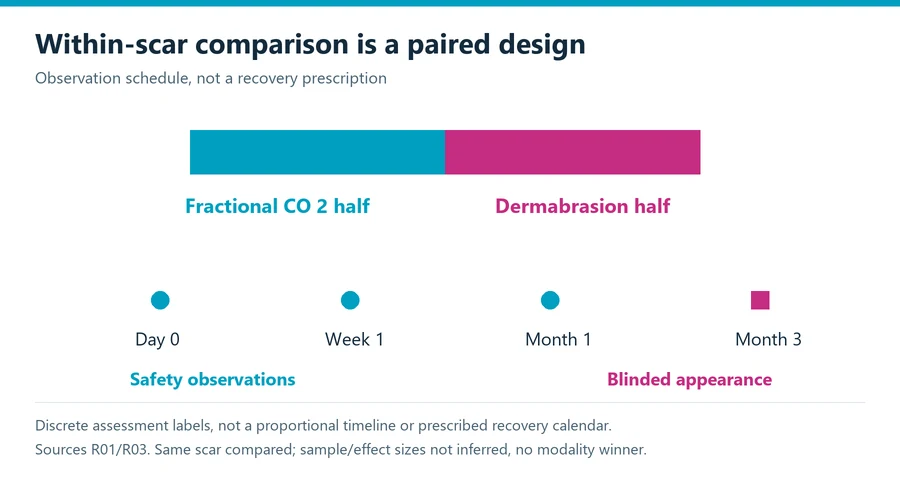
An original trial first published January 23, 2012 compared fractional carbon dioxide laser resurfacing with dermabrasion using a split-scar design on facial postsurgical scars. Early safety was assessed on the treatment day, at one week and at one month. Appearance efficacy was evaluated through blinded standardized photographs at three months. Its abstract reports different early observations but no detected difference in the later appearance comparison. Original split-scar resurfacing trial
The study’s structure is valuable to understand. The comparison concerns parts of the same scar rather than treating every half as an independent person with a separate history. Its early and later observations answer different questions. A statement about an early visible reaction should not be converted into a statement that one treatment erases more scar tissue or is universally safer in every setting.
The accessible abstract does not give all sample details or the size of every measured difference. A statistical probability value is not a percentage of cosmetic improvement. Nor does a lack of detected difference establish that two methods are identical for every scar, skin population, treatment course or long-term outcome. Ask whether the evidence offered for your proposal provides the magnitude and context that a headline leaves out.
The publisher also disclosed donated laser tips for this trial. That does not by itself invalidate an observation, but it is information to retain when reading the evidence. A useful summary keeps study design, endpoints, access limitations and disclosed support visible without turning any one of them into a verdict on its own.
Patient experience and observer measurements are different
A separate study published September 30, 2016 assessed 23 people with facial skin graft scars after skin-cancer surgery. Mean time from surgery to assessment was 23.9 months, ranging from two to 48 months. It used patient reports, three observer ratings and instrument measurements. The observer tools’ average-measure reliability coefficients were 0.76 and 0.80; these describe agreement, not the percentage of patients whose scars improved. Original facial graft scar assessment study
A reliability coefficient is not a treatment success rate
This was an assessment study in a selected graft population, not a trial showing that a revision method works in every facial scar. Its different subjective and instrument findings should not be treated as one interchangeable score. The distinction helps explain why the patient’s experience and a clinician’s visible assessment both deserve a place in the follow-up record.
If a team uses a formal scar scale, ask what it measures and which version or component is being used. Do not create your own score by mixing features from different scales or by translating a photograph into a pain rating. A score can support discussion when its meaning is clear. It should not conceal a concern that matters to you but is not captured by that particular measure.
| Evidence element | Question it can address | Unsupported shortcut |
|---|---|---|
| Early safety observation | What was recorded at a defined early time? | Long-term scar removal |
| Blinded appearance rating | How did defined images compare at that time? | Every symptom or functional goal |
| Patient report | How did the scar feel or matter to the person? | A complete physical measurement |
| Observer reliability | How consistently were ratings made? | Percentage treatment success |
Choose a visual record that preserves context
Ask the team to identify the same scar region consistently when comparing observations. A close-up of one short segment should not be compared with a wider view of the entire scar without explaining the difference. If the concern involves more than one scar, keep their histories and treatment plans separate rather than combining their results into a single rating. This is especially relevant when one mark followed an injury and another followed a later operation. A statement that the face looks better overall can be meaningful to you, but it does not measure the response of each treated scar. The follow-up discussion should preserve that distinction.
If photographs are requested for clinical follow-up, use the treating team’s instructions. Preserve the date, view, lighting and treatment stage when possible. An image taken after several interventions should be labelled with the complete course. Do not attribute every difference to the last treatment simply because it was closest to the photograph date.
For a facial scar, it can be useful to discuss how the feature appears in neutral expression and ordinary movement, without trying to perform a diagnostic maneuver. Ask which observations the clinician wants documented. A still image may emphasize one aspect of the concern while leaving another unrepresented. The record should help communication rather than invite self-diagnosis.
An explanatory diagram should identify concepts rather than pretend to be a patient outcome. For this guide, the planned visual separates a color difference from raised or depressed contour and shows the original trial’s within-scar comparison and endpoint timeline. It does not show a synthetic scar disappearing or supply treatment settings. That distinction protects the reader from mistaking illustration for evidence.
Risk and aftercare need the actual treatment plan
ASPS discusses risks including poor healing, altered sensation, discoloration, a suboptimal appearance result, unfavorable scarring and the possibility of further revision. These are general scar-revision categories, not event rates for every facial treatment. Ask which apply to the specific proposal and how the team explains the relevant uncertainty. ASPS scar-revision safety guidance
Obtain written care instructions rather than borrowing a regimen from another scar or another procedure. The team should explain cleansing, products, activity, protection and contact arrangements as applicable to your course. Do not improvise acid peels, abrasion, injections or laser treatment based on a research description. A comparison of clinical procedures is not an instruction for treating your own face.
Clarify what changes should prompt contact and how to obtain assessment outside office hours. ASPS advises immediate medical attention for shortness of breath, chest pain or unusual heartbeats after surgery. Do not wait for a routine cosmetic follow-up if you have concerning systemic symptoms; use urgent or emergency care as needed. Keep practical access to care part of the decision, particularly if treatment involves travel.
Ask how a possible problem would be distinguished from a planned reassessment of appearance. A symptom concern should not be postponed solely because the cosmetic endpoint is scheduled later. Conversely, an appearance assessment at a specified date does not mean every earlier photograph is a final result. The record should keep the purpose of each contact clear.
Arrange recovery around your actual responsibilities
Describe work that requires public presentation, close visual attention, physical activity or travel. Ask what the treating team recommends for those tasks with the chosen intervention. A general online recovery period cannot account for the exact course or your responsibilities. If help is needed, arrange it around the team’s plan rather than a promised date from an advertisement.
If several stages are being considered, ask what decision separates them and whether additional visits or care are expected. The practical burden can differ from that of a single treatment. Keep the stage plan with the estimate and aftercare instructions so that the course remains understandable. The recovery planning guide offers broader preparation questions without replacing clinical instructions.
Compare costs using a defined course and endpoint
No verified facial-scar-revision total-price range is supplied here. Request an estimate that identifies the assessed scar, treatment components, number of planned sessions or stages, facility or anesthesia charges where applicable and follow-up. Ask what happens financially if the plan changes after reassessment. A price per session is not necessarily a total course estimate.
When comparing proposals, check whether they target the same feature. A surface-treatment estimate and a surgical revision estimate may answer different questions even when both are called scar treatment. Align the indication, components and reassessment plan before comparing amounts. The cost guide explains the difference between a quoted fee and the full care course.
Ask about coverage and documentation if function or a medical reconstruction history is part of the discussion. Do not infer coverage from the word reconstructive or from the existence of a symptom. The insurer’s process and the clinical recommendation are different decisions. Preserve the written terms rather than relying on an informal statement that treatment will probably be covered.
Make a feature-specific decision
Summarize the priority feature, assessed scar type, proposed treatment, expected endpoint and remaining uncertainties. Include what would stay unchanged and how the outcome will be evaluated. If the explanation still promises complete erasure, request a more specific account consistent with the limits of scar revision. A realistic goal can be valuable without pretending that every trace disappears.
Use the consultation question guide and procedure library for preparation. If a scar followed another facial procedure, retain that procedure’s records; the rhinoplasty guide provides broader nasal-surgery context but does not select a scar treatment. Your decision should stay anchored to the actual feature, symptoms and care course being assessed.
Sources and review scope
Plastic Surgery Editorial Team. Source records checked through October 12, 2026. Review scope: source and editorial checks for general education. No individual clinical assessment is represented.
- ASPS scar revision scope. plasticsurgery.org. Publication/update date not stated. Checked 2026-10-12.
- ASPS scar revision risks. plasticsurgery.org. Publication/update date not stated. Checked 2026-10-12.
- Original randomized split-scar resurfacing trial. pubmed.ncbi.nlm.nih.gov. Source date: 2012-01-23. Checked 2026-10-12.
- Original facial graft scar assessment study. pmc.ncbi.nlm.nih.gov. Source date: 2016-09-30. Checked 2026-10-12.