
A thigh lift removes and reshapes excess thigh skin and, where appropriate, fat to improve contour. It addresses a different problem from removing fat alone: the amount and distribution of loose skin help determine the operation and its scars. A useful plan should show which area is expected to improve, where the incision will lie, what will remain unchanged, and how healing will be followed. ASPS explains the skin-versus-fat distinction.
A thigh lift is not a weight-loss treatment or a guarantee of a particular thigh size. The decision is a tradeoff between the proposed contour change, a lasting scar and surgical risks, including wound-healing problems. Evidence needs careful reading because studies use different populations, incision patterns and complication definitions. This guide connects those distinctions to the decisions you can make before consenting.
Identify the problem along the whole thigh
Describe where the concern lies rather than calling the whole leg one treatment area. Is loose skin concentrated near the groin, distributed along the inner thigh, or present toward the outer thigh and hip? Does the concern mainly involve skin, fullness, or both? A proposal aimed at the upper inner thigh should not be assumed to address skin farther down the leg.
A smaller fat deposit and less loose skin are different endpoints. ASPS describes liposuction alone as an option where skin elasticity allows it to conform to the new contour, while poor elasticity can lead to consideration of a lift with liposuction. The relevant question is what your examination shows, not whether a shorter scar sounds preferable in the abstract. The liposuction guide provides the separate fat-removal context.
State the concern in ordinary activities as well as in photographs. You may care about how clothing fits, a visible fold or the appearance of the inner thigh when standing. Those descriptions help clarify the intended endpoint without turning a web article into a diagnosis. If irritation or another symptom is important, describe it to the clinician rather than assuming every contour operation will resolve it.
Ask the surgeon to identify the boundaries of the expected improvement. A plan should explain why the selected approach fits the distribution of excess tissue, including any remaining skin that would not be removed. Leaving an area outside the operative scope can be an intentional choice. It should be discussed before surgery rather than discovered through a difference in expectations afterward.
| Observed concern to discuss | Planning question | Detail to record |
|---|---|---|
| Upper inner-thigh skin | Would a limited upper approach address the distribution? | Expected treatment boundary and scar location |
| Loose skin extending down the inner thigh | Is a longer incision being proposed? | Why the longer scope is needed and what it changes |
| Outer-thigh or hip contour | Is this a different region or broader body-contouring task? | Exact procedure and included regions |
| Fullness with relatively firm skin | Is fat removal the main task? | Skin assessment and reason for or against a lift |
| Skin and fat together | What is the separate role of each proposed component? | Lift and liposuction scope rather than one vague label |
The table is a consultation framework, not a method for selecting an operation by yourself. It helps make the proposal specific enough to compare and gives the surgeon a clear account of the concern you actually want addressed.
Understand the incision tradeoff
ASPS describes incision patterns that can lie in the groin, extend along the inner thigh toward the knee, or involve the outer thigh and hip region. The pattern depends on the treated area and intended correction. ASPS procedure guidance explains why the incision cannot be inferred from the phrase thigh lift alone.
Limited does not automatically mean sufficient
A groin-only or shorter-scar proposal may be appropriate for a particular distribution, but the shorter scar is not proof that it can correct every concern. Ask which part of your thigh would remain outside its effective scope. Conversely, a longer incision needs a clear reason; more extensive does not automatically mean a better result for your goals.
Ask for the planned scar to be shown on your own photograph or during examination. Consider its position in the clothing you normally wear and in the views that matter to you. A generic picture showing a scar beneath a garment is not a guarantee that yours will be invisible. Discuss both the contour objective and your willingness to accept the scar.
When reviewing examples, look for an explanation of the original distribution of excess tissue and the operation performed. A photograph of someone with upper-thigh excess alone is a poor comparison for a person whose concern extends toward the knee. The comparison should also identify the follow-up interval and show enough of the leg to assess the stated region. A close crop can illustrate a scar while concealing the contour question, or show a smooth region while omitting the incision.
Keep clothing concealment separate from scar quality. A scar may fall beneath a particular garment without being inconspicuous when uncovered. Conversely, an acceptable scar does not establish that every contour goal was met. Ask yourself which tradeoff you are considering: coverage in everyday clothes, appearance without that coverage, or the amount of tissue change you would accept. Your answer helps make the consent discussion specific rather than relying on an undefined promise of a better leg shape.
A scar-saving label is not a scar-free result
An original retrospective report, published online in October 2017, assessed 25 bilateral horizontal thigh lifts in selected patients. Mean follow-up was two years and eight months; six patients had complications, five classed as minor and one requiring surgical revision. The authors described the approach for moderate upper-thigh tissue excess. The original horizontal-lift report is not a randomized demonstration that the same approach suits every distribution.
Use that evidence to ask about matching anatomy and follow-up, not to infer a universal technique winner. The word bilateral means both thighs were treated; it does not turn 25 patients into 50 independent people. Likewise, the absence of a vertical scar does not eliminate the horizontal scar or establish complete correction of lower-thigh skin.
Candidacy includes stability and healing capacity
ASPS identifies relatively stable weight, realistic goals, excess soft tissue and health that supports healing among candidacy considerations. It also identifies nonsmoking as important. ASPS candidacy guidance does not provide a universal weight or BMI cutoff that can replace an individual assessment.
Discuss the history of your weight change and whether further change is expected. Bring relevant medical and prior surgical history, including bariatric treatment where applicable. Ask the clinician what would need to be addressed before scheduling and how that judgment relates to the intended operation. A photograph of loose skin alone does not show the whole healing-risk picture.
Do not conceal tobacco use or medication history to qualify for a date. The useful outcome of an assessment may be a different scope, further evaluation or postponement. That is part of choosing an operation responsibly, not evidence that the visible concern is unimportant. A clear explanation should connect the assessment to your health and the specific planned treatment.
Read complication studies by their definitions
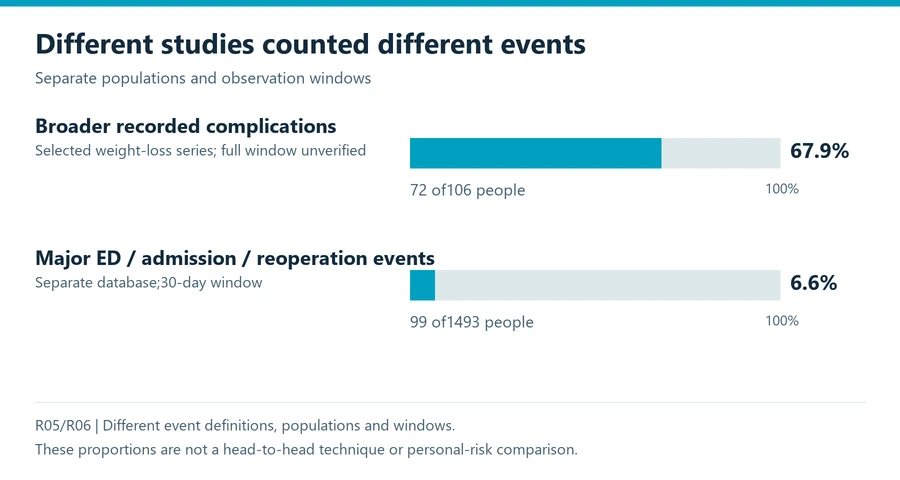
A January 2015 original study evaluated 106 people after major weight loss, including 90 women and 16 men. It reported at least one complication in 72 people and included wound separation, fluid collections, infection and other events. Different incision groups had different observed results. The original medial thighplasty series is a retrospective selected cohort; it does not calculate an individual reader’s probability or prove incision length alone caused the difference.
A separate primary database study, published online in May 2016, assessed 1,493 thighplasty patients. It counted major events requiring an emergency visit, admission or reoperation within thirty days; 99 patients had at least one such event. Many underwent combined procedures. The original database study used a narrower endpoint and a defined early window.
The two counts answer different questions. They should not be plotted as competing safety scores or averaged into a single complication percentage. A wound problem managed without an emergency visit may be important to a patient while not meeting the database study’s major-event definition. A thirty-day study also cannot establish the frequency of every later scar or contour concern.
| Evidence feature | Question to ask before interpreting a number | Why it changes the meaning |
|---|---|---|
| Population | Major weight loss, aesthetic cohort, or a mixture? | Different patients contribute different evidence |
| Scope | Thigh lift alone or combined procedures? | The episode may include other operations |
| Event definition | Any wound problem or only major events? | A narrower endpoint can produce a smaller count |
| Observation window | Thirty days or longer follow-up? | Later events may be outside the window |
| Unit | People, thighs or operations? | Bilateral treatment does not double the patient count |
| Comparison | Randomized groups or selected techniques? | Observed differences do not establish causation by themselves |
Ask what a practice includes in its own rate
If a surgeon offers an experience-based statistic, ask whether it includes minor wound opening, extra visits, prolonged dressings, infection, fluid collection and revision. Request the number of comparable patients and the follow-up interval. “Low complications” is difficult to interpret if the definition is never explained.
Also ask how people who do not attend follow-up are handled. A complete enrollment count is not necessarily the number observed at a later assessment. The aim is not to dismiss useful experience; it is to understand what was actually measured. Precise-looking percentages can conceal substantial differences in definitions and follow-up.
Technique comparisons also need a reason for how patients entered each group. When surgeons select a longer incision for a different tissue distribution, the groups are not necessarily interchangeable at the start. A higher observed event count can reflect differences in the patients, the extent of work, the way events were recorded, or several factors together. It should not be converted into a claim that choosing the shortest scar will produce the lowest risk for every person.
For a useful comparison record, make one entry per study and keep the endpoint beside its count. Do not transfer a major-event definition from one paper onto the broader events in another. Do not add separate infection and wound-separation percentages unless the study establishes that the groups are mutually exclusive. A person can contribute to more than one event category, so a summed percentage can misrepresent the number of people affected.
Make wound care and mobility part of the plan
ASPS lists risks including bleeding, infection, fluid accumulation, wound separation, altered sensation, poor healing, unfavorable scars and blood-clot or cardiopulmonary complications. ASPS risk guidance identifies concerns to discuss; it does not assign all risks the same frequency or establish your personal estimate.
Ask the team how it will assess and respond to a wound concern, swelling or a possible complication. Who provides advice outside normal hours, and where would you be examined? Which dressing reviews are routine, and what happens if more visits are needed? A clear response arrangement matters even when an operation is planned carefully.
The recovery plan also needs practical detail about movement, sitting, clothing, hygiene and help at home. Obtain those instructions from the team for your actual incision pattern. Do not borrow a compression, exercise or wound-care regimen from an unrelated operation. A smaller-looking scar on a photograph cannot determine how much help you will need.
Describe your home and work demands when requesting that plan. Stairs, transport arrangements, prolonged sitting and lifting responsibilities are different practical tasks. Ask which restrictions apply to each and how the team will assess readiness, without assuming this page can set a safe schedule. Arrange help around the instructions you receive rather than around a recovery slogan.
Separate early healing from the settled contour
ASPS describes procedure-specific instructions for incision care, medicines, concerns to monitor and follow-up, with dressings, support or drains where appropriate. ASPS recovery guidance should lead to an individual plan rather than one universal return calendar.
Use named milestones instead of one recovery date
Ask separately about discharge, walking and self-care, work, exercise and later assessment of scars and contour. Being willing to wear a particular garment is different from medical clearance for activity. Being comfortable at home is different from being ready for a physically demanding job. State the task when asking how recovery will affect your schedule.
ASPS advises seeking immediate medical attention for chest pain, shortness of breath or unusual heartbeats after returning home. Keep those urgent instructions distinct from a routine question about appearance, and retain the team’s specific contact route for other concerns. A scheduled review should not become a reason to delay an urgent assessment.
ASPS’s results guidance says final appearance can take months to develop, visible scars remain and results are not guaranteed. Another procedure may sometimes be needed. ASPS results guidance separates the early visible change from the later assessment.
Ask when the clinician expects to evaluate remaining skin, asymmetry and scar concerns. An early swollen photograph does not show the settled contour. A revision policy should specify how a concern is assessed and what costs apply, while acknowledging that correction is not guaranteed. Keep the timing and purpose of each review clear.
Prepare with your own clinical team
ASPS consultation guidance includes surgical goals, medical conditions, allergies, medicines, supplements, tobacco or other substance use and previous operations. Examination, measurements and photographs help establish the plan. ASPS consultation guidance provides the categories to bring rather than a diagnosis you can make from this page.
Preparation may include medical evaluation, tests and directed medication changes. ASPS also describes arranging transport and help after outpatient surgery. ASPS preparation guidance is not permission to stop a prescribed medicine yourself. Ask who coordinates changes with the clinician who prescribed it.
Make sure the plan explains what happens if further assessment reveals a concern. A booking date should not force a decision before the relevant information is available. If another body procedure is proposed, ask for its distinct purpose and its effect on preparation and recovery rather than treating it as a convenient automatic addition.
Compare the complete episode cost
No defensible dated all-inclusive thigh lift total is established here. ASPS distinguishes its displayed fee estimate from the complete price, excluding anesthesia, operating facilities and other related expenses. ASPS cost guidance also lists medicines, testing and postoperative garments among possible components. An undated displayed average should not become a promised current quote.
Obtain the exact procedure scope, surgeon’s fee, facility, anesthesia, planned reviews, garments and revision terms in writing. If liposuction or another lift is included, identify it separately. A quote for upper-thigh work alone cannot be compared fairly with a broader operation without separating the differences. The plastic surgery cost guide can help organize the bill.
| Quote item | Information to verify | Unanswered question to avoid |
|---|---|---|
| Operative scope | Region, incision pattern and bilateral treatment | Does the quote address the whole stated concern? |
| Added procedures | Named lift or liposuction components | Is a combined package being compared with one operation? |
| Facility and anesthesia | Included amounts or billing terms | Is the surgeon fee being mistaken for the total? |
| Follow-up and wound care | Routine visits and additional-care terms | Are extra reviews assumed to be free? |
| Revision | Assessment and charging policy | Is complete correction being implied? |
| Coverage or financing | Current policy or repayment terms | Is a monthly payment being presented as the total cost? |
Agree on the contour and scar tradeoff
Before deciding, summarize the proposal in your own words: the skin distribution being addressed, the expected change, the areas outside scope and the scar you are accepting. Add the wound-care arrangements, recovery milestones and unresolved evidence questions. If that summary differs from the clinician’s, clarify the difference before consent.
A useful thigh lift decision matches the skin problem to the actual operation and recognizes that contour, scars and healing are separate outcomes. Favor explanations that show those connections clearly over a short-scar slogan or a percentage without a definition. You can continue through the procedure guides or surgeon selection information while keeping the same specific account of your goals and tradeoffs.
Sources and review scope
Plastic Surgery Editorial Team. Source records checked through October 12, 2026. Review scope: source and editorial checks for general education. No individual clinical assessment is represented.
- ASPS skin versus fat scope. plasticsurgery.org. Publication/update date not stated. Checked 2026-10-12.
- ASPS incision distribution. plasticsurgery.org. Publication/update date not stated. Checked 2026-10-12.
- Original horizontal thighplasty cohort. pubmed.ncbi.nlm.nih.gov. Source date: 2017-10-25. Checked 2026-10-12.
- ASPS stability and candidacy. plasticsurgery.org. Publication/update date not stated. Checked 2026-10-12.
- Original106-patientmassiveweightlossseries. pubmed.ncbi.nlm.nih.gov. Source date: 2015-01. Checked 2026-10-12.
- Original1493-patientmajor-eventdatabase. pubmed.ncbi.nlm.nih.gov. Source date: 2016-05-23. Checked 2026-10-12.
- ASPS risks. plasticsurgery.org. Publication/update date not stated. Checked 2026-10-12.
- ASPS individualized recovery and urgent care. plasticsurgery.org. Publication/update date not stated. Checked 2026-10-12.
- ASPS settledresults andscars. plasticsurgery.org. Publication/update date not stated. Checked 2026-10-12.
- ASPS history/examination. plasticsurgery.org. Publication/update date not stated. Checked 2026-10-12.
- ASPS directedpreparation. plasticsurgery.org. Publication/update date not stated. Checked 2026-10-12.
- ASPS fee component scope. plasticsurgery.org. Publication/update date not stated. Checked 2026-10-12.