
An arm lift, or brachioplasty, removes excess upper-arm skin and reshapes the tissue beneath it. The central decision is whether the improvement in contour is worth an incision scar, recovery restrictions and surgical risk. It is especially important to distinguish loose skin from localized fat: removing fat alone does not answer the same problem as removing a hanging skin envelope. A useful plan explains the proposed scar, the area being treated and what happens if the result needs further attention.
You do not need to decide how much arm skin should be removed from a photograph or a marketing name. That requires examination. You can, however, arrive knowing what bothers you, which tradeoffs you would accept and which evidence a claim of safety or lasting improvement needs. This guide separates the anatomical goal from the evidence and from the practical consequences of treating both arms.
What brachioplasty changes
The American Society of Plastic Surgeons describes arm lift surgery as treatment of the upper arm from the underarm toward the elbow, involving excess skin, supportive tissue and localized fat. Its guidance also distinguishes excess skin from something exercise can correct. Those are different tissues and different objectives. ASPS arm lift overview
For your own planning, describe the problem in ordinary terms before adopting a surgical label. Is it an overhanging fold when the arm is raised, a bulky circumference, an uneven outline, or dissatisfaction with how sleeves fit? Record where it begins and ends. A concern confined close to the underarm is different from one extending much farther down the arm. Those descriptions do not establish a diagnosis; they make it easier to check whether the proposed treatment actually addresses your goal.
The useful outcome is not necessarily the smallest arm. Someone might value a smoother outline while prioritizing a less visible scar. Another person may accept a longer scar to address more extensive skin. Compare the proposed benefits with your own priorities rather than with a single idealized arm shape. Men and women can both make this decision without their goals being assumed from gender or from the appearance of a model.
Brachioplasty versus arm liposuction
The distinction between skin removal and fat removal should be explicit in the treatment plan. Ask the clinician to describe what is contributing to the contour, what each proposed component changes, and what it leaves behind. An attractive description such as “arm sculpting” may conceal several separate services. It does not tell you whether skin is excised, fat is removed, or an additional device is used.
This is a scope comparison, not a rule that everyone needs one procedure or the other. The liposuction guide explains fat-removal decisions separately. For brachioplasty, the ASPS procedure guidance says fat may be removed directly or with liposuction as part of the operation. A combined plan therefore needs an explanation of both components, rather than presenting liposuction as an automatic addition. ASPS procedure scope
| Main concern to describe | Component to clarify | Question that tests the plan |
|---|---|---|
| Hanging upper-arm skin | Skin removal and incision extent | Where would the incision start and finish, and why? |
| Upper-arm fullness | Whether fat removal is proposed | What part of the outline is attributed to fat rather than skin? |
| Both fullness and a loose envelope | Role of each component | What benefit is expected from each, and what remains uncertain? |
| Uneven sides or a contour transition | Boundaries of treatment | Which areas are included and which lie outside the plan? |
The brachioplasty scar is part of the result
Judge an arm lift as a contour-and-scar result, not as contour alone. A photograph that hides the inner arm may show one aspect of the outcome while withholding the tradeoff most relevant to you. The scar should be discussed before booking, when you can still decide that the proposed change is not worth it.
ASPS explains that incision length and location depend on the amount and position of excess skin and the surgeon’s judgment. Incisions may be on the inside or back of the arm and may extend from the underarm toward the elbow; a more limited incision can be appropriate in some circumstances. A shorter-sounding technique name does not establish that it will address your particular pattern of skin excess. The actual proposed outline matters more than the label.
Ask to see the anticipated location on an unedited anatomical sketch and then consider it with your arm in different positions. Where is it likely to be visible while walking, reaching, wearing a sleeveless top or looking at the arm from behind? This is a visibility exercise, not a prediction of precisely how your scar will heal. Include both your usual clothing and the activities in which appearance matters to you.
A scar discussion should also include what counts as an unacceptable result and how that would be evaluated. “The scar will fade” is not a complete answer to a question about its location, width, symptoms or appearance. Do not treat a proposed correction policy as a guarantee of a particular scar. Ask what assessment, treatment or additional charges the policy actually includes.
What examination needs to establish
Brachioplasty planning begins with whether the operation is suitable, not with selecting an incision from an online menu. ASPS lists substantial upper-arm skin laxity, relatively stable weight, health that supports healing, nonsmoking and realistic expectations among candidate considerations. These are considerations for clinical assessment, not an online eligibility calculator. ASPS candidate guidance
Bring a clear account of weight changes, previous operations, current medicines, supplements and relevant health history. Avoid translating a general phrase such as “healthy candidate” into self-clearance. A consultation should explain which parts of your history affect the recommendation and whether further assessment is needed. If two clinicians propose different operations, ask them to explain the difference in the anatomical problem they believe they are treating.
Weight stability is a planning question rather than a demand to reach a number supplied by an advertisement. If weight is still changing, explain the direction and the treatment involved. The useful question is whether the present contour represents a reasonable basis for the proposed surgery. An answer should be specific to your situation, with any uncertainty recorded before you commit to recovery arrangements or finance.
Brachioplasty risks that deserve a specific discussion
The ASPS safety guidance includes bleeding, infection, fluid accumulation, changes in sensation, poor healing, persistent pain, conspicuous scars, injury to deeper structures and possible revision, alongside anesthesia risks. This is a range of possible harms rather than an estimate that every patient will experience them. ASPS risks and safety
Make the risk conversation concrete by separating an unwanted appearance from a medical complication and from an event requiring urgent treatment. Those categories may overlap, but they are not interchangeable. A service that discusses only scars has not explained the full surgical risk. Equally, a low rate of emergency events does not establish that everyone was pleased with the contour or healed without troublesome scars.
Ask who handles postoperative concerns, how to contact that person outside office hours and where urgent assessment would occur. The answer should apply to the facility and team actually providing your care. If the operation involves travel, ask how follow-up works after you leave. A reassuring conversation with a booking coordinator is not a substitute for knowing who takes clinical responsibility when a problem needs examination.
Reading brachioplasty complication studies
Two frequently cited original studies illustrate why a single percentage is a poor shortcut. A 2016 registry analysis included 2,294 brachioplasty patients within a larger surgical registry, using major events requiring emergency care, admission or reoperation within thirty days. It reported a 3.4% overall major-complication rate. Combined procedures were common, and the reported major-event rates were 4.4% for combined operations and 1.3% for brachioplasty alone. These are historical observational findings, not personal forecasts. Original 2016 registry analysis
An emergency-event rate does not count every unwanted result
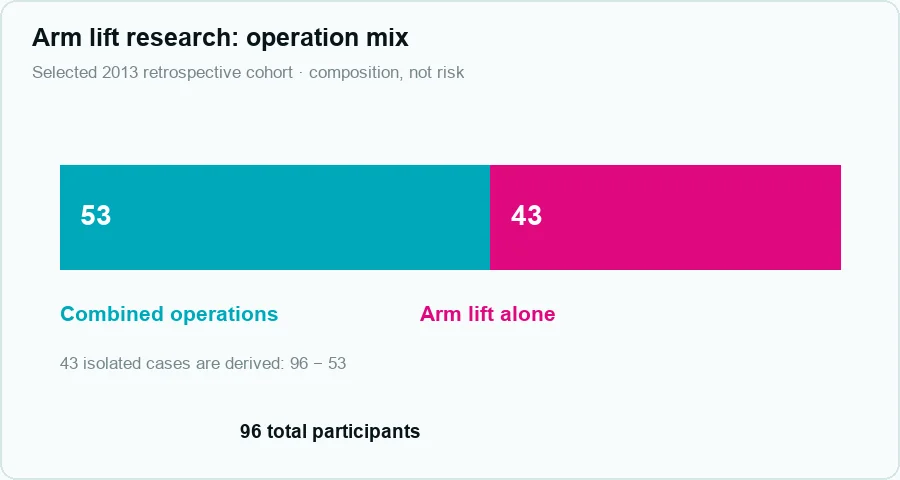
A 2013 multipractice retrospective cohort included ninety-six patients. It reported major and minor complication categories as well as scar and revision outcomes, with a 22.9% revision rate. Fifty-three patients underwent another procedure at the same operation. The abstract did not establish the same thirty-day emergency-event endpoint as the registry. Its findings should not be arranged beside the registry percentage as if both measured identical outcomes over an identical period. Original 2013 cohort
The practical lesson is to ask what a quoted number counts. Did it include minor wound problems? Was scar correction classified as a revision? Did follow-up end after thirty days, or continue long enough to observe later decisions? Were patients undergoing an isolated arm operation or several procedures? These questions reveal missing context without requiring you to perform a medical risk calculation.
| Evidence record | What is actually known here | What it cannot establish |
|---|---|---|
| Registry published in 2016 | 2,294 arm lift patients; thirty-day major emergency/admission/reoperation endpoint | All scar problems, long-term satisfaction or your individual probability |
| Multipractice cohort published in 2013 | Ninety-six patients; separate complication and revision reporting | A like-for-like comparison with the registry’s thirty-day endpoint |
| A clinic’s quoted complication rate | Only what its definition, denominator and follow-up explain | Safety superiority if those details are absent |
Neither abstract provides a basis for ranking today’s individual surgeons. The study dates matter, but “old” does not automatically mean useless, and “new” does not automatically mean applicable. Historical evidence can identify questions worth asking. A present-day recommendation still needs to account for the proposed operation and your clinical circumstances.
Combining brachioplasty with other operations
An arm lift may be offered as part of a larger body-contouring plan. The fact that an operation is combined should appear in the procedure list and cost estimate, not only in a package name. Record which other regions are included, who provides each component and whether staging is an option. Convenience is one decision factor; it does not resolve the medical tradeoff.
The two historical studies do not deliver one simple universal answer about combining operations. The larger registry associated combined operations with more major events, while the smaller cohort did not find a statistically significant increase with concomitant procedures. Different samples, definitions and observation windows can contribute to different findings. A nonsignificant result in a small study does not prove that adding procedures is risk-free.
Use this uncertainty constructively. Ask why the team recommends doing your particular operations together and how it weighs that against separate recovery periods. Make sure practical support is designed for the full plan. Two arms requiring attention alongside another treated body region may create a different household problem from an isolated arm operation, even before any individual restriction is specified.
Preparing for brachioplasty without guessing medication rules
ASPS preparation guidance describes medical assessment or testing, clinician-directed medication adjustments, stopping smoking and arrangements for transport and help after surgery. It also identifies accredited office, ambulatory and hospital settings as possible locations. The appropriate facility and anesthesia plan must be explained for your operation. ASPS preparation guidance
Do not create your own medication-stop schedule from a general cosmetic-surgery checklist. Supply the complete list and request written instructions from the responsible clinical team, including what to do if instructions conflict with another prescriber’s advice. Keep the preparation record separate from advertising materials so that practical medical instructions do not get lost among financing and appointment messages.
Plan transport, first-night help, access to follow-up and the tasks that normally rely on your arms. Ask which tasks will be restricted and what assistance is needed. Examples to discuss include lifting a child, moving luggage, opening heavy doors, putting on clothing and doing physical work. These examples are planning prompts, not universal prohibitions or a substitute for the team’s actual instructions.
Brachioplasty recovery has several different milestones
Being home, being comfortable at a desk, having healed incisions, resuming exercise and judging the scar are different milestones. A single advertised recovery time collapses them into a promise that may not describe any one of those tasks accurately. Ask for separate instructions for work, daily movement, lifting, exercise, travel and wound review, with the reason for any restriction explained.
The ASPS recovery guidance describes dressings, possible compression and drains, and individual instructions for wound care, medication, activities and follow-up. It does not supply one schedule that clears every person for the same activity. ASPS recovery guidance
| Milestone to plan | Detail to obtain from the clinical team | Practical record to keep |
|---|---|---|
| Returning home | Transport and initial support requirements | Named helper and contact details |
| Looking after incisions | Actual dressing, drain and follow-up instructions | Written care plan, not a borrowed online routine |
| Returning to work | Restrictions matched to desk or physical duties | Task list and agreed adjustments |
| Returning to exercise | Which movements need reassessment and when | Clinical clearance tied to activity |
| Assessing the result | Timing and method of contour and scar review | Comparable images and concerns for the appointment |
If you work at a computer, do not assume that a desk job means no arm demands. Describe commuting, carrying equipment, reaching shelves and the length of the workday. If your work is physical, ask about the actual loads and movements rather than requesting a generic back-to-work date. The same approach helps caregivers plan assistance honestly instead of discovering an important task after surgery.
Assessing the brachioplasty result over time
ASPS notes that swelling and bruising obscure early appearance, that a scar remains and that further surgery can sometimes be needed. Its guidance connects lasting contour improvement with stable weight and general fitness while acknowledging changes with age. There is no guarantee of a particular outcome. ASPS results guidance
For your own review, keep contour, scar appearance, symptoms and practical function as separate observations. A photograph may document shape, but it cannot by itself show comfort during movement or satisfaction with clothing. Use similar posture, lighting and camera distance when discussing changes with the team. Do not interpret an early swollen photograph as the final result, and do not assume that a later attractive photograph proves the absence of complications.
If revision is discussed, ask what problem it is intended to address and how the timing was chosen. Request the proposed scope and financial terms again. The original operation’s name does not tell you whether a later procedure is scar treatment, contour adjustment or something else. Keeping those distinctions visible protects against treating “revision included” as a promise of unlimited correction.
Brachioplasty cost: compare the complete plan
An arm lift quotation should identify surgeon fees, anesthesia, facility charges, tests, garments, medications and follow-up arrangements, along with any separate procedures. ASPS explains that the advertised average procedure cost excludes anesthesia, operating-room and related expenses. Its live cost page does not provide a clearly displayed data year for the number, so this guide does not present that figure as a current all-inclusive price. ASPS cost scope
Use the plastic surgery cost guide to organize quotes, then compare equivalent scopes. A lower surgeon fee may coexist with higher facility charges or fewer included visits. Ask what happens financially if surgery is postponed, if an additional review is needed, or if an unexpected problem requires care elsewhere. Financing changes when money is paid; it does not settle which services the price covers.
Leave the consultation with a written account of the area treated, the anticipated scar, the role of fat removal, the facility, recovery responsibilities and the full cost. If a major part remains unclear, the useful next step is clarification. An informed brachioplasty decision can be to proceed, to change the plan, to wait, or to accept the present contour. It should rest on a specific tradeoff you understand rather than on a promise of a scarless transformation.
For related planning, explore procedure guides and the surgeon selection directory.
Sources and review scope
Plastic Surgery Editorial Team. Source records checked through October 11, 2026. Review scope: source and editorial checks for general education. No individual clinical assessment is represented.
- ASPS arm lift overview. plasticsurgery.org. Publication/update date not stated. Checked 2026-10-11.
- ASPS incision and procedure scope. plasticsurgery.org. Publication/update date not stated. Checked 2026-10-11.
- ASPS candidate considerations. plasticsurgery.org. Publication/update date not stated. Checked 2026-10-11.
- ASPS risk categories. plasticsurgery.org. Publication/update date not stated. Checked 2026-10-11.
- Original 2294-patient brachioplasty registry analysis. pubmed.ncbi.nlm.nih.gov. Source date: 2016-05-23. Checked 2026-10-11.
- Original multipractice brachioplasty cohort. pubmed.ncbi.nlm.nih.gov. Source date: 2013-04. Checked 2026-10-11.
- ASPS preparation guidance. plasticsurgery.org. Publication/update date not stated. Checked 2026-10-11.
- ASPS postoperative planning. plasticsurgery.org. Publication/update date not stated. Checked 2026-10-11.
- ASPS results and limits. plasticsurgery.org. Publication/update date not stated. Checked 2026-10-11.
- ASPS cost scope. plasticsurgery.org. Publication/update date not stated. Checked 2026-10-11.